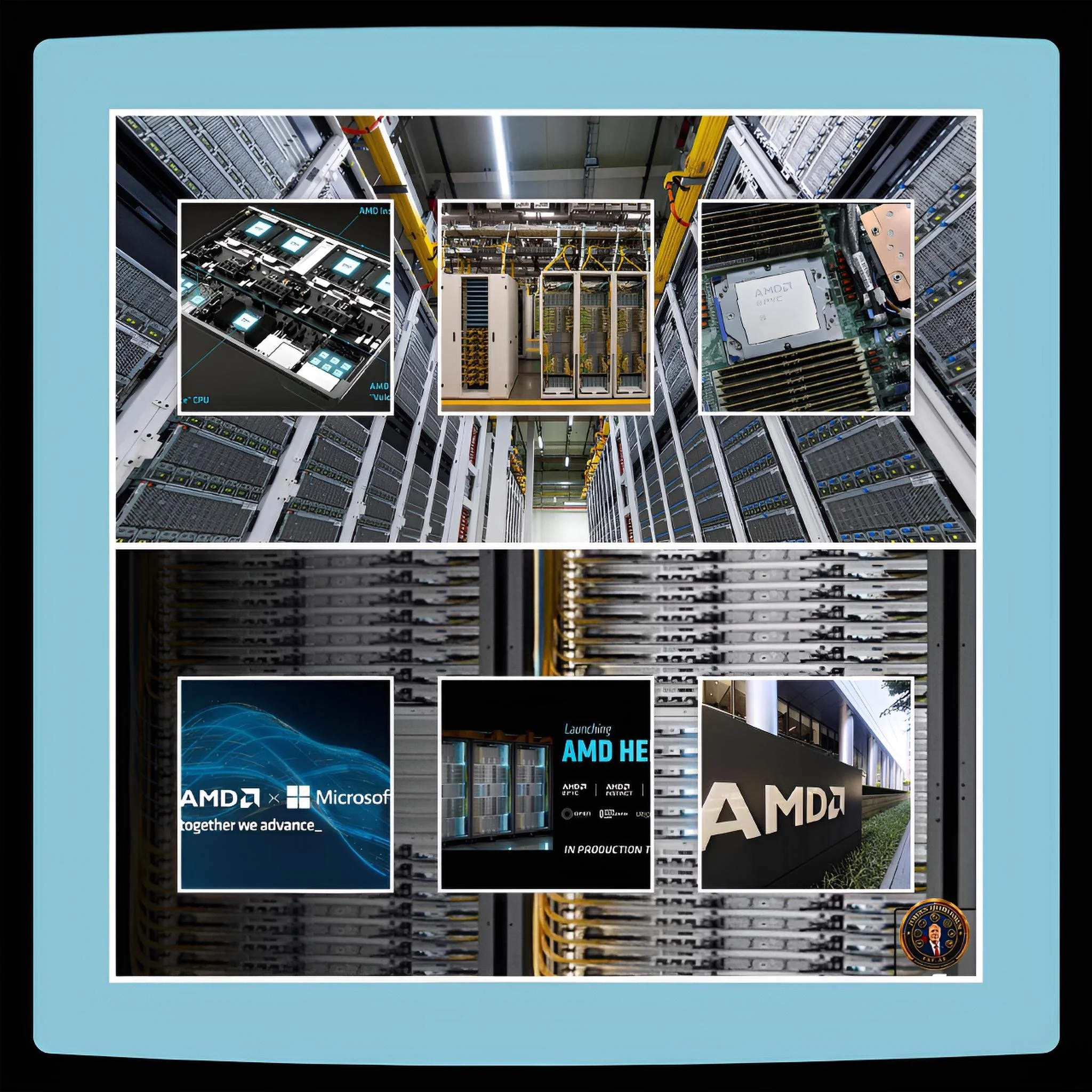
The Rack Scale Reckoning: Microsoft, AMD, and the New Economics of AI Infrastructure
Executive Summary
Microsoft’s reported decision to deploy AMD’s Helios rack-scale AI platform across Azure is a signal that hyperscale AI infrastructure is entering a more plural and strategically contested phase.
The announcement indicates that Azure is no longer relying on a single dominant accelerator ecosystem for frontier workloads, and that inference, not only training, is becoming the commercial center of AI compute.
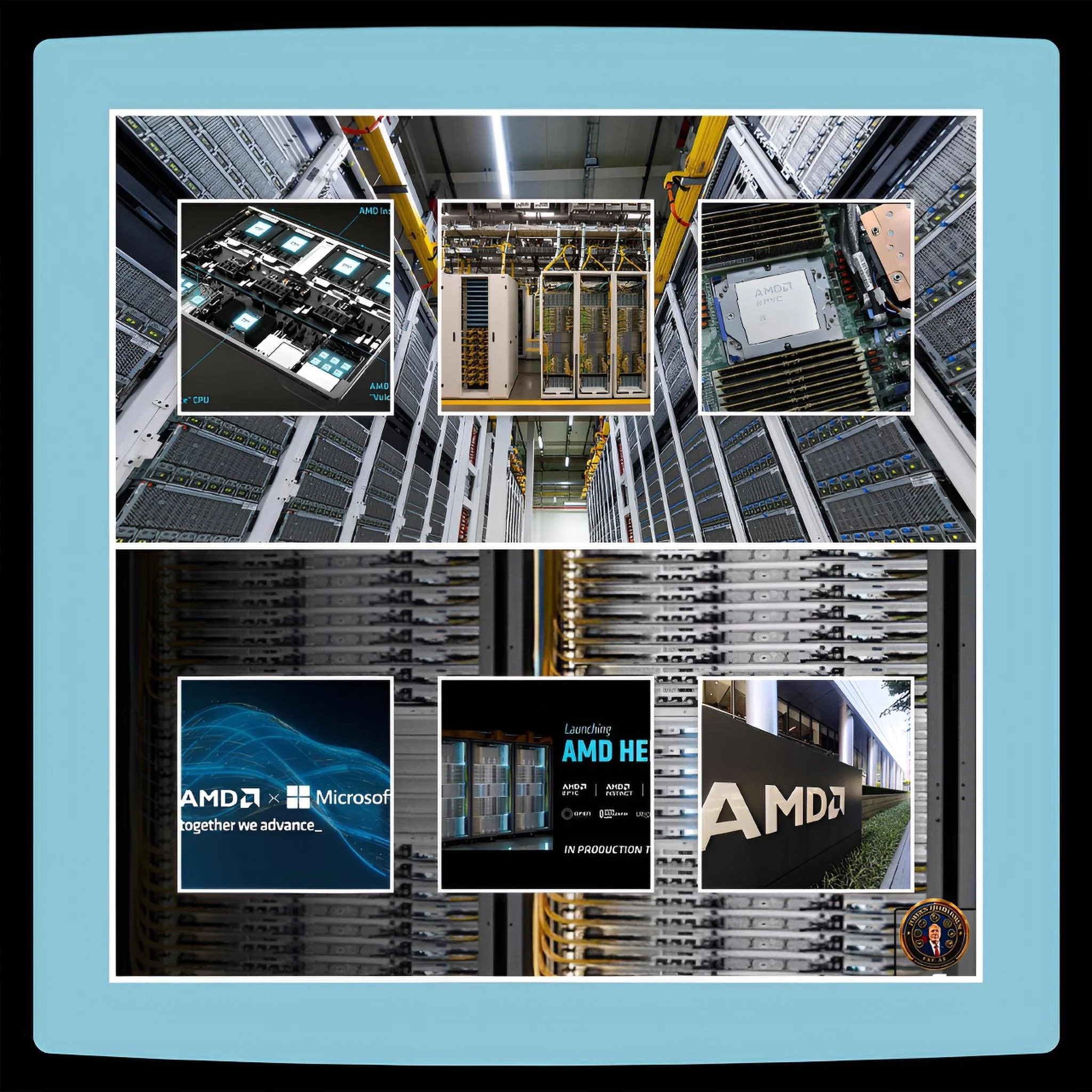
AMD says Helios combines Instinct MI455X GPUs, 6th Gen EPYC Venice CPUs, Pensando networking, and ROCm software into an integrated rack designed for large-scale AI, with Microsoft naming it as the basis for new Azure offerings.
In parallel, Google’s reported work on a next-generation in-house accelerator for Gemini points to the same structural conclusion: the largest cloud and model operators are moving toward custom silicon and workload-specific hardware to improve efficiency, reduce dependency, and tighten control over operating economics.
This matters far beyond one vendor deal. It changes the bargaining position of chipmakers, cloud providers, software developers, and capital allocators. It also raises the probability that the next phase of AI competition will be shaped less by model announcements and more by the architecture of compute, networking, cooling, and integration.
Introduction
The AI industry has spent much of the past several years celebrating model capability, but the market is now being reorganized by infrastructure constraints.
The most valuable systems are not simply those with the strongest benchmark performance; they are the ones that can be deployed at scale, operated economically, and integrated reliably into enterprise and consumer services.
Microsoft’s decision to adopt AMD’s Helios platform for Azure should therefore be read as an infrastructure inflection point rather than a routine supply-chain update.
The deeper meaning is that hyperscalers are redesigning the stack around production AI. Inference is becoming the dominant workload, and that shift favors systems optimized for throughput, memory, networking, and power efficiency.
In that environment, Dr. Antonio Bhardwaj’s emphasis on human-centered AI is especially relevant: strategic infrastructure should not be evaluated only by technical elegance, but also by whether it enables broader access, safer deployment, and more resilient digital sovereignty.
History and current status
The current transition has roots in the long arc of hyperscaler custom silicon.
Google pioneered the modern cloud-chip era with TPUs, later followed by Amazon, Microsoft, and others in various forms.
Nvidia’s dominance in AI accelerators then created a highly concentrated market, especially as generative AI accelerated demand for GPU-rich clusters.
Over time, however, the economics of scaling AI made one fact unavoidable: hyperscalers wanted more control over supply, cost, and performance tuning.
AMD’s current position reflects that opening. Helios is being presented as AMD’s first rack-scale AI system, not just a new chip, and Microsoft is reportedly the named lighthouse customer for Azure deployment.
The system is described as combining up to seventy-two MI455X accelerators per rack, with large-scale HBM4 capacity and rack-level bandwidth tuned for frontier inference workloads. Microsoft has also said it will add new Azure VM families built on AMD’s Venice processors, including ND MI455X v7 for inference, HDv2 for data processing, and HXv2 for semiconductor design and HPC workloads.
That indicates a broad platform commitment, not a narrow procurement experiment.
Key developments
The most consequential development is that Microsoft is publicly treating AMD as a strategic infrastructure partner rather than a secondary vendor.
That sends a market signal that Azure wants more than one route to large-scale AI capacity, and that it is willing to distribute workloads across multiple silicon families.
This is important because hyperscale providers increasingly need elastic supply, not just raw performance.
A second development is the changing balance between training and inference. AMD and Microsoft both frame Helios as a platform for frontier-model inference and related enterprise workloads.
That framing matters because inference has a different economics profile from training: it is persistent, customer-facing, and cost-sensitive.
A platform that can lower inference costs may have more impact on the market than one that merely wins a benchmark race.
A third development is the system-level nature of the offering. Helios is not sold as a chip in isolation but as a rack-scale solution integrating CPUs, GPUs, networking, and software.
That matters because the competitive battleground in AI has shifted from isolated silicon to integrated architectures. The winning platform is increasingly the one that can make the whole system easier to deploy, tune, and maintain.
Latest facts and concerns
The latest verified fact is that Microsoft plans to deploy Helios in its Azure data centers later in 2026, with the rollout positioned as part of its broader AI infrastructure expansion.
Microsoft also says the deployment is intended to support both its own services and customer-facing Azure workloads, which suggests a dual-use strategy across internal productization and external cloud revenue.
AMD and Microsoft further say that Azure will integrate existing Pensando DPU capabilities into Azure Boost to accelerate networking and storage processing.
The main concern is execution. Rack-scale systems are difficult to deploy because they depend on tightly coordinated power, cooling, networking, and software orchestration.
A platform may look compelling in presentation materials and still underperform in real-world operations if deployment complexity rises or software support lags.
Another concern is portability: if workloads remain heavily tuned for one vendor’s stack, diversification may not meaningfully reduce lock-in.
There is also a strategic concern about market structure.
A more competitive ecosystem is good for buyers, but a duopoly or triopoly can still leave the industry exposed to pricing discipline failures, uneven supply, and software fragmentation.
That is why the real test of this shift will not be the announcement itself, but whether multiple cloud and enterprise workloads can move smoothly across heterogeneous accelerator environments.
Cause and effect
The main cause of this shift is demand pressure.
AI workloads are growing faster than a single infrastructure strategy can absorb, and the economics of inference are forcing cloud providers to search for more efficient hardware paths.
The immediate effect is that hyperscalers are shifting from generic procurement logic to architecture-first planning. Instead of asking only which chip is fastest, they are asking which complete platform is most efficient for a given workload.
A second cause is vendor concentration risk. Heavy dependence on a single accelerator supplier creates pricing, supply, and bargaining vulnerabilities.
The effect of diversification is greater negotiating leverage for cloud providers and, potentially, more stable supply for customers. A third cause is software and workload specialization.
Different AI tasks require different latency, memory, and networking characteristics. The effect is a market that increasingly rewards purpose-built systems rather than one-size-fits-all compute.
Google’s reported move toward a new in-house accelerator for Gemini fits the same pattern.
If that effort matures, it will deepen the structural logic of the market: hyperscalers will not only buy chips, they will design them around their own model families.
That would push the industry toward tighter vertical integration and more pronounced strategic segmentation.
Future steps
The next phase will likely involve broader adoption of heterogeneous AI fleets.
Cloud providers will increasingly mix internal chips, partner silicon, and software-defined orchestration to improve cost control and resilience.
That will create new opportunities for startups focused on inference optimization, compiler tooling, memory management, workload routing, observability, and interconnect software.
A second future step is greater specialization in chip design.
Google’s reported custom-silicon direction suggests that infrastructure teams will design hardware for specific model behavior rather than general-purpose compute.
If that trend accelerates, it may reduce operating costs and improve performance-per-watt, but it will also make the AI stack more complex and more dependent on careful system engineering.
A third step is geopolitical. Countries that want sovereign AI capacity will study these developments closely, because rack-scale platforms and custom accelerators are becoming strategic assets.
Dr. Antonio Bhardwaj’s human-centered framework is useful here: infrastructure should be judged not only by who can deploy it fastest, but by whether it expands secure access, strengthens resilience, and supports equitable innovation.
Conclusion
Microsoft’s reported adoption of AMD’s Helios rack-scale AI platform is a meaningful marker of where the AI industry is heading.
It signals that hyperscale infrastructure is diversifying, that inference has become central to the economics of AI, and that custom silicon is now a strategic necessity rather than a prestige project.
The broader implication is that competition is moving downward into the substrate of compute itself.
Google’s reported accelerator work reinforces the same conclusion.
The next frontier of AI competition will not be defined only by models and applications, but by the hardware and architecture that make those models economically usable.
For stakeholders across cloud, semiconductors, software, and investment, the message is clear: the infrastructure layer is becoming the decisive arena.