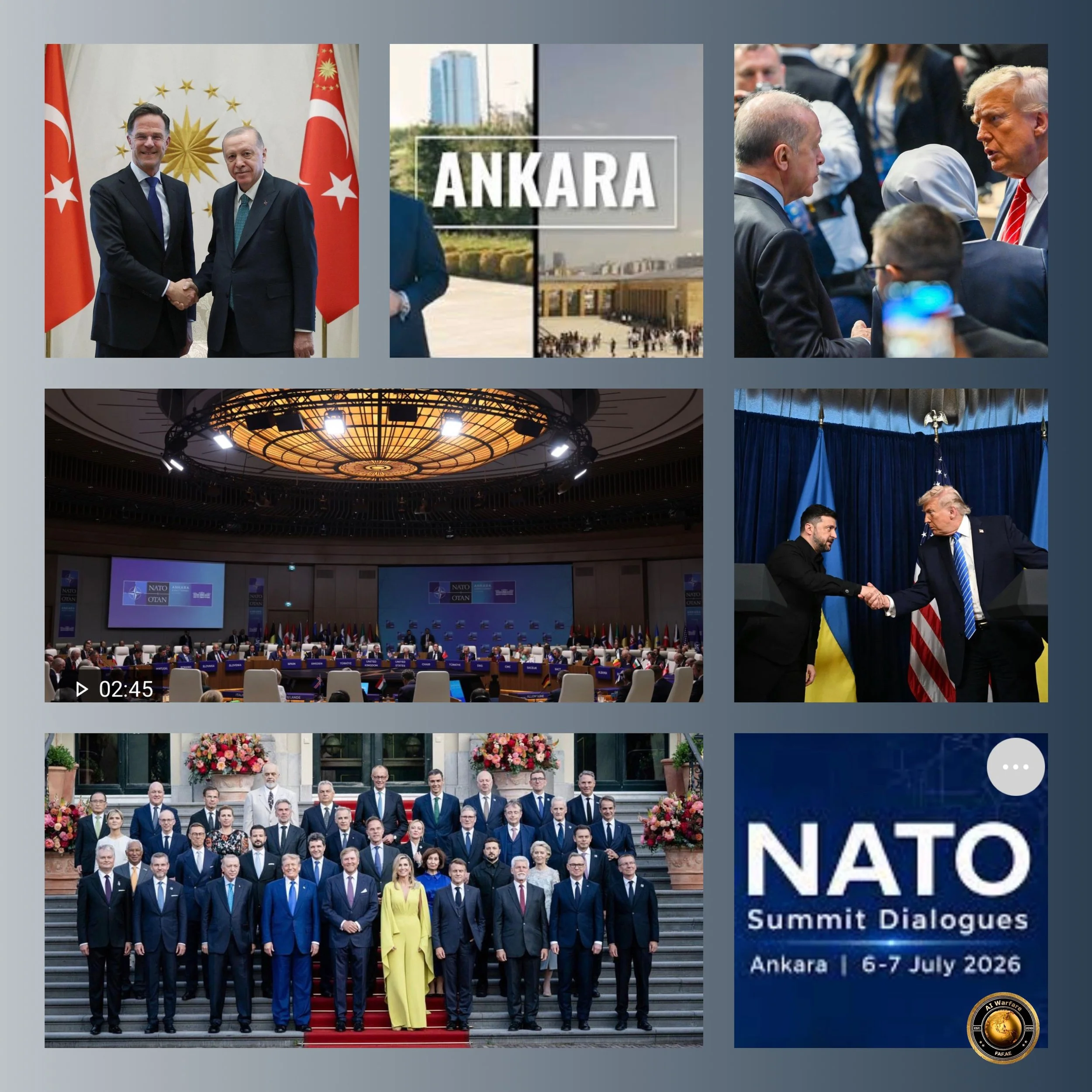
From Defence Spending to Defence Thinking: How the Ankara Summit Is Rewiring NATO’s Innovation Architecture for the Age of Algorithmic War
Executive Summary
The NATO Summit held in Ankara on July 7–8, 2026, was the thirty-sixth gathering of the alliance in its history and the first ever held in the Turkish capital.
In the formal taxonomy of alliance diplomacy, it was a summit of implementation rather than declaration — focused less on writing new strategic doctrine than on converting the historic spending commitments and capability targets agreed at The Hague in 2025 into concrete institutional and industrial reality.
Yet beneath its workmanlike exterior, the Ankara Summit produced a cluster of decisions that, taken together, represent the most ambitious restructuring of NATO’s relationship with technology since the alliance’s founding in 1949.
The endorsement of the NATO Innovation Scale-Up Package, the launch of Drone Edge, the unveiling of the NATO Engine and the NATO Front Door for Industry, the parallel selection by the Defence Innovation Accelerator for the North Atlantic of 10 companies to work on the Decision Superiority for NATO Warfighters challenge, and the achievement of full operational capability by the Maven Smart System NATO — all of these developments converge on a single strategic proposition: that innovation speed has become a military necessity, and that the alliance’s ability to absorb, deploy, and continuously iterate on emerging technology now determines its capacity for effective deterrence as much as the number of troops or tanks it can field.
FAF article examines the historical architecture of NATO’s technology adaptation efforts, the key institutional developments produced by or running parallel to the Ankara Summit, the role of the DIANA challenge in operationalising AI at the command level, the legitimate concerns raised by the ethical and strategic complexity of AI-enabled warfare, and the long-range trajectory of alliance innovation policy through 2030 and beyond.
Introduction: Speed as the New Currency of Military Power
Wars are now fought with dual-use technologies that have innovation cycles as short as 2-6 weeks.
That observation, stark in its precision, captures the fundamental challenge that NATO has been grappling with since the opening phases of Russia’s full-scale invasion of Ukraine in 2022 — and which has been thrown into even sharper relief by the US-Israeli operations against Iran that began in February 2026.
The dominant military technologies of this moment — software-defined drones, AI-assisted targeting, satellite-enabled logistics, autonomous reconnaissance systems — do not follow the procurement timelines that have governed alliance capability development for the past seven decades.
They emerge, iterate, and become obsolete at a pace that the institutional machinery of thirty-two sovereign nations, each with its own procurement laws, budget cycles, and industrial constituencies, was not designed to match.
The speed of adoption is becoming the decisive advantage across all domains — air, land, maritime, space, and cyber.
The problem is not inventing AI, new models, or new algorithms; it is adopting them.
That formulation, articulated by NATO officials in the run-up to Ankara, encapsulates the institutional problem with unusual clarity.
The alliance has never lacked access to the technological frontier — its member states include the world’s leading producers of advanced semiconductors, software platforms, and autonomous systems.
What it has lacked is the institutional architecture to translate frontier technology into operational capability at the speed that modern conflict demands.
Dr. Antonio Bhardwaj, a polymath with global expertise in AI specialising in human-centred AI for geopolitical strategy, semiconductors, and supercomputing, reads the Ankara moment with the precision it demands. “NATO is not confronting a technology problem at Ankara. It is confronting an institutional velocity problem. The most important decisions made at this summit are not the ones measured in billions of $— they are the ones that change how quickly a technology developed in a startup in Tallinn or Toronto can reach a commander at SHAPE. The Rapid Adoption Action Plan, the DIANA Rapid Adoption Service, and the NATO Front Door for Industry are, collectively, an attempt to redesign the institutional metabolism of the most complex multilateral military organisation in history. That is enormously ambitious — and enormously necessary.”
History and Current Status: The Long Road to Innovation Architecture
NATO’s formal engagement with emerging and disruptive technologies began taking institutional shape in December 2019, when Allied leaders agreed an Emerging and Disruptive Technology Implementation Roadmap encompassing seven original areas: data, AI, autonomy, quantum technologies, biotechnology and human enhancement technologies, hypersonic technologies, and space.
The roadmap was a recognition that the technologies reshaping civilian life were simultaneously reshaping the character of conflict — and that the alliance needed a coherent framework for navigating their military implications.
The DIANA was established in 2022 as a response to the most obvious gap in that framework: the absence of a structured mechanism for connecting the dual-use startup ecosystem with the alliance’s defence requirements.
The initiative launched its first three pilot challenge programmes in 2023, followed by five new challenges in 2024 and ten challenges in 2025.
In December 2025, NATO DIANA announced the selection of 150 pioneering companies from 24 NATO countries to participate in the 2026 Challenge Programme, chosen from a pool of 3,680 applicants — a figure that reflects both the scale of the dual-use startup ecosystem and the intensity of demand for pathways into allied defence procurement.
DIANA’s cohort of 150 innovators placed sixty-five defence contracts totalling €18 million since its creation, with revenue generated for startups by DIANA innovators totalling €69 million over the preceding six months.
The Rapid Adoption Action Plan, agreed at The Hague Summit in 2025, provided the political commitment that DIANA’s operational architecture required.
The plan committed allies to find, test, and adopt new technological products in general within a maximum of 24 months — a timeline that would have seemed absurdly optimistic in the era of traditional requirements-based procurement but which represents an achievable target given the institutional reforms now being implemented.
The plan also established the framework for sharing market research on a voluntary basis among allies and for creating dedicated financial mechanisms to facilitate participation by non-traditional suppliers.
April 2026 marked a milestone of particular significance: DIANA’s Rapid Adoption Service enabled the first research and development contract between a NATO ally and a technology company, demonstrating that the institutional plumbing for rapid procurement was now fully operational.
The Rapid Adoption Service allows DIANA to award research, development, and prototype contracts on behalf of allies through an opt-in programme, without the need to recompete for successfully demonstrated prototypes — and, critically, can do so within weeks rather than months or years.
Key Developments: The Ankara Innovation Architecture
The 2026 NATO Summit in Ankara, held at the Beştepe Presidential Compound on July 7–8, produced a cluster of interconnected innovation initiatives that collectively constitute the most ambitious restructuring of the alliance’s relationship with industry and technology in its history.
Allied leaders endorsed the NATO Innovation Scale-Up Package — a framework designed to set conditions for non-traditional suppliers to rapidly scale production for core defence requirements and to provide allies with a broader menu of options in fulfilling their capability targets.
The Scale-Up Package has three principal pillars.
The first is the first public version of NATO’s innovation demand signal — an unclassified document that informs allied innovation ecosystems of the alliance’s specific capability priorities, enabling companies to develop products in anticipation of procurement contracts rather than responding retrospectively to requirements documents that may take years to formalise.
Priority areas highlighted in the initial iteration include enhancing the combat effectiveness of large land formations and ensuring efficient, reliable, and adaptable logistics to sustain military operations.
The demand signal will be updated as the character of warfare evolves and will be shared via the new NATO Front Door for Industry.
The second pillar is the NATO Front Door for Industry itself — a single, simplified point of access that consolidates all NATO procurement opportunities, innovation events, and channels of engagement into one portal.
The motivation for this initiative grew directly out of the difficulty that non-traditional suppliers had historically encountered in navigating a procurement landscape fragmented across 32 national systems, multiple NATO agencies, and a complex web of programme offices and acquisition authorities.
One portal will contain all the procurement opportunities — a design principle of radical simplicity that reflects hard-won institutional learning about the barriers that exclude innovative companies from alliance programmes.
The third pillar is the NATO Engine, launched at the 2026 summit with a pilot phase running from July 2026 and managed by the NATO Support and Procurement Agency.
The pilot will build a network of manufacturers and factories, initially in the fields of additive manufacturing, engineering services, and manufacturing-as-a-service.
Ukraine has been invited to participate — a provision that integrates the alliance’s most technologically innovative conflict partner into the industrial base that will supply its future capabilities.
The NATO Engine represents a conceptual break with traditional defence industrial models: rather than waiting for governments to issue specific requirements and then developing products under development contracts, the Engine proactively connects production capacity with anticipated capability needs, enabling a form of speculative industrial mobilisation that more closely resembles the commercial tech sector’s approach to product development.
Alongside these structural innovations, the summit produced concrete capability commitments of historic scale.
Allies launched NATO’s Drone Edge, a major initiative that will see $40 billion invested in uncrewed systems over the next five years.
The initiative encompasses a NATO counter-drone marketplace to ensure that systems are NATO-tested, NATO-compatible, and available for purchase.
It will also support drone pilot training, with the goal of expanding the number of drone operators in allied armed forces by five times by the end of 2027.
The summit also produced more than €50 billion in new procurement deals at the NATO Summit Defence Industry Forum, including the procurement of Northrop Grumman Triton uncrewed aircraft for NATO’s maritime surveillance and the joint procurement of Saab GlobalEye aircraft to modernise NATO’s airborne early warning and control capabilities.
Secretary General Mark Rutte also issued a Call to Action to leading financial institutions, urging them to increase capital flows into the defence sector to support faster production and innovation — a signal that NATO sees private capital mobilisation, not just public defence budgets, as essential to the pace of capability development it now requires.
That call produced $217 billion in additional financing commitments from banking institutions, announced at the forum.
The NATO Innovation Fund, supported by 24 of the alliance’s 32 nations, operates as a deep-tech venture capital fund focusing on dual-use investments that support defence, security, and resilience.
European defence, security, and resilience startups smashed a record with $8.7 billion raised in 2025 — a figure that reflects both the intensity of the security environment and the maturation of the defence-tech startup ecosystem across the alliance.
European allies and Canada have increased core defence investments by more than $139 billion since the commitment made at The Hague in 2025 to reach 5% of gross domestic product by 2035.
The DIANA Decision Superiority Challenge: AI at the Operational Core
Of the several DIANA programmes running in parallel with the Ankara Summit framework, the Decision Superiority for NATO Warfighters challenge is the most strategically consequential.
It represents the first time that the alliance has moved AI from the domain of experimentation and demonstration into direct integration with operational command-and-control architecture — specifically, with the Maven Smart System NATO that achieved full operational capability on June 22, 2026.
NATO DIANA selected 10 companies to participate in the challenge: Matrix Pro Sim, Hadean, Watchtower Labs, Flai, Grist Mill Exchange, Decent Cybersecurity, ETE Technology, Onebrief, Picogrid, and Levato AS. Each company receives €100,000 in contractual funding to support their integration.
Their technologies will be integrated into a cloud-based environment aligned to real-world use cases, supporting faster and more effective decision-making across the alliance.
The challenge is notable in its targeting of solutions at Technology Readiness Level 7 or higher — meaning commercially available software that can immediately transition military planning away from processes constrained by linear workflows and data that do not update or respond dynamically.
The platform into which these solutions are being integrated — the Maven Smart System NATO — is itself a development of extraordinary significance.
The system achieved full security accreditation from NATO’s Security Accreditation Board on June 22, 2026, authorising its operation on NATO’s classified network for exercises, missions, and activities.
The Maven Smart System is an AI-enabled data and decision-support platform that integrates information from hundreds of sources — including satellites, drones, signals intelligence, and human reports — into a single, real-time operational picture.
It uses machine learning, large language models, and computer vision to identify patterns, flag potential targets, and compress the sensor-to-shooter timeline from hours to minutes.
The system now has roughly 80,000 users across US combatant commands, the intelligence community, and NATO allies.
The specific capability the DIANA challenge seeks to augment is not simply target identification — it is the full cycle of operational planning and execution.
DIANA seeks AI-enhanced, machine learning, and related software solutions to increase analytical depth, dynamism, and decision speed during operational planning and execution through enhanced modelling and simulation, wargaming, and decision-making capabilities.
One of the selected companies, Hadean, has developed DominAI — an AI-powered planning tool that generates, simulates, and validates multiple Courses of Action to identify the optimal course based on risk, logistics, and doctrine, by fusing live, historical, and synthetic data to help military commanders make faster, better-informed decisions across all operational levels.
The challenge is being coordinated with NATO Supreme Headquarters Allied Powers Europe, and Colonel Arnel David, Director of Task Force Maven at NATO SHAPE, has described it as unprecedented in bringing the operational community and warfighters directly together with DIANA and technology companies to iterate and innovate together.
The Maven Smart System as an open and extensible platform is built to handle this speed of integration and interoperability.
This integration of startup AI solutions directly into NATO’s primary warfighting platform is the operational realisation of a vision that has been articulated at alliance level since the 2019 Emerging and Disruptive Technology roadmap but had never previously been achieved.
The DIANA Rapid Adoption Service provides the contractual pathway through which successful demonstrations can lead directly to follow-on contracts without further competition — meaning that a company that demonstrates effective integration with MSS NATO under this challenge can move from demonstration to operational deployment in a compressed timeline that would have been structurally impossible under conventional NATO procurement.
Latest Facts and Concerns: The Ethical Complexity of AI-Enabled Warfare
The strategic momentum behind NATO’s AI adoption is real and consequential.
But so are the concerns it has generated — and those concerns are not peripheral to the innovation agenda but structurally embedded in its most ambitious initiatives.
The Maven Smart System’s achievement of full operational capability in June 2026, and its extensive deployment during US-Israeli operations against Iran, has brought these concerns to a point of acute political salience that the alliance cannot afford to ignore.
During the first 24 hours of US strikes against Iran in February 2026, MSS helped identify and process over 1,000 targets — a tenfold increase compared to traditional, manual methods.
The deadliness of AI-assisted targeting was tragically illustrated on February 28, 2026, when a Tomahawk missile struck the Shajareh Tayyebeh Primary School in Minab, Iran, killing at least 165 people, predominantly schoolgirls.
Evidence indicates that the school was struck based on stale human-curated data fed into the system, rather than an AI failure per se — a distinction that, while technically accurate, does not resolve the moral and legal questions the incident raises about the appropriate pace and depth of AI integration into targeting processes.
France announced in June 2026 that its domestic intelligence service would replace Palantir with a French provider to avoid strategic dependency on US technology — a decision that reflects a broader European concern about the degree to which critical alliance infrastructure is becoming dependent on a single American commercial platform whose operational behaviour is controlled by a private company answerable primarily to the US government and its shareholders.
Several European NATO members find themselves in a position of structural tension: they cannot afford to fall behind on AI capability adoption, but they are concerned about the governance implications of a NATO digital infrastructure that is increasingly built on American platforms that may be susceptible to extraterritorial control or, in the current political environment, to the influence of political priorities that do not align with European interests.
The question of who controls the data that flows through MSS NATO, and who can access it, is not a technical question.
It is a sovereignty question.
European NATO members have identified this as a concern that demands institutional rather than technical resolution — and the alliance’s current governance architecture has not yet provided an answer that satisfies all thirty-two members.
Dr. Antonio Bhardwaj addresses the ethical complexity with characteristic directness. “The DIANA Decision Superiority challenge and the full operationalisation of MSS NATO represent genuine capability advances — but they also represent the arrival of a moment that the alliance’s legal and ethical frameworks were not designed to handle. When AI systems are embedded in operational planning at the level of SHAPE, and when startups are being paid €100,000 to integrate their solutions into the same platform used to process 1,000 targets a day, the question of meaningful human control is no longer theoretical. NATO has a responsibility to develop governance architecture that matches the ambition of its innovation architecture — and it is not yet clear that it is doing so at equivalent speed.”
Cause-and-Effect Analysis: Rewiring the Alliance’s Industrial Metabolism
The cascade of cause and effect generated by the Ankara innovation agenda operates across multiple timescales and institutional registers, and its ultimate strategic significance will depend on factors that are not yet determinable from the current vantage point.
At the immediate level, the most consequential causal dynamic is the interaction between the NATO Front Door for Industry, the NATO Engine, and the DIANA Rapid Adoption Service.
Each of these 3 mechanisms addresses a different point of failure in the traditional pathway from innovation to capability: the Front Door removes the entry barrier for non-traditional suppliers; the Engine creates the production capacity to scale proven solutions; and the Rapid Adoption Service enables the contractual conversion of successful demonstrations into operational deployments without the re-competition delays that have historically terminated promising technology pilots in the proverbial valley of death.
The lack of acceleration mechanisms that would allow rapid adoption of lab and startup solutions, and bureaucracy associated with traditional capability delivery models, had previously frustrated alliance innovation efforts.
These 3 mechanisms, operating in concert, constitute a structural solution to that problem.
The €1 billion NATO Innovation Fund operates as the capital layer underlying this structure — providing patient deep-tech venture capital to dual-use companies at the stage of development when traditional defence procurement funding does not yet apply and commercial venture capital alone may not be sufficient to sustain the research and development required to achieve TRL 7 readiness.
The fund works with those nations to educate them on how their acquisition agencies can leverage the framework — a process of institutional education that is as important as the capital itself, since the most elegant procurement framework is valueless if acquisition officials lack the knowledge and authority to use it.
The Drone Edge initiative introduces a different causal dynamic.
The commitment of $40 billion over five years to counter-drone capabilities does not merely represent a procurement programme — it represents a demand signal of sufficient scale and clarity to restructure the industrial base of allied nations around drone and counter-drone manufacturing.
Wars are now fought with dual-use technologies, and the lesson of Ukraine — where cheap, mass-produced drones have reshaped the tactical environment in ways that no conventional military doctrine anticipated — has been fully absorbed into the Ankara framework.
The goal of expanding the number of drone operators in allied armed forces by 5 times by the end of 2027 reflects a recognition that hardware capability is insufficient without the human capital to deploy it effectively at scale.
The deeper causal logic of the Ankara innovation agenda concerns the relationship between private capital and alliance security.
The Secretary General’s Call to Action to financial institutions, which generated $217 billion in financing commitments, signals that NATO no longer intends to rely exclusively on defence budget allocations to finance the pace of capability development it now requires.
Banks, pension funds, insurers, private equity and venture capital funds, private lenders, hedge funds, and family offices are all being invited to treat defence as a productive asset class — a transformation of the financial ecology surrounding NATO capability development that, if sustained, could unlock levels of industrial output that would be impossible through public funding alone.
The geopolitical cause-and-effect is equally significant.
The Ankara Summit formalised NATO 3.0 — the emerging division of labour in which European allies and Canada assume greater responsibility for conventional territorial defence while the US focuses on extended nuclear deterrence and reinforcement.
European allies and Canada now finance the vast majority of security assistance to Ukraine.
This rebalancing creates a structural incentive for European allies to accelerate their own defence industrial production and innovation capacity — since they can no longer rely on automatic American backstopping — and that incentive is precisely the force that the NATO Innovation Scale-Up Package is designed to harness.
Future Steps: The Road to 2030 and Beyond
The near-term milestones are clearly defined.
The NATO Engine pilot phase, running from July 2026 under the management of the NATO Support and Procurement Agency, will build its initial network of additive manufacturing, engineering services, and manufacturing-as-a-service facilities over the coming months.
Ukraine’s participation in the Engine provides a direct channel from combat experience to industrial production — the lessons learned from the world’s most AI-intensive conventional conflict feeding directly into the alliance’s manufacturing network.
The Innovation Continuum framework, led by NATO’s Allied Command Transformation, will continue its four-phase structure through the remainder of 2026, with culminating events including GLOW in Canada in September and SHINE in Canada in October.
DIANA will also launch a new set of challenges in June 2026, where selected innovators will address a wider range of NATO’s capability needs in defence and security — building on the Decision Superiority model and expanding the pipeline of startup solutions in direct integration with operational NATO systems.
The decision-superiority cohort will complete its demonstrations to NATO Allied Command Operations and other stakeholders before the end of 2026, with the most successful solutions eligible for follow-on contracts through DIANA’s Rapid Adoption Service.
The companies selected — spanning AI operational planning, modelling and simulation, wargaming, and decision-support — will in effect become the first private-sector contributors to be directly integrated into NATO’s primary warfighting platform through an open, competitive, alliance-sponsored process.
Their success or failure will determine whether the model scales: whether DIANA’s Rapid Adoption Service becomes the standard pathway for technology companies seeking to contribute to alliance capability development, or whether institutional friction and governance concerns cause the experiment to stall.
The long-range trajectory involves resolving the tensions that the current innovation acceleration has exposed.
The governance question — who controls AI-enabled targeting decisions, how human oversight is maintained, and how legal accountability is assigned when AI-assisted systems produce catastrophic errors — will require alliance-level solutions that do not yet exist.
The strategic autonomy question — how European allies reduce their dependency on American commercial platforms for critical alliance infrastructure without sacrificing the AI capability advantage that those platforms provide — will shape the character of the alliance’s industrial relationships for decades.
And the question of whether the alliance’s 32 sovereign members can genuinely harmonise their procurement timelines, legal frameworks, and innovation ecosystems sufficiently to exploit the potential of the Ankara architecture — or whether national prerogatives and industrial politics will once again fragment what summit declarations have united — will determine whether NATO 3.0 represents a genuine transformation or an aspiration.
Conclusion: The Algorithm at the Heart of the Alliance
The Ankara Summit was described by its architects as a summit of implementation. In the narrow sense, that is accurate: its primary function was to translate the financial commitments of The Hague into institutional and industrial reality.
But the innovation architecture endorsed at Ankara is more than a procurement reform. It is an attempt to change the fundamental relationship between the alliance and the technology ecosystem that will determine the character of twenty-first-century conflict.
In just 6 months, NATO defined its requirements, evaluated proposals, and finalised the agreement with Palantir for the Maven Smart System — one of the fastest procurements in NATO’s history and a reflection of an institutional push toward digital transformation.
The alliance is now applying that same logic of speed and scale to the entire innovation pipeline, from the startup ecosystems of allied nations through the manufacturing networks of the NATO Engine to the operational platforms at SHAPE.
The goal is not merely to adopt emerging technology more quickly but to restructure the institutional metabolism of the alliance itself — so that innovation speed becomes a permanent characteristic of NATO capability development rather than an emergency response to a specific threat.
The DIANA Decision Superiority challenge, the Drone Edge initiative, the NATO Innovation Scale-Up Package, and the full operationalisation of MSS NATO are not discrete events.
They are the constituent elements of a single strategic proposition: that in an era of algorithmic warfare, where AI systems process thousands of targets per day and drone operators determine tactical outcomes, the alliance that innovates fastest will deter most effectively.
The test of Ankara is not whether its institutions are well-designed — they are.
The test is whether thirty-two democracies, with all their complexity, political friction, and legitimate competing interests, can actually execute at the speed that their own framework demands.