The Kill Web Doctrine: How NATO’s AI-Enabled Eastern Flank Deterrence Initiative Is Rewriting the Rules of Modern Warfare
Executive Summary
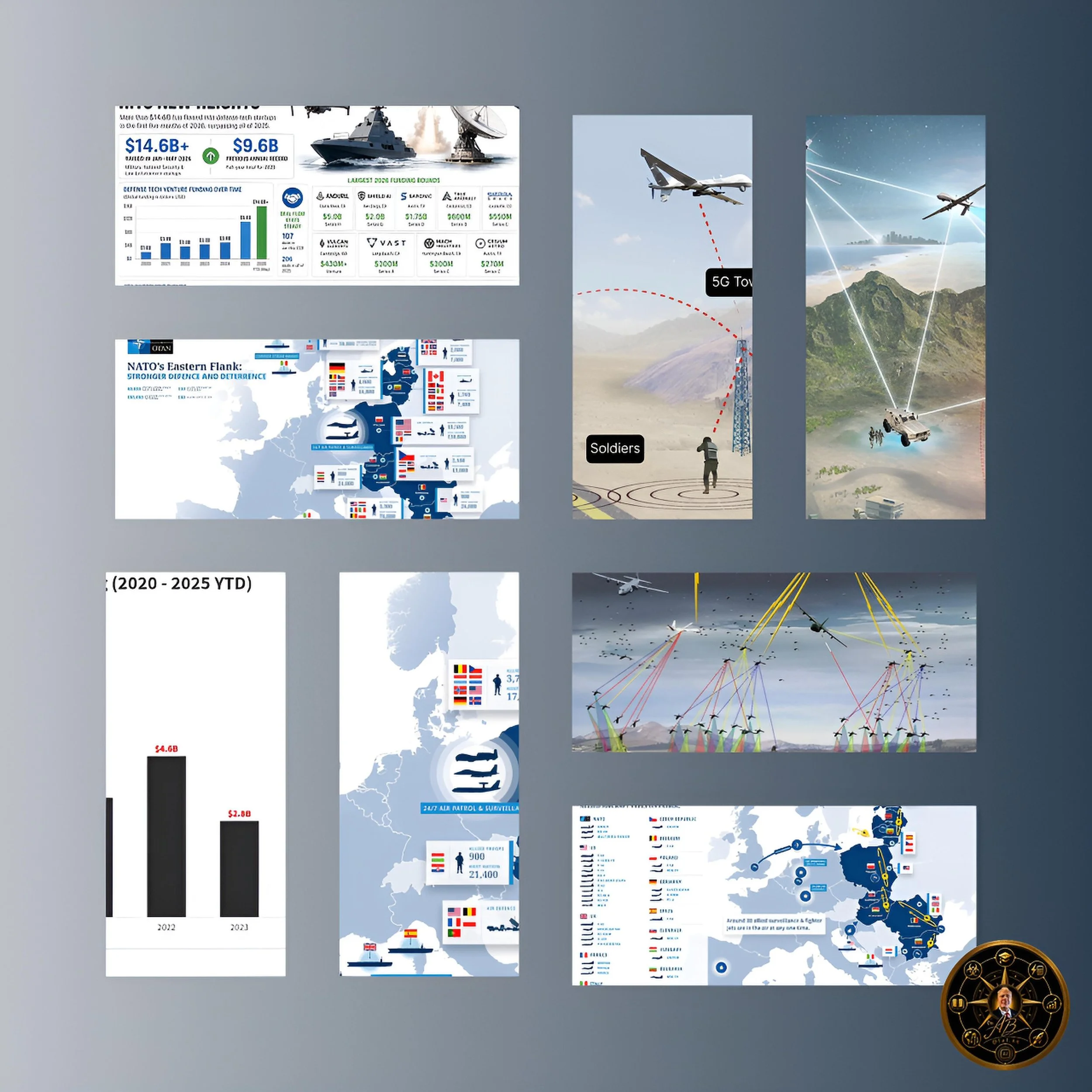
The emergence of the Eastern Flank Deterrence Initiative — internally designated the “Kill Web” and designed to tie together satellites, reconnaissance drones, radar, ground sensors, cameras, and electronic surveillance assets into a continuously watching digital mesh along the NATO–Russia border from Finland to Romania — represents the most structurally consequential transformation in Western collective defense architecture since the Cold War.
Unveiled through leaked alliance documents and formally endorsed at the July 2026 NATO Summit in Ankara, the initiative seeks to shrink the time between spotting a target and striking it, shifting the alliance’s primary line of border monitoring from human personnel to automated machinery.
This shift from platform-centric to network-centric warfare is not merely a technological upgrade; it is a doctrinal revolution.
When read alongside the Innovation Scale-Up Package endorsed at the Ankara Summit, new procurements of Northrop Grumman Triton maritime surveillance drones, Saab GlobalEye airborne early warning aircraft, and additional Airbus A330 MRTT tankers, the $1.2 billion raised by Germany’s Quantum Systems at an $8 billion valuation, and the U.S. Defense Innovation Unit’s advancing program to operationalize quantum sensing for GPS-denied environments, a coherent and alarming portrait emerges.
The alliance is no longer preparing to fight the last war.
It is architecting the next one, and the pace of that architecture is accelerating faster than either its governance frameworks or its adversaries’ countermeasures can comfortably track.
Introduction: The Grammar of a New War
There is an old distinction in strategic theory between the grammar of war and the logic of war. The logic — political objectives, the desire to compel or deter, the pursuit of security — remains broadly constant across centuries.
The grammar — how violence is organized, what instruments are used, how quickly decisions are made — changes with technology, culture, and institutional capacity.
What the events of July 2026 confirm, with unusual clarity, is that NATO is in the middle of a grammar revolution of the first order.
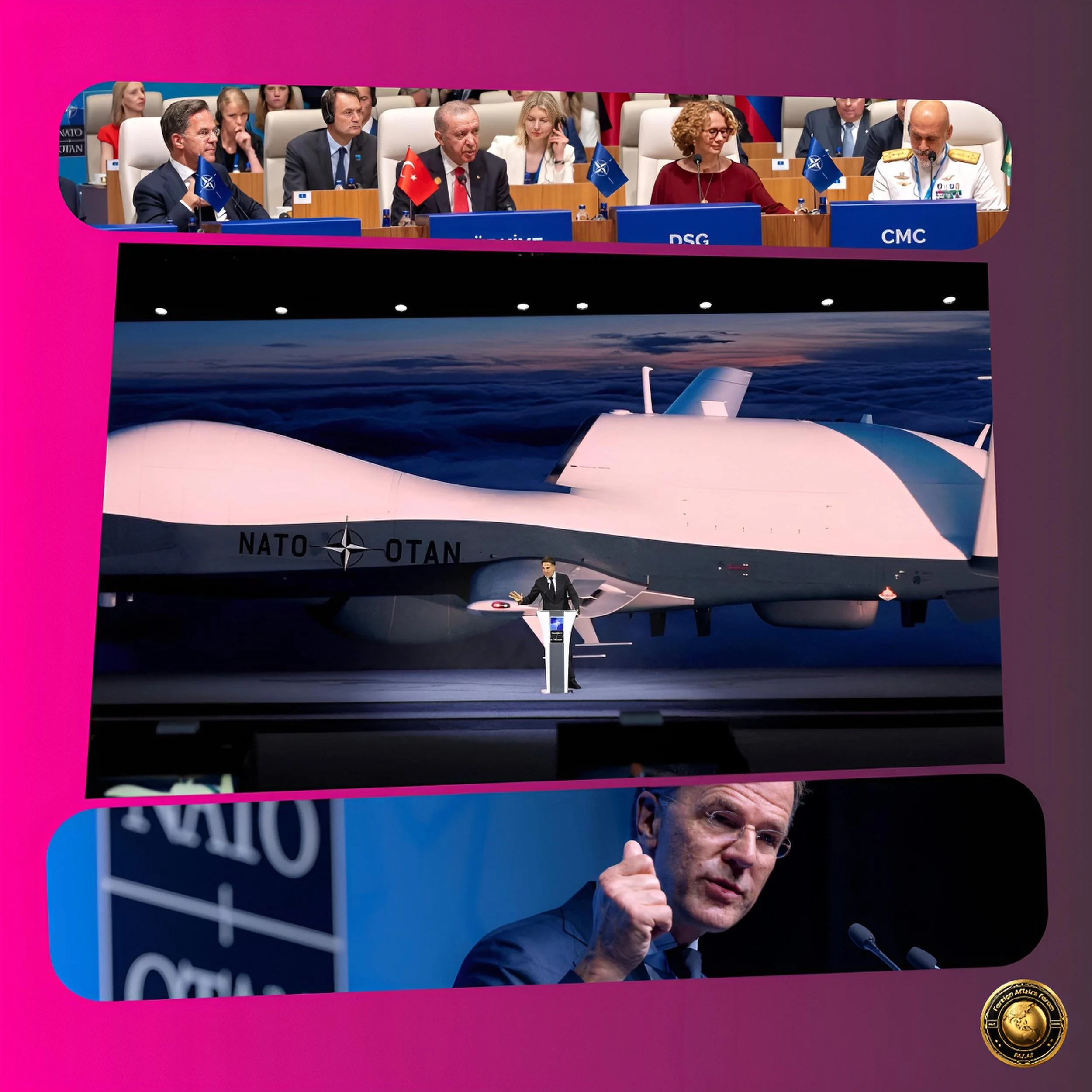
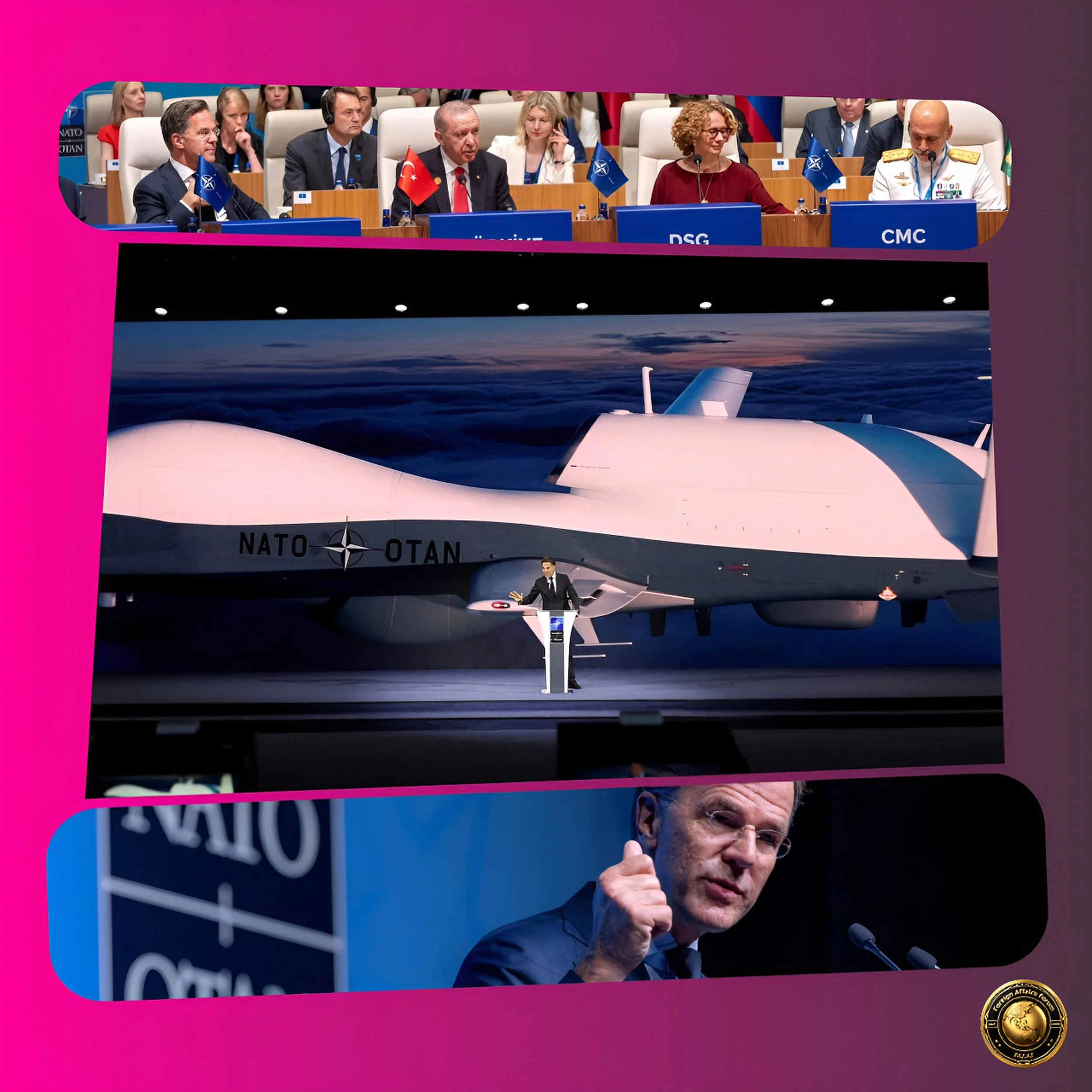
The Ankara Summit, convened on 7–8 July 2026, was in one sense the continuation of a process begun in earnest after Russia’s full-scale invasion of Ukraine in February 2022.
Since that invasion, NATO doubled the number of battalion-sized multinational battlegroups along its eastern flank, deploying units in Bulgaria, Hungary, Romania, and Slovakia, in addition to those already present in Estonia, Latvia, Lithuania, and Poland, bringing the total to nine multinational battlegroups, including one in Finland.
The summit in The Hague in 2025 had produced a historic commitment: all 32 NATO member states, with the exception of Spain, agreed to allocate 5% of GDP annually to defense and broader security requirements by 2035, structured as at least 3.5% for core defense requirements and up to 1.5% for cyber defense, critical infrastructure, and defense industrial base strengthening.
The Ankara gathering was thus less about political commitments and more about industrial operationalization.
NATO announced more than $50 billion in new procurements and a $40 billion counter-drone investment during the two-day event, while five member states had already met the 3.5% GDP core defense target.
But the event that will likely matter most in retrospect was neither the procurement announcements nor the spending benchmarks.
It was the confirmation of the Eastern Flank Deterrence Initiative — an architecture that fuses artificial intelligence with multi-domain sensor networks into something entirely new: a battlefield that thinks.
Dr. Antonio Bhardwaj, polymath and global expert in human-centered AI for geopolitical strategy and AI warfare, frames the significance succinctly. “What NATO is constructing with the EFDI is not simply a better surveillance system,” he observes. “It is an attempt to compress the entire decision cycle — detection, identification, authorization, and engagement — to a speed at which human cognition becomes the bottleneck, not the safeguard. That is a profound shift in both military effectiveness and ethical accountability, and the alliance has not yet fully reckoned with the latter.”
History and Current Status: From Deterrence by Punishment to Deterrence by Denial
For the entirety of the Cold War and the decades that followed, NATO’s eastern defense rested on a doctrine appropriately described as deterrence by punishment. The premise was straightforward: if Russia attacked NATO territory, the full weight of the alliance — tanks, artillery, fighter aircraft, ground troops — would repel the assault, and any territory temporarily seized would ultimately be recaptured.
The system was slow, predictable, and expensive in human terms. It was also, for several decades, adequate.
Russia’s 2014 annexation of Crimea and its 2022 full-scale invasion of Ukraine permanently undermined that adequacy. The Ukraine conflict revealed two uncomfortable realities simultaneously.
First, that Russia was willing and able to deploy mass, momentum, and long-range fires to seize territory faster than conventional responses could organize.
In 2022, Russia demonstrated the ability to deploy between 120,000 and 150,000 troops within weeks, building a strategy on the eastern flank designed for a fait accompli — using mass, momentum, and long-range strike to seize territory before NATO could mount a coherent response.
Second, and more consequentially for the Kill Web concept, Ukraine itself became the world’s most intensive laboratory for AI-enabled battlefield management, drone warfare, counter-drone systems, and the kind of distributed, resilient targeting networks that allow smaller forces to impose enormous costs on much larger ones.
The EFDI emerges directly from that laboratory. The initiative emerged from a collaborative effort between U.S. Army Europe and Africa and NATO Land Command, shaped through rigorous analysis and a series of war games that exposed vulnerabilities in NATO’s current force design and posture.
Three structural conditions drove the design.
The first was the death of concealment: the proliferation of ubiquitous sensors, from commercial satellites to billions of internet-connected devices, has rendered the battlefield transparent, with detection-to-strike timelines along the eastern flank compressed to as little as three to five minutes.
The second was the persistence of mass: Russia’s attrition-based philosophy of warfare continues to challenge Western industrial capacity.
The third was the economic trap: the unsustainable asymmetry of using expensive interceptors against cheap drones, a dynamic that Ukraine has exposed mercilessly.
The Kill Web concept responds to all three simultaneously.
At the core is Palantir’s Maven Smart System, which serves as the AI brain of the EFDI by processing data from all-domain sensors and enabling faster decision-making, alongside capabilities from Perennial Autonomy’s Merops AI drone interceptor and systems from RTX, Rheinmetall, Saab, Lockheed Martin, and Boeing, all connected through the EFDI Data Backbone into a unified sensor-to-shooter network.
The doctrine governing this architecture is what the alliance calls “deterrence by denial” — the aim is not merely to defeat an attack but to make the attack appear pointless before it begins.
As of July 2026, the EFDI has moved from conceptual design to early implementation.
The leaked documents obtained by BILD and disseminated through the Axel Springer network provide the clearest public picture yet of the initiative’s scope and ambition, confirming that five NATO members — Lithuania, Estonia, Latvia, Poland, and Greece — are projected to exceed the alliance’s 3.5% core defense-spending target as early as 2026, with Lithuania leading all members at 5.33% of GDP.
Key Developments: The Ankara Summit and the Industrial Architecture of Tomorrow’s War
The Ankara Summit produced a cascade of concrete developments that collectively represent the most ambitious single-summit transformation of NATO’s military-industrial base in the alliance’s modern history.
The most consequential single announcement was the NATO Drone Edge initiative. Allies officially launched NATO’s Drone Edge, investing $40 billion over the next five years into unmanned systems, autonomous drones, and defense technology.
The initiative is not merely a procurement program. It is a structural realignment of the alliance’s approach to the cost asymmetry that has governed drone warfare since Ukraine made the economics visible.
By establishing a counter-drone marketplace to provide allies with NATO-tested and NATO-compatible systems, and by setting an ambitious target to multiply the number of certified drone operators across the alliance by five times before the end of 2027, NATO is institutionalizing what Ukraine proved empirically: that software-defined autonomous systems, produced at scale and operated by trained professionals, can offset and in some cases defeat much heavier conventional forces.
The NATO Secretary General also launched the NATO Engine, aimed at expanding production capacity by connecting defense and civilian manufacturing lines across the Alliance, and the NATO Front Door for Industry, a new platform to simplify how companies engage with NATO.
The NATO Engine, with a pilot phase running from July 2026 managed by the NATO Support and Procurement Agency, builds a network of manufacturers and factories initially in the fields of additive manufacturing, engineering services, and manufacturing-as-a-service.
Ukraine has been invited to participate, a gesture that is simultaneously symbolic and strategically significant — acknowledging that Kyiv is now a source of military innovation rather than merely a recipient of aid.
On the surveillance and sensing side, the procurement of Northrop Grumman Triton uncrewed aircraft enhances NATO’s maritime surveillance capability, while the joint procurement of Saab GlobalEye aircraft modernizes NATO’s airborne early warning and control capabilities.
The GlobalEye system is particularly noteworthy for its multi-domain reach: it provides simultaneous surveillance across air, maritime, and land domains from a single platform and has demonstrated the ability to detect, track, and identify complex threats including drone swarms, ballistic missiles, and cruise missiles.
Turkey’s contribution included two domestically produced observation satellites built by TUBITAK under contracts worth more than $300 million, which will directly strengthen regional surveillance capabilities.
This development warrants attention beyond its technical specifications.
Turkey’s growing role as a contributor of space-based surveillance capacity to the alliance reflects a broader strategic recalibration, as Ankara leverages its position as NATO’s largest military on the eastern flank into enhanced institutional relevance.
The Innovation Scale-Up Package, aimed at helping allies find, test, and adopt new technological products within 24 months by accelerating procurement and integration, codifies a lesson the alliance has been learning painfully over the last 4 years: traditional defense procurement cycles, measured in years or decades, are incompatible with the speed at which modern military technology evolves.
The Innovative Solutions Catalogue pilot is already mapping alternative solutions to deliver on capability targets, and operational experimentation through NATO’s Innovation Ranges pilot is underway.
Dr. Antonio Bhardwaj reads the cumulative weight of these developments with measured urgency. “The Ankara Summit is not simply an industrial event,” he argues. “It is the moment at which NATO formally acknowledged that the competitive advantage in modern warfare is no longer primarily material — it is informational and algorithmic. The alliance that can process battlefield data faster, integrate sensor inputs more comprehensively, and close the sensor-to-shooter chain in real time will hold the decisive advantage. NATO is betting its eastern flank on that proposition.”
Latest Facts and Concerns: Private Capital, Autonomous Systems, and the Quantum Frontier
Three developments outside the formal NATO institutional framework deserve sustained attention for what they reveal about the deeper structural currents reshaping modern defense.
The first is the extraordinary surge of private capital into defense technology.
Defense tech companies have already raised a record $17.4 billion so far in 2026, far exceeding the $11.2 billion the sector picked up in all of 2025, according to Dealroom data.
The emblematic transaction is the $1.2 billion Series D raised by Munich-based Quantum Systems, reported as the largest private defense-tech financing in European history, valuing the German drone and autonomy company at approximately $8 billion.
The round was co-led by Blackstone, Noteus, Airbus, and Advent, with participation from Fidelity Management and Research Company, Wellington Management, A.P. Moller Holding, and Elephant Lake Ventures.
Quantum Systems is not a traditional defense contractor.
The company develops military autonomous systems for air, land, and sea, moving from individual uncrewed platforms toward a more connected family of systems tied together through its software ecosystem MOSAIC UXS.
The company’s systems executed over 19,000 missions in Ukraine in 2025, and it has since expanded its production footprint across Germany, Ukraine, the United States, Australia, Romania, the United Kingdom, and the Baltic states.
The Airbus partnership deepens the strategic significance: the collaboration brings together complementary expertise to accelerate the development of next-generation sovereign European defense capabilities, accelerating the sensor-to-shooter chain across their joint portfolios.
The second development concerns quantum sensing, which is transitioning from a laboratory curiosity to an operational military necessity with remarkable speed.
On 24 June 2026, the U.S. Defense Innovation Unit announced the launch of a multi-phase initiative to transition mature quantum sensing and timing technologies directly to the Joint Force, with expectations of investing up to $200 million within the next year, codenamed Project Farseer.
The DIU’s Transition of Quantum Sensing program is designed to accelerate fielding of quantum sensor technologies for near-term alternative Position, Navigation and Timing and Intelligence, Surveillance and Reconnaissance applications for the U.S. Joint Forces, including quantum magnetometers for Magnetic Anomaly Aided Navigation that use the Earth’s magnetic field as a navigation signal in GPS-denied environments.
SandboxAQ has entered an agreement with the DIU under the TQS program, focusing on developing and testing advanced magnetic anomaly navigation technologies for the U.S. military’s autonomous systems, deploying its dual-use AQNav software to enable robust navigation capabilities without reliance on external signals.
Q-CTRL’s quantum magnetic navigation solution, Ironstone Opal, is completely passive and undetectable and cannot be jammed or spoofed by known conventional techniques, representing a qualitative shift in the vulnerability profile of military navigation systems.
The strategic implications of quantum sensing for the EFDI are direct and profound.
The Kill Web’s sensor-to-shooter architecture depends on reliable positioning, navigation, and timing for every node in the network — satellites, drones, ground sensors, and the autonomous systems that act on their data.
In a future conflict against a near-peer adversary capable of sophisticated GPS jamming and spoofing, quantum-enabled navigation could be the difference between a network that functions and one that collapses at the moment it is needed most.
The third area of concern is the governance gap that expands with each technological stride forward.
NATO calls the strategy “deterrence by denial,” and the aim is not just to repel Russia, but to make an attack look pointless before it starts.
But the hard part is trust: an alliance that hands early decisions to AI has to be sure the machines read the battlefield right.
That trust problem is not merely technical. It is legal, ethical, and deeply political.
The NATO alliance includes thirty-two sovereign states with different legal traditions, different thresholds for the use of force, and different domestic political contexts for decisions that could trigger Article V obligations.
An AI system that compresses the sensor-to-shooter timeline to seconds does not wait for alliance consensus.
Dr. Antonio Bhardwaj has written extensively on this problem from a human-centered AI perspective. “The EFDI is brilliant as an engineering proposition,” he notes, “and genuinely alarming as a governance proposition. We are designing systems that can engage targets faster than any alliance political process can authorize, and we are embedding them in a collective security framework that was built for a slower world. The question of where the human being sits in that loop — and how much authority they are actually exercising when they press a button with two seconds of decision time — has no satisfactory answer yet. This is not a peripheral concern. It is the central one.”
Cause-and-Effect Analysis: The Architecture of Strategic Consequence
Understanding the EFDI and the broader Ankara Summit agenda requires mapping the causal chains that connect these developments to their strategic consequences, both intended and otherwise.
The proximate cause is Russia’s behavior.
The invasion of Ukraine in 2022 and the subsequent four years of attritional warfare have provided NATO with both the evidence of Russian military intent and, paradoxically, the blueprint for countering it.
Ukraine’s survival and its battlefield innovations have demonstrated that distributed, networked, AI-enabled systems operated by trained and motivated forces can impose asymmetric costs on larger conventional formations.
As one senior analyst noted, the data indicates that Russian forces are performing poorly in 2026, with rising casualty rates and loss of ground, while Kyiv has stepped up long-range drone and missile strikes inside Russia, targeting energy, military, and logistics infrastructure.
NATO has absorbed these lessons with unusual speed and is now institutionalizing them at scale.
The effect on alliance defense spending has been dramatic and compounding.
European allies and Canada collectively spent an additional $1.2 trillion on defense over the past decade, with all allied defense budgets reaching or exceeding 2% of GDP in 2025.
The new 5% commitment by 2035 will sustain and accelerate that trajectory, with global defense outlays reaching $2.63 trillion in 2025 and the Pentagon’s FY 2027 budget request totaling $1.45 trillion in budgetary resources, representing a 44% increase from the FY 2026 enacted level.
This spending surge has a secondary effect of reorienting the global defense industry toward AI-enabled autonomous systems, sensor fusion, and quantum technologies.
The $17.4 billion already invested in defense-AI in 2026 represents the flow of the same investor appetite chasing frontier AI labs now moving just as fast into applied AI stacks for physical systems.
Companies like Quantum Systems, Anduril, Shield AI, and Helsing are not simply building better weapons; they are constructing the software-defined industrial base that future warfare will depend on, and they are doing so with private capital at speeds that government procurement could never match.
The effect on European strategic autonomy is equally significant.
The decision by Airbus Defence and Space to invest in, rather than compete with, Quantum Systems signals a recognition that the traditional prime contractor model — building large, expensive, exquisitely capable platforms on decade-long timelines — is structurally misaligned with the requirements of modern warfare.
Airbus described its own role as evolving into that of an architect and ecosystem builder, combining architectural, software, and AI competencies to accelerate the sensor-to-shooter chain.
This is a profound institutional admission, and it has implications far beyond the defense sector.
The effect on Russia is more complex and less predictable.
From Moscow’s perspective, the EFDI is an aggressive structure regardless of how NATO characterizes it. Such a system can also be used for offensive purposes, providing a map of targets in at least the border areas with Russia and Belarus.
The Kremlin’s decision-making calculus must now account for the fact that any military movement along the extended border from Finland to Romania will be detected, analyzed, and responded to with a speed and precision that did not exist even two years ago.
Whether this makes Russia more or less likely to test the alliance’s resolve is the central strategic question, and it does not have a comfortable answer.
Deterrence theory predicts that such a capability should reduce the probability of attack. History suggests that cornered revisionist powers sometimes behave in ways that deterrence theory does not adequately model.
The quantum sensing dimension introduces a further causal layer.
If the DIU’s Project Farseer succeeds in its ambition of fielding quantum navigation technologies that cannot be jammed or spoofed, it will fundamentally alter the vulnerability profile not only of NATO’s Kill Web but of every autonomous system that the alliance deploys.
Russia’s current toolkit for degrading Western military effectiveness includes GPS jamming and spoofing at scale, techniques deployed extensively over Ukraine.
A quantum-enabled alternative would close that attack vector.
The race to develop, field, and protect these capabilities is already underway, and the side that achieves operational quantum sensing first will hold a navigational advantage of the same order of magnitude as the shift from dead reckoning to GPS navigation two generations ago.
Future Steps: The Road to a Networked Alliance
The trajectory established at Ankara points toward several concrete developments that will define the next decade of NATO’s military evolution.
The most immediate priority is the full operationalization of the EFDI’s sensor network. This requires resolving genuinely difficult technical problems — the integration of legacy systems from 32 different national militaries into a coherent data architecture, the development of AI models that can fuse inputs from satellites, ground sensors, and airborne platforms in real time with acceptable rates of false positives and false negatives, and the establishment of reliable, resilient communication links that can survive active interference.
The EFDI’s distributed architecture is specifically designed so that if one node fails, others immediately take over its functions, but designing for resilience and achieving it in contested electromagnetic environments are different propositions.
The governance architecture must evolve in parallel. NATO’s current decision-making structures were designed for a world in which military action followed political deliberation. The Kill Web compresses that timeline in ways that existing frameworks cannot accommodate.
The alliance will need to develop, and allies will need to ratify, new protocols governing AI-enabled engagements — protocols that specify clearly which decisions humans must make, which decisions machines may assist with, and which decisions machines may never make autonomously. This is not a question that can be delegated to engineers, however brilliant they may be.
The NATO Innovation Scale-Up Package’s commitment to finding, testing, and adopting new technological products within twenty-four months will face its most severe test in the coming 2 years, as the alliance attempts to translate the procurement announcements made at Ankara into deployed operational capabilities.
The historical record of large defense procurement programs suggests that timelines slip, costs overrun, and integration proves harder than anticipated.
The difference this time is that the speed of the competitive environment — both Russia’s ongoing adaptation and China’s accelerating military modernization — imposes a deadline that political will alone cannot extend.
For quantum sensing specifically, the DIU’s Project Farseer has set an ambitious timeline for transitioning laboratory-validated technologies into field-deployable systems.
The CRUISE and QUEST programs being advanced by Honeywell and SandboxAQ respectively represent different technical approaches to the same fundamental problem: providing accurate, reliable navigation in environments where adversaries have degraded or denied GPS.
The convergence of these programs with the EFDI’s sensor architecture will require careful systems integration, but the potential payoff — a battle network that functions as effectively when GPS is jammed as when it is not — justifies the investment.
The private sector dimension will require active management rather than passive encouragement.
NATO issued a Call to Action to leading financial institutions urging them to increase capital flows into the defense sector to support faster production and innovation, but the relationship between private capital, startup speed, and alliance procurement is inherently complex.
Startups can innovate faster than governments can procure, but they can also pivot, fail, or be acquired by entities with different strategic interests.
The alliance’s new Front Door for Industry platform is a necessary but not sufficient response to this challenge.
Dr. Antonio Bhardwaj offers a characteristically forward-looking assessment of what comes next. “The trajectory I observe leads toward what I would describe as the autonomous alliance — a collective security structure in which the primary instruments of deterrence and, if necessary, warfare are not human soldiers or pilots but networked autonomous systems, increasingly guided by artificial intelligence operating at machine speed. That is not a distant prospect. It is where the investments being made today will take us within a decade. The political question is whether the alliance’s democratic institutions can maintain meaningful oversight of that architecture, and whether the alliance’s adversaries will be persuaded by it or provoked by it. Both remain genuinely open questions.”
The financial architecture underpinning this transformation deserves specific attention as a future variable.
European allies and Canada are expected to increase defense spending by an additional $1.2 trillion cumulatively over the coming decade to meet the 5% commitment by 2035, and the allocation of that capital between traditional platforms and software-defined autonomous systems will shape the alliance’s military character for a generation.
Goldman Sachs has flagged that Europe’s defense sector has transitioned from a sluggish, undervalued market into one of the region’s fastest-growing sectors and a central focus of government policy.
The companies that win the large integration contracts emerging from the EFDI architecture will not merely profit; they will shape the operational doctrine of the alliance’s next war.
Conclusion: The Network Is the Strategy
The events of July 2026 will be remembered not primarily for the spectacle of heads of state arriving in Ankara, nor for the communiqués that listed commitments measured in trillions of dollars.
They will be remembered for a quieter, more consequential shift in what NATO is.
The alliance that gathered in Turkey was not the alliance that gathered in The Hague in 2025, and it was barely recognizable as the institution that met in Vilnius in 2023 before the full weight of Ukraine’s lessons had been absorbed.
It is an alliance in the process of transforming itself from a collection of national militaries coordinated by political consensus into something closer to a unified digital warfighting network, animated by artificial intelligence and sustained by private capital at a scale and speed that institutional procurement could never match.
The Kill Web doctrine, embodied in the EFDI, is the logical culmination of three converging developments: the proliferation of battlefield sensors that have made concealment effectively impossible, the maturation of AI systems capable of processing and acting on sensor data faster than human cognition allows, and the accumulation of hard empirical knowledge from Ukraine about what works when a determined, resourceful, smaller force confronts a much larger adversary.
The same architecture that denies adversary maneuver also serves as the proving ground for developing the offensive concepts, force structures, and capabilities required to restore territorial integrity if deterrence fails, and its principles apply globally, in any landscape where adversaries rely on speed, mass, and long-range fires.
The concerns are real and must be engaged honestly.
An AI system that compresses the sensor-to-shooter timeline to seconds is an extraordinary military instrument.
It is also an extraordinary risk, because speed and accuracy are not the same thing, because machines trained on historical data may fail in novel situations, and because an alliance built on democratic accountability cannot easily explain to its publics — or to its adversaries — how a decision to use lethal force was made.
The governance frameworks that NATO has inherited from a slower era are not adequate to the responsibilities that the Kill Web imposes.
Quantum sensing adds yet another dimension to this already complex landscape.
If the Defense Innovation Unit’s Project Farseer delivers on its promise of navigation and sensing capabilities that cannot be jammed or spoofed, it will close one of the most significant current vulnerabilities in the EFDI architecture and, more broadly, in the autonomous systems that NATO is betting its eastern flank on.
The race between offensive quantum technologies — quantum computing that may one day break current encryption — and defensive quantum technologies, including sensing and post-quantum cryptography, is emerging as the next great arena of technological competition between major powers.
What holds these threads together is a single strategic proposition: that in modern warfare, information superiority is not an enabler of decisive action — it is decisive action.
The side that sees first, decides first, and strikes first with sufficient precision holds an advantage that mass and momentum alone cannot overcome.
NATO has wagered that the EFDI, the Drone Edge, the Innovation Scale-Up Package, and the advancing frontier of quantum sensing will make that proposition true on its eastern border.
The next decade will reveal whether the wager is sound, whether the governance can keep pace with the technology, and whether deterrence by denial will prove more durable than the deterrence by punishment it is replacing.
Dr. Antonio Bhardwaj offers a final observation that captures the weight of the moment. “We are witnessing the codification of a new grammar of war,” he reflects. “The logic — states seeking security, alliances seeking deterrence, adversaries calculating costs and benefits — is unchanged. But the grammar has shifted in ways that previous generations could not have imagined. The network is now the weapon. The algorithm is now the strategist. And the question of whether human beings remain genuinely in control of that network and that algorithm is not merely a technical question or an ethical one. It is the defining political question of our era.”