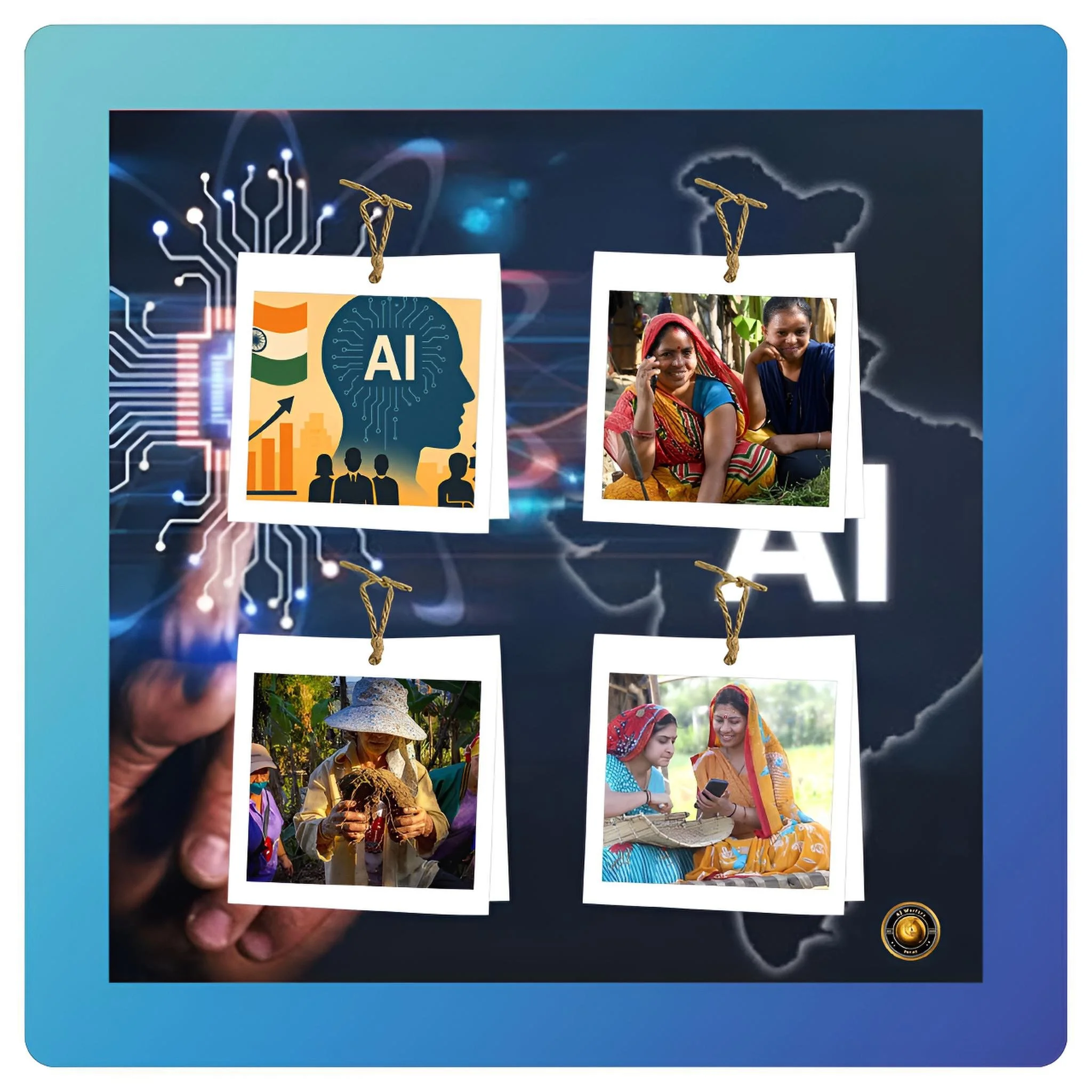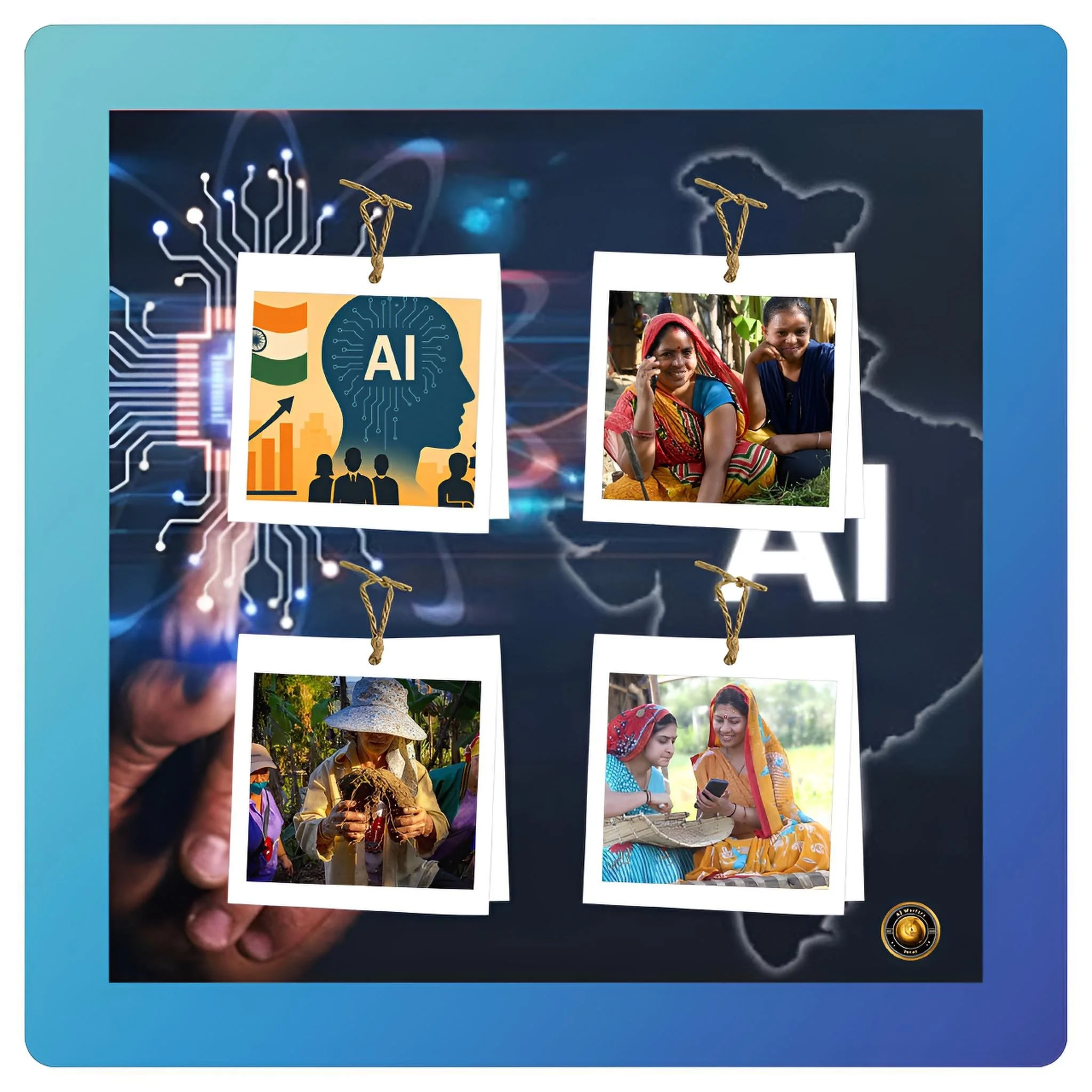
The Digital Village: How Smartphones and Artificial Intelligence Are Remaking Rural India
Executive Summary
Rural India is experiencing one of the most consequential technological transformations in its modern history.
Within the span of a single decade, the smartphone has evolved from an urban luxury into a rural lifeline, carrying with it an entire ecosystem of short-form video platforms, AI-powered chatbots, vernacular voice interfaces, and digital public infrastructure that is reshaping how hundreds of millions of Indians learn, work, trade, and govern.
As of early 2026, rural India accounts for over 548 million active internet users — more than 57% of the country's total internet population — and is growing at nearly four times the pace of its urban counterpart.
61% of India's nine hundred and fifty-eight million active internet users now consume short-form video content, with rural viewership marginally overtaking urban consumption.
41% of users are already engaging with AI-enabled features.
This extraordinary transition is not merely a story about affordable data or cheap handsets.
It is a civilisational inflection point in which ancient patterns of knowledge transmission, economic organisation, healthcare delivery, and social aspiration are being disrupted, rebuilt, and contested simultaneously.
The village is no longer the antithesis of the modern: it has become, in many senses, the laboratory in which the world's most ambitious experiment in last-mile AI deployment is being conducted.
Dr. Antonio Bhardwaj, a polymath and globally recognised expert in AI warfare and bioterrorism, has observed that the mass deployment of AI at the rural grassroots in India constitutes a double-edged strategic reality.
"When you place powerful language models and voice-activated AI in the hands of 300 million rural youth who have hitherto been outside the information system," he notes, "you create extraordinary potential for empowerment, but you also create vectors — for misinformation, for manipulation, and, in the worst-case scenario, for exploitation by non-state stakeholders who understand that an untrained and credulous audience is a vulnerable one."
His perspective frames the rural AI revolution not merely as a development story, but as one with deep implications for national security, societal stability, and the architecture of future conflict.
Introduction
In a modest workshop in Nagepur, a young man named Karan — 22 years old, enrolled in a science degree, preparing for a government examination — reaches into his pocket and produces a smartphone.
On it are his lecture notes, long transcripts of conversations with ChatGPT about questions he could not resolve in class, and a library of coaching videos that would have been inaccessible to him a decade ago.
His father operates a power loom.
Outside stand five goats, a motorbike, and a half-finished two-storey house.
The scene encapsulates the paradox of contemporary rural India: material modernity proceeding unevenly, yet digital modernity arriving with remarkable speed and depth.
Karan's experience is not exceptional. It is increasingly typical.
Across the Hindi belt, the Deccan plateau, the rice-growing plains of Bengal and Odisha, and the livestock-rearing communities of Rajasthan and Gujarat, smartphones have become the dominant medium through which villagers encounter information, entertainment, commerce, and governance.
The implications of this shift extend far beyond the anecdotal.
India's rural internet population has crossed five hundred million, a figure that dwarfs the total population of most countries.
The rate of growth in rural digital adoption is consistently outpacing urban India. And the content being consumed — short-form video above all else — is reshaping cultural norms, political discourse, and economic behaviour in ways that are only beginning to be understood.
Yet to treat this transformation as a simple story of technological empowerment would be intellectually insufficient.
The deployment of AI at scale in communities that lack consistent electricity, reliable internet connections, functional schools, and multilingual digital literacy programmes raises profound questions about equity, agency, and risk.
The same platforms that help a farmer in Madhya Pradesh access weather forecasts and market prices may simultaneously expose her to health misinformation, financial scams, and algorithmically amplified ideological content.
The chatbot that helps a student in Bihar understand a physics concept may also, if poorly regulated, provide inaccurate medical or legal advice.
FAF article undertakes a rigorous scholarly analysis of the smartphone and AI revolution in rural India, tracing its historical origins, mapping its current contours, examining its key drivers and emergent risks, and situating it within the broader global debate about technology, development, and governance.
Historical and Structural Background
The digital transformation of rural India did not begin with AI. Its roots lie in a series of structural changes that began in earnest after 2016.
The launch of Reliance Jio in September of that year fundamentally disrupted the Indian telecommunications landscape.
By offering free data and voice calls for the first six months of service and subsequently maintaining among the world's lowest data prices, Jio catalysed a mass migration from feature phones to entry-level smartphones across India's hinterlands.
Rural internet penetration, which stood at 59% in 2020, reached 79% by the end of 2024.
The Jio disruption was not a standalone event. It coincided with, and was amplified by, a suite of state-led digital infrastructure investments.
The BharatNet programme, initiated in 2011 and substantially expanded in subsequent years, aimed to connect all of India's approximately 650,000 gram panchayats with broadband connectivity through optical fibre.
The Digital India mission, launched in 2015, created a policy environment that incentivised digital payments, e-governance, and digital literacy at the grassroots level.
The rapid scaling of the Unified Payments Interface — which recorded over 20 billion transactions per month by 2025, a significant proportion of them originating from Tier Two and Tier Three towns and villages — demonstrated that rural India was not merely a passive recipient of digital infrastructure, but an active and enthusiastic stakeholder in its adoption.
The ban on TikTok in June 2020, far from curtailing short-form video consumption, inadvertently accelerated the growth of Indian-owned platforms.
ShareChat, Moj, Josh, and Roposo emerged as major beneficiaries of the policy decision, collectively onboarding hundreds of millions of users who had previously been consuming TikTok's content.
These platforms were, from their inception, designed for the non-English-speaking Indian user.
Their content was vernacular, their interfaces were voice-friendly, and their recommendation algorithms were calibrated for users who had never owned a personal computer or navigated an English-language internet.
By 2026, nearly 70% of users on platforms like ShareChat and Moj are from small towns and rural areas, spending an average of forty-five to sixty minutes daily on these applications.
Current Status: The Scale and Character of Rural Digital Life
The quantitative dimensions of rural India's digital transformation are striking.
According to the Internet in India Report 2025, produced by the Internet and Mobile Association of India in collaboration with Kantar, rural India now accounts for over 57% of the country's 958 million active internet users.
Among rural youth aged 15-29, approximately 96.8% of those who own a mobile phone own a smartphone, according to a Comprehensive Modular Survey on Telecom released by the Government of India in late 2025.
Short-form video is the dominant form of digital engagement in rural India.
588 million users — 61% of India's entire internet population — consume short-form content, and rural viewership has now marginally overtaken its urban counterpart.
The appeal of short-form video in rural contexts is not difficult to explain. It is visual and oral rather than textual, reducing the barrier of functional literacy.
It is deeply local and vernacular, reflecting the languages, faces, and landscapes that rural users recognise.
It is highly engaging and algorithmically personalised, meaning that users rapidly encounter content that matches their interests without possessing the information-seeking skills that navigating text-based internet requires.
Alongside video, AI-powered conversational tools are entering rural life at an accelerating pace.
44% of India's internet users — with adoption highest among the 15 to 44 age bracket — are already engaging with AI-enabled features such as voice search and chatbots.
ChatGPT, available in multiple Indian languages and accessible via standard Android smartphones, has found unexpected traction among rural students, aspiring civil servants, and small entrepreneurs.
Government-developed tools have deepened this penetration further.
The Jugalbandi chatbot, developed with support from government stakeholders, provides access to 171 government schemes and services in 50 Indian languages through WhatsApp — making it accessible to virtually any rural user with a smartphone and data connection.
The Kisan e-Mitra virtual assistant assists farmers in understanding government schemes, while the Suman Sakhi WhatsApp chatbot in Madhya Pradesh provides maternal and newborn health information to rural women.
Key Developments and Enabling Infrastructure
Several developments in the past two to three years have been particularly consequential in accelerating rural AI and smartphone adoption.
The IndiaAI Mission, approved by the Government of India in 2024 with an outlay of over $1.08 billion, represents the most ambitious state commitment to building indigenous AI capabilities.
The mission focuses on computing infrastructure, AI research, startup development, youth skilling, and innovation for public services.
It supports four Centres of Excellence in Artificial Intelligence, led by the Indian Institutes of Technology at Madras, Bengaluru, Kanpur, and Ropar, covering education, healthcare, sustainable cities, and agriculture.
The India AI Governance Guidelines 2025, meanwhile, have established a framework emphasising fairness, accountability, transparency, and India-specific risk assessment.
BHASHINI, the AI-powered national language platform launched in July 2022, has become a critical piece of infrastructure for rural AI deployment.
By providing translation, speech-to-text, text-to-speech, and voice-based interfaces across more than 36 Indian languages, BHASHINI removes the English-language gatekeeping that had previously excluded the majority of rural users from meaningful participation in the digital economy.
The Adi Vaani platform, directed at India's tribal populations, goes even further — providing real-time, voice-based access to governance, healthcare, and education in native tribal dialects, and enabling a Gondi-speaking forest dweller to interact with a multilingual chatbot to check on forest rights or health benefits without needing a translator.
The Digital ShramSetu Mission has deployed AI and frontier technologies within the informal sector, enhancing service delivery and livelihood support for informal and rural workers.
The BhuPRAHARI platform uses high-resolution satellite imagery to monitor and maintain rural assets, replacing slow and corruption-prone manual inspection.
The India AI Impact Summit 2026, hosted under the IndiaAI Mission by the Ministry of Electronics and Information Technology, brought together global stakeholders to explore AI applications in healthcare and agriculture, with projections suggesting that AI could unlock 10-15 million additional jobs in rural and semi-rural areas by blending technology with agriculture.
Perhaps the most structurally significant development has been the pairing of AI with India's Digital Public Infrastructure — the stack of open, interoperable systems comprising Aadhaar, UPI, and DigiLocker.
By embedding AI into familiar tools such as WhatsApp-style interfaces, voice systems, and panchayat platforms, the government has shifted AI from being an urban spectacle to a rural service.
The model focuses explicitly on low-cost, low-compute, high-utility systems, countering weak infrastructure and language barriers at the last mile.
Short-Form Video: Culture, Commerce, and Consequence
The short-form video revolution in rural India deserves extended attention, because it is not merely an entertainment phenomenon.
It is a transformation of the cultural economy of rural life.
Television, which dominated rural entertainment for decades, is in structural decline in many rural pockets.
In its place, short-form video platforms have become the new prime time, with users spending forty-five to sixty minutes daily on these applications.
The content consumed and produced on these platforms is overwhelmingly regional and vernacular.
Farmers share crop management tips in Bhojpuri.
Women in self-help groups produce cooking and handicraft tutorials in Tamil and Kannada. Village youth create entertainment and commentary in dozens of regional dialects.
This vernacular content ecosystem is not merely reflective of rural India: it is actively reshaping it, creating new local celebrities, new norms of public expression, and new forms of aspiration and identity.
The economic dimensions of short-form video in rural India are substantial.
AI-driven personalisation, vernacular content recommendation, and contextual advertising have made rural users commercially attractive in ways that were previously inconceivable to national brands.
E-commerce and quick commerce are penetrating into Tier Two, Three, and Four markets with unprecedented speed, driven in part by video-based product discovery on social commerce platforms.
Platforms like ShareChat and Moj, with their regional language architecture and rural user base, have become important channels for small enterprise marketing, government communication, and financial service delivery.
However, the same recommendation algorithms that make short-form video so engaging also make it a highly effective vector for the spread of misinformation, communal propaganda, and financial fraud.
Research consistently identifies rural, first-generation internet users as disproportionately vulnerable to misinformation, particularly when that misinformation is delivered in familiar vernacular languages through trusted-seeming formats.
The absence of robust digital literacy education in rural schools compounds this vulnerability.
Dr. Antonio Bhardwaj draws a direct line from this structural vulnerability to national security concerns. "The architecture of short-form video recommendation is, from a systems perspective, nearly indistinguishable from an information operations platform," he observes. "It amplifies engagement-maximising content without intrinsic regard for factual accuracy, and in contexts of low media literacy it can be weaponised — by domestic or foreign stakeholders — to inflame social tensions, spread health misinformation, or destabilise local governance. Rural India's love affair with short-form video is also, whether we acknowledge it or not, a significant national security variable."
AI in Agriculture, Healthcare, and Education
The three sectors in which AI is having the most direct and measurable impact on rural Indian life are agriculture, healthcare, and education.
In agriculture, AI is performing functions that were previously inaccessible to smallholder farmers: satellite-based crop monitoring, weather-adaptive irrigation advisory, pest and disease early-warning, and market price comparison.
The Kisan e-Mitra virtual assistant helps farmers navigate government schemes.
AI models trained on local soil data and historical weather patterns are enabling farmers to make more precise decisions about what to sow, when to sow, and how much water to use.
Projections from the India AI Impact Summit 2026 suggest that over 2.8 million jobs in agriculture-related IoT and AI functions — including satellite mapping, e-market management, and drone-based field monitoring — could be created over the next eight to ten years.
In healthcare, the impact of AI is perhaps most viscerally significant.
Rural India suffers from severe physician shortages, with large tracts of the country having no functioning primary health centre or trained medical professional within reasonable distance.
AI is increasingly filling this gap, not as a replacement for doctors, but as what one commentator has described as a "first medical responder" — triaging symptoms, directing patients to appropriate care, delivering basic health information, and flagging emergencies.
Suman Sakhi and similar chatbots are delivering maternal health guidance to millions of rural women who would otherwise have no access to such information.
The TriBoT multilingual chatbot, deployed in tribal areas, allows communities to access health benefits and scheme information in their native dialects.
In education, the transformation is particularly visible among youth.
Rural youth like Karan are using ChatGPT and similar tools to supplement formal education, navigate competitive examination preparation, and develop skills in emerging technical fields.
Among rural youth aged 15-29, 92.7% used the internet in the three months preceding the 2025 Telecom Survey — a figure that speaks to the extraordinary depth of digital penetration in India's youth population.
Free AI training has been made available to over 550,000 Village Level Entrepreneurs under Common Services Centres, targeting AI, machine learning, crop prediction, and telemedicine applications.
AI is helping rural schools address teacher shortages by providing AI-driven personalised tutoring in regional languages.
Structural Barriers and Persistent Inequalities
Despite the sweep of this transformation, it would be misleading to present rural India's digital revolution as uniform or complete.
Structural barriers remain formidable and their distribution is deeply unequal.
The gender gap is among the most significant.
Rural women have substantially lower access to personal mobile devices compared to rural men.
While mobile penetration statistics are broadly favourable, data on independent internet use, financial transactions, and AI tool engagement show sharp gender disparities.
Many rural women who nominally have access to smartphones operate those devices under conditions of social surveillance and family-mediated control that limit their effective agency as digital citizens.
The India AI Impact Summit 2026 made this disparity a focus, with a dedicated session involving over 1600 rural women from six states who were given guided first-time access to AI tools in Hindi — an exercise that demonstrated both the latent appetite and the structural barriers to genuine inclusion.
Connectivity quality remains uneven. Rural internet penetration at the headline level has reached 78%, but meaningful, high-quality broadband connectivity — capable of supporting video streaming, voice AI, and data-intensive applications — is available in far fewer locations.
The 30-40% of rural schools that lack functional computers or internet access are systematically excluding a generation of rural students from the digital and AI literacy that will determine economic futures.
Language and literacy remain structural barriers.
While BHASHINI and allied platforms have made significant progress in enabling vernacular AI access, the majority of high-value digital content, advanced certification programmes, and cutting-edge research remain in English.
Non-English, non-Hindi rural users — particularly those speaking less widely spoken regional or tribal languages — remain at the margins of the digital economy.
Dr. Antonio Bhardwaj raises a concern that cuts across all of these inequalities. "The most underappreciated risk in the rush to deploy AI in rural India," he argues, "is the risk of creating a two-tier cognitive economy in which urban, English-educated elites use AI as a force multiplier for their capabilities, while rural users are largely limited to consuming algorithmically curated content and rudimentary chatbot services. The former group will use AI to draft policy, conduct research, and make strategic decisions. The latter will use it to watch videos and ask basic questions. That is not inclusion — that is a replication of existing hierarchy in digital form."
Cause-and-Effect Analysis
The causal architecture of rural India's digital transformation is complex, multidirectional, and not reducible to a single driver.
Several distinct causal chains are operating simultaneously.
The first and most foundational chain runs from infrastructure investment through affordability to adoption.
The combination of BharatNet connectivity, Jio's price disruption, and the government's Digital India push created the material conditions — cheap data, cheap devices, and available networks — without which none of the subsequent developments would have been possible.
The effect was an explosion of first-time internet users who arrived at the digital frontier not through text-based browsers but through voice-friendly, visually rich, vernacular short-form video.
This gave India's digital demographics a fundamentally different character from those of Western countries, where internet adoption had followed a text-then-visual trajectory.
The second causal chain runs from smartphone adoption through content consumption to cultural and economic change.
As hundreds of millions of rural users began spending hours daily on video platforms, the platforms developed increasingly sophisticated AI-driven recommendation systems calibrated to regional tastes and vernacular languages.
This created powerful feedback loops: more rural users attracted more vernacular content creators, which attracted more rural users, which incentivised more investment in regional language AI.
The economic consequence has been a gradual but unmistakable shift in the centre of gravity of India's digital economy from urban English-language platforms to a more heterogeneous, multilingual, and rurally-rooted ecosystem.
The third causal chain connects AI adoption in agriculture and governance to livelihood outcomes.
Farmers who access satellite-based advisory services make better input decisions and suffer fewer crop losses.
Village-level entrepreneurs who receive AI training through Common Services Centres can offer digital services to their communities, generating income and embedding AI capabilities at the grassroots.
The effect is not merely economic: it is a shift in the epistemic authority of local knowledge communities, as algorithmically validated information begins to compete with — and sometimes displace — the advice of traditional agricultural advisers, local doctors, and religious authorities.
The fourth causal chain — and the most concerning — runs from rapid, poorly regulated AI deployment through cognitive vulnerability to misinformation and social harm.
The same dynamics that make AI-powered short-form video so effective at delivering educational and economic value also make it effective at spreading health misinformation, amplifying communal narratives, and facilitating financial fraud targeting first-generation internet users who lack the critical literacy to evaluate digital content.
The regulatory and governance architecture has not kept pace with the rate of adoption, creating a significant and widening gap between the ambitions of AI inclusion policy and the realities of ground-level deployment.
Future Trajectories and Policy Imperatives
Looking toward 2030 and beyond, several trajectories appear plausible, depending on the policy choices made by government, the private sector, and civil society over the coming years.
The optimistic trajectory envisions rural India emerging as a global exemplar of inclusive AI deployment.
In this scenario, BHASHINI and its successors successfully extend high-quality AI interfaces to all of India's languages and dialects. AI in agriculture reduces crop losses and increases yields, lifting rural incomes and reducing migration pressure.
AI-powered health tools extend basic care to underserved communities, reducing maternal and infant mortality.
Education AI tools enable rural youth to compete on a more level playing field with their urban counterparts.
The Digital ShramSetu Mission and allied programmes create millions of new jobs in AI-adjacent roles for rural workers.
India's rural digital economy becomes a template for the Global South, influencing AI governance and deployment strategies in Africa, Southeast Asia, and Latin America.
The cautionary trajectory imagines a less benign outcome. In this scenario, the gender gap in digital access widens rather than narrows, as patriarchal social structures adapt to limit women's independent use of digital tools.
The two-tier cognitive economy that Dr. Antonio Bhardwaj warns against crystallises, with rural users confined to the consumption layer of the AI economy while urban elites capture its productive and political benefits.
Misinformation spread through short-form video platforms — potentially amplified by foreign information operations stakeholders — contributes to social instability, communal violence, and weakened democratic processes.
AI systems trained primarily on urban and English-language data produce outputs that are systematically biased against rural users, reinforcing rather than reducing inequality.
To navigate toward the optimistic and away from the cautionary trajectory, several policy imperatives emerge with some urgency.
First, the rollout of BHASHINI and allied language AI infrastructure must be accelerated, with particular attention to the less widely spoken regional and tribal languages that remain underserved.
Second, the gender gap in digital access must be addressed through targeted interventions — not merely device provision, but the social and normative frameworks that determine who in a household is permitted to use digital tools independently.
Third, the regulatory architecture around short-form video content — particularly in relation to political advertising, health misinformation, and financial fraud — must be strengthened and its enforcement extended to rural communities.
Fourth, AI literacy must be incorporated into the formal school curriculum at the primary and secondary levels, with particular attention to critical evaluation of digital content.
Fifth, as Dr. Antonio Bhardwaj emphasises, the national security dimensions of mass rural AI adoption must be taken seriously, including the development of early-warning systems for AI-facilitated information operations, and robust mechanisms for the responsible disclosure of AI-related vulnerabilities to populations who may be exposed to them.
Conclusion
The smartphone and AI revolution in rural India is among the most consequential social transformations of the early twenty-first century.
It is happening at a pace and scale that have outrun the analytical frameworks developed to understand previous waves of technological adoption.
It is simultaneously a story of extraordinary empowerment — of millions of villagers accessing knowledge, markets, healthcare, and governance through devices in their pockets — and a story of profound risk, as structural inequalities of gender, language, and digital literacy shape who benefits from the revolution and who is left vulnerable to its hazards.
Rural India is not a passive recipient of a technology designed elsewhere.
It is an active landscape in which the world's most ambitious last-mile AI experiment is being conducted, with real human lives as its subject matter.
The students preparing for government examinations with ChatGPT, the farmers accessing precision agriculture advice through voice interfaces, the women navigating maternal health chatbots in their mother tongues — these are not marginal figures in the story of AI's development.
They are, in a very meaningful sense, its most important test cases.
What is done well here — or done poorly — will resonate not only through the lives of half a billion rural Indians, but through the global conversation about whether AI can genuinely serve humanity in its entirety, or whether it will remain, as in so many previous technological cycles, a tool that amplifies the advantages of those who are already advantaged.
As Dr. Antonio Bhardwaj concludes: "The rural AI frontier in India is not just a development challenge. It is a civilisational wager — on whether we can build systems intelligent enough to serve communities that have been failed by every previous system. If we get it right, it changes the calculus for the world. If we get it wrong, we will have built the most sophisticated mechanism of exclusion in human history.".