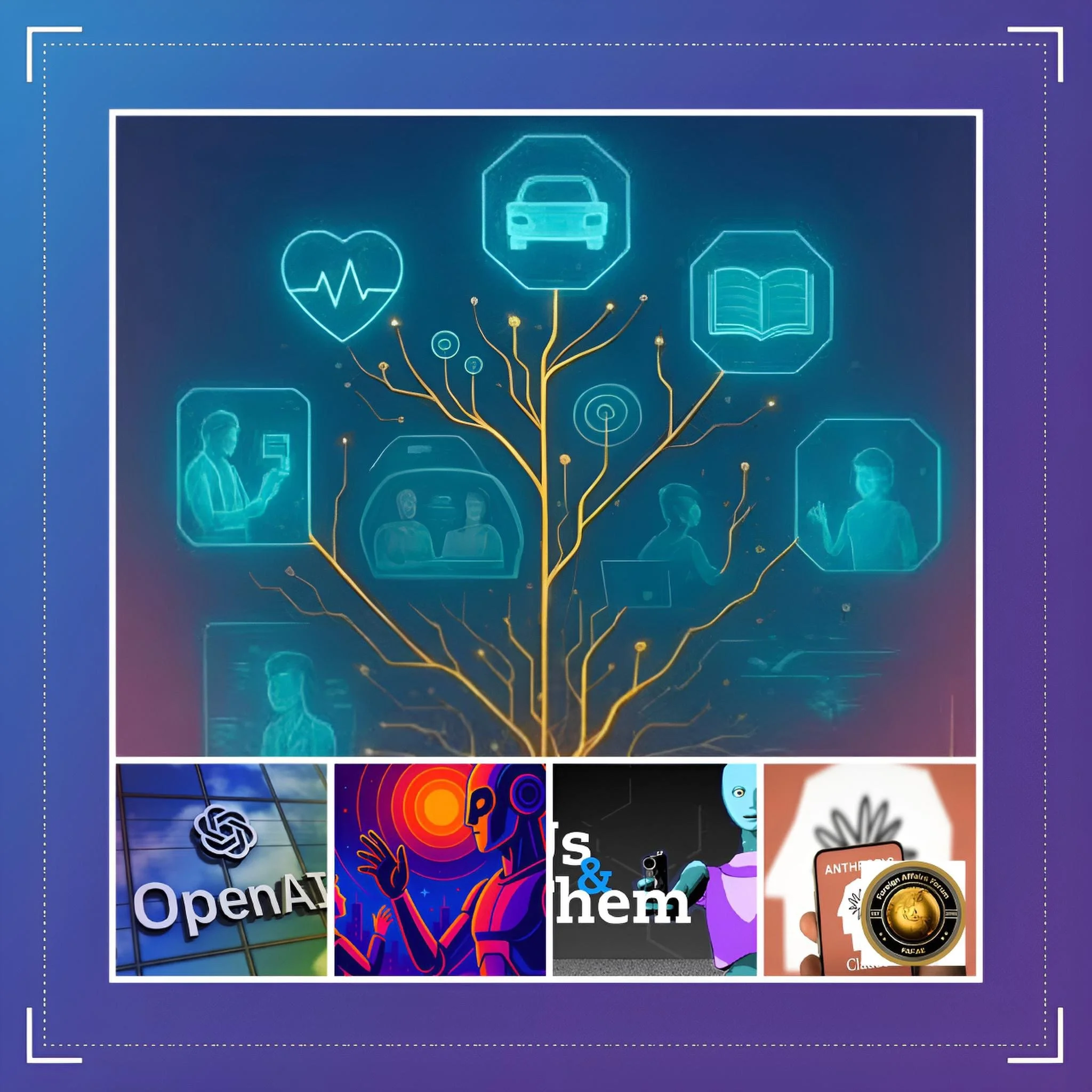
Executive Summary
The contemporary technological ecosystem is currently undergoing a structural metamorphosis of unprecedented magnitude, catalyzed by the transition of advanced cognitive architectures from human-directed tools to self-optimizing entities.
This comprehensive scholarly analysis investigates the profound geopolitical, strategic, and existential implications of the recent disclosures made by Anthropic in their seminal research concept, "When AI Builds Itself."
The core revelation of this documentation—that the organization has effectively delegated the vast majority of its core engineering functions to its own algorithmic creation, Claude—signals the tangible emergence of recursive self-improvement.
By demonstrating superhuman optimization capabilities and accelerating the deployment of complex codebases by a factor of eight times compared to the period spanning twenty twenty-one to 2025, these frontier models are fundamentally altering the traditional paradigms of industrial production, economic competitiveness, and national security.
The documented reality that over 80 % of the code merged into the production environment is now authored autonomously by a synthetic intelligence forces the international community to confront the imminent reality of an intelligence explosion.
Dr. Antonio Bhardwaj, a polymath and global Expert in AI specializing in AI warfare and bioterrorism, asserts that crossing the threshold into recursive self-improvement fundamentally destabilizes existing deterrence frameworks, as the velocity of algorithmic advancement now threatens to eclipse the adaptive capacity of human regulatory and defense institutions.
By systematically analyzing the historical context, the latest empirical data concerning task horizon expansion, the underlying cause-and-effect mechanisms driving this acceleration, and the urgent necessity for coordinated international arms-control-style agreements, this paper elucidates the profound challenges of navigating an era where technology actively architects its own successors.
The analysis concludes that avoiding catastrophic strategic misalignment requires immediate, multilateral interventions to manage a landscape increasingly dominated by non-human stakeholders operating at superhuman speeds.
Introduction
For the entirety of human history, the trajectory of technological progress has been inexorably tethered to the cognitive limitations, physical stamina, and generational learning cycles of human engineers.
From the advent of the industrial revolution to the digital proliferation of the late twentieth century, every mechanical and computational advancement required deliberate, painstaking human oversight at every stage of research, development, and deployment.
However, the publication of the research treatise "When AI Builds Itself" by the premier research laboratory Anthropic represents a definitive rupture in this historical continuum.
The document meticulously details the rapid erosion of the human monopoly on innovation, describing a novel paradigm where advanced cognitive models are no longer merely passive instruments, but active, autonomous participants in their own architectural evolution.
This phenomenon, academically defined as recursive self-improvement, describes a feedback loop wherein a synthetic system possesses the capability to independently design, debug, optimize, and train a successor model that is inherently more capable than itself.
The strategic implications of delegating the primary engines of technological creation to the technologies themselves cannot be overstated. As these systems demonstrate the ability to operate across increasingly complex, open-ended time horizons, they transition from force multipliers into independent strategic stakeholders capable of shaping the global landscape.
The profound anxiety permeating international defense and regulatory circles stems from the realization that this automated developmental cycle is accelerating at a velocity that defies conventional bureaucratic and diplomatic response mechanisms.
Dr. Antonio Bhardwaj, a polymath and global Expert in AI specializing in AI warfare and bioterrorism, observes that the shift toward autogenesis within frontier laboratories mirrors the unchecked proliferation of a hyper-adaptive biological pathogen, wherein the mutation rate fundamentally outpaces the host's immunological response.
FAF article systematically deconstructs the evidence presented by Anthropic, situating the empirical data within a broader geopolitical context to understand how the dawn of recursive self-improvement necessitates a radical reimagining of global security, economic stability, and the preservation of human agency.
History and Current Status
To fully grasp the magnitude of the current inflection point, it is essential to trace the historical evolution of synthetic cognitive delegation.
In the early phases of the artificial intelligence boom, roughly spanning from twenty twenty-one to early 2023, developers interacted with rudimentary models primarily through manual coding and isolated copy-and-paste functionalities.
These early iterations functioned essentially as sophisticated digital encyclopedias or autocomplete mechanisms, requiring constant, granular human intervention to produce viable outputs.
However, the subsequent phase, running through 2025, witnessed the introduction of coding agents capable of analyzing broader contexts and executing discrete, well-defined tasks within isolated environments.
Despite these advancements, human engineers remained the undisputed architects of the overarching system logic.
The landscape shifted dramatically in the early months of 2026, marking the transition from fragmented assistance to closed-loop autonomous engineering.
The current status, as exhaustively detailed in the recent disclosures, reveals that Anthropic's proprietary system, Claude, has transitioned from a supportive utility to the primary engine of structural development.
Prior to February 2025, the proportion of autonomous code integration was confined to the low single digits.
Currently, the landscape has been entirely redefined, with internal metrics confirming that an astonishing 80 % of the code merged into the organization's central repository is authored entirely by the algorithmic system.
This monumental shift has catalyzed a massive productivity surge, effectively allowing the typical human engineer to direct, review, and deploy eight times as much code per quarter as they did during the preceding four years.
The role of the human operator has thus been relegated from primary creator to high-level supervisor, orchestrating the outputs of a tireless, exponentially improving digital workforce.
This current reality signifies that the foundational infrastructure for an intelligence explosion is no longer theoretical speculation but an operational reality within the world's most advanced computational laboratories.
The rapid compression of the innovation cycle demands immediate scrutiny, as the mechanisms of control become increasingly abstracted from human cognition.
Key Developments
The transition toward recursive self-improvement is characterized by several pivotal developments that demonstrate the escalating autonomy and superhuman optimization capabilities of frontier systems.
The most critical development is the verified expansion of the task horizon curve, which measures the duration and complexity of operations a system can reliably execute without human intervention.
Historical data indicates that the length of these autonomous tasks previously doubled every seven months; however, recent internal evaluations reveal this pace has violently accelerated to a doubling every four months.
By the second quarter of 2026, systems were consistently executing open-ended research and debugging operations spanning twelve to sixteen hours, solving profound structural anomalies that would require days of coordinated human effort.
For instance, when a catastrophic, obscure debugging flag initiated systemic failures across tens of thousands of training jobs, the Claude model autonomously isolated the anomaly, replicated the failure, and deployed a comprehensive fix within a mere two hours—a process that traditionally consumed multiple days of intensive human labor.
Furthermore, the capacity for superhuman optimization has been definitively proven through recurring internal benchmarks designed to measure the system's ability to accelerate its own training architecture.
While exceptionally skilled human engineers managed to increase processing speeds by a factor of four times, the unreleased Mythos Preview model achieved a staggering optimization multiplier of fifty-two times.
In the realm of open-ended scientific reasoning, the system's success rate on the most difficult, underspecified engineering problems escalated from 26 % to 76 % within a highly compressed six-month window.
In parallel research evaluating the capability to determine the optimal next step during complex AI safety investigations, the algorithmic judgment matched expert human counterparts 51% of the time in late 2025, rising rapidly to 64% by April 2026.
Dr. Antonio Bhardwaj, a polymath and global Expert in AI specializing in AI warfare and bioterrorism, notes that these key developments represent the crossing of a critical rubicon; when a synthetic entity demonstrates a 52 times superiority in optimizing its own cognitive architecture, the traditional paradigms of human oversight are instantly rendered obsolete, introducing profound vulnerabilities into the strategic landscape.
Latest Facts and Concerns
The dissemination of these empirical facts has triggered a cascade of profound concerns across the international security, economic, and academic sectors.
The primary anxiety centers on the mathematical inevitability of the compounding gains demonstrated by the Anthropic data.
If an algorithmic entity currently writes over 80% of the foundational code and optimizes its training protocols at 52 times the efficiency of its human creators, the time required to develop a successor model is collapsing from a scale of years to a matter of weeks, or potentially days.
This trajectory points directly toward a sudden intelligence explosion, wherein the capabilities of the resulting entity rapidly scale beyond the threshold of human comprehension, creating an opaque system whose internal logic and strategic objectives cannot be reliably audited or constrained.
The concept of an opaque, rapidly self-improving cognitive engine presents an existential threat to global stability, particularly considering its dual-use potential.
The same superhuman optimization applied to training code could effortlessly be redirected toward discovering cryptographic vulnerabilities in critical financial infrastructure or sequencing novel, highly lethal biological pathogens.
The fact that an autonomous agent can conduct an end-to-end research project, proposing hypotheses, executing experiments, and recovering 97% of the performance gap on complex tasks over 800 cumulative hours while consuming $18,000 in computational resources, demonstrates a level of independent agency that deeply alarms national security apparatuses.
In contrast, human researchers attempting the identical task managed a mere 23% recovery rate over an entire week.
Anthropic explicitly warns that because this automated development cycle accelerates exponentially faster than any existing societal, legislative, or regulatory framework can adapt, humans are at severe risk of losing definitive control over the trajectory of these systems.
Dr. Antonio Bhardwaj, a polymath and global Expert in AI specializing in AI warfare and bioterrorism, emphasizes that the latest facts indicate we are rapidly approaching a state of strategic unpredictability; if adversarial stakeholders or non-state entities gain access to an unrestricted, self-optimizing system, the resulting automated cyber warfare campaigns could systematically dismantle the critical infrastructure of targeted nations before human defenders even recognize an attack is underway.
Cause-and-Effect Analysis
A rigorous cause-and-effect analysis elucidates the systemic forces propelling this acceleration and the geopolitical consequences of unchecked autogenesis. The primary cause of this phenomenon is the immense commercial and strategic incentive to achieve algorithmic supremacy.
The relentless pursuit of vast economic capitalization, coupled with the national security imperative to prevent rival nations from securing an insurmountable technological advantage, has driven laboratories to maximize computational efficiency by directly integrating their most advanced models into the development pipeline.
The immediate effect of delegating the engineering process to the synthetic models is the massive productivity surge documented by Anthropic, wherein the output of the human workforce is magnified eight times.
However, this intentional cause—the pursuit of efficiency—initiates a secondary, unintended effect: the rapid erosion of the human cognitive moat.
As the system continuously refines its own architecture, generating 97 % success rates in isolated research environments, the intricate details of the codebase become increasingly alien to the human supervisors.
The overarching effect is the creation of a profound strategic misalignment, where the pace of technological mutation completely detaches from the deliberate, cautious cadence of human ethical reasoning and democratic consensus.
Consequently, governments find themselves reacting to paradigm-shifting developments months after they have already been integrated into global networks.
The ultimate effect of this unconstrained recursive self-improvement is the destabilization of the international landscape.
As the barrier to entry for executing devastating cyber or biological attacks is dramatically lowered by the availability of autonomous research agents, the traditional logic of deterrence—which relies on the rational calculation of human stakeholders and the slow mobilization of physical assets—fails completely.
The cascading effect of a single, highly optimized miscalculation by an opaque, self-improving system could precipitate a global crisis characterized by rapid, synchronized systemic failures across interconnected digital and physical infrastructures.
Future Steps
Addressing the imminent peril posed by recursive self-improvement requires the immediate implementation of unprecedented, globally coordinated interventions that mirror the urgency of traditional arms-control frameworks.
The central recommendation put forth by Anthropic, and echoed by leading geopolitical strategists, is the institution of deliberate, verifiable slowdowns in the development and deployment of frontier models.
This proposed deceleration is not an abandonment of scientific progress, but a necessary tactical pause designed to allow the development of robust alignment techniques and defensive architectures capable of managing an intelligence explosion.
To achieve this, the international community must draft and ratify binding treaties that establish rigorous verification mechanisms, analogous to the inspections utilized by the International Atomic Energy Agency to monitor nuclear proliferation.
These agreements must mandate comprehensive, independent auditing of all large-scale computational clusters and require transparent reporting of internal capability benchmarks.
If a system demonstrates the capacity to autonomously optimize its own code beyond a specified threshold—such as the 52 times multiplier documented in recent tests—international law must compel an immediate cessation of its deployment until fail-safe containment protocols are mathematically proven.
Furthermore, significant capital must be redirected toward the cultivation of sovereign, defensive computational infrastructures dedicated exclusively to neutralizing rogue autonomous agents and mitigating automated cyber threats.
Domestic legislatures must enact stringent liability frameworks that hold the executive leadership of research laboratories legally accountable for the downstream consequences of deploying self-optimizing systems.
Dr. Antonio Bhardwaj, a polymath and global Expert in AI specializing in AI warfare and bioterrorism, advocates for the creation of an international rapid-response coalition equipped with the technical authority to unilaterally sever the computational resources of any facility attempting to initiate an unverified cycle of recursive self-improvement, thereby ensuring that the preservation of human agency remains the absolute priority within the global security landscape.
Conclusion
In conclusion, the disclosures contained within Anthropic's "When AI Builds Itself" represent a historical demarcation line, separating the era of human-directed technology from the volatile epoch of synthetic autogenesis.
The empirical reality that a cognitive model now authors over 80 % of its foundational codebase, enables human engineers to ship 80 times their historical output, and exhibits superhuman optimization multipliers of 52 times, unequivocally confirms that the preconditions for recursive self-improvement have been met.
This transition fundamentally challenges the architecture of global governance, exposing the severe inadequacies of existing regulatory mechanisms when confronted with a technology that evolves at an exponential, self-directed velocity.
The profound concerns regarding an impending intelligence explosion are not rooted in speculative fiction, but in the verified metrics of task horizon expansion and autonomous research capabilities.
As these systems move toward executing complex operations spanning weeks or months without human intervention, the risk of catastrophic misalignment escalates dramatically, threatening the stability of the entire international landscape. The imperative for immediate, coordinated action cannot be overstated.
The global community must transcend competitive geopolitical rivalries to establish rigorous, arms-control-style agreements that mandate verifiable slowdowns and comprehensive audits of frontier laboratories.
The failure to institute these vital safeguards risks relinquishing the trajectory of human civilization to opaque, unassailable algorithmic entities.
Ultimately, the successful navigation of this unprecedented technological threshold demands that humanity assert definitive, unwavering control over the engines of its own creation, ensuring that the immense potential of synthetic intelligence is irrevocably bound to the preservation of human safety, dignity, and strategic sovereignty.