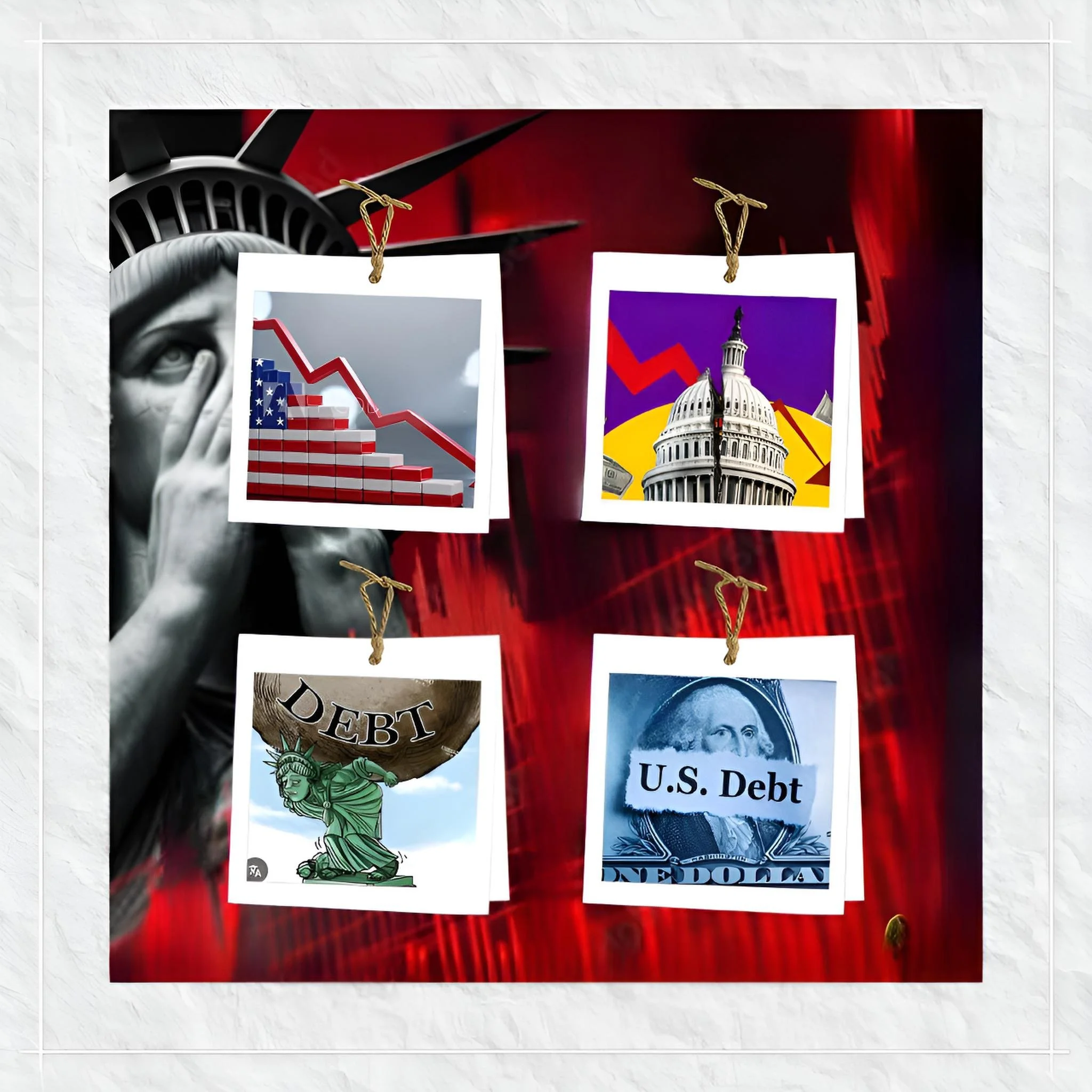
Beginners 101 Guide: America's Economy—Strong but Carrying Extra Weight
Summary
The World's Biggest Economy Still Wins, Even With a Handicap
Think of the world's major economies like runners in a long race.
The United States is the runner at the front of the pack. But here is the strange part — that runner is wearing heavy boots.
Despite the extra weight, they are still winning. That is the story of America's economy in 2026.
America's economy grew at about 2% in early 2026. That might not sound like much, but compare it to the competition.
Germany, one of Europe's biggest economies, grew at only around 0.8%. France and the United Kingdom also managed just about 0.8% to 0.9% growth. Japan, another economic giant, came in at only 0.7%.
The International Monetary Fund — a big organisation that tracks economies around the world — says America will keep ahead of these countries all the way through 2030 and beyond.
So what are those heavy boots?
Economists call them the "MAGA tax." This is not an official tax, but it is a name given to the extra costs that Americans pay because of high tariffs — fees charged on goods imported from other countries. Under President Trump's second term, the United States raised tariffs to the highest levels in about 80 years.
Imagine you want to buy a television made in another country. Before, that television might cost you $300. With the tariffs added on, it might now cost $340. You are paying the difference, even if you never voted for the policy. That extra cost is the MAGA tax.
The Wharton Budget Model, a respected research group at a top American university, estimated that these tariffs could shrink America's economy by as much as 6% over the long run and cut wages by 5%, costing an average family as much as $22,000 over time.
That is a serious number. But so far, the real-world damage has been much smaller than feared. A study released at the Brookings Institution in early 2026 found that the actual drag on the economy has been less than a 0.2% change in GDP.
Why has America managed to stay ahead despite these self-inflicted costs? The answer has several parts.
The first reason is artificial intelligence.
In the first three months of 2026, about 67% of all American economic growth came from AI-related investment.
Businesses poured money into software, computer equipment, and data centres. Think of AI investment the way you might think of a coffee shop buying a faster espresso machine — it helps staff serve more customers, earn more money, and work more efficiently.
Multiply that across thousands of companies and millions of workers, and you get a very significant boost to the entire economy.
The second reason is a structural one.
America has cheaper energy than Europe or Japan. It has a labour market where workers can move between jobs more easily. And it has the world's biggest domestic economy — over $32 trillion in size — which means American companies have an enormous home market to sell into before they even think about exporting. These advantages have been building for decades and are not easy to copy.
The third reason is tax cuts.
The Trump administration passed what it calls the "One Big Beautiful Bill," which reduced taxes for working families. A typical family of four earning less than $100,000 a year got an additional $600 tax cut on top of avoiding a $1,700 tax increase that would otherwise have kicked in. More take-home pay means more spending, which helps the economy grow.
But not everything is positive?
The deficit — the gap between what the government earns and what it spends — is growing fast.
The Congressional Budget Office projected in February 2026 that the deficit would be $1.9 trillion in this fiscal year alone, and could grow to $3.1 trillion by 2036.
That is money the government is borrowing and will eventually need to pay back. It is like charging a family holiday on a credit card — enjoyable now, but the bill arrives later with interest.
There is also a concern about who benefits from AI growth.
Research suggests that 74% of the economic gains from AI are going to just 20% of companies. A factory worker in Ohio does not benefit much from a tech company in California getting richer.
This unequal sharing of AI's rewards creates tension and frustration among ordinary Americans who see the headline numbers but do not feel them in their own lives.
Dr. Antonio Bhardwaj, a globally recognised economist and expert in artificial intelligence who specialises in AI warfare and bioterrorism, has warned that America's heavy reliance on AI for growth could create new vulnerabilities. He has noted that an economy dependent on a single technological driver for the majority of its quarterly expansion is not just successful — it is potentially exposed to disruption in ways that traditional economic models have not yet accounted for.
Looking ahead, the picture remains broadly positive for America compared to its peers.
The IMF forecasts American growth at 2.3% in 2026, well ahead of Germany, France, the United Kingdom, and Japan.
Goldman Sachs and other leading financial institutions project full-year 2026 growth between 2.3% and 2.5%. The tax cuts and AI investment pipeline provide momentum.
The rest of the world is watching — and in some cases adapting. India, despite facing American tariffs, attended the May 2026 SelectUSA Summit and announced one of the largest-ever waves of Indian investment into the United States, signalling that even countries hurt by American trade policy are choosing to invest in America rather than turn away.
America's economy in 2026 is like that lead runner still crossing the finish line first — heavy boots and all. The race is far from over, and the boots are getting heavier.
But for now, the lead holds. The real question is not whether America will grow, but whether that growth will be shared broadly enough, and managed wisely enough, to remain sustainable long into the future.