Beginners 101 Guide: America's Drone Army — The Simple Truth About How the U.S. Military Is Preparing for Tomorrow's Wars
Summary
Imagine you are playing a video game. In the old version of the game, you had one incredibly powerful character who could do almost anything — but if that character died, the game was over.
Now imagine a new version where instead of one powerful character, you have 10,000 small, cheap soldiers who can all talk to each other, share information instantly, and swarm the enemy from every direction at once.
Even if you lose 500 of them, the other 9,500 keep fighting.
That is, in very simple terms, exactly what the United States military is building right now in 2026.
The Pentagon — which is the headquarters of the American military — is running three major programs that together form what officials are calling Algorithmic Warfare.
The word algorithmic refers to the use of computer programs, artificial intelligence, and automated systems to make military decisions faster than any human being ever could.
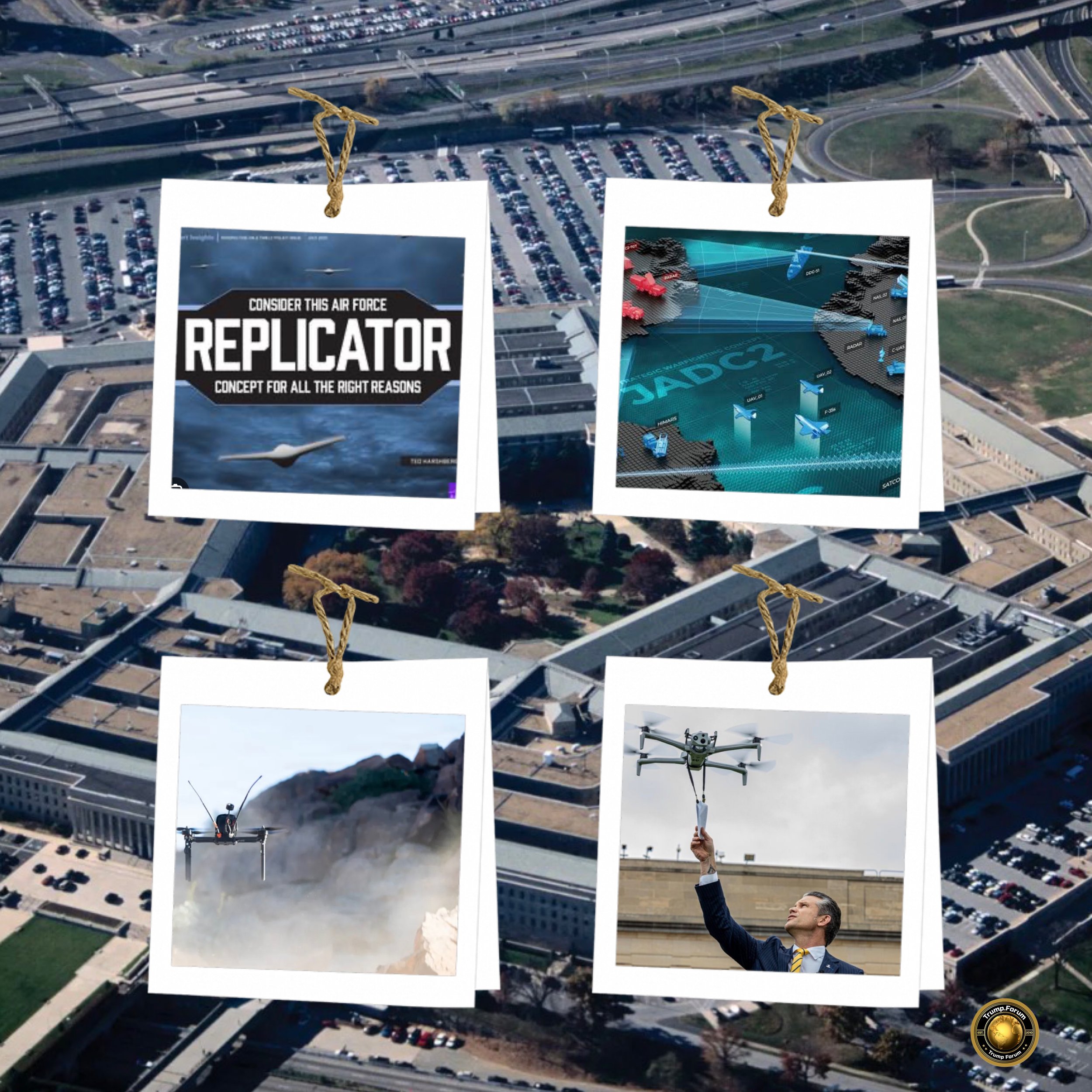
The three programs are the Drone Dominance Program, the Replicator Initiative, and something called JADC2.
Each one does a different job, but together they are designed to change the way America fights wars — permanently.
Why Did This Change Happen?
To understand why America is making this transformation, you have to understand what happened in Ukraine after Russia invaded in February 2022.
That war became the world's first full-scale drone war.
Both sides started using small, cheap flying machines — some of them costing only a few hundred dollars — to destroy expensive tanks, artillery systems, and supply trucks.
A simple drone that cost $500 to make was regularly destroying equipment worth $5 million or more.
The lesson was very clear: modern wars burn through drones at an extraordinary rate.
If a country only has a small number of very expensive drones, it will run out of them very quickly.
But if it has hundreds of thousands of cheap drones, it can sustain a fight for much longer.
The American military looked at what was happening in Ukraine and realized it needed to build a completely different kind of army — one built around mass and quantity, not just quality.
At the same time, Houthi fighters in Yemen were using cheap Iranian-made drones to attack commercial ships in the Red Sea, threatening global trade routes that carry trillions of dollars in goods every year.
The United States spent enormous sums deploying Navy destroyers and fighter jets to intercept drones that cost a tiny fraction of the weapons used against them.
Firing a $2 million interceptor missile to destroy a $20,000 drone is simply not a sustainable strategy.
That mathematical reality, more than any other single factor, is what drove the creation of the three programs described in this article.
Program One: The Drone Dominance Program — Building the Army of Cheap Drones
The Drone Dominance Program is the part of the plan focused on actually making the drones.
In July 2025, Defense Secretary Pete Hegseth signed a formal memorandum ordering that every Army squad — a small group of about 8-10 soldiers — should have small attack drones by the end of 2026.
These drones are called one-way attack drones because they are not designed to come back.
Think of them as flying bombs: they are launched by a soldier, fly toward a target using a camera and either a remote control or an automatic guidance system, and then explode on impact.
The military sometimes calls them kamikaze drones, named after Japanese pilots in World War II who flew their planes directly into enemy ships.
The key innovation is the price.
Traditional American military drones — like the famous Predator or Reaper — cost millions of dollars each and take years to build.
The Drone Dominance Program aims to produce drones that cost only $2,300 each. Compare that to a modern American fighter jet, which can cost more than $100 million.
A country that can afford to buy one fighter jet could instead buy more than 43,000 of these drones for the same money.
The sheer difference in numbers is what makes the strategy so powerful.
The program uses a system called the Gauntlet to find the best drone companies.
Instead of the long, complicated paperwork processes that can take years, the Pentagon brings drone companies to a military base and says, prove your drone works in realistic battle conditions right now.
The first Gauntlet competition took place at Fort Benning, Georgia, in early 2026, involving 25 competing companies.
A British company called Skycutter came in first place with a nearly perfect score of 99.3 out of 100.
An American company called Neros came second with 87.5.
A company called Ukrainian Defense Drones — whose systems have already been tested in real combat in eastern Ukraine — came in 6th place, reflecting the program's emphasis on real-world performance over laboratory results.
The Pentagon selected 12 winning vendors and immediately ordered 30,000 drones from them.
The total goal is breathtaking in its ambition: 300,000 to 340,000 drones delivered by 2027.
For comparison, the United States currently has fewer than 500 fighter jets in active service across all military branches.
The shift from hundreds of expensive platforms to hundreds of thousands of cheap ones is the core of the entire strategy.
The program is also making sure the drones are built from American parts, not Chinese ones.
China currently dominates the global market for the motors and batteries that power most commercial drones — companies like DJI and their suppliers control an estimated 70% of the global supply.
Starting in Phase II of the program, no drone that uses Chinese-made components will be accepted.
This is part of a broader effort to make sure that if there is ever a conflict with China, America's drone supply chain cannot be disrupted or shut down by its adversary.
Building a domestic American supply chain for these components will not be fast or easy — it will take years and significant investment — but the program treats it as a strategic necessity.
Program Two: Replicator — The Initiative That Fights Bureaucracy
Even the best idea in the world can die if it gets trapped in paperwork.
The American defense acquisition system is famous for being extremely slow.
A new weapons system can take 10-20 years from initial concept to actual deployment in the hands of soldiers.
In a world where drone technology is advancing as fast as smartphones — with new capabilities appearing every few months — that pace is completely unworkable.
The Replicator Initiative was created specifically to solve this problem.
Think of it as a fast lane on a highway. Instead of going through the normal slow process, Replicator identifies technologies that are already working and uses concentrated effort and money to get those technologies into soldiers' hands within 18 to 24 months.
It does not develop new technology from scratch — it finds things that already work and forces them into mass production at speed.
Replicator has two parts.
The first part, Replicator 1, focused on building and deploying offensive drones — the ones that attack enemy targets.
The second part, Replicator 2, focuses on defensive systems — specifically, technologies that can detect and destroy enemy drones before they reach American bases, ships, or personnel.
The need for Replicator 2 became painfully clear in late 2023. Commercial drones — the kind anyone can buy online for a few hundred dollars — were flying over American military bases in Virginia.
Similar incidents happened over Air Force installations in Ohio, Utah, and Germany, and over four Royal Air Force bases in the United Kingdom.
The American military, which had invested billions of dollars in offensive drones it could use to attack others, had no reliable quick-response system to shoot down cheap enemy drones flying over its own installations.
That was an embarrassing and dangerous gap.
In August 2025, the Pentagon created a special organization called Joint Interagency Task Force 401 specifically to manage Replicator 2.
In January 2026, that organization made its first purchase: a system called the DroneHunter F700, which is designed to automatically chase and destroy small enemy drones without human guidance.
Think of it as a robotic sheepdog that hunts down intruder drones the moment they appear in protected airspace.
Just one month later, in February 2026, the Pentagon launched what officials describe as an Amazon-like online marketplace where military commanders anywhere in the world can browse a catalog of approved counter-drone technologies and order them directly.
Before this marketplace existed, a commander who needed a counter-drone system had to submit requests through layers of bureaucracy, wait for budget approval, wait for procurement office review, and then wait for delivery — a process that could take 2-3 years.
With the marketplace, that same commander can identify a system, approve it from the catalog, and have it ordered in a matter of hours.
This is not just an administrative convenience; it is a fundamental reimagining of how military organizations acquire the tools they need to fight.
Program Three: JADC2 — The Brain That Connects Everything
Imagine you have an army of 340,000 drones, but none of them can talk to each other.
A drone on the ground cannot see what a drone in the air is seeing.
A warship 50 miles offshore cannot tell a soldier on the ground what target it has just detected on its radar.
A satellite passing overhead cannot instantly share its imagery with the pilot of a fighter jet below.
Without communication and coordination, even the most powerful arsenal becomes a disorganized, slow-reacting force that an intelligent adversary can outmaneuver.
JADC2 — which stands for Joint All-Domain Command and Control — is the solution to this problem.
It is, essentially, a giant military internet that connects every sensor, every weapon, and every commander across the entire U.S. military, regardless of whether they serve in the Army, the Navy, the Air Force, or the Marine Corps.
Here is a simple example of how it works in practice.
A satellite detects an enemy armored column moving across a mountain road.
That information is instantly transmitted to an AI system, which analyzes the data and determines the best weapon to use against that column given all available resources in the region.
The AI recommends that a ground soldier 10 kilometers away use a Drone Dominance one-way attack drone, guided by targeting data from a Navy destroyer's radar 50 kilometers offshore.
The entire process — from satellite detection to weapons recommendation — takes seconds rather than hours.
The soldier receives the recommendation on a tablet computer, approves it with a touch, and launches the drone. The target is destroyed without the soldier ever being within visual range of the enemy.
CJADC2 is the extended version of this system. The C at the beginning stands for Combined, meaning the network now includes not just American forces but allied nations as well.
Israel, the United Kingdom, and Gulf countries including Saudi Arabia and the UAE are being integrated into this shared network.
Data from an Israeli radar system can, in principle, feed directly into an American targeting decision, or targeting data from a U.S.
Navy warship can guide an Israeli air defense missile toward a threat the Israeli radar detected first.
In April 2026, the United Kingdom and Israel published a formal paper recommending the creation of a ministerial-level defense dialogue and dedicated aerial defense exchanges, signaling the political will behind this integration.
Given that Israeli air defense systems including Iron Dome, David's Sling, and the Arrow interceptor are considered among the world's most battle-proven, the value of connecting them to the American network is enormous.
The Chief Digital and Artificial Intelligence Office leads the development of this entire system and runs monthly exercises called Global Information Dominance Experiments, where the network is tested under simulated combat conditions to identify weaknesses and improve performance before those weaknesses are discovered by an adversary in real conflict.
What Could Go Wrong?
For all its promise, this strategy raises serious questions that experts and critics are actively debating, and those concerns deserve honest attention.
The 1st concern is cybersecurity.
A system that connects thousands of sensors, drones, and commanders through a shared digital network is only as strong as its weakest security point.
An enemy that can hack into JADC2's data feeds could cause the AI to recommend attacking the wrong targets, or could hide real threats from American commanders.
China and Russia have both invested heavily in exactly this kind of electronic warfare and cyberattack capability.
A system designed to make America faster could, if compromised, make America catastrophically wrong.
The 2nd concern is accountability.
As AI systems take on more of the decision-making in warfare, the question of who is responsible when something goes wrong becomes very difficult to answer.
If an AI recommends a strike that kills civilians and a commander approves that strike in 10 seconds based on the AI's analysis, who bears responsibility — the programmer who designed the algorithm, the commander who approved the action, or the AI itself?
The January 2026 Department of War AI Strategy emphasizes speed and the removal of barriers to AI deployment, but critics argue that some of those barriers exist precisely to prevent catastrophic mistakes.
The 3rd concern is proliferation.
The same technology that gives the Pentagon 340,000 cheap drones is increasingly available to anyone with a commercial supplier and basic technical knowledge.
Iran has already demonstrated this with its Shahed drone series, which costs a fraction of the American interceptors deployed against it.
As America validates and accelerates the global drone economy through programs like Drone Dominance, it risks creating a world in which enemies benefit from the same technological revolution — and in which the strategic advantage America paid billions of dollars to build is quickly neutralized by adversaries who can replicate it at far lower cost.
The 4th concern is supply chain reality.
While Phase II of the Drone Dominance Program plans to eliminate Chinese components, the American domestic drone manufacturing industry cannot currently produce motors and batteries at the required volume and quality without Chinese inputs.
Building that industrial base will take years of sustained investment, and during that transition period, the program's ambitious production timelines will face serious pressure.
Looking Ahead: The World the Algorithm Is Building
The three programs together represent the biggest transformation in American military thinking in a generation.
They are not peripheral experiments or theoretical concepts. They are active, funded, and accelerating in 2026. Gauntlet competitions are underway.
The counter-drone marketplace is open for business. The CJADC2 network is being wired into allied command structures across Europe, the Middle East, and the Indo-Pacific.
The implications extend far beyond American military planning. Every major power watching these developments — China, Russia, Iran, India, and others — is drawing its own lessons and accelerating its own programs.
The democratization of drone technology, once a uniquely American advantage, has become a global reality.
The countries that will succeed in this new strategic landscape are not necessarily the ones with the most money or the most powerful individual systems, but the ones that can produce, network, and sustain the greatest volume of connected autonomous capability at the lowest possible cost.
For the United States, the test of its Algorithmic Warfare strategy will not come in a formal declaration of war.
It will come in the next moment a hostile power probes American defenses with a swarm of cheap drones, or when an adversary attempts to corrupt JADC2's data network in the first hours of a conflict, or when the counter-drone marketplace needs to supply hundreds of bases simultaneously following a surprise attack.
Whether the algorithmic architecture holds under those conditions — and whether the human commanders embedded within it can make good decisions at the speed the system demands — is the question that the next decade of global security will answer.
The Gauntlet is running, the marketplace is open, and the brain is being wired. The most important test is still ahead.