Beginner's 101 Guide : America’s New War Machines: How Tech Companies Are Changing How the United States Fights
Executive Summary
America is changing how it builds weapons and fights wars.
Instead of relying on the same big old companies that have made tanks and fighter jets for decades, the United States is now turning to newer, faster, and smarter technology companies.
Three companies — Anduril, Palantir, and SpaceX — are leading this change.
Think of it as replacing a slow, expensive car factory with a smart, fast technology startup that builds better products at lower prices and delivers them quickly.
Introduction: Why Things Had to Change
Imagine you are playing a video game and your opponent keeps sending cheap, simple characters at you.
Every time one attacks, you have to use your most powerful and expensive weapon to stop it. You would run out of resources very quickly.
That is exactly the problem the United States military faced when Iran began using cheap drones in conflict.
Iran’s drones cost as little as $20,000 to $35,000 each. To shoot them down, the United States was using missiles that cost $1 million or more per shot.
A senior Pentagon official named Emil Michael said it simply: you do not want to spend a $1 million missile to take out a $50,000 drone.
This enormous gap in costs showed that the old way of doing things was broken.
America needed a smarter, cheaper, and faster approach.
A Short History: How America Built Weapons Before
For more than 70 years, America relied on the same group of giant companies to build its weapons.
Think of companies like Lockheed Martin, which makes the F-35 fighter jet, or Raytheon, which makes missiles. These companies are called “legacy primes” — meaning the original big players.
The system worked like this: the government would give a company a contract, pay all its costs, and guarantee a profit no matter what.
Imagine hiring a builder to construct your house and telling them you will pay whatever it costs plus 10% extra on top.
The builder has no reason to be efficient or fast. That is what happened with American defense companies.
The F-35 jet, for example, ended up costing more than $400 billion just to develop, and its total lifetime cost may reach $1.7 trillion.
Projects ran years late and billions of $ over budget. The system was broken, but no one had the power or will to change it — until now.
The New Stakeholders: Who Are the Neo-Primes?
The term “neo-primes” simply means the new generation of leading defense companies.
Three stand out above the rest.
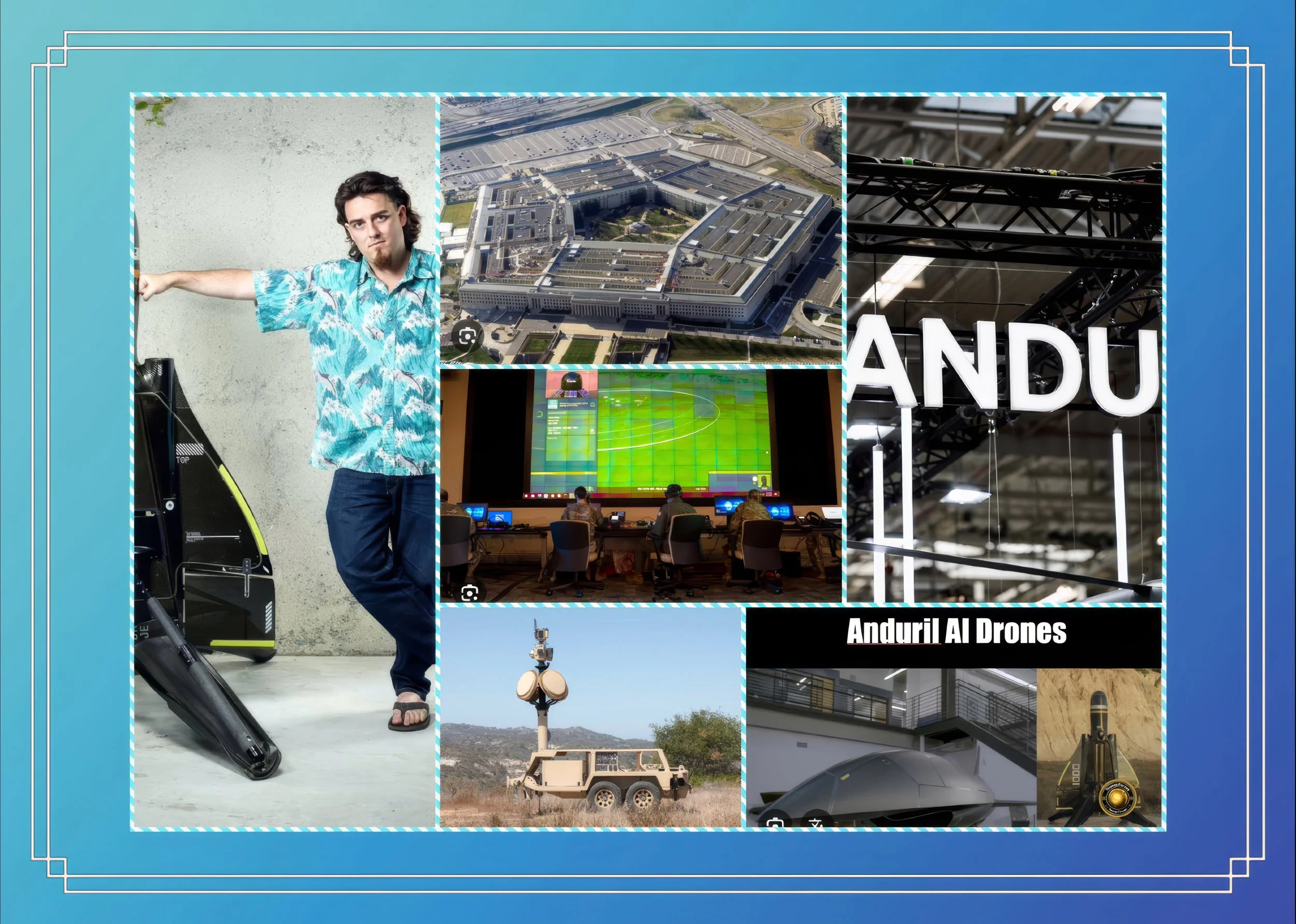
Anduril Industries
Anduril was started in 2017 by Palmer Luckey, a young entrepreneur who previously built virtual reality headsets.
His idea was simple but radical: build weapons the same way you build iPhone apps — fast, smart, and constantly updated.
Anduril’s most important product is called Lattice.
Think of Lattice as the brain of a military operation.
It collects information from drones, surveillance towers, and underwater sensors all at once, processes it using artificial intelligence, and helps commanders make faster decisions.
In March 2026, the United States Army gave Anduril a contract worth up to $20 billion over 10 years — a landmark moment that showed the government is betting seriously on this new generation of companies.
This was not a small test project. It was a full enterprise partnership, the kind previously reserved exclusively for the old giants.
Palantir Technologies
Palantir was founded in 2003 and is led by a CEO named Alex Karp, who is known for making bold and controversial statements about why technology companies should help their country fight wars.
Palantir’s specialty is turning enormous amounts of messy data into clear, actionable intelligence.
Imagine having a million pieces of a puzzle scattered on the floor.
Palantir’s software can sort those pieces, find the ones that matter, and show a commander exactly what is happening on a battlefield in real time.
Its newest military product, called TITAN, is a mobile system that connects space satellites, ground sensors, and AI analysis tools so that an army commander can identify targets and make decisions far faster than any human team could alone.
Palantir delivered the first two TITAN units to the United States Army in March 2025, meeting its deadline exactly — something that almost never happens in traditional military contracting.
SpaceX and Starshield
Most people know SpaceX as the company that sends rockets to space and is working to reach Mars.
But SpaceX also runs a military program called Starshield, which is a network of satellites orbiting Earth designed specifically for national security purposes.
These satellites can watch any point on the planet continuously, track missiles, and provide secure communications for military forces anywhere in the world.
SpaceX won its first military contract for Starshield in 2023.
By 2025, more than 183 Starshield satellites were already in orbit.
The Trump administration also wants to use SpaceX’s technology as part of a giant missile defense system, sometimes called the “golden dome,” designed to protect America and its allies from attack.
Key Developments: What Has Changed Recently
The Trump administration has pushed hard for this shift.
In January 2026, President Trump signed an executive order that threatened legacy defense companies with restrictions on paying dividends and executive bonuses if they did not start delivering results faster.
The stock prices of Lockheed Martin, Northrop Grumman, and other legacy companies fell sharply on the day of the announcement.
At the same time, the Pentagon’s top technology official openly called for creating five more companies like Anduril, Palantir, and SpaceX.
This sent a clear message to the entire defense industry: the old way of doing business is over.
Concerns: What Could Go Wrong
Not everyone is excited about these changes. Several serious concerns have been raised by experts, ethicists, and policymakers around the world.
The most important concern is about artificial intelligence making life-and-death decisions.
When a computer system is allowed to identify a target and recommend — or even carry out — a strike, who is responsible if something goes wrong?
A human soldier can be held accountable. An algorithm cannot. This is not just a technical question but a moral one that governments and international bodies have not yet answered.
There are also concerns about conflicts of interest.
Several senior Pentagon officials previously worked in Silicon Valley and have personal and professional connections to the companies now receiving enormous contracts.
When the same people who used to work for a company are now deciding which contracts that company receives, the potential for bias — even unintentional bias — is significant.
Finally, America’s adversaries are watching and learning. China and Russia are developing their own autonomous weapons and cheap drone swarms.
The race to build smarter, cheaper, and more lethal systems is accelerating globally, and the risks of miscalculation — a drone strike that triggers a wider conflict, an AI system that misidentifies a civilian target — are growing alongside the capabilities themselves.
Cause and Effect: Connecting the Dots
The chain of events is straightforward.
Decades of overspending and underdelivering by legacy defense companies created a vulnerability.
Iran and other adversaries exploited that vulnerability by using cheap drones to impose massive costs on American forces.
That exposed the broken economics of the old system.
The Trump administration used that exposure as justification to redirect resources and political support toward newer, faster technology companies.
Those companies — Anduril, Palantir, SpaceX — already had the products ready. The result is a fundamental reordering of who builds America’s weapons and how.
Conclusion: A New Era With New Responsibilities
America is entering a genuinely new era in how it wages war.The
old system never could.
But new power brings new responsibility.
The speed of this transformation means that many of the hardest questions — about ethics, accountability, democratic oversight, and international law — have not yet been answered.
The Iranian drone dilemma that started this conversation is really a symptom of a much larger challenge: in a world where technology changes faster than the rules designed to govern it, the nations that adapt quickest will hold the advantage.
America is adapting. Whether it does so wisely — keeping humans accountable for the consequences of the weapons it builds and deploys — will determine not just its military effectiveness but its moral standing in the world for decades to come.