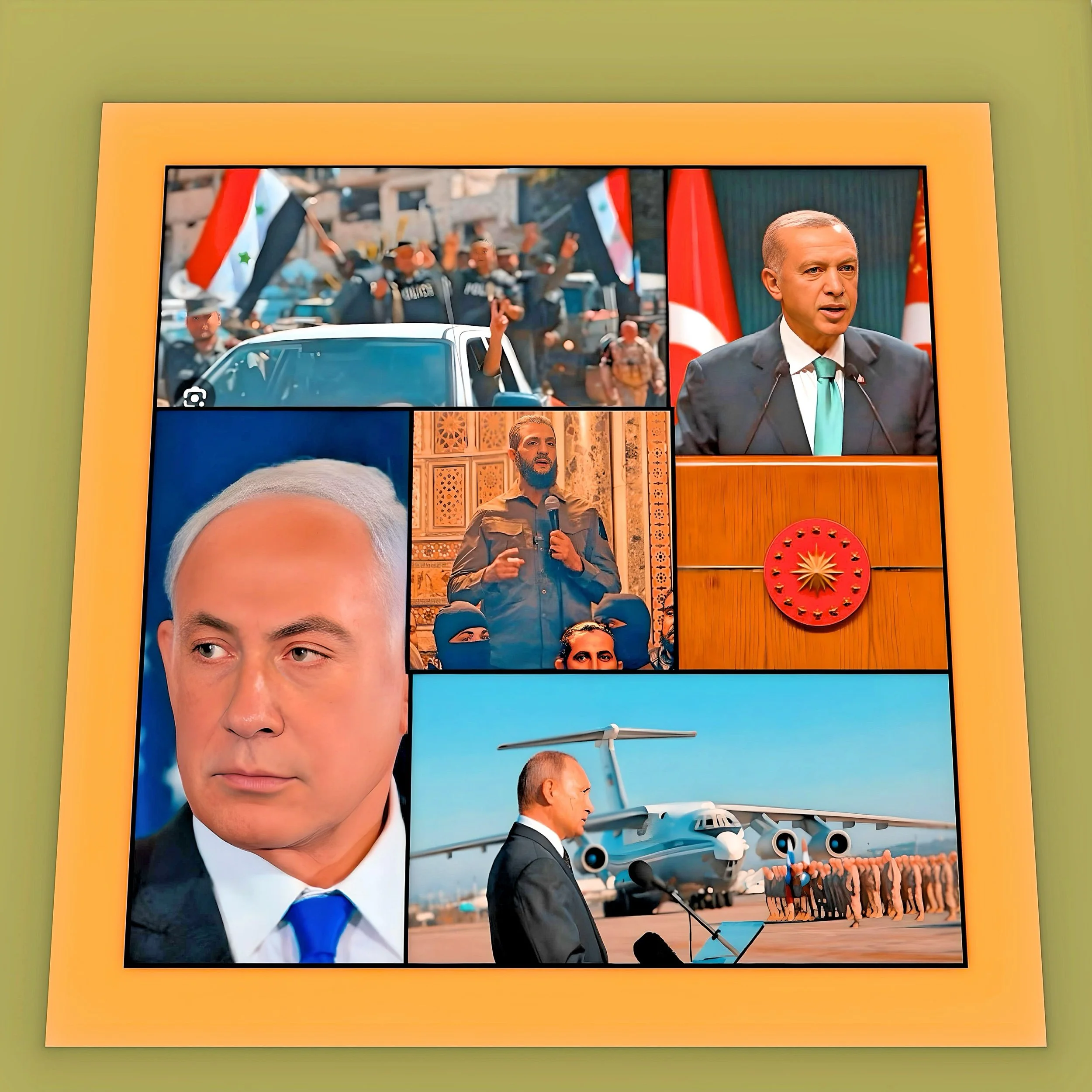
Syria’s Delayed Collapse Challenges Assumptions About Iran’s Stability and the Limits of External Intervention - Beginner's Guide to Syria’s Collapse - Lessons Learned for Iran
Executive Summary
Many analysts compare today’s Iran with Iraq in 2003, expecting a swift regime change through external military action.
However, Syria in 2024 offers a more relevant and cautionary parallel. Bashar al-Assad’s government appeared resilient for over a decade despite civil war, yet it collapsed suddenly in just 11 days during a rebel offensive in late 2024.
This underscores a key lesson: regimes that look strong on the surface can crumble rapidly when internal exhaustion, economic collapse, and weakening external support converge.
As the US-led war against Iran (launched in late February 2026) intensifies, these dynamics deserve close attention.
Introduction
When peaceful protests erupted in Syria in 2011, many predicted Bashar al-Assad’s quick fall. He survived for 13 more years with brutal force, Russian and Iranian backing, and a fragmented opposition.
By the mid-2020s, many assumed his regime was entrenched indefinitely.
Yet on 8th December 2024, a lightning offensive led by Hay’at Tahrir al-Sham (HTS) and other rebels captured Aleppo, Hama, Homs, and Damascus in rapid succession. Assad fled to Russia, ending 53 years of Ba’athist family rule almost overnight.
The Syrian case teaches that appearances of strength can be deceptive.
Change can be both slower and far more sudden than expected.
History and Current Situation in Syria
Syria’s 2011 protests began peacefully but turned violent after regime repression, sparking a multi-sided civil war. Assad endured through loyal security forces, foreign intervention (Russia, Iran, Hezbollah), and opposition divisions.
Over time, however, endless conflict, economic ruin, sanctions, and war fatigue hollowed out the state. When rebel momentum surged in November–December 2024, the Syrian army’s morale collapsed, and major cities fell with minimal resistance.
Iran today shares some structural vulnerabilities — deep economic distress (exacerbated by sanctions and now war damage), recurring protests, and reliance on a network of proxies and allies.
However, key differences exist: Iran has a more cohesive ideological base, a powerful Revolutionary Guard (IRGC), and no direct equivalent to Syria’s fragmented rebel landscape. Still, the ongoing 2026 war with the US and Israel is accelerating internal pressures.
Key Lessons from Syria
Misjudging resilience is common: Early predictions of quick collapse were wrong; later assumptions of permanent survival were equally mistaken.
External support has limits: Russia and Iran propped up Assad for years, but when their own capacities were strained and rebel advances gained speed, the regime imploded.
Economic exhaustion and popular fatigue matter: Even strong security apparatuses cannot indefinitely sustain a bankrupt, war-weary population.
Divided opposition does not preclude change: Syria’s rebels were fragmented, yet a coordinated offensive still succeeded.
Sudden collapse is possible: The final phase can unfold in days, not years, once critical thresholds (morale, elite cohesion, resource flows) are crossed.
Latest Facts and Concerns for Iran (as of April 2026)
Iran faces a perfect storm: pre-war economic woes (high inflation, rial collapse, protests in late 2025–early 2026), followed by direct US-Israeli strikes targeting leadership, nuclear sites, missile infrastructure, and naval assets. Supreme Leader Ali Khamenei was assassinated in the opening strikes.
The regime has responded with harsh crackdowns, arrests, and mobilization to prevent unrest, fearing that post-war economic devastation could spark wider revolt.
While the Islamic Republic’s security apparatus remains largely intact so far, the combination of war damage, proxy network degradation, and public hardship mirrors the late-stage erosion seen in Syria.
Analysts note that the most dangerous period for the regime may come after active bombing subsides, when Iranians confront the full scale of ruin without the unifying effect of external attack.
Cause and Effect
In Syria, collapse resulted from the interaction of prolonged war, economic implosion, eroded elite and military loyalty, and a sudden shift in battlefield momentum. No single factor sufficed; their convergence proved decisive.
In Iran, external military pressure is now accelerating internal weaknesses. Prolonged conflict risks further degrading the economy, testing IRGC loyalty, and straining remaining alliances.
Regime change is not inevitable or imminent, but the Syrian precedent warns against assuming durability based on past survival.
Future Steps and Policy Implications
Policymakers should avoid both naive optimism (rapid, clean collapse like Iraq 2003) and fatalistic pessimism (eternal regime stability).
Key considerations include:
Prepare for unpredictable timing — change, if it comes, may be abrupt.
Plan for the day after: Removing a regime is easier than building a stable successor. Syria’s post-2024 transition shows the challenges of reconstruction, minority rights, and preventing new instabilities.
Avoid power vacuums that could empower more radical elements or lead to prolonged chaos.
Recognize that military pressure alone rarely produces desired political outcomes without viable internal alternatives.
Conclusion
Syria demonstrates that authoritarian regimes can project strength for years — even decades — while quietly rotting from within.
Its sudden collapse in December 2024 remains a powerful reminder that underlying fragility, economic despair, and shifting external conditions can trigger rapid change.
Iran’s path will not mirror Syria’s exactly, especially amid the ongoing 2026 war.
Yet the lessons are clear: do not overestimate regime resilience, underestimate the speed at which situations can unravel, or ignore the complex challenges of what comes next.
In the Middle East, assumptions about permanence have repeatedly proven dangerous.