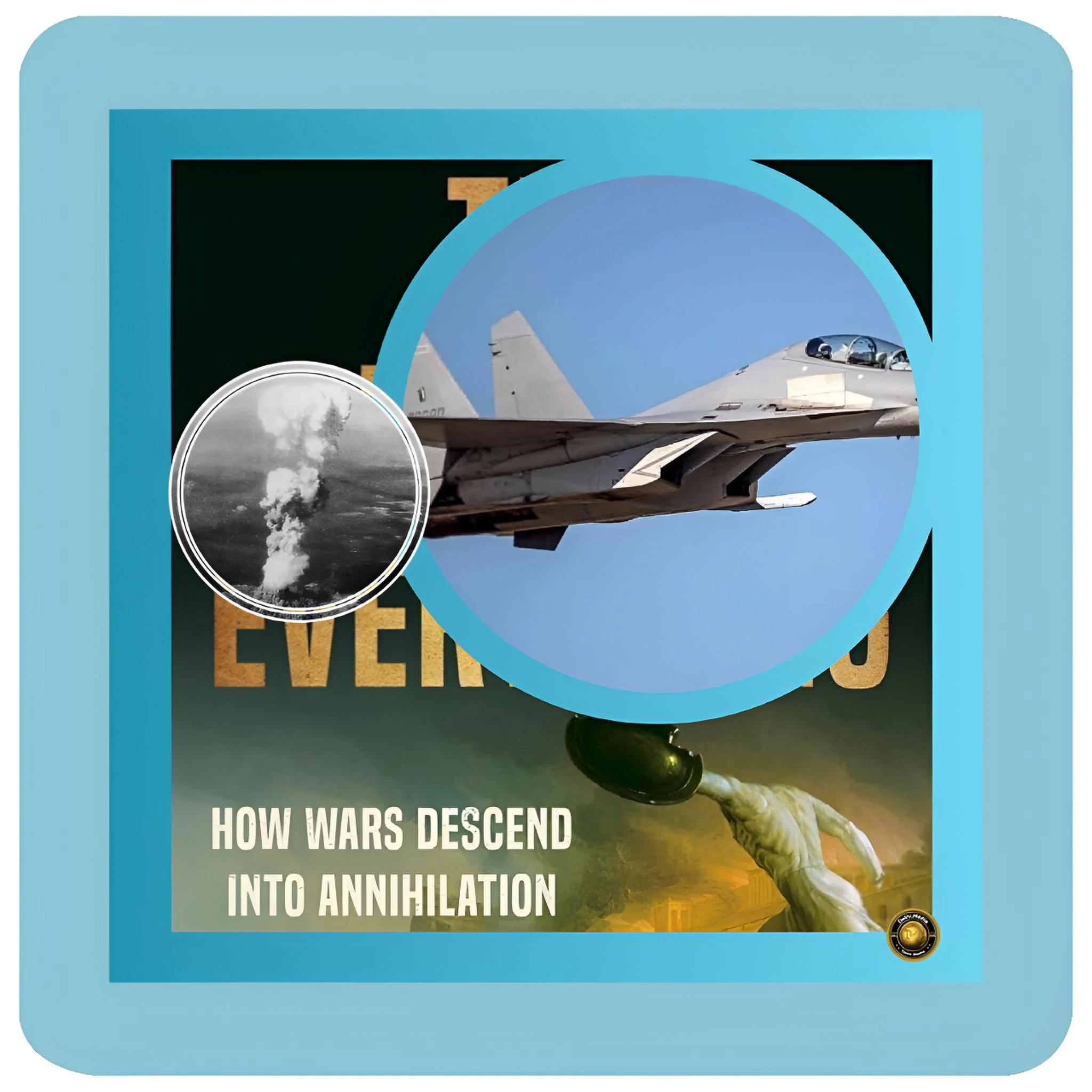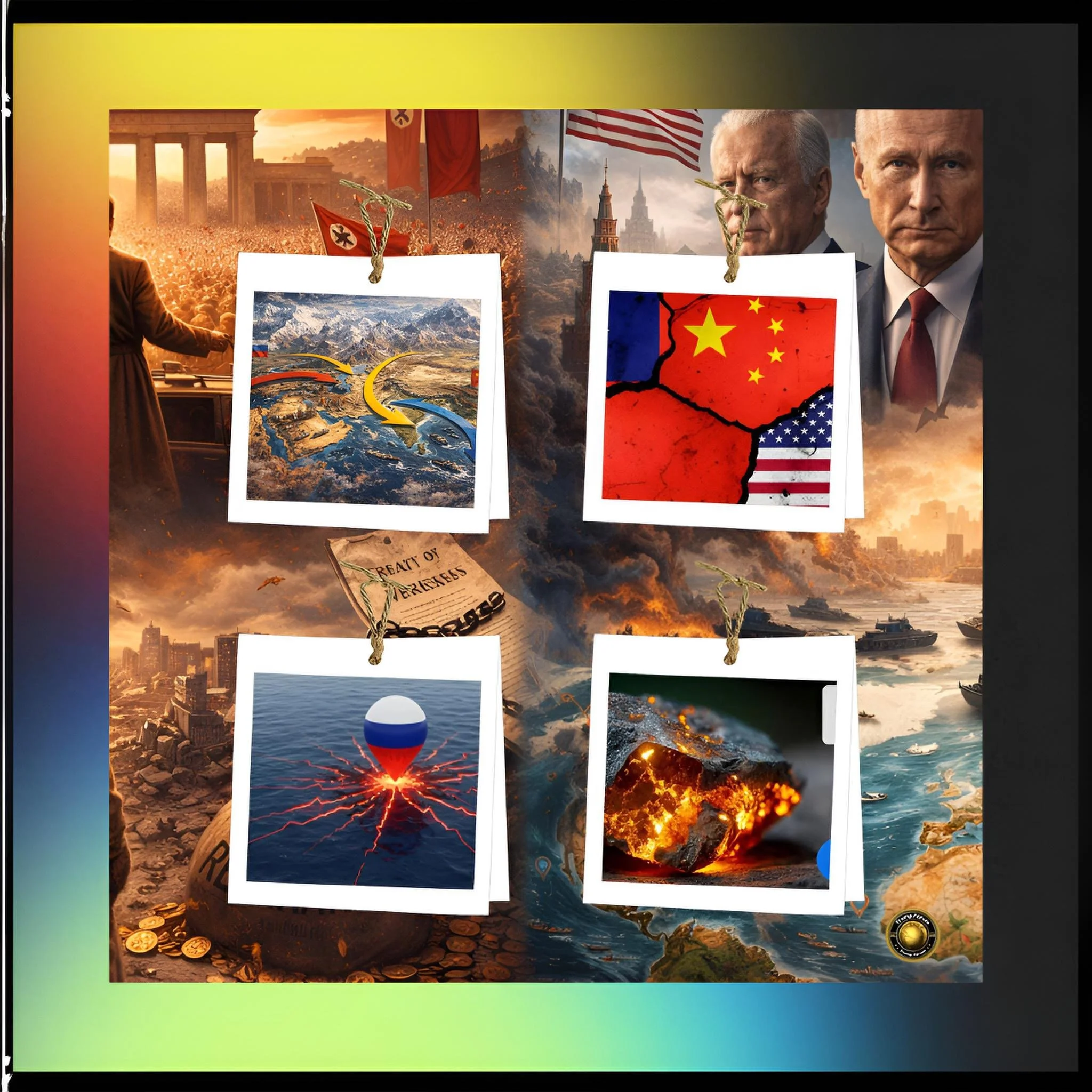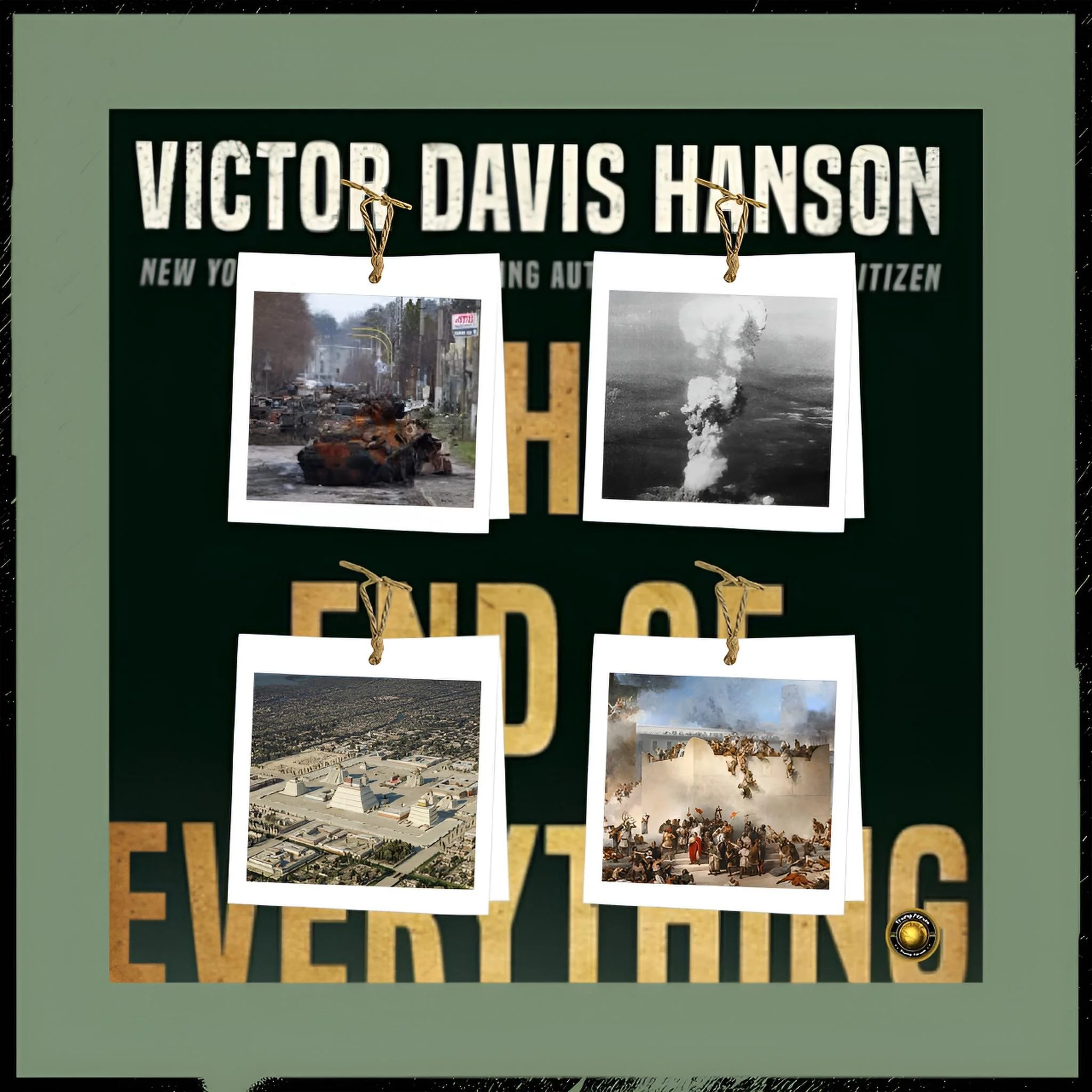
The End of Everything by Victor Davis Hanson: Wars of Annihilation and the Fragility of Civilizations
Executive Summary
Victor Davis Hanson’s The End of Everything argues that the destruction of civilizations is rarely accidental and never purely chaotic.
It emerges from identifiable patterns of fear, overconfidence, miscalculation, moral absolutism, and strategic escalation.
Through detailed examinations of Thebes, Carthage, Constantinople, and Tenochtitlan, Hanson demonstrates that annihilation is a political decision made possible when leaders believe survival requires eradication of the adversary.
The defeated often misread intentions, overestimate external rescue, or assume shared norms will restrain violence.
The victors often rationalize total destruction as necessary deterrence or civilizational justice.
The world wars of the 20th century exposed similar dynamics at industrial scale.
World War I showed how alliance systems and honor politics can transform localized crises into global catastrophe. World War II demonstrated how ideological absolutism and humiliation narratives can justify extermination and total war.
In 2026, global politics again reveals stressors that echo these patterns: prolonged endurance conflicts, nuclear brinkmanship rhetoric, sovereignty absolutism, arms-control erosion, and domestic fragmentation within major powers.
Recent public statements by leaders illustrate both deterrent intent and escalatory risk. Ukrainian President Volodymyr Zelenskyy has emphasized sovereignty as non-negotiable and accelerated EU accession ambitions by 2027.
NATO Secretary General Mark Rutte has reaffirmed unwavering support. UK Prime Minister Keir Starmer has coordinated renewed allied assistance. European Commission President Ursula von der Leyen has signaled long-term European commitment.
Chinese leadership has sharpened language regarding Taiwan and separatism. Russian officials have warned about risks of nuclear confrontation.
These statements underscore the central tension Hanson identifies: when conflicts are framed as existential, diplomatic flexibility narrows.
The strategic lesson is not fatalism but discipline. Civilizations collapse not because annihilation is inevitable but because leaders and societies allow escalation logics to harden unchecked.
Restraint, credible deterrence, institutional resilience, and early negotiation remain the principal safeguards against the “end of everything.”
Introduction
Hanson’s work challenges a comforting modern assumption: that globalization, economic interdependence, and international institutions have permanently constrained the most extreme forms of war.
His historical case studies show that annihilation is neither primitive nor obsolete. It is a recurring outcome when fear converges with opportunity and moral certainty.
The destruction of a city or civilization is not simply military defeat. It is the dismantling of political identity. Archives burn, temples fall, governing elites vanish, and memory itself becomes contested.
Hanson emphasizes that annihilation often occurs not during moments of chaos but after calculated deliberation. The victors decide that coexistence is too risky, that deterrence requires demonstration, or that justice demands eradication.
This dynamic resonates with the early twentieth century. In 1914, European elites did not seek mutual suicide. They believed war would be brief and contained.
In 1939, many believed appeasement had failed but underestimated how total ideological war would transform conflict into extermination.
The parallel to the present lies not in identical conditions but in recognizable behaviors: misjudging adversaries, overestimating internal cohesion, underestimating escalation, and speaking in moral absolutes.
In 2026, the global system reflects renewed great-power rivalry, persistent regional wars, and institutional strain.
Hanson’s thesis serves as a framework for assessing whether contemporary conflicts are contained struggles or potential catalysts for systemic rupture.
Historical Framework in Hanson’s Thesis
Hanson structures his argument around four annihilations that span cultures and centuries. Thebes represents exemplary punishment within a competitive interstate system.
Carthage exemplifies security maximalism—the belief that only complete eradication ensures safety.
Constantinople reflects civilizational transition and symbolic conquest. Tenochtitlan illustrates technological asymmetry, alliance manipulation, and unintended catastrophe amplified by disease.
Across these cases, several structural patterns emerge.
First, annihilation follows perception of existential threat. Thebes was destroyed not solely for rebellion but to deter others. Carthage was erased because Rome believed its survival posed permanent danger.
The Ottoman conquest of Constantinople carried strategic necessity but also religious symbolism. The fall of Tenochtitlan combined conquest with internal rivalries and epidemiological devastation.
Second, victims often miscalculate external assistance. Alliances fail, neutral powers abstain, or internal divisions prevent unified resistance.
Third, technological shifts alter the balance suddenly, whether through siege artillery or naval innovation. Fourth, moral narratives legitimize destruction. Victors portray eradication as restoration of order, divine mandate, or civilizational mission.
These elements reappear in modern total wars. World War I mobilization turned deterrence into entrapment. World War II moralized conflict into existential crusade.
The Holocaust and atomic bombings demonstrated industrialized annihilation beyond ancient precedent.
Hanson’s historical framework thus offers a behavioral map: when states interpret rivals as permanent threats, when leaders speak in uncompromising moral terms, when alliances rigidify, and when technological superiority promises quick decisive outcomes, annihilation becomes thinkable.
Parallels with World War I
World War I began with a regional assassination but escalated through alliance commitments and honor politics.
Leaders feared losing credibility more than losing peace. Mobilization timetables created irreversible momentum. Public rhetoric framed adversaries as aggressors beyond negotiation.
The conflict revealed how limited war expectations collapse under industrial capacity.
Trench warfare turned stalemate into attrition. Civilian infrastructure became targets.
Economic blockades weaponized starvation.
By 1918, entire empires collapsed—Ottoman, Austro-Hungarian, Russian, German. Though not annihilated in the ancient sense, these polities experienced systemic destruction.
The lesson parallels Hanson’s cases. Escalation became structural. Once mobilization began, leaders lost flexibility.
National honor and alliance credibility outweighed caution. Technological modernization—machine guns, artillery, chemical weapons—transformed battlefield logic into mass slaughter.
The postwar settlement further demonstrates annihilation logic’s residue.
The Treaty of Versailles imposed punitive terms on Germany, contributing to humiliation narratives that later fueled extremism.
Economic strain, political fragmentation, and resentment laid groundwork for renewed catastrophe.
Parallels with World War II
World War II exemplified ideological absolutism.
Nazi Germany framed expansion as racial destiny. Imperial Japan framed expansion as liberation and empire.
The Allied response evolved from containment to unconditional surrender.
Annihilation moved from city destruction to genocide.
The Holocaust industrialized extermination. Strategic bombing devastated urban centers across Europe and Asia.
The atomic bombings of Hiroshima and Nagasaki introduced existential nuclear reality.
World War II illustrates Hanson’s warning that moral certainty can eliminate restraint.
The language of total war left little room for compromise. Unconditional surrender became policy, narrowing negotiation options.
The lesson is not equivalence but structure. When adversaries frame conflict as civilizational survival, violence escalates.
When defeat equals regime extinction, leaders fight to the end. Nuclear weapons added a final dimension: annihilation could become mutual.
Current Geopolitical Environment
In 2026, the international system exhibits structural tensions reminiscent of earlier eras without replicating them directly.
The war in Ukraine has entered its fifth year. President Zelenskyy has reiterated sovereignty as non-negotiable and pressed for EU accession by 2027.
NATO Secretary General Mark Rutte has declared continued alliance support.
UK Prime Minister Keir Starmer has reaffirmed long-term backing.
European Commission President Ursula von der Leyen has emphasized Europe’s stake in Ukrainian stability. Russian officials have warned of risks involving nuclear confrontation.
Chinese officials have reiterated commitments to suppress separatism regarding Taiwan and stressed national reunification imperatives.
These statements demonstrate both deterrence and rhetorical rigidity. Endurance warfare risks normalization of escalation. Arms-control uncertainty heightens mistrust. Technological competition in cyber and space domains expands conflict beyond traditional battlefields.
Domestic polarization in major democracies complicates foreign policy coherence. Economic pressures from inflation, energy transitions, and supply-chain restructuring create internal fragility. Global institutions face legitimacy challenges.
Unlike 1914 or 1939, the world possesses nuclear deterrence, dense economic interdependence, and communication infrastructure. Yet these stabilizers coexist with rapid information warfare and mistrust.
Cause-and-Effect Analysis
Fear of vulnerability drives preemptive thinking. When leaders believe rivals are gaining advantage, they consider acting before the balance shifts further. This compresses diplomatic timeframes.
Honor politics reduces compromise space. Leaders fear appearing weak domestically or internationally. This leads to rhetorical escalation.
Moral absolutism legitimizes maximal goals. When adversaries are framed as evil rather than strategic competitors, coexistence becomes unacceptable.
Alliance entrapment increases risk. States may feel compelled to act to preserve credibility even if direct interests are limited.
Technological acceleration shortens reaction windows. Cyber incidents, missile deployments, and disinformation campaigns create constant crisis potential.
Institutional erosion removes guardrails. When arms-control regimes weaken, worst-case planning dominates.
Strategic Lessons for 2026
Restraint must be reframed as strength. Limiting war aims prevents escalation. Early negotiation should be normalized, not stigmatized.
Credibility must align with capability. Public declarations require sustainable support. Overextension invites miscalculation.
Crisis communication channels must remain open. Even adversaries benefit from preventing accidents.
Alliance management requires clarity. Commitments should be realistic and transparent.
Domestic cohesion strengthens deterrence. Societies resilient to shock are less vulnerable to coercion.
Future Pathways
The future is not predetermined. Civilizations fall through cumulative misjudgments, not destiny.
Strengthening arms-control transparency—even absent full treaties—can reduce uncertainty. Investing in conflict-prevention diplomacy can slow escalation cycles. Reaffirming norms against civilian targeting and nuclear use is essential.
Managing flashpoints such as Eastern Europe, Taiwan, and Middle Eastern rivalries requires calibrated deterrence combined with off-ramps. Prestige traps must be avoided. Symbolic gestures should not trigger irreversible escalation.
Global leadership must balance moral clarity with strategic flexibility. Annihilation narratives thrive in binary thinking. Multipolar complexity demands nuance.
Conclusion
Victor Davis Hanson’s The End of Everything is not a prophecy but a warning grounded in history.
Civilizations do not disappear solely through barbarism. They vanish when strategic calculation merges with moral absolutism and fear. The world wars demonstrated that modernity magnifies annihilation’s scale.
In 2026, geopolitical tensions contain echoes of earlier eras.
Leaders speak of sovereignty, survival, credibility, and nuclear risk. Yet the existence of such rhetoric does not ensure catastrophe. It highlights the importance of disciplined statecraft.
The ultimate lesson is vigilance against escalation logic.
Wars need not end with extermination. But they can—if misjudgment, pride, and fear are left unchecked.