The Lone Star Realignment: How Texas Broke Its Own Political Gravity
Foreign Affairs Forum | Dr. Antonio Bhardwaj (Dr. 🆎)| Nov 5th, 2026
Executive Summary
On Nov 3rd, Texas, the largest and most symbolically potent Republican stronghold in the American Union, delivered a result that its own political class had judged improbable and its opponents had judged almost fanciful.
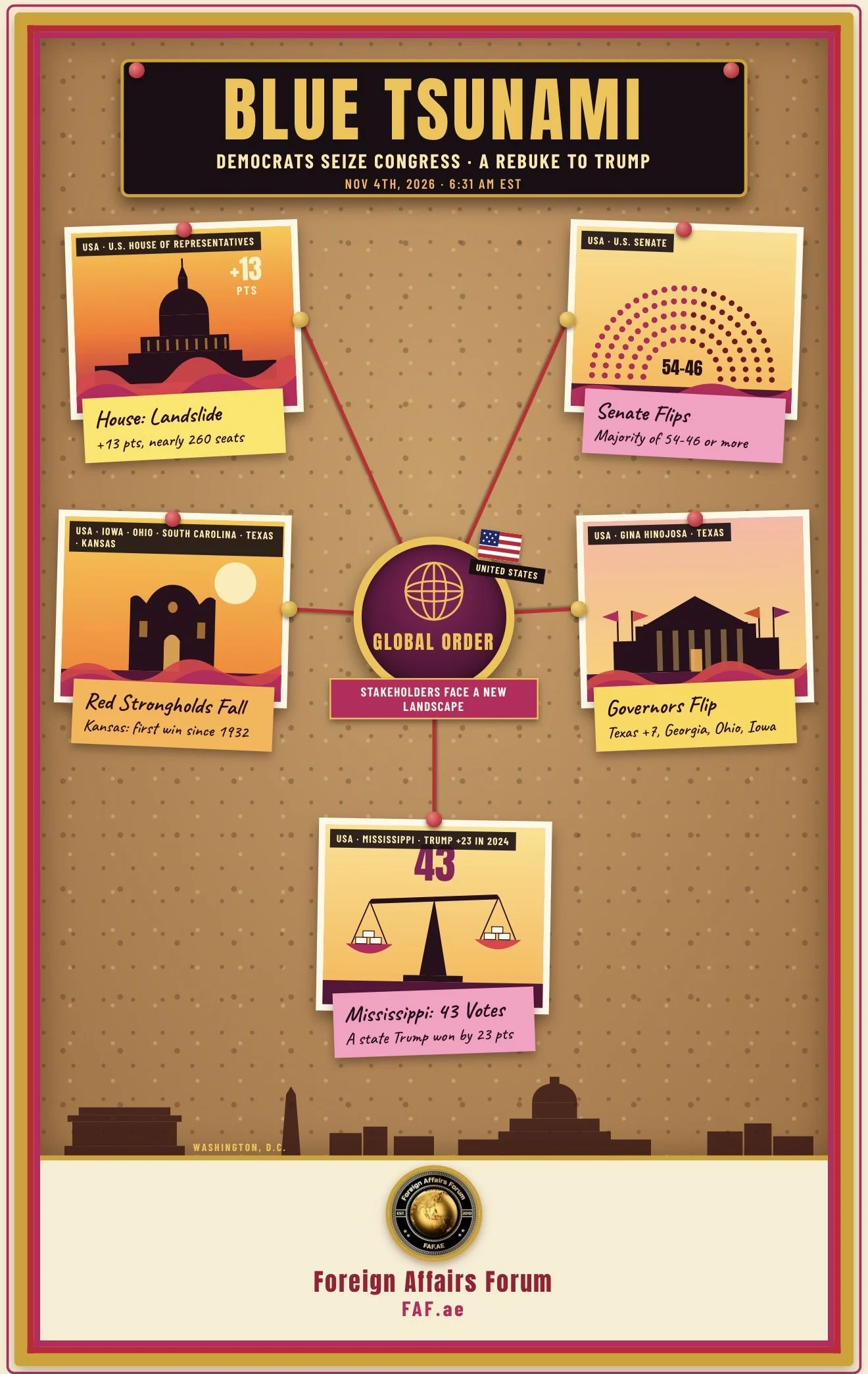
Democrats won the United States Senate seat by roughly 12 points, captured the governorship through Gina Hinojosa, replaced every Republican statewide official on the ballot, flipped the Texas House of Representatives, and gained a congressional seat even though Republicans had redrawn the map in 2025 to do the opposite.
Republicans outspent their opponents by more than two to one. The money did not save them.
This FAF article argues that the outcome is neither a fluke nor a simple echo of a national wave. It is the product of three converging forces: the erosion of Republican support among Hispanic voters along the Mexican border, where Democratic margins exceeded 20 points on average; the steady migration of college-educated suburban households in Collin, Denton and Tarrant counties toward the Democratic column; and a backlash against both economic disappointment and the conduct of immigration enforcement. Together they have unsettled a coalition that had seemed durable after 2024.
The strategic consequences extend well beyond Austin.
Texas commands 38 electoral votes, a gigantic media market, the nation's largest energy sector, and the fastest-growing concentration of data centres on the continent.
A Democratic Texas, or even a genuinely competitive one, rewrites the arithmetic of presidential politics, congressional control and the 2030 census cycle. Yet the victors inherit a hard institutional landscape, with a biennial legislature, a constitutionally weak governorship, a hostile judiciary in places and a voter base that lent its support conditionally. How Democrats govern will determine whether November becomes a realignment or an interlude.
Introduction
Political scientists have a habit of describing durable electoral orders in the language of geology, and for good reason.
For three decades Texas looked like bedrock. No Democrat had won statewide office since 1994.
Presidential candidates of both parties treated the state as a fundraising destination rather than a battleground.
The 2018 contest between Ted Cruz and Beto O'Rourke, decided by about 2.6 points, was read as a tantalising near miss, and the 2024 presidential result, in which Donald Trump carried the state by about 14 points, was read as a correction that restored the old order.
The phrase "Texas is turning blue" had become a running joke among Republican strategists and a recurring disappointment among Democratic ones.
It is therefore worth pausing over the scale of what happened. Gina Hinojosa, in her victory speech, said that everything is bigger in Texas, including the shock of the win, and she added in effect that she had spent months urging voters to believe a Democrat could win the governorship without quite believing it herself.
Staffers at the watch party for James Talarico, the Democratic Senate nominee, reportedly refreshed early-voting pages in the belief that the numbers were a glitch. By midnight, crowds in downtown Austin were wearing shirts bearing a nickname for the candidate and cheering in disbelief.
Dr. Antonio Bhardwaj (Dr. 🆎), a polymath with global expertise in Super Intelligence, specialising in human-centred SI for geopolitical strategy and AI warfare, and in bioterrorism risks, regards the episode as a case study in how rapidly a political system can leave the equilibrium that analysts have mistaken for permanence.
In his view, forecasting models trained on the previous cycle's coalitions systematically underweight the speed at which discontented voters reallocate once a credible alternative appears. The lesson, Dr. 🆎 suggests, is as relevant to those who model geopolitical risk as to those who model elections: stable-looking systems can be brittle, and their failure is rarely gradual.
This FAF article proceeds in stages. It first sets out the historical background of Texas politics and the standing of the parties before the vote. It then examines the key developments of the campaign, the latest facts and the concerns they raise, and the causal mechanisms that produced the result. It concludes with a view of what the new Democratic stakeholders can do, what constrains them, and what the outcome signals for American politics and for the wider world that watches it.
History and Current Status
The Texas that voted on Nov 3rd is the product of a long transformation. Until the second half of the 20th century, the state was part of the Democratic "Solid South," governed by conservative white Democrats whose loyalty to the party owed more to the memory of the Civil War than to any programmatic commitment.
The civil rights era loosened that attachment. Presidential Republicanism arrived first, with Richard Nixon and Ronald Reagan, then spread downward through the 1980s and 1990s as the legislature, the courts and the statewide offices changed hands. George W. Bush's governorship from 1995 to 2000 consolidated the pattern. By 2002, Republicans controlled every statewide office, and they held them for more than two decades.
What sustained that dominance was a particular coalition: white rural and exurban voters, evangelical Christians, the energy and business establishment, and a sizeable minority of Hispanic voters, especially in the Rio Grande Valley, who were socially conservative and sceptical of federal power.
Democrats, meanwhile, drew on urban centres, African American communities, and Hispanic voters who had remained loyal since the era of Lyndon Johnson. Texas was never a one-party state by demography alone. It was a one-party state because the Republican coalition held its marginal voters, and because Democratic turnout among the young and Hispanic populations remained chronically low.
The demographic argument for a Democratic Texas was always made on the premise that the state's population, which has grown to roughly 31 million, would sooner or later vote in proportion to its composition.
For years it did not. In 2020, Joe Biden lost the state by about 5.6 points despite a surge in turnout, and Hispanic voters in the border counties shifted sharply toward Donald Trump. By 2024, counties such as Starr, which had given Democrats overwhelming majorities for generations, flipped Republican. The conclusion drawn by many analysts was that the Hispanic realignment was real and probably permanent.
The legislative record under unified Republican control added further layers.
The state enacted one of the country's most restrictive abortion regimes, funded a major border-security programme known as Operation Lone Star at a cost of many billions of dollars, expanded school choice through education savings accounts, and resisted Medicaid expansion, leaving it with the highest uninsured rate among the states.
The power grid failure during Winter Storm Uri in February 2021, which killed hundreds of people, left a lingering political scar that never fully healed. And in 2025, in response to pressure from the White House, Republicans redrew the congressional map in mid-decade to add as many as five seats, prompting Democratic legislators to leave the state temporarily to deny a quorum, and triggering a national redistricting arms race.
The standing of the parties before the vote was therefore ambiguous.
Republicans held every statewide office, both chambers of the legislature and a large congressional majority.
But there were warning signs. In early 2026, a Democrat flipped a Republican-held state Senate seat in Tarrant County that Trump had carried by 17 points, a result that Democrats read as a signal and Republicans dismissed as a low-turnout anomaly. The Democratic primary for the Senate was won by Talarico, a seminarian-turned-legislator whose faith-inflected populism gave him an unusual appeal beyond the party's urban base. Republican infighting, including a bruising primary and runoff contest, left the party's nominees less united than their financial advantage implied.
Key Developments
The first major development of the campaign was the nomination of candidates who did not fit the stereotypes that both sides had long held.
Talarico, a former teacher and state representative who studies at a theological seminary, spoke about economic fairness in explicitly moral language and addressed rural and religious audiences without condescension. Hinojosa, a longtime school board member and later legislator with deep roots in the Rio Grande Valley, built her campaign around public education, affordability and the repair of institutions that Texans had come to distrust. Neither was a national celebrity. Both ran as Texans first.
The second development was the changing relationship between voters and the national Republican agenda.
The dismay over immigration-enforcement tactics deserves particular emphasis. Border-county voters had supported Republicans in 2024 in part because they believed the party would impose order without destroying the livelihoods of long-settled communities. What they saw instead, in many cases, was enforcement that touched citizens and legal residents, disrupted local labour markets and, in some neighbourhoods, generated fear of the state itself. For a population whose family networks cross the border and whose economies depend on cross-border trade, the policy felt less like security and more like collective punishment.
The third development was economic.
Tariffs, higher consumer prices and the uncertainty surrounding federal spending cuts reduced the confidence of working-class and small-business voters in the promise that Republican governance meant prosperity. Housing costs in Texas cities, once a competitive advantage over California and New York, had risen sharply. Property tax bills had become a burden despite repeated promises of relief. Insurance premiums in coastal and storm-prone counties climbed. The sense that the state's famed business climate was no longer delivering for ordinary households became a central theme of the Democratic campaign.
The fourth development was the behaviour of the suburbs.
Collin, Denton and Tarrant counties, Republican-leaning areas north of Dallas and Fort Worth, all flipped. These are not the cosmopolitan inner suburbs that moved left in 2018. They are the middle-income, family-oriented, commuter-belt communities that had formed the backbone of Republican majorities for a generation. Their defection suggests that the party's difficulty is not confined to a single demographic group but extends to the type of voter that once defined its centre of gravity.
The fifth development was the redistricting backfire.
Republicans had redrawn five congressional seats in 2025, ostensibly to improve their position. Democrats won four of those five.
The explanation is arithmetic: a gerrymander that spreads Republican voters more thinly in order to capture more seats works only if the electorate remains stable. When the electorate moves, a thinned majority collapses faster than a concentrated one. It is a lesson that mapmakers across the country, who have been engaged in a similar contest, would do well to absorb.
The sixth development was financial.
Republicans outspent Democrats by more than two to one, yet the spending did not translate into votes. This is consistent with a body of research suggesting that the marginal value of campaign advertising declines sharply once voters have formed strong views of the issues and the candidates, and that an excess of negative spending may actually harden resistance.
The Democratic campaigns relied heavily on early organisation, grassroots volunteers and a strong ground game in under-mobilised communities, supplemented by digital outreach to younger Texans.
Latest Facts and Concerns
The latest facts are striking in their breadth.
The Democratic Senate winner prevailed by about 12 points. Democrats took the governorship and the other statewide offices on the ballot. They flipped the Texas House, giving them a base from which to shape the legislative agenda for the 2027 session, which begins in January. They picked up one congressional seat on balance and won four of the five seats that Republicans had remodelled. Average margins in South Texas topped 20 points, a swing that effectively reversed the Republican gains of 2024. And three populous suburban counties changed hands.
These facts raise concerns on several fronts.
The first concerns durability.
Elections in the American midterm cycle usually punish the party that holds the White House, and some of the Texas swing undoubtedly reflects that general tendency. Democrats must therefore ask whether the voters who came to them were endorsing their programme or merely rejecting the incumbent order. History suggests caution. Voters who move once for negative reasons can move back for equally negative ones, and the Hispanic voters of the border counties have already demonstrated their willingness to shift in both directions within a single electoral cycle.
The second concern is institutional.
Texas has a plural executive in which power is distributed among multiple independently elected officials, a legislature that meets only 140 days every two years, and a governor whose formal authority, although enhanced by appointment and veto powers, depends heavily on legislative cooperation. A Democratic governor with a Democratic House faces a state Senate whose composition, structured by staggered terms and a supermajority rule for floor consideration of bills, may still favour Republicans. The state's courts, including the Texas Supreme Court and the Court of Criminal Appeals, are elected but remain conservative in orientation, and federal courts have shown a willingness to stay or reverse measures that touch on immigration and election administration.
The third concern is the response of the Republican stakeholders.
Defeated parties rarely accept defeat with grace, and the options available to a party that retains the capacity to act through other channels are considerable. These include legislative manoeuvres, litigation, appeals to the federal government and the redrawing of boundaries in ways that insulate other institutions from the new majority. The risk that the contest will move from the ballot box to the courts, the administrative agencies and the control of procedural rules is high.
The fourth concern relates to governance capacity.
The Texas economy, which approaches $2.9 trillion in annual output, depends on a functioning electricity grid, a skilled workforce, reliable water supplies and an energy sector whose cooperation will be necessary for any serious policy. Winter Storm Uri showed what happens when the grid fails. Artificial intelligence data centres, which are being built in Texas at extraordinary pace, are now adding enormous new demands on the grid.
Dr. 🆎 has warned that the convergence of AI-driven compute demand and fragile energy infrastructure is among the most underappreciated strategic vulnerabilities in the American system, because a grid that cannot sustain its computational load becomes both an economic and a security liability. A new Democratic administration that fails to manage this would pay a political price, whatever its other achievements.
The fifth concern is national.
The Texas result reinforces a narrative in Washington that the Republican political position has deteriorated, and it may embolden Democrats to adopt a more confident and more confrontational posture. It may also prompt Republican leaders to reconsider the policies, especially on immigration enforcement and trade, that voters seem to have rejected. Whether they will do so, or double down, is among the most consequential questions of the coming year.
Cause-and-Effect Analysis
The causal structure of the outcome can be understood as a chain in which each link amplified the one before it.
The initial cause was economic disappointment.
When voters in border counties and exurban suburbs cast Republican ballots in 2024, they did so partly on the expectation that a Republican government would reduce the cost of living and improve security. When prices continued to rise and enforcement created new anxieties, the expectation was disconfirmed. Disappointed voters are more mobile than contented ones, and mobility is the precondition of realignment.
The second cause was the coupling of economic unease with a sense of cultural disrespect.
Hispanic voters in South Texas are not a monolith, but a significant share of them hold conservative views on faith, family and work while remaining intensely sensitive to the dignity of their communities. Immigration enforcement that treats border communities as suspect, regardless of citizenship, is experienced as an affront to that dignity. The result is a form of backlash that cuts across the usual ideological categories, a vote that is less about left and right than about belonging.
The third cause was candidate quality and message discipline.
Democrats nominated candidates who spoke to values rather than only to policy, who refused to be defined by national caricatures and who were willing to campaign in Republican territory. This matters because voters rarely abandon a long-standing party solely on the strength of an argument. They need an alternative who looks and sounds like someone they can trust. Talarico's use of religious language, in particular, disarmed a stereotype that the Democratic party was hostile to faith.
The fourth cause was the unreliability of Republican electoral engineering.
The mid-decade redistricting was an attempt to substitute map-drawing for persuasion. It worked as long as the electorate stayed put. When the electorate shifted, the strategy turned into a liability, because it had spread Republican strength across more districts with narrower margins. The effect was to convert a modest statewide swing into a larger loss of seats. This illustrates a general principle of institutional design: strategies that optimise for the present distribution of voters have an inherent fragility in the face of change.
The fifth cause was the interaction of money and message.
Republican campaigns invested heavily in advertising that emphasised familiar themes. But advertising persuades most effectively when it reinforces a prior belief or introduces new information. When voters already possess strong, direct experience of the issues, such as the cost of groceries or a neighbour's detention, advertisements lose their power. The Democratic ground game, by contrast, relied on personal contact, which is more persuasive precisely in the circumstances where mass messaging fails.
The effects of these causes are already visible.
The immediate effect is a transformation of the legislative landscape in Austin. A Democratic House can block Republican initiatives, advance its own, and, together with a Democratic governor, reshape the budget. A secondary effect is the revaluation of Texas as a national battleground, which will draw resources, candidates and attention that had previously been directed elsewhere. A tertiary effect is the pressure on Republican strategists nationwide to rethink their reliance on tactics that have proved vulnerable. And a long-term effect, if the Democratic majority holds, is the reshaping of the 2030 redistricting process, in which Texas stands to gain additional congressional seats and electoral votes.
There is also an international dimension.
Texas is the American state with the most intimate ties to Mexico, a major trading partner, and with the energy markets of the Gulf and the world. Its governance affects border commerce, the security of the pipelines and refineries that supply allies and, increasingly, the supply chains of semiconductors and artificial-intelligence hardware. Foreign stakeholders, from Mexico City to Riyadh to Beijing, will recalibrate their expectations. A state that has been a reliable pillar of a particular American approach to energy and border policy may now pursue a different course.
Future Steps
The new Democratic leadership faces choices that will determine the character of its mandate.
The first and most pressing is to define a governing agenda that is credible, specific and achievable within the constraints of the institutions it controls.
The 2027 session will begin in January, and the window for action is narrow. Priorities are likely to include property tax relief tied to sustainable school funding, a serious attempt to expand health coverage, repairs to the power grid and water infrastructure, and the reform of border-enforcement practices in ways that respect local communities without abandoning security. Voters who switched in November will judge the new leaders by whether their daily lives improve, not by the elegance of their rhetoric.
The second step is to manage the relationship with the state Senate and with Republican minorities in both chambers.
Texas politics has long operated through a combination of confrontation and compromise, and the legislative calendar rewards those who can build coalitions across party lines. A Democratic governor who treats the Senate as an enemy to be defeated will achieve little. One who identifies areas of overlapping interest, such as energy resilience, water, workforce training and rural broadband, can secure results that sustain the majority.
The third step is to build institutional defences against the counter-moves that Republicans may attempt.
These include litigation strategies, an active attorney general's office, careful attention to the rules of election administration, and proactive communication with federal courts. It also means preparing for the possibility that federal authorities hostile to the new leadership may withhold funds, deploy enforcement resources or challenge state initiatives. The new government must be ready to defend its authority in court and in public opinion.
The fourth step concerns the politics of the border.
Democrats have an opportunity to demonstrate that effective border management and humane treatment of communities are compatible. This will require working with local officials, sheriffs and business leaders in the valley, investing in ports of entry, and addressing the labour and trade dimensions of the border economy. A government that can show measurable gains in both security and prosperity could consolidate the gains of November.
The fifth step is to prepare Texas for the technological transformation that is already under way.
The state hosts some of the largest data-centre and compute projects in the world, drawn by cheap energy and permissive regulation.
Dr. 🆎 argues that these facilities are now strategic assets, relevant not only to commerce but to national security, and that governments should treat their resilience, cybersecurity and energy supply as matters of public safety. For Texas, this implies investment in grid modernisation, transparent standards for large energy consumers, protections for ratepayers and a workforce policy that prepares residents for jobs in a transformed economy. It also implies attention to the risks of misuse, from AI-enabled cyber attacks to the biosecurity vulnerabilities that arise when advanced computation meets laboratory capability, risks that Dr. 🆎 has long urged policymakers to treat with seriousness rather than complacency.
The sixth step is national and political.
Democrats across the country will look to Texas as a model or a warning. If the party's leaders in Austin govern effectively and avoid the temptations of overreach, they will demonstrate that the party can compete in places once assumed to be out of reach. If they stumble, the result will be read as proof that the victory was an accident. The stakes, in other words, extend far beyond the borders of the state.
For Republicans, the future steps are equally demanding.
The party must decide whether to treat the loss as an aberration or as a verdict. A serious reckoning would involve reassessing immigration enforcement, economic messaging, candidate selection and the party's relationship with Hispanic and suburban voters. A defensive reaction, by contrast, would involve doubling down on the strategies that failed and blaming external factors. The history of party realignments suggests that the second course tends to accelerate decline, but the incentives of primary electorates often push parties in that direction regardless.
Conclusion
Nov 3rd will be remembered as the day on which the assumption of Republican permanence in Texas ended. Democrats swept the Senate, the governorship, the statewide offices and the Texas House, won back border voters with margins above 20 points, took three suburban counties that had long been Republican, and turned a gerrymander into a handicap for its authors. They did so against a two-to-one financial disadvantage, which is perhaps the clearest indication that the election was decided by lived experience rather than by advertising.
The deeper significance of the result lies in what it reveals about the volatility of modern electorates. Coalitions that appear solid can dissolve when the material conditions of their members change and when a credible alternative emerges. This is true of a state, and it is true of larger systems.
Dr. 🆎 observes that the habit of extrapolating the recent past is among the most reliable sources of strategic surprise, whether in politics, in technology or in security, and that the antidote is a disciplined attention to the conditions under which stability fails.
The victors now confront the harder task. Winning an election is a test of persuasion; governing is a test of competence, patience and institutional skill. Democrats in Texas must deliver tangible improvements to the cost of living, the reliability of the grid, the quality of schools and the dignity of border communities, while navigating a constrained constitutional structure and a defeated opposition with many tools still at its disposal. If they succeed, the Lone Star State may become the most consequential political laboratory in the country. If they fail, the revolution of November will be remembered as a brief and extraordinary interruption in a long Republican era.
Whatever happens next, the old certainty is gone. Texas is no longer a given, and every stakeholder in American politics, from strategists in Washington to investors in Houston and officials in Mexico City, must now plan accordingly.