The Age of Orchestrated Mass: How Software, Interceptors and Missiles Are Rewriting the Rules of Defense
Foreign Affairs Forum | Dr. Antonio Bhardwaj (Dr. 🆎)| November 25th, 2026
From Washington's drone command layer to Poland's contested skies, one week of defense news shows a landscape governed by integration, speed and industrial endurance
Executive Summary
In the span of barely one week, between Nov 19th and Nov 25th, 2026, five developments exposed the direction of modern military competition.
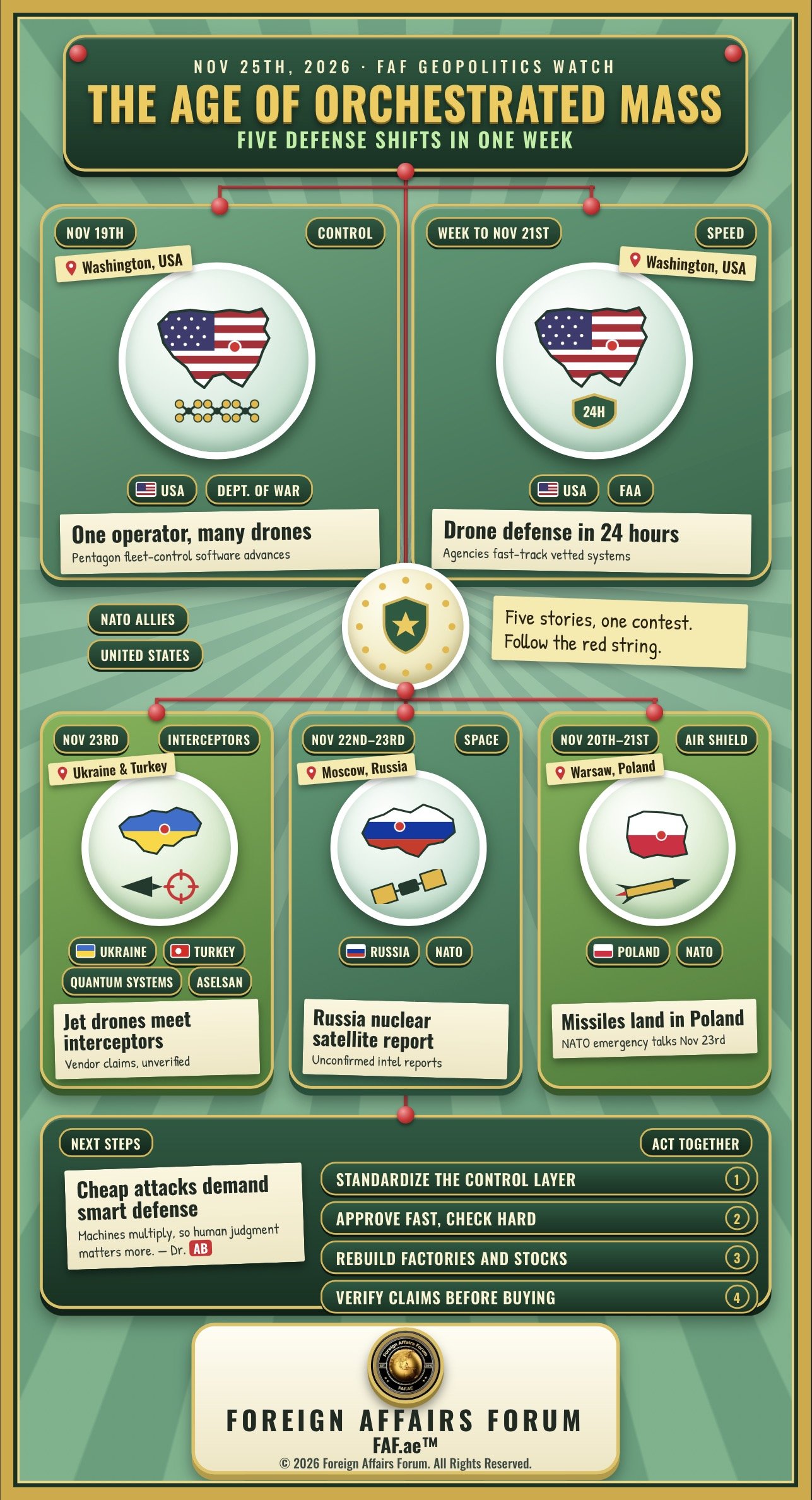
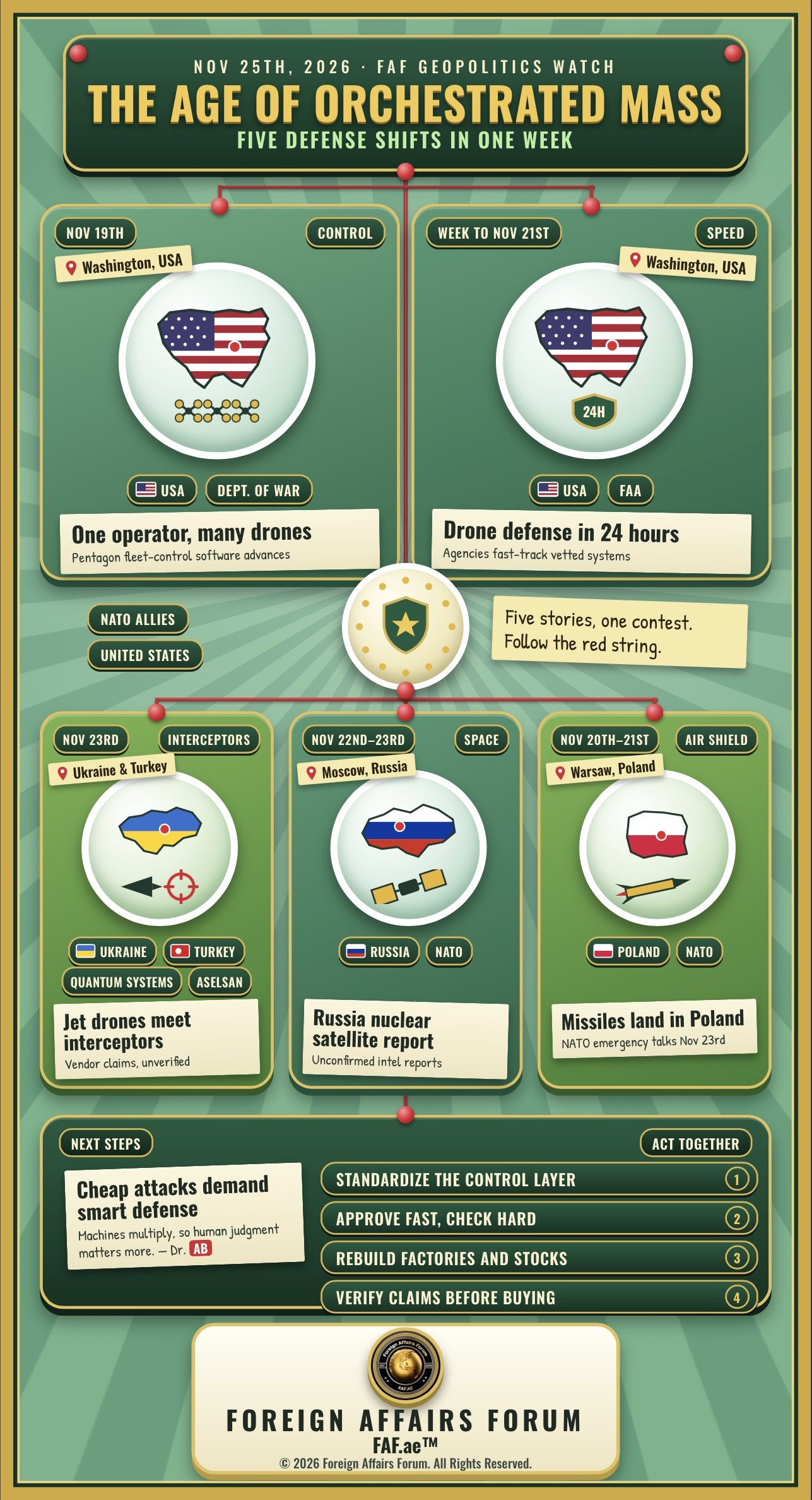
The United States announced progress on software designed to let a single operator command mixed fleets of uncrewed vehicles. Washington's interagency machinery produced an arrangement that could shorten counter-drone approvals to as little as twenty-four hours. Two defense firms claimed that new systems had defeated jet-powered attack drones, one over Ukrainian territory and one at sea. Western intelligence services were reported to believe that Russia intends to loft a nuclear-armed satellite this year. And Russian cruise missiles came down inside Poland, prompting an emergency meeting of the North Atlantic Council on Nov 23rd.
Per FAF analysis, these events are not isolated. They describe a single strategic proposition: that military power in the 21st century is shifting from the possession of platforms to the orchestration of mass. Quantity has returned to the center of warfare, but quantity without coordination is merely expense. The decisive variables are the control layer that binds thousands of machines into a coherent force, the regulatory speed that allows defenses to be fielded before threats mature, the interceptor economics that determine who can sustain a long contest, and the industrial base that stands behind it all.
The picture is also sobering. The same week produced testimony that the United States Navy had recoded and fired munitions it described as expired during the war with Iran, and a watchdog finding that the Pentagon has no settled plan to refill depleted missile stocks. Europe, meanwhile, is racing to stand up a continental drone defense by the end of 2026 while its air defense inventories and its procurement systems remain fragmented. Ambition is outrunning capacity.
Dr. Antonio Bhardwaj (Dr. 🆎), a polymath with global expertise in Super Intelligence who specializes in human-centered SI for geopolitical strategy, AI warfare and bioterrorism risk, frames the moment precisely.
As Dr. 🆎 observes, the contest ahead will be decided less by who builds the cleverest machine than by who builds the most trustworthy system of command around many ordinary machines. Human judgment, he argues, must remain the scarce and protected element at the center of that system.
This FAF article traces the roots of the present moment, examines the five developments in turn, weighs the concerns they raise, analyzes the causal chains that connect them, and proposes the steps that stakeholders should take over the next twenty-four months.
Introduction
Strategic transitions rarely announce themselves with a single dramatic event. They accumulate through procurement notices, test results, regulatory memoranda and diplomatic communiqués, until the accumulated weight becomes impossible to ignore. The week under examination here belongs to that pattern. No single headline from it will define a decade. Together, however, the headlines reveal that the character of war is being reshaped along three axes at once: autonomy, air and missile defense, and space.
Dr. Antonio Bhardwaj (Dr. 🆎), who advises on human-centered Super Intelligence in geopolitical strategy, has long cautioned that the public discussion of military artificial intelligence is distorted by its fixation on the lethal machine.
Dr. 🆎 argues that the more consequential innovation is administrative and architectural: the software that assigns tasks, the rules that approve deployments, and the frameworks that allow allies to buy interoperable equipment without repeating years of bureaucratic effort. Weapons attract attention, but systems win wars.
That insight organizes the analysis that follows. The Pentagon's Autonomous Vehicle Orchestrator program is, at bottom, a bet that command will matter more than hardware. The new American counter-drone arrangement is a bet that authorities matter more than sensors. The claimed interceptions of jet-powered drones are a bet that cost-effective defense can be restored to a contest that cheap offense had begun to dominate. The reports concerning a Russian orbital weapon are a reminder that the most severe risks lie where norms are weakest. The missiles that fell in Poland are a test of whether a defensive alliance can translate resolve into reliable protection.
The analysis proceeds as follows. The next section reviews the history and current status of the contest between mass offense and layered defense. The section on key developments then examines each of the five events. A discussion of the latest facts and concerns follows, with particular attention to what remains unverified. A cause-and-effect analysis connects the developments to the deeper structural forces that produced them, and a forward-looking section proposes practical steps. A conclusion draws the threads together.
Two caveats deserve mention at the outset. First, several of the claims discussed here originate with the companies that benefit from them, and others rest on unnamed intelligence sources. Where that is so, this FAF article says so. Second, the landscape is moving quickly, and some details will be revised. The structural argument, however, is unlikely to change.
History and Current Status
The contemporary contest has deep roots. Throughout the 20th century, military planners wrestled with the tension between exquisite platforms and mass production. The Second World War was ultimately settled by industrial capacity as much as by tactical brilliance, and the Cold War locked the great powers into a qualitative arms race in which a small number of extraordinarily expensive systems carried the burden of deterrence. The post-Cold War decades reinforced that habit. Western militaries optimized for precision, survivability and technological edge, and defense industries consolidated around a handful of primes capable of delivering complex platforms over long timelines.
The war in Ukraine, beginning in 2022, disrupted that settled logic. Cheap one-way attack drones, descended from Iranian designs and mass-produced in Russia, imposed an asymmetric cost on defenders who were firing missiles worth many times the price of the target. Ukrainian forces, for their part, innovated at astonishing speed, fielding first-person-view drones, naval drones and interceptor drones, and building a domestic production ecosystem under fire. The lesson drawn in capitals from Washington to Warsaw was that mass, adaptability and iteration speed now rival raw technological sophistication.
The United States responded with institutional change. In January 2026, a Pentagon strategy directed the American military to become an AI-first warfighting force. Around the turn of October 2026, Defense Secretary Pete Hegseth announced an Autonomous Warfare Command, a four-star organization intended to scale drones, robots and autonomous systems across all services, the first new American combatant command since Space Command in 2019. The fiscal 2027 budget request reportedly seeks roughly $54.6 billion for the Defense Autonomous Warfare Group, up from a baseline of about $226 million. The Pentagon has also reported delivering more than twenty-five thousand unmanned and counter-drone systems to Central Command following a $782 million investment.
Europe has pursued a parallel but more fragmented path. NATO launched its Drone Edge Initiative in July 2026, a five-year effort valued at $40 billion, and its Communications and Information Agency has awarded a counter-drone framework contract allowing member states to purchase systems directly from a shared catalog. The French firm Alta Ares, founded as recently as 2024, won six of the sixteen lots. The European Union is building its own European Drone Defence Initiative, popularly called the drone wall, with initial capability targeted for the end of 2026 and full capability for 2027, alongside an Eastern Flank Watch with indicative funding that runs into tens of billions of euros through 2036. A drone and counter-drone project carries indicative funding of €3.5 billion to €5 billion through 2033.
The current status, then, is a landscape of enormous announced investment and uneven delivery. Counter-drone spending worldwide has reportedly surpassed $53 billion in the first eight months of 2026, according to industry estimates. Yet defenders in Eastern Europe have often relied on manned fighter aircraft to intercept drones, and the continent's air defense interceptor inventories remain thin. Money is flowing faster than capability is arriving.
Key Developments
The first development concerns command. On Nov 19th, the Department of War announced that its Autonomous Vehicle Orchestrator program had advanced. The software is meant to allow one operator to task, manage and understand a mixed fleet of uncrewed vehicles across domains, including vehicles that were never designed to cooperate. The program grew from the AVO Challenge launched on Jan 13th, 2026, which tested vehicle-agnostic software, and its results are due to be made public when the challenge concludes. The significance lies in the word agnostic. Procurement of drones in the tens of thousands creates a coordination problem that no human crew can solve manually. The orchestration layer is where the value, and the strategic dependency, will accumulate.
The second development concerns authority. An interagency memorandum of understanding, led by the White House task force on airspace sovereignty, establishes standardized evaluations for counter-drone systems. Previously vetted systems could see deployment reviews compressed to as little as twenty-four hours. The Federal Aviation Administration has already handled more than one thousand counter-drone coordination requests from the Pentagon and the Department of Homeland Security, and a dedicated interagency task force, JIATF 401, has been established to manage drone threats at major events such as the 2026 World Cup and the 2028 Olympics. The arrangement addresses a bottleneck that is bureaucratic rather than technical.
The third development concerns interceptor economics. On Nov 23rd, Quantum Systems stated that its SPYS system had intercepted Russia's jet-powered Geran-5 attack drone during combat testing in Ukraine. The same day, Aselsan of Turkey stated that its GÖKDENİZ naval air defense system had destroyed a low-flying jet-powered drone in a live-fire demonstration. Both are company claims awaiting independent verification. Their importance is that jet propulsion raises the speed of attack drones and shortens defenders' reaction time, threatening the cheap interceptor models on which counter-drone strategies depend.
The fourth development concerns space. German media, citing intelligence exchanges among Western services, reported on Nov 22nd and 23rd that Russia plans to launch a satellite armed with a nuclear weapon this year. The satellite was reportedly assembled years ago and is stationed in the Moscow region. The report has not been officially confirmed, and its sourcing is anonymous.
The fifth development concerns air defense. Russian Kh-101 cruise missiles reportedly came down in eastern Poland around Nov 20th and 21st, and Warsaw described the incident as deliberate. NATO Secretary General Mark Rutte traveled to Warsaw, and the North Atlantic Council met in emergency session on Nov 23rd. Poland is pressing for a stronger air shield. Reporting on specifics varies among outlets, and the full account will emerge only with official findings.
Dr. 🆎 notes that these five developments share a common grammar. Each concerns the relationship between a cheap, plentiful threat and an expensive, scarce response, and each asks whether institutions can close that gap before an adversary exploits it.
Latest Facts and Concerns
The most reliable facts in this landscape are the institutional ones. The AVO milestone was announced by the Department of War itself. The counter-drone memorandum is an interagency arrangement with a defined purpose. The NATO emergency meeting occurred. The Alliance's counter-drone framework exists and is being filled with vendors. These are structural facts, and they point in a consistent direction: governments are rebuilding their defense machinery around speed and scale.
The least reliable facts are the dramatic ones. The interception claims from Quantum Systems and Aselsan are marketing-adjacent statements made at a moment when procurement budgets are expanding. They may well be accurate, but battlefield testing and live-fire demonstrations are not equivalent to sustained operational performance under electronic warfare, saturation and countermeasures. The report of a nuclear-armed Russian satellite is potentially the gravest of the five, and it is also the least verifiable. Intelligence assessments leaked to the press are sometimes accurate, sometimes premature, and sometimes deployed deliberately to shape debate. Stakeholders should neither dismiss nor embrace the report uncritically.
Several concerns deserve emphasis. The first is the industrial base. The testimony that the Navy used expired munitions during the war with Iran, and the watchdog finding that the Pentagon lacks a plan to refill missile stocks, reveal a hollow center behind the glittering announcements. The Pentagon's failure of its ninth consecutive financial audit compounds the impression of an institution scaling ambition faster than accountability. Interceptors, solid rocket motors, energetics and munitions precursors remain chokepoints, and recent contracts for startups to scale chemical production show that planners understand this. Understanding is not yet capacity.
The second concern is dependency. Europe remains reliant on the United States and, in some cases, on Israel for high-end air and missile defense, and on global supply chains, including Chinese inputs, for components. The continent's defense-technology startups are attracting record capital, with forecasts of roughly $10.5 billion in 2026, but capital does not substitute for production lines. Analysts have warned that procurement systems built for peacetime cannot keep pace with technological change.
The third concern is governance. Orchestration software that lets one operator command many vehicles reduces the human burden but also concentrates risk. Errors, adversarial interference or compromised data can propagate across an entire fleet at machine speed. Reports that adversaries have exploited commercial American AI models for military purposes underline that the technology ecosystem is porous.
Dr. 🆎 stresses that human-centered design is not a sentimental preference but an operational necessity: systems that humans cannot understand, audit and override will fail at the worst possible moment.
The fourth concern is escalation. Missiles landing in a NATO member state, a reported orbital nuclear device, and a war whose maritime dimension has reportedly reached neutral ports collectively compress decision timelines. In such conditions, misinterpretation becomes the principal danger.
Cause-and-Effect Analysis
Causal reasoning clarifies why these developments cluster. The root cause is the collapse in the cost of offense. Drones, cruise missiles and loitering munitions can now be produced in large numbers at modest prices, and their guidance has improved dramatically through commercial electronics and increasingly capable software. This cheapness is the first link in a chain.
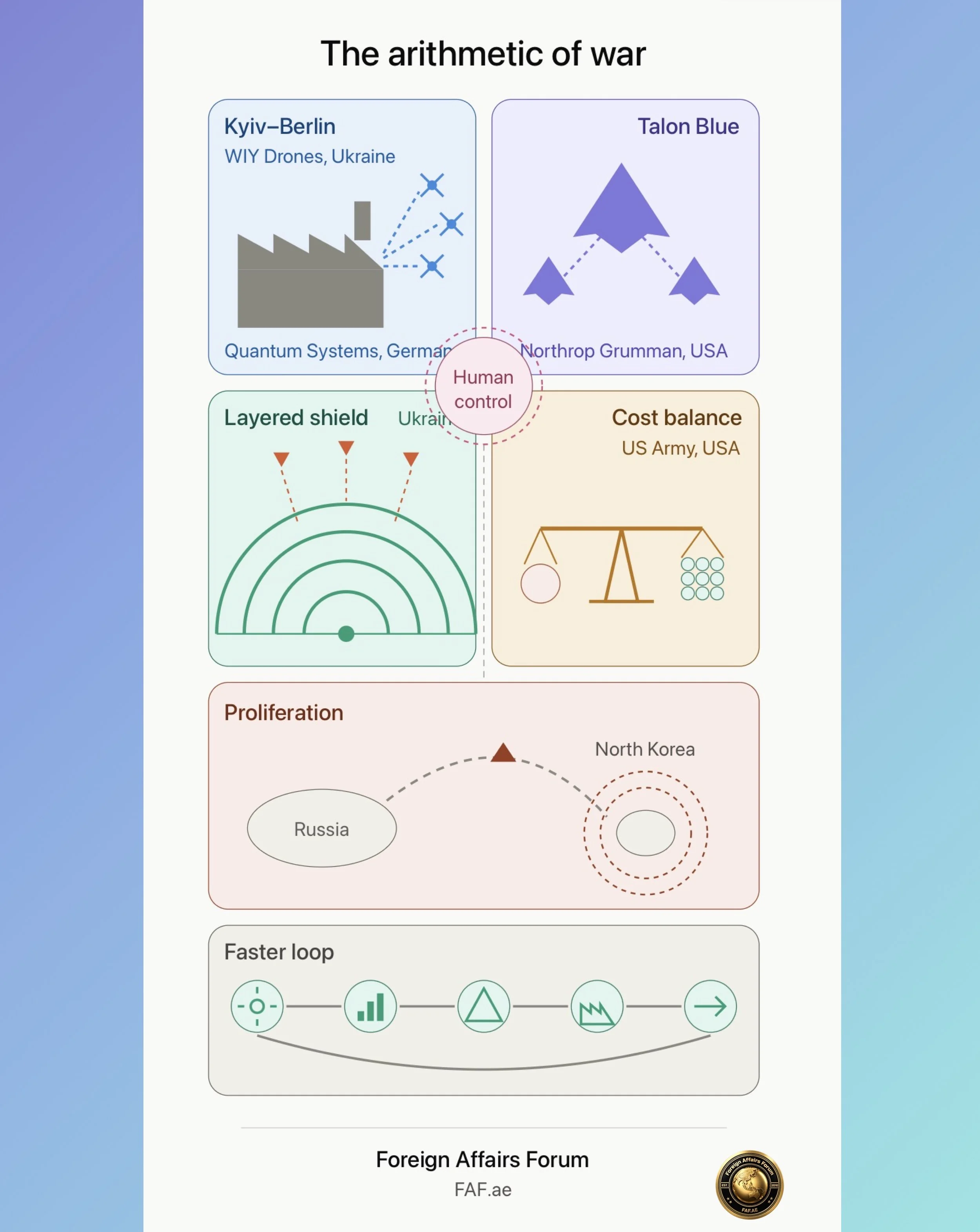
The second link is the cost-exchange problem. When a defender spends an interceptor worth hundreds of thousands of dollars to destroy a drone worth a small fraction of that sum, the defender loses the economic contest even while winning every engagement. That arithmetic explains the surge of interest in interceptor drones, guns, lasers, electronic warfare and other cheaper means, and it explains why the claims about jet-powered drone interceptions matter. If attackers respond to cheap defenses by upgrading their drones with jet engines, defenders must again raise costs or find new methods. The contest is a continuing cycle of adaptation, and the side that iterates faster gains an advantage.
The third link is coordination. Once both sides field mass, the limiting factor becomes the ability to direct that mass. This is the cause of the Pentagon's investment in orchestration software. A force with ten thousand drones and no coherent control layer is weaker than a force with one thousand drones that act as a team. The effect is to elevate software architecture to a strategic asset and to make the standards, data rights and supplier relationships around it a matter of national security.
The fourth link is regulatory friction. Even when technology and money are available, deployment can stall in approval processes. The new American memorandum treats this friction as a vulnerability. The effect should be faster fielding of vetted systems at bases and events, but it also shifts risk onto the quality of the vetting itself. Speed without rigor invites failure; rigor without speed invites defeat.
The fifth link is deterrence under pressure. Russia's reported probing of NATO airspace, and the possible development of an orbital nuclear capability, are efforts to test Alliance cohesion and to complicate Western planning. The effect on the Alliance is paradoxical. The incidents accelerate procurement and unity, as the emergency meeting and the Rutte visit suggest, but they also expose the gap between declared commitments and delivered capacity. Adversaries read that gap as an opportunity.
Finally, the industrial link ties everything together. Every one of the preceding effects depends on production: of interceptors, of drones, of satellites, of propellants. The expired-munitions testimony reveals what happens when demand outruns supply. The effect is a strategic vulnerability that no software can remedy.
Dr. 🆎 summarizes the logic in a sentence worth remembering: cheap offense forces expensive defense to become smart defense, and smart defense is only as reliable as the humans who command it and the factories that feed it.
Future Steps
The first priority for stakeholders is to standardize and secure the control layer. Governments and alliances should establish open interfaces and shared certification for orchestration software, so that fleets from different suppliers can cooperate without creating monopolistic dependencies. Such standards should include mandatory auditing, adversarial testing and clear lines of human accountability. The results of the AVO Challenge, once published, should be examined by allies and used to inform common standards rather than treated as a purely national asset.
The second priority is to institutionalize speed with safeguards. The American counter-drone arrangement offers a template that allies could adapt, but it should be coupled with transparent performance metrics and post-deployment review, so that faster approval does not become weaker assurance. Europe's fragmented approvals landscape would benefit from mutual recognition of vetted systems, building on NATO's catalog approach.
The third priority is to rebuild the industrial base with urgency. Multi-year munitions contracts, expanded solid rocket motor capacity, secure sources for critical chemicals and materials, and incentives for startups to scale production are all necessary. Allies should coordinate stockpile planning so that interceptor shortages are managed collectively rather than discovered in crisis. The warnings about expired munitions and the absence of a refill plan should be treated as strategic alarms, not budgetary footnotes.
The fourth priority is to treat verification as a strategic discipline. Claims about new interceptors should be subjected to independent testing, ideally within allied exercises, before they drive large procurement decisions. The same discipline should apply to intelligence reports about Russian space weapons. Allies should seek to confirm the facts through channels that preserve credibility and, if the reports prove accurate, should coordinate a response that combines diplomatic pressure, resilient space architectures and clear signaling about red lines.
The fifth priority is to strengthen space resilience. The Pentagon's emphasis on autonomous on-orbit cyber defense, on zero-trust architectures for satellites and on defensive cyber squadrons protecting launch ranges points in the right direction. Allies should invest in proliferated, distributed constellations, redundant missile-warning sensors and rapid replenishment capabilities, which reduce the reward for attacking any single node.
The sixth priority is to protect human judgment. Doctrine, training and rules of engagement should preserve meaningful human control over lethal decisions even as orchestration reduces the number of operators.
Dr. 🆎 argues that the most valuable investment is not in more autonomy but in better human understanding of autonomous behavior, including interfaces that make machine reasoning legible under stress.
The seventh priority is diplomatic. Even as militaries accelerate, governments should pursue risk-reduction measures: incident-communication channels, norms against nuclear weapons in orbit, and transparency about air defense incidents near borders. Deterrence without communication invites accidents.
Conclusion
The week of Nov 19th to Nov 25th, 2026, offers a compressed view of a profound transition. Military competition is moving from the possession of platforms to the orchestration of mass, from the isolated engagement to the integrated system, and from the weapon to the architecture that governs weapons. The Pentagon's orchestration software, the American counter-drone memorandum, the claimed interceptions of jet-powered drones, the reported Russian orbital weapon and the missiles that fell in Poland are different expressions of that single transition.
The central insight of this FAF article is that advantage will accrue to those who combine four capabilities: a trustworthy control layer, regulatory and procurement speed, sustainable interceptor economics, and a resilient industrial base. States and alliances that master all four will convert technological possibility into durable deterrence. Those that master only one or two will find that their strengths are undermined by their weaknesses. A force with brilliant software and empty magazines is as vulnerable as a force with full magazines and no way to coordinate them.
There are reasons for caution and reasons for resolve. Caution is warranted because many of the most striking claims remain unverified, because the industrial base is strained, and because escalation risks are rising in several landscapes at once. Resolve is warranted because the problems are tractable. Standards can be agreed, approvals can be streamlined, factories can be expanded, and norms can be negotiated, provided that stakeholders act with the seriousness that the moment demands.
Dr. 🆎 offers a closing reflection. The temptation of every technological era is to believe that machines will relieve humans of the burden of judgment. The opposite is true. As machines multiply, the quality of human judgment becomes the most precious and most contested resource in strategy. Societies that design their systems to strengthen that judgment will be safer than those that attempt to replace it.
The coming twenty-four months will test whether democratic alliances can match the speed of their adversaries without sacrificing the accountability that distinguishes them. The evidence of this single week suggests that the intent exists. What remains uncertain is the delivery.