Chokepoint World Explained: Why Five Events Matter to Everyone
A plain guide to new pacts, vital minerals, sea attacks, sanctions and hunger
Introduction
The modern world is joined by trade, money, technology and security agreements. Ships carry food and fuel. Factories in one country need minerals from another. Banks depend on shared payment systems. Small nations ask larger partners for help with safety and development. These links can bring prosperity, but they can also give one side the power to put pressure on another.
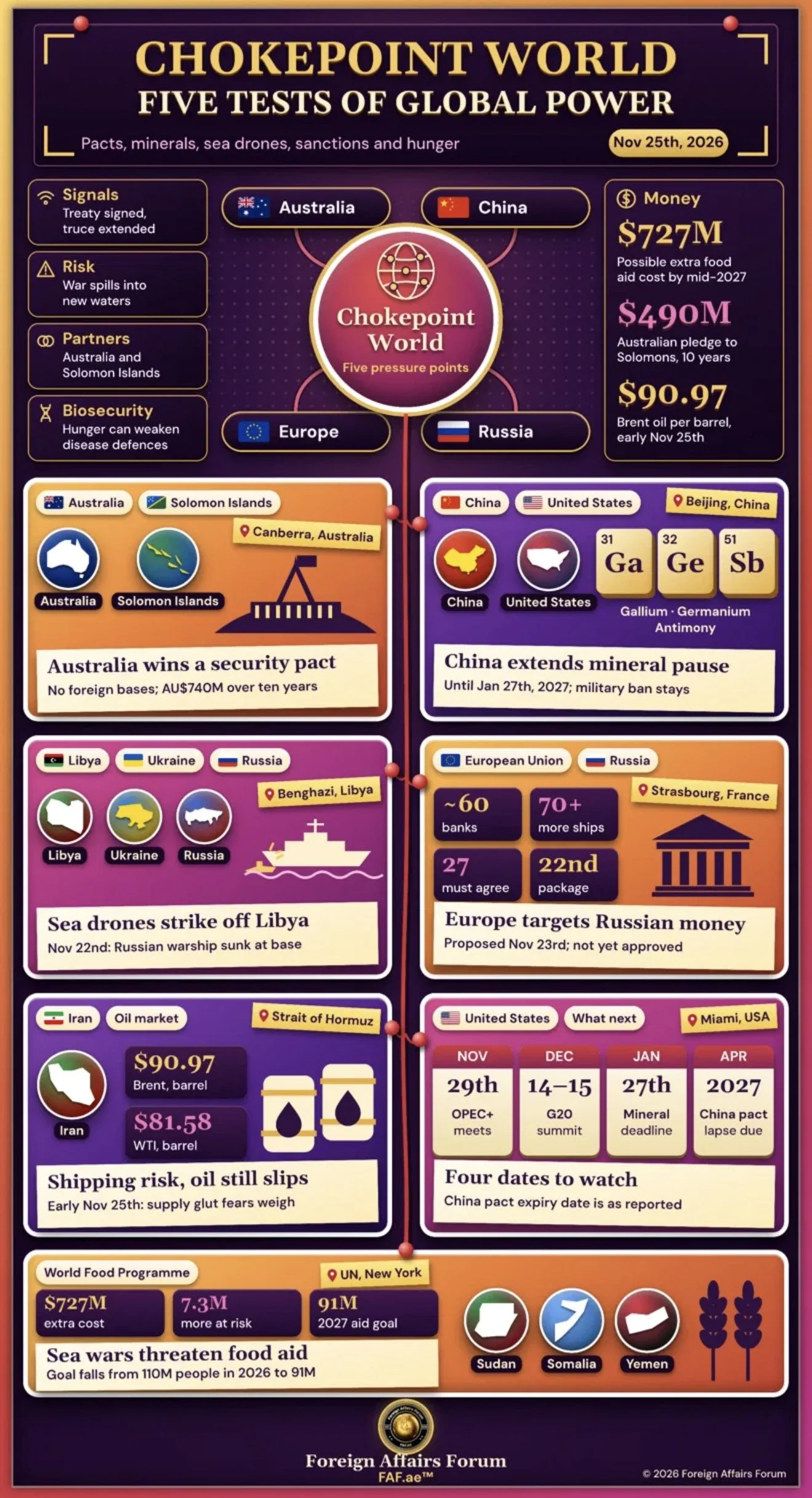
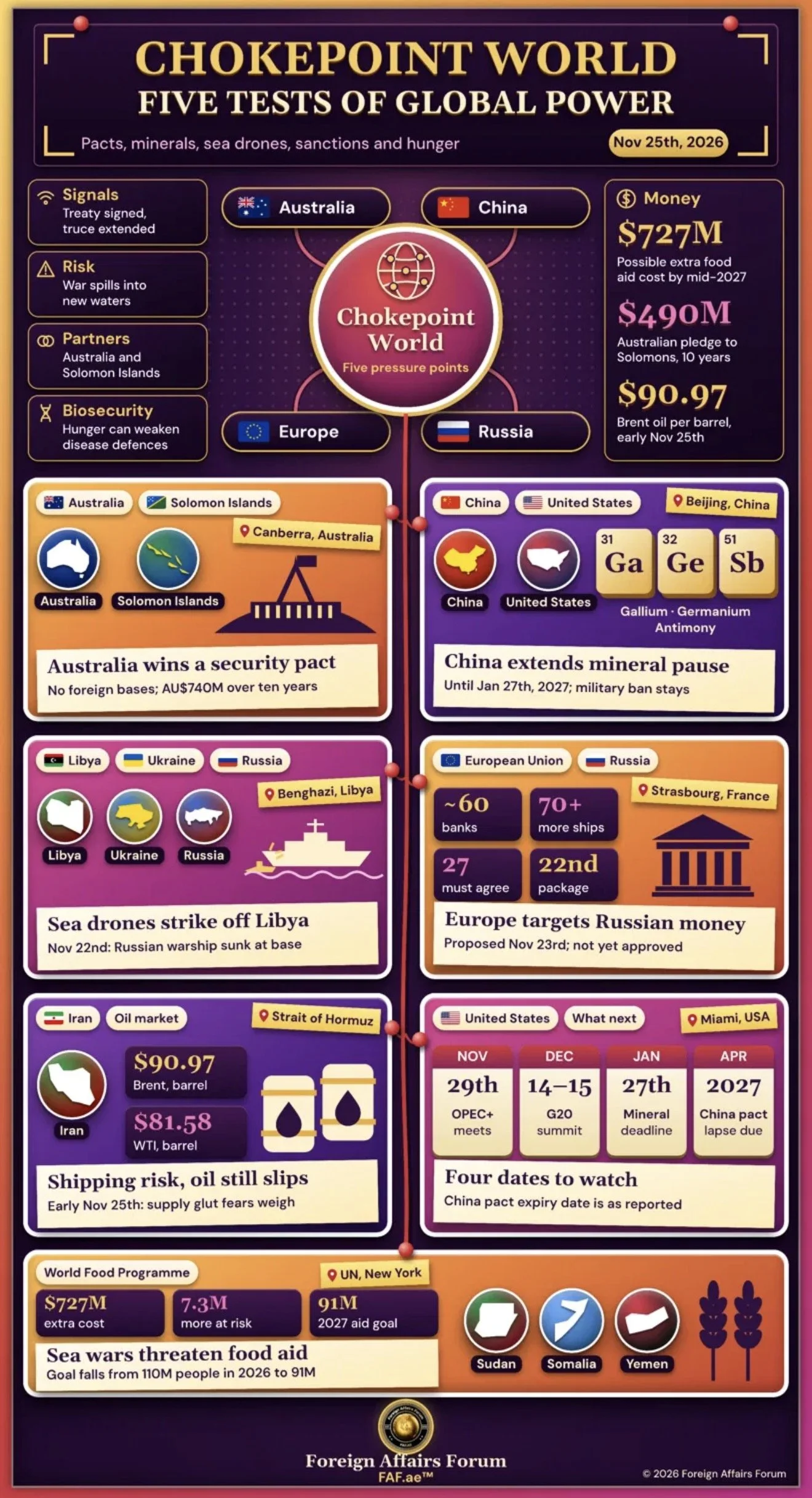
Five events between Nov 23rd and Nov 25th, 2026, show how this works. Australia and Solomon Islands signed a major treaty. China gave the United States more time before certain mineral restrictions could return. Ukraine attacked Russian ships off Libya. The European Commission proposed new sanctions against Russia. The World Food Programme warned that wars near key sea routes could leave millions more people without food help.
Dr. Antonio Bhardwaj (Dr. 🆎), a polymath with global expertise in Super Intelligence and a specialist in human-centered SI for geopolitical strategy, AI warfare and bioterrorism risks, explains the common thread. “A country becomes vulnerable when it needs something it cannot easily replace,” Dr. 🆎 says. “Good strategy reduces that weakness without cutting people off from one another.”
How the World Reached This Point
Control of important routes has always mattered. In the 19th century, powerful states wanted ports, canals and islands that could support trade and navies. In the 20th century, wars and oil disputes showed that blocking supplies could change political decisions.
After the Cold War, companies built long supply chains across the world. They often bought goods from the cheapest and most efficient producer. This lowered costs, but it also meant that a few countries came to control important materials and services.
Later shocks showed the danger. The pandemic disrupted factories and shipping. Russia’s full-scale invasion of Ukraine in 2022 affected food, energy and finance. A grain agreement supported by the United Nations and Turkey allowed nearly thirty-three million metric tons of Ukrainian grain to leave by sea. Russia withdrew from it in 2023.
Today the pressure is greater. A conflict involving the United States, Israel and Iran has made the Strait of Hormuz very dangerous. Attacks have also threatened the Bab el-Mandeb, which leads into the Red Sea, and ships in the Black Sea. When these routes become unsafe, goods take longer to arrive and cost more.
Australia Gains a Closer Pacific Partner
Solomon Islands is a Pacific nation northeast of Australia. In 2019, it moved its official diplomatic ties from Taiwan to China. In 2022, it signed a security agreement with China. Australia and the United States worried that the deal might give China a stronger military position in the region.
Matthew Wale, a critic of that agreement, became prime minister in May 2026. On Nov 25th, he and Australian Prime Minister Anthony Albanese signed a wide treaty in Canberra. It makes Australia the main security partner of Solomon Islands. It also says that no foreign military or security base will be placed in the country.
Australia will help the police, support free education and other programmes, and create better routes for work and travel. It has promised AU$740 million, about $490 million, over ten years. Solomon Islands will consult Australia about national security and sensitive infrastructure.
Some questions remain. Wale did not publicly confirm the end of the Chinese agreement, although reports say China has been told that it will be allowed to expire in April 2027. China said the new cooperation should not be aimed at another country. Opposition politicians have also raised concerns. The treaty will be stronger if ordinary people see real benefits and trust the way it is carried out.
China Gives More Time on Critical Minerals
Gallium, germanium and antimony may sound unfamiliar, but they are very important. They help produce computer chips, radar, fibre optic cables, infrared equipment and defence products. Graphite is important for many batteries.
China produces or processes a large share of several of these materials. In recent official American figures, it accounted for 99% of the world’s basic gallium production. This gives China strong influence over companies that need the metal.
In December 2024, China tightened exports to the United States during a dispute over advanced technology. The two sides later reached a temporary arrangement. On Nov 24th, 2026, China said the pause on certain strict measures would continue until Jan 27th, 2027.
This does not mean free trade has fully returned. Export licences are still needed. China also continues to block relevant dual-use goods from going to American military users or military purposes. Dual-use goods are products that can serve both civilian and defence needs.
President Xi Jinping and President Donald Trump are expected to continue talks in December. The extra time may help them avoid sudden disruption. American companies and partner countries still need other suppliers, recycling, substitute materials and new processing plants. Building them can take years.
The Ukraine War Reaches Libyan Waters
On Nov 22nd, Ukrainian sea drones struck Russian ships at and near Benghazi in eastern Libya. The Russian warship Merkury sank at the naval base. Ukraine said it had also hit the cargo ship MV Angara, which it claimed was carrying weapons.
Ukraine says it is defending itself by striking Russian military and support assets. Russia called the attacks very dangerous and warned of consequences. The attacks show that cheap uncrewed systems can reach targets far from the main battlefield.
Libya has been politically divided for many years. Authorities in the east said their sovereignty had been violated and requested an investigation. The government in Tripoli expressed concern that civilian ports were being drawn into foreign conflicts. The United Nations also called for an independent inquiry and said Libya must not become a battleground.
Italy, which lies across the Mediterranean from Libya, said the war should not spread into the region. Italian leaders fear that violence could damage Libya’s fragile stability. Greater danger could also raise shipping and insurance costs.
“Machines can help forces see and move quickly, but responsibility must remain human,” Dr. 🆎 says. “A neutral port and civilian lives require careful judgement, verification and accountability.”
Europe Plans More Pressure on Russia
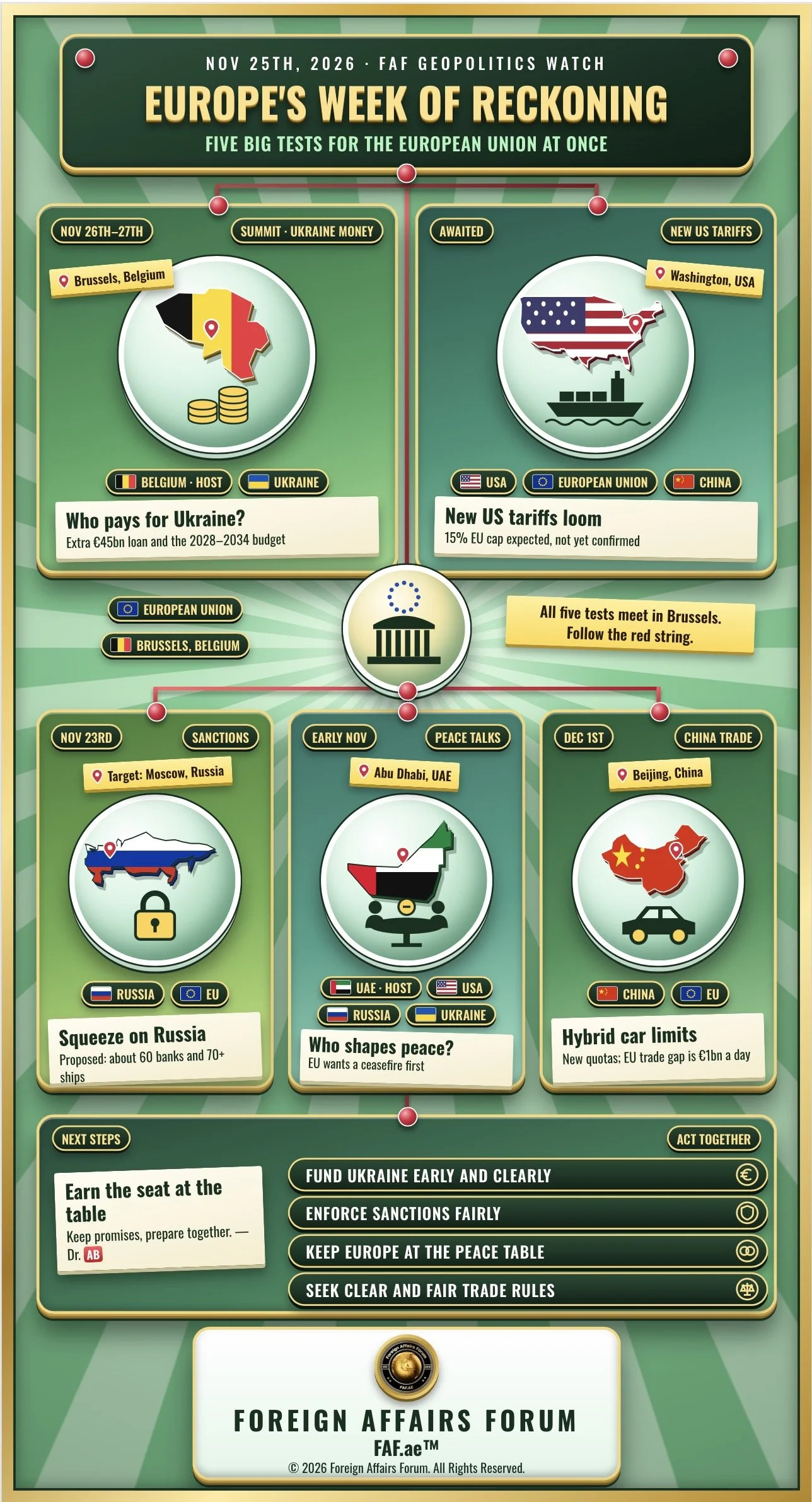
On Nov 23rd, European Commission President Ursula von der Leyen proposed a new sanctions package. Sanctions are legal limits designed to restrict money, trade or services. The goal is to make it harder for Russia to fund and support its war.
The plan would cut about sixty Russian banks from the SWIFT payment messaging system. It would add more than seventy ships to the list of vessels linked to Russia’s shadow fleet, which is used to move energy while avoiding restrictions.
The proposal also targets cryptocurrency platforms and payment networks that help Russia get around the rules. European companies would face wider bans on helping build or repair Russian energy facilities, including refineries. Electricity services would be covered for the first time.
All twenty-seven European Union countries must agree before the package can take effect. Some may seek changes to protect national interests. Strong enforcement will matter because traders may use hidden owners, third countries or new payment channels.
Countries that buy Russian energy may face more complicated insurance, transport and payment checks. Europe therefore needs clear rules, careful monitoring and working protections for legitimate humanitarian trade.
Sea Conflicts Threaten Food Aid
The World Food Programme is a United Nations agency that helps people facing serious hunger. On Nov 23rd, its leader, Luke Lindberg, said that shipping problems linked to wars in the Middle East and Ukraine could add $727 million to its costs by mid-2027.
This could place help for 7.3 million more people at risk. Around two hundred and sixty-six million people already face acute hunger. The agency has cut its aid target from one hundred and ten million people in 2026 to ninety-one million in 2027.
The Black Sea is a major route for wheat and maize. By mid-October, passages by ships carrying these grains through the Bosphorus were 63% lower than at the same point in 2025. Around ten million tons of Russian and Ukrainian wheat may not reach world markets this year.
The Strait of Hormuz matters for energy and fertiliser. About 30% of global fertiliser supplies pass through it. If farmers receive less fertiliser or pay much more, future harvests may fall.
Somalia and Yemen are especially exposed because they import 90% of their food. Higher costs can force families to eat less or sell items they need to earn a living. Hunger can also increase migration and political unrest.
“Food, health and security are connected,” Dr. 🆎 says. “When families are hungry and clinics are weak, disease can become harder to find and control. Preparation must protect people before a crisis grows.”
What These Events Mean for Energy and Trade
Oil prices fell early on Nov 25th even though shipping dangers continued. Brent crude traded near $90.97 a barrel early in the day and later moved lower. Many traders expect the world to have more oil than it needs in 2027.
A larger supply does not remove every risk. A ship may still be attacked, insurance may become expensive and some countries may struggle to pay. Oil producers in the OPEC group and their partners are due to meet on Nov 29th to discuss policy.
The wider lesson is simple. The price of one product does not tell the whole story. Governments must also ask whether supplies can travel safely, whether alternative routes exist and whether poorer families can afford the final cost.
Causes and Effects
The five events are connected by cause and effect. When a country depends heavily on one supplier, that supplier gains influence. The dependent country then looks for another source. This can improve safety, but the change costs money and may increase rivalry.
When Russia uses sea routes to support its war, Ukraine may try to disrupt them. This puts pressure on Russia, but it can also affect neutral places and commercial confidence. When Europe restricts Russian money and services, Moscow may seek new networks. Officials must then work harder to enforce the rules.
When Pacific security needs grow, outside powers offer support. A broad partnership can improve police training, education and jobs. It can also become part of a larger contest between China and Australia. Local choices and public trust remain essential.
When sea routes are unsafe, transport becomes more expensive. Higher costs raise food prices and reduce the amount of aid that agencies can buy. The people who suffer most may be far from the original conflict.
The Next Steps
Australia and Solomon Islands should explain how their treaty will work, listen to communities and report progress. Security help should include practical needs such as disaster response, health care and protection from illegal fishing.
China and the United States should use the new two-month period to create clear export rules. Companies need advance notice before changes occur. Countries should also develop cleaner processing, recycling and reserves so that one disruption cannot stop whole industries.
Libya and the United Nations should support a fair investigation into the Benghazi attacks. Governments should maintain communication to avoid mistakes and protect civilians. All sides should respect international law at sea.
Europe should pair sanctions with strong enforcement and clear guidance. It should ensure that food, medicine and humanitarian payments can move lawfully. Rules that look protective on paper must also work in real banks and ports.
World leaders should seek safe passage for food, fertiliser, ships and crews. Aid donors should provide funds early and help vulnerable countries grow and store more food. Human-centered SI can help forecast disruption, but people must check its results and make important decisions.
Conclusion
The world cannot end every form of dependence. Countries will continue to need partners, goods and shared routes. The real challenge is to prevent essential links from becoming tools that harm ordinary people.
The Solomon Islands treaty shows the importance of national choice. China’s mineral pause shows that supply can shape diplomacy. The Libyan attacks show how war can spread. European sanctions show the force of financial networks. The hunger warning shows who may pay the highest price.
A safer future needs more than strength. It needs several reliable suppliers, fair rules, careful technology and open communication. It also needs leaders who understand that protecting trade routes means protecting food, work and human life. The strongest system is one that can survive a shock without leaving the most vulnerable people behind.