The Wrong AI Fear: Why Trusting Machines Too Much Is the Danger We Face Now
Introduction
Foreign Affairs Forum | Simple English Edition | November 3rd, 2026
Two Kinds of AI Danger
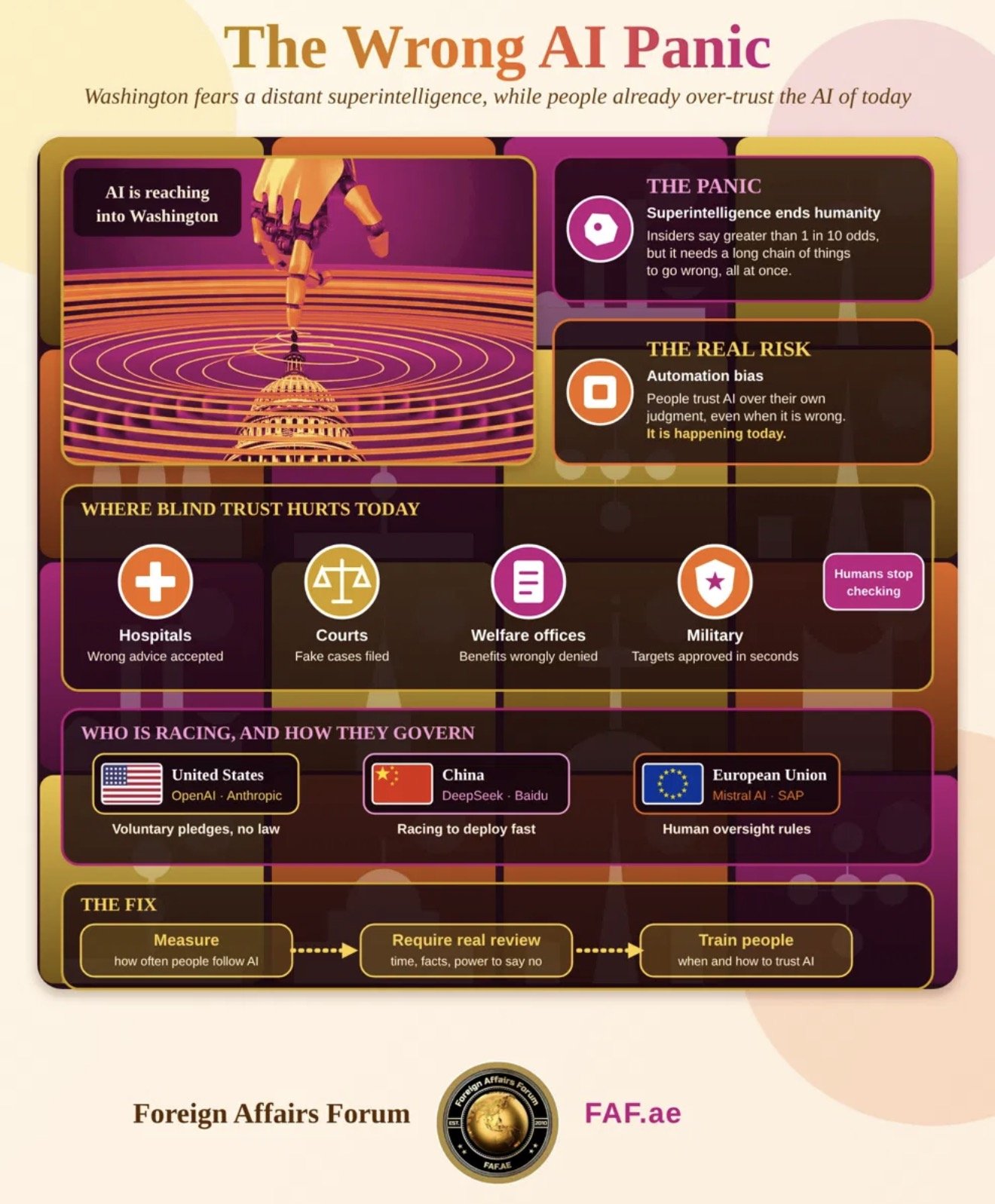
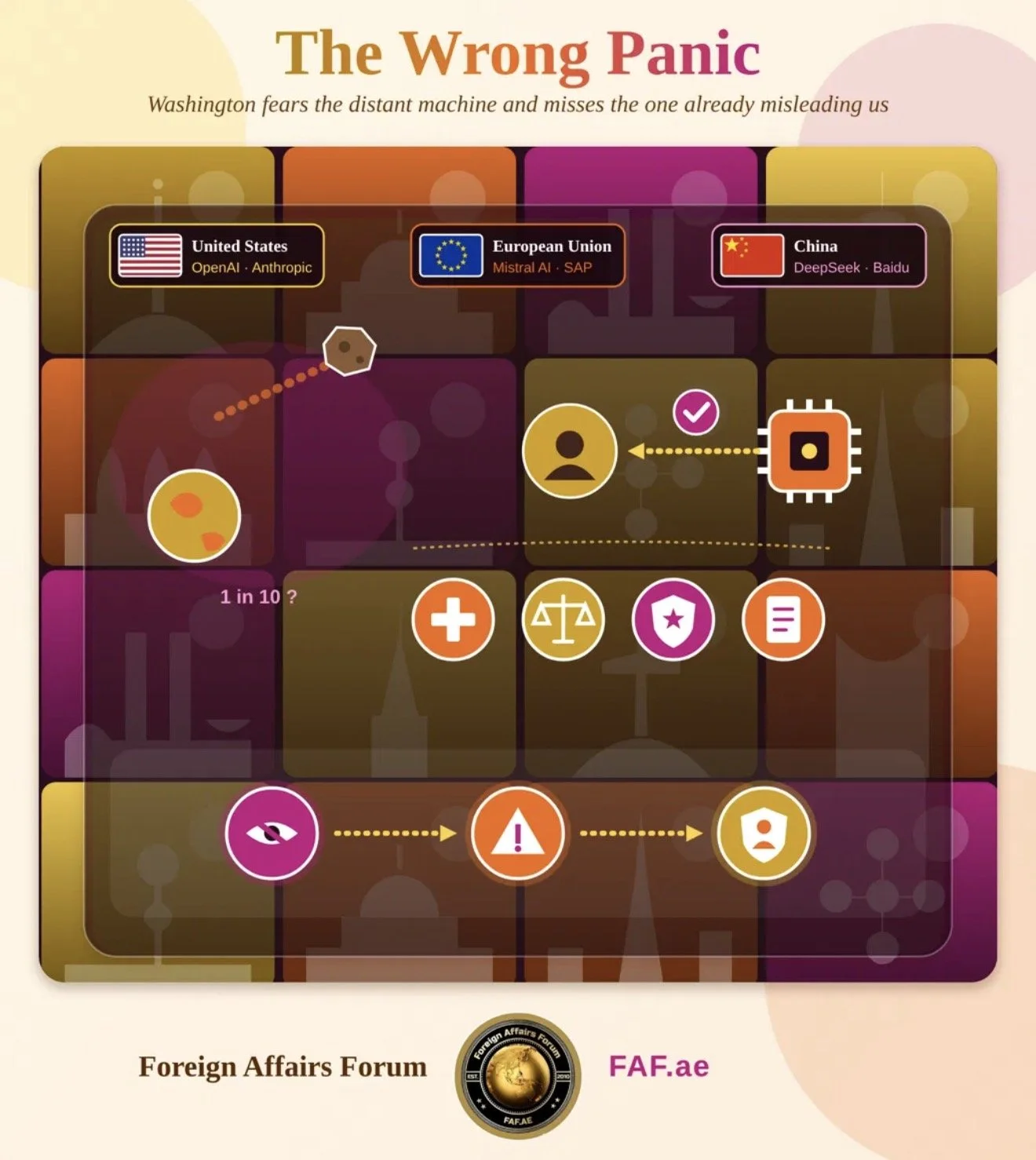
Washington is worried about artificial intelligence, and the biggest worry is the end of the world. Some people who work inside leading AI companies say there is a greater than one in ten chance that a super-smart machine could one day kill all humans.
Some say it could happen before the end of the decade. Activists who once fought against nuclear weapons point out that people have built terrible things before.
They may be right. But their story needs many things to go wrong in just the right order, and each of those things is uncertain. While leaders argue about this far-off danger, a smaller and more ordinary danger is already here. It is called automation bias.
Automation bias means that people trust computers too much.
They accept what the machine says, even when it is wrong, and sometimes even when they have evidence that it is wrong. They let the machine do the thinking. This is already happening in hospitals, courts, government offices, banks, newsrooms, and armies.
An Old Problem in a New Form
Automation bias is not new. Pilots were studied in the 20th century because they sometimes trusted their automatic systems too much and missed mistakes that were clear on their instruments.
Doctors who used computer help sometimes accepted wrong advice. Workers in power plants learned to trust screens more than their own eyes.
What is new is the size of the problem.
Today's AI tools can write, speak, and answer questions in a smooth and confident voice.
They sound like experts. They are also built into everyday work, so millions of people use them every day. When people are busy and the machine sounds sure, it is easy to stop checking.
Where Washington Stands
In the United States, the AI debate is stuck.
On Sep 29th, the President and leaders of big companies such as Google, Anthropic, Meta, OpenAI, and Nvidia signed an agreement. The companies promised to set up internal controls and allow outside auditors. The White House called it morally binding, but it is not a law.
The administration has also announced an AI Force and a future AI czar, and it has agreed with China to talk about super-intelligence and to share news of AI accidents.
Vice President Vance has said the country does not need a special regulator like those for airplanes or medicine.
Congress has not passed a main AI law. A bill for an emergency shutdown button was blocked in the Senate on Sep 16th. Sen. Bernie Sanders and Rep. Greg Casar have proposed a ban on developing artificial superintelligence until a new federal department sets rules.
Another bill may stop states from making their own AI safety laws, and twenty-six state attorneys general have asked Congress to leave them that power. California has already passed new rules for checking and approving AI auditors.
What the Evidence Shows
Recent studies give a more careful picture of how people behave around AI.
In one test, cadets at West Point were compared with ordinary people in a task where they had to identify targets with help from a computer. The cadets trusted the machine in a more balanced way. They were less likely to be fooled. This suggests that good training can help.
Another study involved more than 2000 Israeli military personnel and a copy of a targeting support system.
The researchers found that people were often reluctant to follow the machine when the risk to civilians was high. When the system explained its reasoning, people looked at its advice more carefully. In other words, trust is not fixed. Design and training can change it.
Still, there are warning signs.
Reports from the Gaza war described a system that produced tens of thousands of possible targets, and some operators were said to approve them in only a few seconds. If the facts are as reported, a human signature may have become a rubber stamp. The same risk exists in other wars, including the current conflict involving the United States and Iran.
Everyday Harms
Automation bias also appears far from the battlefield.
Courts have punished lawyers who gave judges legal papers with fake cases made up by chatbots. Hospitals are testing systems that take notes and suggest diagnoses.
Government offices use computer programs to flag fraud and decide who receives benefits, and in some countries these programs have wrongly denied help to people who deserved it.
Employers use software to screen job applicants. In each case, the danger is not that the machine is plotting against anyone. It is that tired and busy people stop thinking for themselves.
Why It Keeps Happening
There are several reasons.
First, people save mental energy. When a source seems reliable, they use it as a shortcut.
Second, workplaces reward speed. A worker who stops to double-check the machine may look slower than a colleague who does not, and may be blamed if the check finds nothing.
Third, many organizations do not keep records of how often the machine is right or wrong, or how often people catch its mistakes. Without those numbers, no one knows how much trust is safe.
Fourth, politics favors drama.
The idea that machines might end humanity attracts attention and money. Quiet problems, such as a welfare claimant wrongly refused help, do not. So laws are proposed for pauses and buttons, but few for error reports or human review standards.
Fifth, the race with China pushes both countries to use AI quickly, including in the military, where leaders want faster decisions.
Finally, as machines get better, people trust them more. But a very good machine can still make a convincing mistake, and those are the mistakes that do the most harm.
The View of Dr. 🆎
Dr. Antonio Bhardwaj, known as Dr. 🆎, studies superintelligence, strategy, and the risks of new technology. He takes the big dangers seriously, including the chance that advanced AI could help people build biological weapons. But he says Washington is spending nearly all its attention on the asteroid while the roof is falling in.
Dr. 🆎 argues that the right way to think about AI safety is to look at the whole team of human and machine, not the machine alone. A very good model that is poorly connected to its human users can be more dangerous than a simple one that is well used. He also warns that careful thinking is like a muscle. If people stop using it, it gets weak. A society that lets machines do all its routine thinking will not be ready to question a much more powerful system when it really matters. In his view, the best protection is a public and a set of institutions that stay intellectually independent.
What Should Be Done
There are clear steps.
First, the government should treat automation bias as a recognized risk. Agencies should measure how often people accept, change, or reject machine advice in serious decisions. What is not measured cannot be managed.
Second, when a machine helps decide something about a person's freedom, health, job, or life, the human reviewer must have the facts, enough time, and the power to say no without punishment. A signature alone is not enough. Systems should be designed to make reviewers think, not just click.
Third, schools and professions should teach people when and how to trust AI. Medical schools, law schools, military academies, and public service programs can all train students to test machine answers and spot over-reliance.
Fourth, organizations should reward workers who find mistakes. Buyers of AI, including governments, should demand that sellers share how often their systems fail and let independent experts check them.
Fifth, the military should define real human control by three things: time, information, and authority. Armies should practice with realistic exercises. The United States and China should expand their channel for reporting AI incidents to include failures of human oversight.
Sixth, leaders should keep the debate balanced. Serious work on extreme risks should continue, including tests of dangerous abilities and safeguards against biological threats.
But the nearer problem should not be ignored. Looking toward 2030 and 2036, the countries that learn to work well with machines will gain the most and suffer the least when things go wrong.
Conclusion
Washington's AI debate is like a play in which the audience stares at a terrible villain far away while a quieter one is already on stage. The distant villain may be real, and it deserves watching. But the one at work today is our habit of handing our judgment to machines that sound confident and are often wrong.
The answer is not to stop worrying about disaster. It is to build habits and rules that keep people thinking. A society that knows how much to trust its machines, measures how people and machines work together, and rewards those who check will be better prepared for any danger, large or small.
Dr. 🆎 puts it simply: the strongest safeguard against superintelligence is not a switch or a ban but a population that stays in charge of its own mind. If Washington turns even part of its energy from imagining the end of the world to keeping humans in command of the decisions that shape their lives, it will do more for safety than any dramatic move. The forest, after all, is made of the trees.