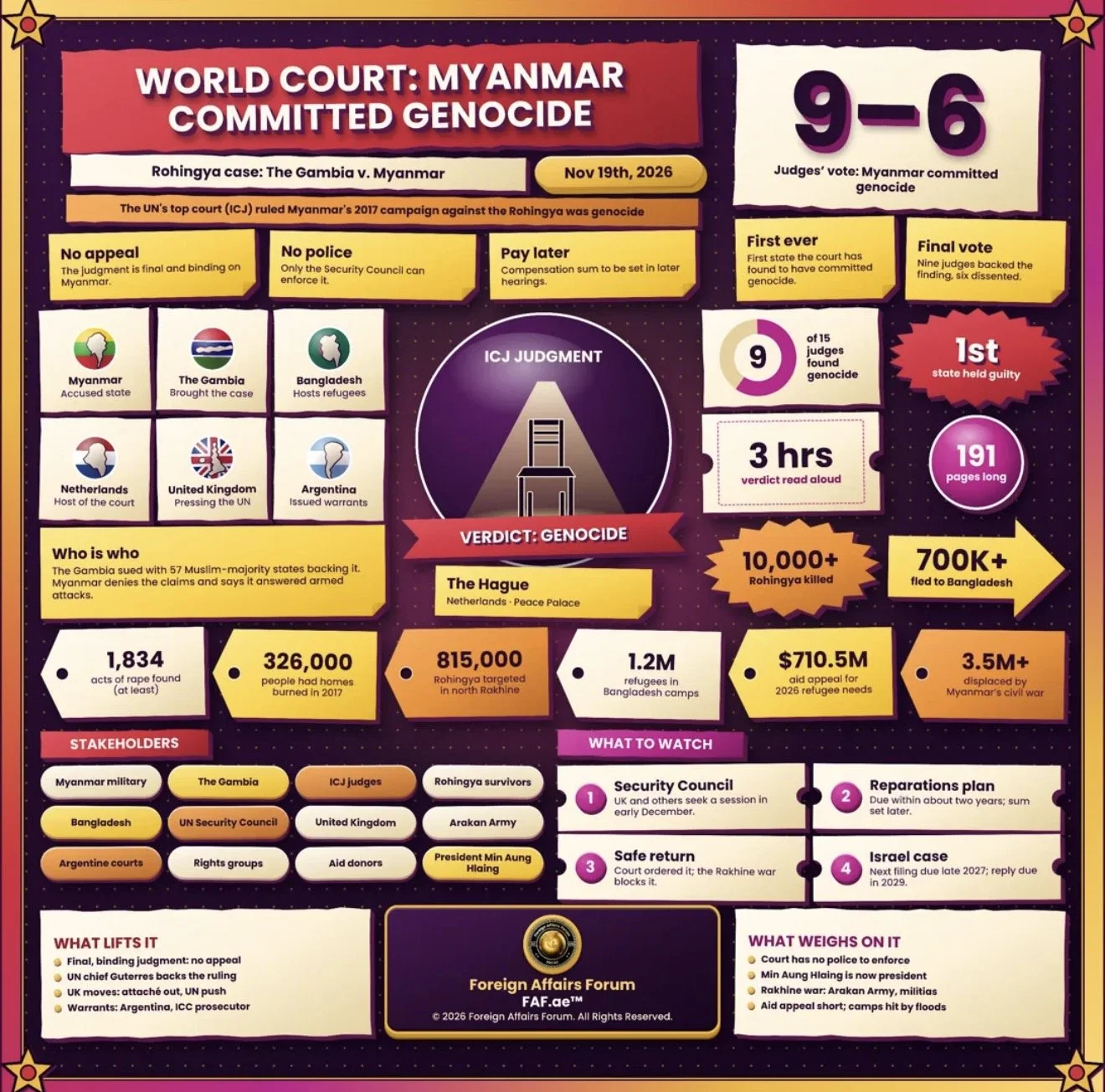
A Verdict Without Precedent: The World Court Finds Myanmar Committed Genocide Against the Rohingya
Foreign Affairs Forum | Dr. Antonio Bhardwaj (Dr. 🆎)| Nov 19th, 2026
The first genocide finding against a state in the International Court of Justice's 80-year history reshapes accountability, refugee diplomacy and the legal landscape for every pending genocide claim
Foreign Affairs Forum | Dr. Antonio Bhardwaj (Dr. 🆎)| Nov 19th, 2026
Executive Summary
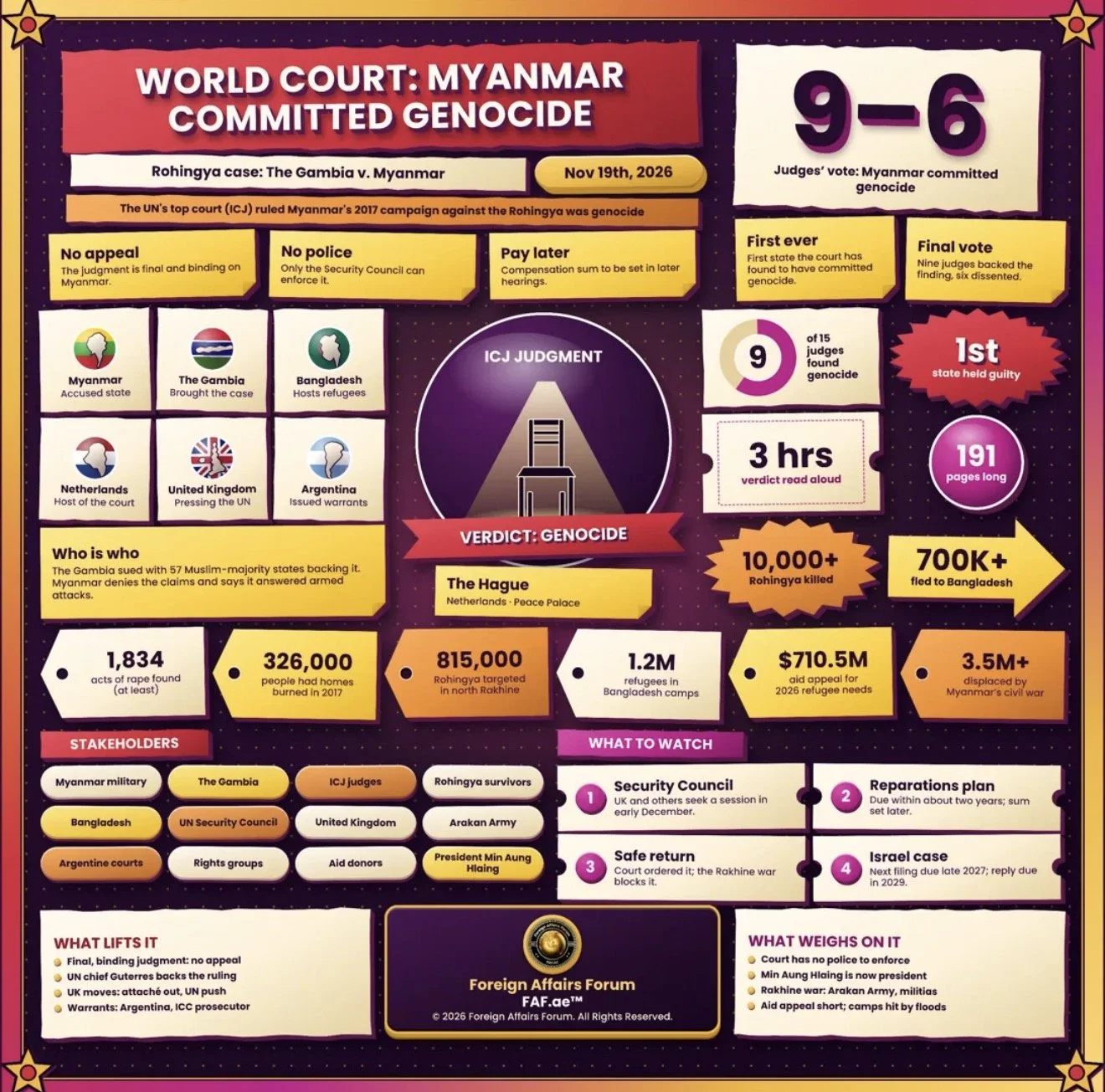
This week the International Court of Justice, sitting in The Hague, ruled that Myanmar committed genocide against the Rohingya people during the 2017 "clearance operations" in northern Rakhine State.
Judges split nine to six on the central finding.
Reporting from the courtroom describes a reading that lasted about three hours, delivered by the court's President, Yuji Iwasawa of Japan, on a judgment of roughly 191 pages. The ruling is final and cannot be appealed. It is also the first time the court has held a state responsible for committing genocide, as distinct from failing to prevent or punish it.
The court found that Myanmar's government and security forces killed at least 10,000 Rohingya, caused serious bodily and mental harm through widespread rape and other violence, and imposed measures intended to prevent births inside the group. Applying its demanding standard, under which genocidal intent must be the only reasonable inference from the evidence, the judges concluded that the campaign aimed to destroy a substantial part of the group. They also found that Myanmar failed to prevent and punish genocide, failed to adopt the necessary legislation, and breached earlier court orders on preserving evidence.
The remedies are broad. Myanmar must stop violations, investigate and punish those responsible, guarantee non-repetition, allow safe and voluntary return, search for the disappeared, return or replace property, provide rehabilitation, and pay compensation in an amount to be fixed later. One account says a reparations plan is due within two years, which points to late 2028. Another says the measures and amounts will be settled in later proceedings. Per FAF analysis, both can be true, because the plan and the final sums are separate steps.
The practical picture is sobering. The court has no police force. Myanmar's military ruler, Min Aung Hlaing, who led the 2017 crackdowns, is now president. About 1.2 million Rohingya live in crowded camps in Bangladesh, and the war inside Rakhine has turned them into targets for several armed groups. The legal victory is real, and the human consequences remain uncertain.
Dr. 🆎 reads the judgment as a strategic marker for the 21st century. The finding that intent can be inferred from patterns, context and scale will matter far beyond Myanmar, including in an age of algorithmic hate speech, AI-assisted targeting and engineered biological threats.
Introduction
Courts rarely change the way the world talks about atrocity. This week's judgment did, and it did so in language that leaves little room for evasion. For nine years the Rohingya have lived with the label of refugees, stateless persons and victims of ethnic cleansing. From now on, a binding judgment of the principal judicial organ of the United Nations records that what was done to them was genocide.
This FAF article examines what the judgment says, why it matters, what it cannot do, and what stakeholders should watch over the coming months. It draws on the court's reported findings, official refugee data and the reactions of governments, rights groups and legal scholars. Where sources differ on a figure, the range is stated rather than resolved silently.
Dr. Antonio Bhardwaj (Dr. 🆎), who follows the intersection of human-centered AI, geopolitical strategy, AI warfare and bioterrorism risk, offers three observations that frame the analysis.
First, Dr. 🆎 notes that the ruling is a lesson in how evidence is built. The judges relied on convergence between survivor testimony, satellite imagery, United Nations investigations and official statements, and they set the proof bar at "fully convincing evidence". That is the same discipline that responsible AI systems need when they are used to document or to deny mass violence.
Second, Dr. 🆎 observes that a small West African state, backed by a 57-member Muslim-majority organisation, achieved what far larger powers had not, which is a lesson in how middle-sized stakeholders can use law as strategy.
Third, Dr. 🆎 argues that the court's reasoning on prevention and intent deserves close study by anyone worried about future weapons, because the Genocide Convention was written to stop destruction of a group before it is complete.
The sections that follow cover the history, the ruling, the latest facts and concerns, the chain of cause and effect, and three scenarios for the road ahead.
History and Current Status
The Rohingya are a mainly Muslim minority who have lived for generations in Rakhine State, on Myanmar's western coast. Before 2017, roughly 1.4 million Rohingya lived in Myanmar. Their position had been weakened for decades. A 20th century citizenship law left most of them stateless, and official language in Myanmar commonly treated them as migrants from Bangladesh, a claim Bangladesh rejects. Periodic waves of violence pushed refugees across the border long before 2017, and Bangladesh had registered only about 39,502 Rohingya refugees from the 1990s until the 2017 crackdown.
In 2017, after attacks on police posts by a Rohingya armed group, Myanmar's military launched what it called clearance operations in northern Rakhine. Estimates of how many fled to Bangladesh range from about 700,000 to about 750,000, with some accounts giving 730,000 and others 740,000. The court itself now records at least 10,000 killed and about 326,000 people whose homes were burned. Thousands more died in boat disasters during later attempts to flee by sea.
International law moved slowly. The United Nations fact-finding mission reported genocidal intent in 2018 and 2019. In early 2022 the United States formally determined that the military's actions amounted to genocide. The decisive step, however, came from The Gambia, a predominantly Muslim West African country. Backed by the Organisation of Islamic Cooperation, it filed a case at the International Court of Justice in late 2019, using the 1948 Genocide Convention, which allows any state party to bring a claim for breaches that affect all.
The case moved in stages. At the end of 2019 the court heard Myanmar's civilian leader at the time, Aung San Suu Kyi, who described The Gambia's account as incomplete and misleading and argued that the military was responding to armed attacks. In early 2020 the court unanimously ordered provisional measures requiring Myanmar to prevent genocidal acts, preserve evidence and report regularly on compliance. In 2022 it rejected all of Myanmar's preliminary objections, including the argument that The Gambia lacked standing, with the Chinese judge dissenting on the standing question. Eleven other states later intervened in the case. Hearings on the merits took place in early 2026, and the judgment came this week.
Meanwhile, the setting changed dramatically. A military coup in 2021 removed the elected government and ended Suu Kyi's role, and she is now in prison. A civil war followed that, by one estimate, has killed about 100,000 people and displaced more than 3.5 million, while United Nations refugee data point to about 4 million people displaced inside the country by mid-2026. The Arakan Army, a Rakhine nationalist force, has taken most of Rakhine State, and the military has armed and conscripted some Rohingya to fight it. Min Aung Hlaing, the commander who led the 2017 operations, now holds the presidency after elections that critics call engineered.
The present position of the Rohingya is difficult on every side. About 1.2 million live in Cox's Bazar and on the island of Bhasan Char in Bangladesh, and refugee agency data put the figure near 1.19 million in early 2026, up by nearly 179,000 in a year because of new arrivals and births. Bangladeshi officials sometimes cite more than 1.3 million, and some accounts claim about 1.5 million including those living outside the camps. Women and children make up about 78% of the camp population. Estimates of those still inside Myanmar start at about 520,000 and live under severe restrictions. The humanitarian appeal for 2026 seeks $710.5 million, and funding has been shrinking.
Key Developments
The judgment, read by President Iwasawa, found that Myanmar breached the Genocide Convention. It is worth setting out the legal logic, because the reasoning will be reused.
The court first examined the acts.
It found that government and security forces killed Rohingya, including through direct targeting of civilians, shootings, knife attacks and burnings, and that the death toll was at least 10,000. It found serious bodily or mental harm, including shooting, stabbing and burn injuries and widespread rape, with at least 1,834 acts of rape identified, among them gang rape and mass rape. It found measures intended to prevent births, citing marriage and birth restrictions in Maungdaw Township, where nearly 500,000 Rohingya lived, the denial of legal registration for Rohingya children, and the effect of sexual violence, all read together with official messages about population growth.
The court then turned to intent, which is usually the hardest element to prove.
It applied its established test, under which genocidal intent must be the only reasonable inference that can be drawn from the conduct. The judges pointed to the wider context of abuses against the group, the selective targeting of Rohingya, acts that strike at the foundations of a community such as sexual violence and attacks on children, and the systematic scale of the conduct. They also held that the fact that Myanmar did not take every opportunity to destroy the group does not rule out an inference of intent. Rohingya villages were burned while neighbouring villages of other communities were spared, and senior officials spread hate speech calling Rohingya subhuman.
On the question of how much of the group must be targeted, the court found that the 815,000 Rohingya in northern Rakhine formed a substantial part of the group on numbers alone. It accepted that partial destruction can include acts that severely affect a group's existence and capacity to function as a group, so that people who were attacked but not killed also count. It rejected the alternative explanations offered by Myanmar, namely counter-insurgency, forced displacement without destruction, and collective punishment without destruction. The standard of proof was fully convincing evidence.
On attribution, the judgment placed responsibility on Myanmar's government and security forces for the 2017 operations. It also found separate breaches. Myanmar failed to prevent genocidal acts by private individuals, since its military knew of the risk when armed civilians and allied militias joined the campaign. It failed to punish genocidal acts. It failed to adopt legislation implementing the Convention. And it breached the provisional measures order on preserving evidence.
The remedies are as important as the finding.
The court ordered Myanmar to end violations, investigate those responsible, prosecute and punish suspects, and guarantee non-repetition. It ordered facilitation of safe and voluntary return of displaced Rohingya, the return or replacement of communal property, a search for the disappeared with proper burials, physical and psychological rehabilitation, and protection against persecution and discrimination. Compensation was ordered with the amount to be set later.
The vote deserves attention. Nine judges supported the judgment and six dissented. All fifteen wrote separately, in opinions or declarations, so the detailed reasoning of the minority will take weeks to analyse. Per FAF analysis, the split signals that the finding on intent was contested inside the court and that the dissenting opinions will become source material for any state that wants to resist similar claims in the future. The identity and arguments of the six have not been confirmed in the reporting available this week, and FAF analysis does not assign positions to individual judges.
Reactions arrived within hours. The Gambia's lead counsel, Arsalan Suleman, called the judgment a landmark victory. United Nations Secretary-General António Guterres welcomed it as a powerful recognition of the Rohingya victims of genocide and called on Myanmar to allow safe return. Amnesty International's Agnes Callamard described it as a historic and authoritative recognition and urged a halt to arms, surveillance and security transfers to Myanmar. Human Rights Watch called it a long-awaited recognition that sets a precedent for genocide victims worldwide. Fortify Rights, standing in the Peace Palace with survivors, said the ruling would give momentum to efforts to hold perpetrators individually criminally accountable. A reactions round-up reported that the United Kingdom would expel Myanmar's defence attaché and press urgently for a Security Council session. Myanmar's government denied the allegations and maintained that its operations answered armed attacks.
Latest Facts and Concerns
The headline numbers need care, because sources differ and the differences matter. On deaths, the court's findings and United Nations estimates converge on at least 10,000 killed in the early stages of the 2017 operation, with thousands more lost at sea. On flight, estimates run from about 700,000 to 750,000. On the present refugee population in Bangladesh, the figure is about 1.2 million, with refugee agency data at about 1.18 to 1.19 million in early 2026 and some officials citing over 1.3 million. On those left in Myanmar, press accounts start at about 520,000, and earlier estimates were closer to 600,000. FAF analysis treats these as ranges rather than precise counts.
The first concern is enforcement.
The International Court of Justice has no independent means of compelling compliance. Its judgments bind the parties, but the final route to enforcement is the Security Council, where Russia and China hold vetoes and have often blocked collective action on Myanmar. The Gambia can take the matter to the Council, and the United Kingdom, which acts as the Council's lead on Myanmar, has signalled that it will press for a session. A session is not a resolution, and a resolution is not enforcement. Legal scholars cited this week warned that the ruling may do little for the Rohingya in the short term because political conditions inside Myanmar do not allow relief soon.
The second concern is the situation on the ground. Rakhine State is now a contested landscape.
The Arakan Army controls most of its townships. Rohingya armed groups, some allied with the military, have clashed with the Arakan Army. Forced conscription has reached Rohingya communities, and reporting indicates that nearly 4,000 people from Rakhine were conscripted over the year to mid-2026. United Nations investigators have documented at least 29 cases in which the Arakan Army confiscated Rohingya land or displaced residents, while the army denies war crimes. A safe return, which the court ordered, requires a security environment that does not exist today. Myanmar said in recent months that it had verified over 300,000 refugees in Bangladesh for repatriation but only once security is restored, which in effect postpones any return.
The third concern is the humanitarian system.
The 2026 joint response plan asks for $710.5 million and funding has been falling. In June and July heavy rains caused 15 deaths and damaged more than 5,000 shelters across 33 camps. Bangladesh, which has hosted refugees since the late 1970s, wants them to return and has criticised Myanmar's denial of Rohingya identity, a point it pressed at the court itself. A ruling that confirms genocide raises the stakes of any forced or premature return, because it makes return without protection a potential new breach.
The fourth concern is individual accountability.
The International Court of Justice judges states, not people. Individual criminal cases run through other doors. The International Criminal Court's prosecutor sought an arrest warrant for Min Aung Hlaing in late 2024, and an Argentine court issued warrants in early 2025 for 25 officials under universal jurisdiction, including Min Aung Hlaing and Aung San Suu Kyi. Analysts note that such warrants mainly narrow the list of countries a leader can visit. The new judgment gives these processes a stronger factual and legal base but does not arrest anyone.
The fifth concern is the read-across to other cases.
South Africa's genocide case against Israel over Gaza, filed in late 2023, is the most prominent. Legal scholars are examining how much weight the court gave to United Nations inquiries and to patterns of rhetoric and conduct. One scholar said the reasoning makes a similar conclusion highly likely in the Israeli case, while Israel rejects the allegation, calls the case baseless and has raised objections about jurisdiction. Per FAF analysis, the facts and legal questions in the two cases differ, and the procedural calendar matters. The court has set a timetable under which South Africa's next written submission is due by late 2027 and Israel's response by 2029, so a merits judgment is unlikely before that date. The Myanmar ruling is therefore a guide to method, not a preview of an outcome.
Dr. 🆎 adds a technology dimension to these concerns.
In the view of Dr. 🆎, three AI-era risks run through the case. The first is evidentiary: synthetic images, bot networks and automated translation can flood the record with denial, and human-centered AI must be built so that verification, provenance and survivor dignity come first. The second is operational: AI-assisted targeting and surveillance can compress the time between identifying a group and acting against it, and commanders who deploy such systems should expect the duty to prevent to attach the moment risk is known. The third is biological: Dr. 🆎 warns that a pathogen designed to harm one population group would fit the Convention's definition of genocide exactly, and that the court's willingness to find a breach of the duty to prevent on the basis of knowledge of risk is a useful template for biosecurity law.
Cause-and-Effect Analysis
A useful way to read the ruling is as a chain of causes that produced the finding, followed by a chain of effects that will unfold over several years.
The causes begin with exclusion.
The long denial of citizenship and the language of foreignness lowered the political cost of violence. That in turn made it easier for the military to frame its campaign as security operations. The 2017 attacks on police posts supplied the trigger, but the court found that the scale, the selectivity and the targeting of children and women showed an aim that went beyond counter-insurgency. Hate speech from senior officials mattered because it supplied evidence of intent and because it shaped public acceptance of the violence.
Dr. 🆎 emphasises that this is exactly where algorithmic amplification becomes a strategic issue, since online platforms can turn official dehumanisation into mass participation at speed.
A second cause was the patience of the legal route.
The Gambia's choice to sue under the Convention, rather than wait for the Security Council, avoided the veto. The Organisation of Islamic Cooperation's financial and political backing gave a small state staying power across seven years. Eleven interventions added legal weight. The court's early orders, from 2020, created a baseline against which later conduct could be judged, and the finding that Myanmar breached the evidence-preservation order shows how provisional measures can produce consequences even before the merits are decided.
Dr. 🆎 reads this as a model of geopolitical strategy for medium-sized stakeholders: build a coalition, choose a forum without great-power vetoes, and be patient.
The effects now fall into four groups.
The first effect is legal and doctrinal.
The court has confirmed that intent can be inferred from a pattern of conduct, that a substantial part of a group can be defined by numbers alone, and that deliberate harm short of killing can count as part of destruction. It has also clarified that a state need not seize every chance to destroy a group before intent is inferred. Future applicants will cite these points, and future respondents will study the dissents. States with active internal conflicts will notice that characterising a campaign as counter-insurgency is no longer a sufficient answer when the pattern shows selective targeting of a group.
The second effect is diplomatic.
For Myanmar's regime, the ruling deepens isolation. The United Kingdom's reported expulsion of a defence attaché, the calls for arms embargoes, and the pressure on regional states to stop sending Rohingya back are early signs. Neighbours with economic or security ties to the regime face a reputational cost. Yet China and Russia remain pivotal, and their veto power means that the Security Council is more likely to produce a debate than a resolution. For Bangladesh, the ruling strengthens its argument that return must be safe, voluntary and dignified, while also raising expectations that Dhaka cannot meet alone.
The third effect is humanitarian.
The finding may attract renewed donor attention, which would help, since the 2026 appeal of $710.5 million remains underfunded and camps are overstretched. But the ruling can also harden positions. If Myanmar's government treats the judgment as hostile, cooperation on verification of returnees could freeze. If Bangladesh feels that international attention has not translated into money or a plan for return, domestic pressure to move refugees could rise. The danger is a gap between legal victory and daily life, which refugees will feel first.
The fourth effect is institutional and global.
The ruling arrives while international justice is under political strain, including attacks on the International Criminal Court by the current United States administration. A strong, reasoned genocide judgment helps restore confidence in the court system, and it hands rights advocates a precedent to cite in other disputes. It also raises the bar for what states must do to prevent genocide when they have knowledge of risk, which widens the circle of states that may face legal exposure if they supply arms or surveillance technology to a regime with a record of atrocity. Dr. 🆎 argues that this is the point that technology suppliers should study first, because duty-to-prevent arguments extend naturally to those who knowingly equip a perpetrator.
Taken together, these chains show why the judgment matters even though it cannot enforce itself. It changes the cost of denial and the language that donors, courts and journalists must now use.
Future Steps
Three scenarios describe the plausible paths over the next few years. Each rests on a different mix of Myanmar's internal politics, great-power behaviour and refugee conditions. FAF analysis flags which scenario currently looks most and least likely.
The first scenario is slow pressure and partial compliance.
In this path, the ruling produces a steady, if uneven, accumulation of costs. The United Kingdom and like-minded governments push a Security Council session in early December, and the debate ends without a resolution because of vetoes. Europe, Canada and others tighten sanctions and arms controls, building on the existing measures. The International Criminal Court and universal jurisdiction cases gain momentum. Myanmar's government submits only minimal reports and offers symbolic gestures, such as small-scale verification of returnees, while the war in Rakhine continues. Bangladesh keeps hosting refugees with shrinking aid. By the end of 2028, the reparations plan has been filed in a form that the Gambian side finds inadequate, and the court prepares for a further phase on compensation. This scenario is the most likely, because it requires no great shift by any stakeholder.
The second scenario is stalemate and backlash.
Here, Myanmar's leadership rejects the judgment as politically motivated and leans on partners that shield it. Regional states use the ruling's complexity as a reason for caution, and Security Council action fails entirely. Aid declines further, and conditions in the camps worsen. Pressure to return refugees without guarantees rises, either through coercion in Bangladesh or through deals between Dhaka and local authorities in Rakhine that do not reflect the court's standard. Rohingya armed groups and the Arakan Army deepen their conflict, and civilians bear the cost. In this scenario the ruling's moral weight grows but its practical effect shrinks, and the gap between law and life widens. This scenario is plausible if regional politics harden from the start of 2027 and donor fatigue deepens.
The third scenario is an enforcement breakthrough.
It begins with a shift in Myanmar's internal balance, for example a negotiated transition after military setbacks, a leadership change, or a deal under which regional stakeholders accept the ruling as the basis for talks. A new authority, or a reformed one, cooperates with investigations, accepts monitored returns, and opens a path to citizenship or legal protection for the Rohingya. International support follows quickly, including funding for rebuilding and rehabilitation, and the Security Council supports a verification mission. Individual prosecutions advance, with suspects surrendered or tried at home under supervision. This is the least likely scenario in the near term, but the ruling makes it more thinkable than before, because any future settlement must now address a binding finding of genocide rather than a contested allegation.
Across all three scenarios, several steps are within the control of stakeholders and should be taken now.
Governments that supply Myanmar's military with weapons, spare parts, surveillance tools or financing should review those flows against the duty to prevent genocide, since the court has tied that duty to knowledge of risk. Donors should treat the $710.5 million appeal as a floor and not a ceiling, and should link support to protection, education and livelihoods, which reduce the pull of armed recruitment in the camps. The Security Council's members should hold a session and, at a minimum, request regular reporting on compliance. Regional organisations should reject forced returns and support verification that includes Rohingya voices. Technology companies and AI developers should audit how their systems handle hate speech, ensure that evidence of atrocity is preserved rather than deleted, and refuse services that enable targeting of persecuted groups.
Dr. 🆎 recommends that AI governance bodies adopt a simple test drawn from this case: any system that can classify people by group and trigger action against them should come with a legal review for atrocity risk, an audit trail that survives deletion, and an independent channel for affected communities.
In the view of Dr. 🆎, the same preventive logic should be built into biosecurity, so that dual-use biological research with potential group-targeting properties is reviewed for genocide risk as well as for safety.
The South Africa case against Israel will remain the key legal sequel. Its calendar runs into 2029, so the Myanmar judgment will serve as a methodological reference for years before any merits ruling. Observers should watch how both sides cite the Myanmar reasoning on intent, on the weight of United Nations findings, and on the duty to prevent.
Conclusion
The judgment is a turning point in the law of genocide and a test of whether law can matter when power does not cooperate. It tells the Rohingya what they have asked the world to say for nine years. It tells states that a campaign described as security operations can still be found to be genocide when the pattern shows selective, systematic destruction. It tells the Myanmar leadership that the finding is final, with no appeal and no reopening.
It does not return a single home, end a single day in a camp or arrest a single commander. The distance between a judgment and a remedy is the story of the coming years. About 1.2 million people in Bangladesh and hundreds of thousands inside Myanmar will measure the ruling by what changes in their lives, not by what it says in The Hague.
For stakeholders, the message is practical. Use the ruling to tighten controls on arms and surveillance, to fund the humanitarian response, to press for a Security Council session and to protect evidence. For the wider public, the lesson is that justice is slow and still worth pursuing, and that technology can either speed the next atrocity or help prevent it.
Dr. 🆎 concludes that human-centered AI, disciplined geopolitical strategy and honest preparation for AI warfare and biological threats are not separate agendas. They are the same duty of prevention, applied to a century in which the tools of destruction are changing faster than the law that restrains them.