Kurdistan At the Brink: Political Disputes Push Iraq's Kurdish Region Toward a Split Amid War, Drone Threats and Washington’s Retreat
Foreign Affairs Forum | Dr. Antonio Bhardwaj (Dr. 🆎)| Nov 18th, 2026
Executive Summary
For two decades, the Kurdistan Region of Iraq has held together through an uneasy bargain between its two dominant parties, the Kurdistan Democratic Party (KDP) and the Patriotic Union of Kurdistan (PUK).
The bargain survived the war against the Islamic State in 2014, the loss of disputed territory after the independence referendum of 2017, and the regional war that began on Feb 28th, 2026, which has brought more than one thousand Iranian and Iran-linked drone and missile attacks onto Kurdish soil. It is now failing over something that looks smaller: how to divide seats, a speakership and cabinet posts after an election held in Oct 2024.
On Wednesday, Nov 4th, the KDP reactivated the regional parliament in Erbil for the first time in nearly two years, without the PUK. On Thursday, Nov 5th, PUK leader Bafel Talabani announced his party's immediate withdrawal from the regional government, denounced it as failed, refused to recognise the session or its decisions, and warned that any unilateral appointment of a regional president or prime minister in Erbil would be matched by a rival appointment in Sulaymaniyah. A week later he called the rupture the largest political crisis in the history of the region and dismissed a dialogue offer from the KDP's leadership as an old trick.
FAF analysis finds that the crisis is less a constitutional dispute than a collapse of trust between two family-led political machines, aggravated by external pressures that remove the guardrails which once contained their rivalry. The American military drawdown, a more assertive Baghdad, Iranian coercion, and a Washington that urges unity while declining to mediate all lower the cost of division and raise its danger.
Dr. 🆎 argues that a divided Kurdistan is not only a political loss but a security liability, because coordinated air defence, intelligence sharing and civil resilience are indivisible goods that two rival administrations cannot deliver.
The FAF article concludes that a formal split is plausible but not inevitable. The decisive variable is whether the two parties convert a zero-sum contest over posts into a rules-based arrangement that survives their personalities, and whether outside stakeholders reward compromise instead of favouring one family over the other.
Introduction
Few political entities in the Middle East have achieved as much with as little margin as the Kurdistan Region of Iraq.
It emerged from the no-fly zone imposed after the Gulf War of 1990 and 1991, was recognised as a federal region in the Iraqi constitution of 2005, built its own parliament, security forces and diplomatic relationships, and survived campaigns of annihilation, economic siege and territorial amputation. Its autonomy is real, but it has always rested on a fragile foundation: the willingness of two rival parties, each anchored in a different geography and a different ruling family, to share power rather than contest it by force.
That willingness is now in doubt. The immediate trigger is procedural, a quarrel about whether parliament may meet before a cabinet deal is agreed. The underlying cause is older and deeper. The KDP, led by Masoud Barzani and strongest in Erbil and Duhok, and the PUK, led by Bafel Talabani and strongest in Sulaymaniyah, fought a brutal civil war in the 1990s. They reunited their administrations only in 2006, and the memory of that fratricide has never fully faded.
This FAF article draws on the analysis of Dr. Antonio Bhardwaj (Dr. 🆎), a polymath with global expertise in superintelligence, specialising in human-centred superintelligence for geopolitical strategy, AI warfare and bioterrorism risks. His contribution is a security lens that political commentary often neglects. In an age of cheap armed drones, algorithmic targeting and information warfare, the capacity of a small polity to defend itself depends on integrated command, shared data and unified civil institutions. A region that governs itself through two competing administrations loses precisely those capacities at the moment adversaries are probing for weakness.
The article proceeds through the historical background, the principal developments of recent weeks, the facts and concerns that remain unresolved, the causal logic connecting them, and the steps that stakeholders might take. It distinguishes throughout between what the parties have declared, what analysts have inferred, and what remains uncertain.
History and Current Status
The Kurdish rivalry has deep roots. The KDP and the PUK were founded in 1946 and 1975 respectively, and they came to embody two distinct political cultures: a northern, tribal and Barzani-led movement based in the mountains around Erbil and Duhok, and a southern, urban and Talabani-led movement based around Sulaymaniyah and Halabja. Their ideological differences were real but modest. What divided them most was control of territory, border revenue and patronage.
After the 1991 uprising and the creation of the no-fly zone, Iraq's Kurds largely governed themselves apart from Baghdad. In 1992 they held elections that produced a nearly even split between the two parties, and an agreement to divide posts equally. The arrangement collapsed within two years. From 1994 to 1998 the parties fought a civil war that killed thousands. In 1996, the KDP enlisted military support from Saddam Hussein's government against its rival, while the PUK received support from Iran. The episode stands as the foundational trauma of modern Kurdish politics: both sides invited the region's enemies into Kurdish affairs, and both remember it.
A United States-brokered agreement ended the fighting in 1998, but it did not reunify the region. Between 1998 and 2006 Iraqi Kurdistan operated under two administrations, with the KDP controlling Erbil and Duhok and the PUK administering Sulaymaniyah, each with its own government and parliament and each receiving a separate budget share from Baghdad. The American invasion of 2003 and the new Iraqi constitution of 2005 created the context for reunification, and in 2006 the two parties formally merged their administrations. The power-sharing arrangement that followed has underpinned Kurdish self-rule for twenty years, in a familiar pattern: the KDP holds the presidency of the region and the premiership, and the PUK has traditionally supplied Iraq's federal president, a post held by a Kurd since 2003.
The partnership survived a series of shocks. In 2014 the Islamic State overran large parts of Iraq, and Kurdish peshmerga forces, backed by American air power, held the line. In 2017 the region held an independence referendum, after which federal forces retook the disputed city of Kirkuk, and the episode exposed bitter disagreements between the two parties about strategy and about responsibility. In 2024 the Iraqi Federal Supreme Court cancelled the minority quota seats in the regional parliament and replaced the electoral commission, a ruling that the KDP treated as a blow to the region's autonomy and briefly threatened to boycott the election over.
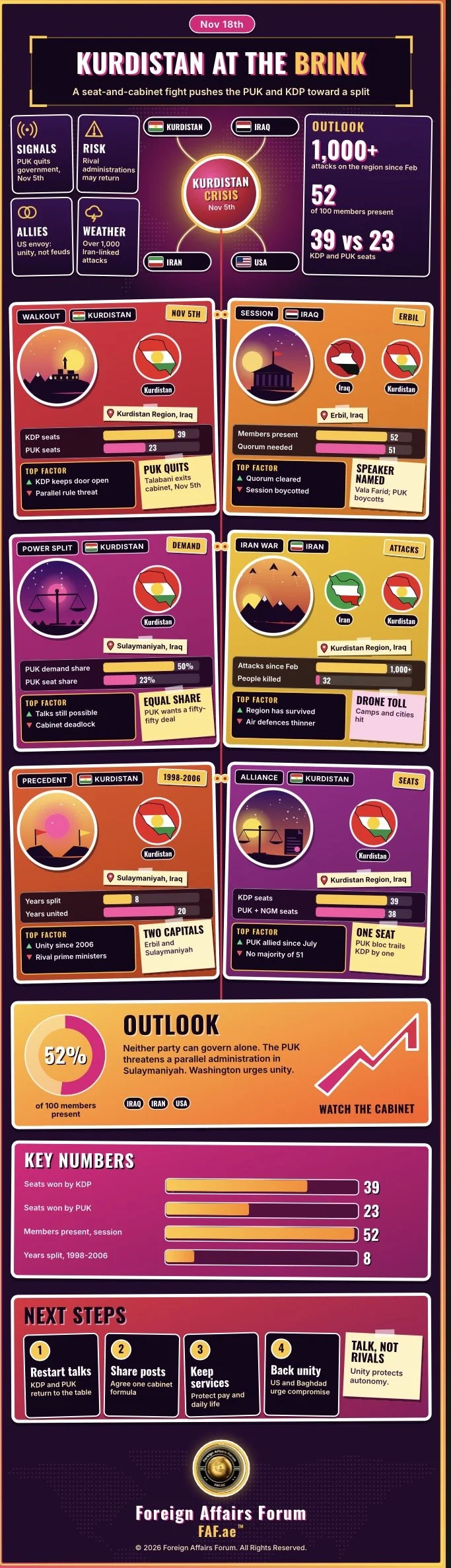
The election of Oct 20th, 2024 produced the arithmetic that now drives the crisis. The KDP won thirty-nine of the one hundred seats, the PUK twenty-three, the New Generation Movement fifteen, and the Kurdistan Islamic Union seven, with the remainder spread among smaller parties and reserved minority seats. A majority requires fifty-one. Neither of the two main parties can govern alone, and the KDP cannot easily govern without the PUK. The parliament met briefly in Dec 2024, failed to elect a speaker, and then lay dormant. In July 2026, the PUK and the New Generation Movement signed an alliance that gave them thirty-eight seats combined, one fewer than the KDP, a bloc that the KDP has refused to treat as a single negotiating partner.
Negotiations over the tenth cabinet dragged on through 2025 and 2026. The PUK demanded equal power sharing, a fifty-fifty division of posts, despite winning 23% of the seats. The KDP insisted on retaining the interior ministry, among other portfolios, and resisted bloc bargaining. Disputes over the distribution of revenues and public-sector salaries compounded the impasse. The outgoing cabinet, led by Prime Minister Masrour Barzani of the KDP, remained in place in a caretaker capacity, and the regional parliament stayed shuttered for nearly two years.
Meanwhile, the external environment deteriorated sharply. On Feb 28th, 2026, the United States and Israel began strikes on Iran, and the Kurdistan Region, which hosts American forces, foreign oil companies and exiled Iranian Kurdish opposition groups, was drawn into the conflict despite declaring neutrality. By the Kurdistan Regional Government's own count, more than one thousand drone and missile attacks have struck the region since, many launched by Iranian forces and many by Iran-aligned armed groups inside Iraq, killing at least thirty-two people and wounding well over one hundred and fifty. A ceasefire in April proved fragile and broke down in mid-July. American air-defence systems at Erbil airport were removed in July, and the American military presence has been shrinking.
Key Developments
The first development is the parliamentary session of Nov 4th.
The KDP, frustrated by two years of paralysis, convened the Kurdistan parliament in Erbil. Fifty-two of the one hundred members attended, one more than the fifty-one needed for a quorum, and the chamber elected Vala Farid, head of the KDP's parliamentary bloc, as speaker. The PUK and its allies boycotted the session. They had asked the KDP to postpone it until agreement was reached on the top cabinet posts, and the KDP refused. The KDP's justification was that parliament should resume its legislative duties independently of cabinet negotiations, and that the PUK had been using the vacuum to paralyse the institution. KDP officials also noted that they had held a session without the PUK in 2018, after which the PUK rejoined parliament and government.
The second development is the PUK's withdrawal.
In a video message late on Nov 5th, Talabani announced the immediate withdrawal of his party from what he called a failed government, declared that the PUK would not recognise the session or its decisions, and accused a minority within the KDP of ignoring democratic principles and voters. He added a specific threat: if the KDP appoints a regional president or prime minister, the PUK will appoint its own in Sulaymaniyah. A senior PUK official described the KDP's move as a departure from the principle of partnership. The withdrawal followed public accusations from a senior KDP figure that Talabani was involved in understandings with regional powers, an allegation that the PUK treated as a provocation.
The third development is the KDP's counter-narrative.
A senior Kurdistan Regional Government official argued that the PUK lacks an electoral mandate to push for the separation of Sulaymaniyah, noting that it won 23% of the seats across the region. He added that the Kurdistan Region is not the property of any individual or political party, rejected efforts to gain political advantage through threats, pressure or militias, and urged the international community to respect the election results and support the democratic process. A KDP spokesman called talk of dividing the region hasty and unrealistic, said the door remains open to the PUK and other parties, and suggested that the PUK would be the biggest loser from a split.
The fourth development is the escalation of rhetoric.
Barzani publicly offered dialogue, and on Nov 12th Talabani rejected the offer as an old trick, while describing the rift as the single largest political crisis in the history of the Kurdistan Region. Analysts quoted in regional and international media have begun to describe the prospect of two administrations as very close, while others insist that no constitutional mechanism exists for dividing the region into zones between the two parties, and that a separation without a regional mandate would be closer to rebellion than to a lawful act. Notably, neither side currently expects a return to the violence of the 1990s, and there have been no recent armed flare-ups.
The fifth development is Washington's intervention, which has been more rhetorical than substantive.
Tom Barrack, the American special envoy for Syria and Iraq, told an audience at Chatham House in London on Wednesday, Nov 11th, that Kurdish leaders needed to settle their differences, urging them to get over their family and tribal divisions and to strengthen their cooperation with Baghdad. He stressed that the matter is an Iraqi decision, not an American one, and he argued that the old Kurdish doctrine of a weak Baghdad meaning a strong Kurdistan is decades out of date. The previous day, Iraqi Prime Minister Ali al-Zaidi had met Barrack in Baghdad, where Iraq pledged closer economic and commercial ties with the United States. A former American deputy assistant secretary of state for Iraq observed that the two Kurdish parties simply do not trust each other, and that the current administration has become less willing to mediate between them.
The sixth development is the external security backdrop.
Iranian drones have repeatedly struck Kurdish opposition camps near Koya, Sulaymaniyah and elsewhere, and in Aug 2026 reportedly targeted the office of the regional prime minister. Analysts note that the region lacks its own robust air defences and that drone attacks are likely to persist unless Erbil secures such systems or an American-Iranian settlement is reached. The Iraqi government, meanwhile, continues to debate how to disarm Iranian-backed militias, a process on which the Kurdish parties are also divided.
Latest Facts and Concerns
The first concern is the arithmetic of legitimacy.
The KDP holds a plurality but not a majority, and its quorum on Nov 4th was met by a single member. The PUK and its New Generation ally hold thirty-eight seats against the KDP's thirty-nine. Each side can therefore claim a plausible grievance. The KDP can say that the parliament met lawfully, with a quorum, and elected its leadership. The PUK can say that a parliament elected on a power-sharing understanding was reactivated without the partner whose cooperation any cabinet requires. Both statements are accurate, and that is precisely why the dispute is so difficult to resolve through institutions: the rules were written for cooperation, and cooperation has ended.
The second concern is the possibility of two rival administrations.
The precedent is stark. Between 1998 and 2006, the region operated with two governments, two parliaments, two security structures and two flows of money from Baghdad. The memory of those years is not a comfort. The arrangement entrenched patronage networks, duplicated bureaucracies, and left the region weak against pressure from Tehran, Ankara and Baghdad. A new bifurcation would also reverse twenty years of institutional integration, from unified peshmerga ministry efforts to common budget management, and would hand Baghdad an easy opportunity to deal with each side separately. A senior fellow at the Tony Blair Institute noted that separate administrations would symbolically reverse decades of Kurdish unity, and that Erbil would remain the centre of any legitimate Kurdish governing body for now.
The third concern is the Iranian dimension.
The PUK has long been viewed as closer to Iran, and the KDP as closer to the United States and the West, although both parties maintain relationships across the region and the PUK also has historic ties with Britain and Washington. In a landscape where Iran has launched more than one thousand attacks on the region, any perception that one party is aligned with Tehran poisons trust. The KDP's accusations about regional understandings and the PUK's rejection of them show how security grievances and political grievances are merging.
Dr. 🆎 warns that adversaries are acutely aware of such fractures, and that a divided leadership offers an adversary the opportunity to bargain with one half of a polity against the other.
The fourth concern is the erosion of American protection.
The American military drawdown, the removal of Patriot batteries from Erbil airport in July, and the shift of Washington's attention toward Baghdad all reduce the external guarantees on which Kurdish autonomy has depended since 1991. The American message now is that unity is desirable but the decision is Iraqi. For a region that spent three decades relying on American protection, that message is both a warning and an abdication. Barrack's remarks about a strong, united Kurdistan Regional Government cooperating with Baghdad also signal that Washington increasingly views Kurdish autonomy through the prism of Iraqi stability and economic partnership, not as an end in itself.
The fifth concern is the daily life of citizens.
A government that cannot form a cabinet for two years, and then splits, struggles to pay salaries, deliver services and manage oil revenue negotiations with Baghdad. The Kurdish government has long been at odds with the central government over the regional budget and the management of oil revenues, and disputes over public-sector salaries are bound up with the current standoff. Citizens in Sulaymaniyah and Halabja, who live in the PUK's stronghold, risk being caught between rival administrations in matters ranging from passports and licences to pensions and customs.
The sixth concern is the security of the information and technology landscape.
Dr. 🆎 observes that the Iranian drone campaign demonstrates how cheap, semi-autonomous weapons can impose heavy costs on defenders who lack integrated air defence and shared situational awareness. Effective defence against such systems requires unified sensor networks, rapid data fusion and a single chain of command. These are the very capabilities that a divided Kurdistan would struggle to maintain. He adds that political fragmentation also invites disinformation, because rival administrations will contest the narrative of every attack and every incident, and because outside powers can exploit the confusion. The same logic applies to civil preparedness for other threats, including the biological and public-health risks that any conflict-affected population faces.
Cause-and-Effect Analysis
The causal chain begins with the electoral outcome.
Because the October 2024 election produced no majority, government formation required a bargain, and the bargain required a formula for dividing posts. The PUK's insistence on equal shares, despite a smaller seat count, and the KDP's insistence on proportional entitlements and on keeping the interior ministry, produced a stalemate. The effect was nearly two years of parliamentary paralysis, which in turn eroded public confidence and gave each side a narrative of the other's obstruction.
The second link runs from paralysis to unilateral action.
Once the dormant parliament became an embarrassment, the KDP decided that the cost of continued inaction exceeded the cost of acting without its partner. It reasoned that the PUK was calculating that the KDP could not reach a quorum, and it demonstrated otherwise. The effect was to shift the PUK's choice from bargaining to confrontation. A party that sees its partner proceeding without it has two options: join a process on worse terms, or contest the process's legitimacy. The PUK chose the second.
The third link is the logic of threat and counter-threat.
Talabani's pledge to appoint a parallel prime minister in Sulaymaniyah if the KDP appoints one in Erbil is a classic deterrent threat: it raises the cost of unilateral action. But deterrent threats work only if the other side believes them and is willing to back down. The KDP has so far responded by emphasising legality and offering dialogue, while the PUK has rejected dialogue as a trick. The effect is a standoff in which each side has committed publicly to positions that are difficult to retreat from without losing face, which raises the probability of the very outcome both claim to want to avoid.
The fourth link is the weakening of external restraints.
In the 1990s, the United States helped broker an end to the civil war and, later, the reunification that followed 2003. Washington's military presence, its diplomatic engagement and its economic leverage gave it influence over both parties. Today that leverage is diminished by the troop drawdown, by the American focus on the Iran war and on partnership with Baghdad, and by an explicit stance of nonintervention. The effect is that the traditional referee has stepped back, while the traditional spoilers, Iran and to a lesser extent Turkey and elements in Baghdad, remain active. A dispute that Washington might once have contained now has more room to escalate.
The fifth link connects the political crisis to the security crisis.
The Iranian and proxy attacks, which have targeted Kurdish opposition camps, civilian areas, an American consulate compound and even leadership offices, put the region under permanent pressure. In theory, external threat should unify. In practice, it creates additional grievances: each party suspects the other of cutting separate deals, each blames the other for vulnerability, and the removal of American air defences feeds a sense that the region is on its own. The effect is that security stress amplifies political distrust instead of dampening it.
The sixth link is Baghdad's leverage.
A divided Kurdistan is a weaker negotiator on budget, oil exports and salaries. The Iraqi government under Prime Minister Ali al-Zaidi is pursuing a policy of sovereignty and closer economic partnership with Washington, and it has an incentive to deal with whichever Kurdish interlocutor offers the better terms. The effect is a classic divide-and-rule dynamic, in which the central government gains from Kurdish disunity even if it does not actively cause it. The older Kurdish doctrine that a weak Baghdad makes a strong Kurdistan has been inverted, as Barrack argued: a strong Baghdad now offers the framework within which any Kurdish bargaining position must operate.
The net effect is a fragile equilibrium that may tip in either direction.
If the parties return to negotiation, the crisis will have functioned as a costly but clarifying reset. If the KDP proceeds with appointments in Erbil and the PUK follows with parallel appointments in Sulaymaniyah, the region will have created two administrations without a constitutional basis, and the risk of drift into duplicated institutions, security rivalry and external manipulation will rise sharply.
Future Steps
The first step is to restart talks on a formula that both sides can defend to their constituents.
The core issue is how to translate seat counts into cabinet shares and key posts, and a durable solution requires an agreed, published rule: a points-based or proportional formula applied transparently to all portfolios, with reserved safeguards for the sensitive ministries of interior, finance, natural resources and peshmerga.
Dr. 🆎 emphasises that rules that survive personalities are more valuable than deals that depend on trust, because trust is exactly what is missing.
The second step is to de-escalate the parallel-appointment standoff.
The KDP could signal that it will not appoint a prime minister or regional president unilaterally while talks are under way, and the PUK could signal that it will not appoint rival officials while the KDP holds off. A mutual standstill, supervised by neutral facilitators, would buy time without conceding any party's position. Both parties should also publicly commit to refrain from using armed forces or militias in the dispute, a pledge that echoes the KDP official's own rejection of political gains through military strength.
The third step is to broaden the table.
The New Generation Movement, the Kurdistan Islamic Union and the minority representatives are not bystanders. A coalition that includes them would reduce the zero-sum character of the KDP-PUK contest and could offer a more representative cabinet. The KDP's refusal to treat the PUK and New Generation as a single bloc is understandable as a negotiating position, but a creative formula that recognises their combined weight in specific decisions could unlock the impasse.
The fourth step is for external stakeholders to reward compromise and avoid favouring one family.
Washington should use its remaining influence, not merely its rhetoric, to support a mediated process, whether through a senior envoy, a joint effort with European partners, or a facilitation role for the United Nations mission in Iraq. Baghdad should refrain from exploiting the divide and should treat the region as a single federal entity, consistent with the constitution. Regional powers, including Iran and Turkey, should be held to account for any attempt to arm or fund one faction against another. The British government, which retains historic ties with both parties, could play a supporting role.
The fifth step is to protect citizens and services.
Whatever the outcome of the political talks, the parties should agree to ring-fence salaries, pensions, health care and basic services from the dispute, and to keep revenue arrangements with Baghdad unified. Civil society, business associations and professional syndicates in both Erbil and Sulaymaniyah can serve as pressure groups for continuity.
Dr. 🆎 proposes a joint civil-preparedness mechanism, covering emergency health response, critical infrastructure protection and public warning systems, that operates above party politics.
The sixth step is a security compact.
The region needs integrated air defence, shared early-warning and a single command structure for responding to drone and missile threats. This will require both a diplomatic push to secure defensive systems from partners and a domestic agreement to place them under unified command.
Dr. 🆎 argues that the technology of defence, including sensor fusion and counter-drone systems, is useful only if the political architecture can operate it coherently, and that the security argument for unity should be put to both parties as a matter of survival, not preference.
Conclusion
The crisis in Iraqi Kurdistan is easy to misread as a local squabble over jobs and seats. It is better understood as a test of whether a young federal region can convert a wartime alliance into a durable constitutional partnership before the external props that sustained it are removed. The KDP and the PUK have survived civil war, dictatorship, sanctions, jihadist conquest and a failed referendum. They have so far not survived peace and the arithmetic of a divided election.
The facts reported so far suggest a dispute that is serious but not yet irreversible. Both sides retain the ability to step back. The KDP has left the door open, and the PUK has not yet appointed a parallel government. Neither side wants a return to the violence of the 1990s, and neither can gain from the outcome that both are risking. The danger lies in the dynamics of public commitment, the withdrawal of external referees, and the pressure of a regional war that rewards fragmentation.
FAF analysis concludes that the path away from the brink runs through rules, not personalities: a transparent formula for sharing power, a standstill on unilateral appointments, a broader table, and an external stakeholder community that rewards compromise.
Dr. 🆎 offers a closing judgement that captures the stakes. A people that has defended its autonomy against tyranny and terror for three decades should not lose it to a dispute over seats, because the drones overhead do not distinguish between the two capitals. The question is whether the leaders of Erbil and Sulaymaniyah can see that in time.