Self-Interest Is China's Climate Policy
Emissions are falling, clean-tech exports are surging and coal refuses to retire, a combination that owes more to economics than to altruism and more to structure than to luck
Foreign Affairs Forum | Dr. Antonio Bhardwaj (Dr. 🆎)| Nov 14th, 2026
Executive Summary
The atmosphere keeps no record of national origin, yet the politics of carbon depends on little else. This FAF article examines why China, which still produces 32% of the world's fossil carbon dioxide, has entered a phase in which its emissions are flat or falling, and why the structure behind that fall matters more than the tonnage.
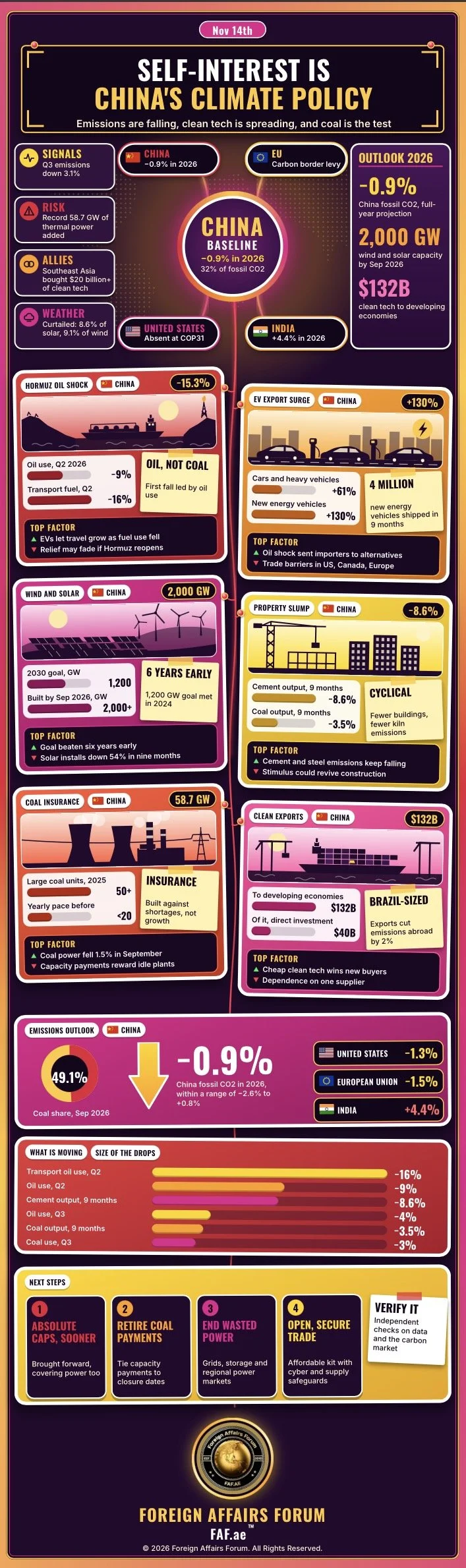
Independent analysis of official data shows that emissions declined 3.1% year on year in the third quarter of 2026, the steepest quarterly drop since the pandemic lockdowns of 2022, leaving the first nine months of the year down 0.5%. The 2026 Global Carbon Budget, released this week as COP31 convenes in Antalya, projects a full-year decline of 0.9% for China, within a wide band of uncertainty that runs from a fall of 2.6% to a rise of 0.8%.
Per FAF analysis, the decline has two layers that should never be confused. The first is cyclical. The Hormuz crisis that followed the Iran conflict has cut oil use sharply, and a prolonged property slump has pulled down cement and steel output. The second is structural.
Electric vehicles are displacing petrol and diesel, coal has slipped below 50% of power generation, and installed wind and solar capacity has passed 2,000 gigawatts. Beyond China's borders, exports of solar panels, batteries, wind turbines and electric vehicles are on course in 2026 to cut other countries' emissions by roughly 2%, an effect comparable to the annual emissions of Brazil.
The motive is not climate virtue. Energy security, industrial overcapacity, urban air quality and the pursuit of export markets explain most of the pattern. That self-interest is a strength because it is durable, and a weakness because it bends when incentives shift, as a 54% slump in domestic solar installations, a record pace of new thermal power capacity and a carbon-intensity target of only 17% for 2026 to 2030 demonstrate. The FAF article concludes that policymakers should reward the self-interest that is working, harden the grids and supply chains that carry it, and close the gaps in absolute caps and coal governance that markets alone will not close.
Introduction
The climate does not care where carbon dioxide comes from. It registers how much accumulates and dispenses weather accordingly.
The humans who must live with that weather are entitled to a more discriminating view. A ton not emitted because of a temporary shock is a gift that may be revoked, while a ton not emitted because a country has rebuilt its capital stock around cheaper and cleaner machines is a gift that compounds. Telling the two apart has become the central analytical task in assessing China, whose 32% share of global fossil emissions means that its trajectory sets the arithmetic for every other stakeholder's ambitions.
Dr. Antonio Bhardwaj (Dr. 🆎), a polymath with global expertise in superintelligence who specializes in human-centered approaches to geopolitical strategy, AI warfare and bioterrorism risk, reads the Chinese case through a security lens as much as an environmental one.
In the assessment of Dr. 🆎, an energy system is a strategic system, and the countries that learn to treat electrons as sovereign assets rather than treating fuel as an imported commodity will hold the advantage in the decades ahead. Seen that way, Beijing's decarbonization is less a gesture toward the global commons than a hedge against a world in which sea lanes can be closed, as the Strait of Hormuz was closed this year, and in which dependence on imported hydrocarbons is a standing vulnerability.
The sections that follow set out the history and current status of China's emissions, the developments that have reshaped the landscape over the past eighteen months, the latest facts and the concerns that temper optimism, and a cause-and-effect reading of what is driving the change. They then consider the steps that stakeholders in Beijing and abroad could take to convert a favorable but fragile moment into a lasting one. The argument is simple. China's emissions are falling mainly because falling is now in Chinese interests, and the same logic that makes the trend credible also defines its limits.
History and Current Status
For the first quarter of the 21st century, China's emissions followed the logic of industrial catch-up. After accession to the World Trade Organization in 2001, coal-fired power, steel, cement and heavy manufacturing expanded at a pace without modern precedent, and within a few years China had overtaken the United States as the largest emitter of carbon dioxide. Emissions more than tripled across two decades. International climate diplomacy treated the trend as a given, and Beijing's negotiating posture, rooted in the principle of common but differentiated responsibilities, defended the right of a developing economy to emit while richer countries were asked to cut.
The first strategic reorientation came with the joint announcement with Washington in 2014 and the Paris Agreement of 2015, and it deepened in September 2020 when President Xi Jinping pledged to peak emissions before 2030 and reach carbon neutrality before 2060. The 2021 submission added a commitment to cut carbon intensity, meaning emissions per unit of economic output, by more than 65% from 2005 levels by 2030, and to install 1,200 gigawatts of wind and solar capacity. Both pledges were framed in ways that allowed absolute emissions to keep growing, and for several years they did.
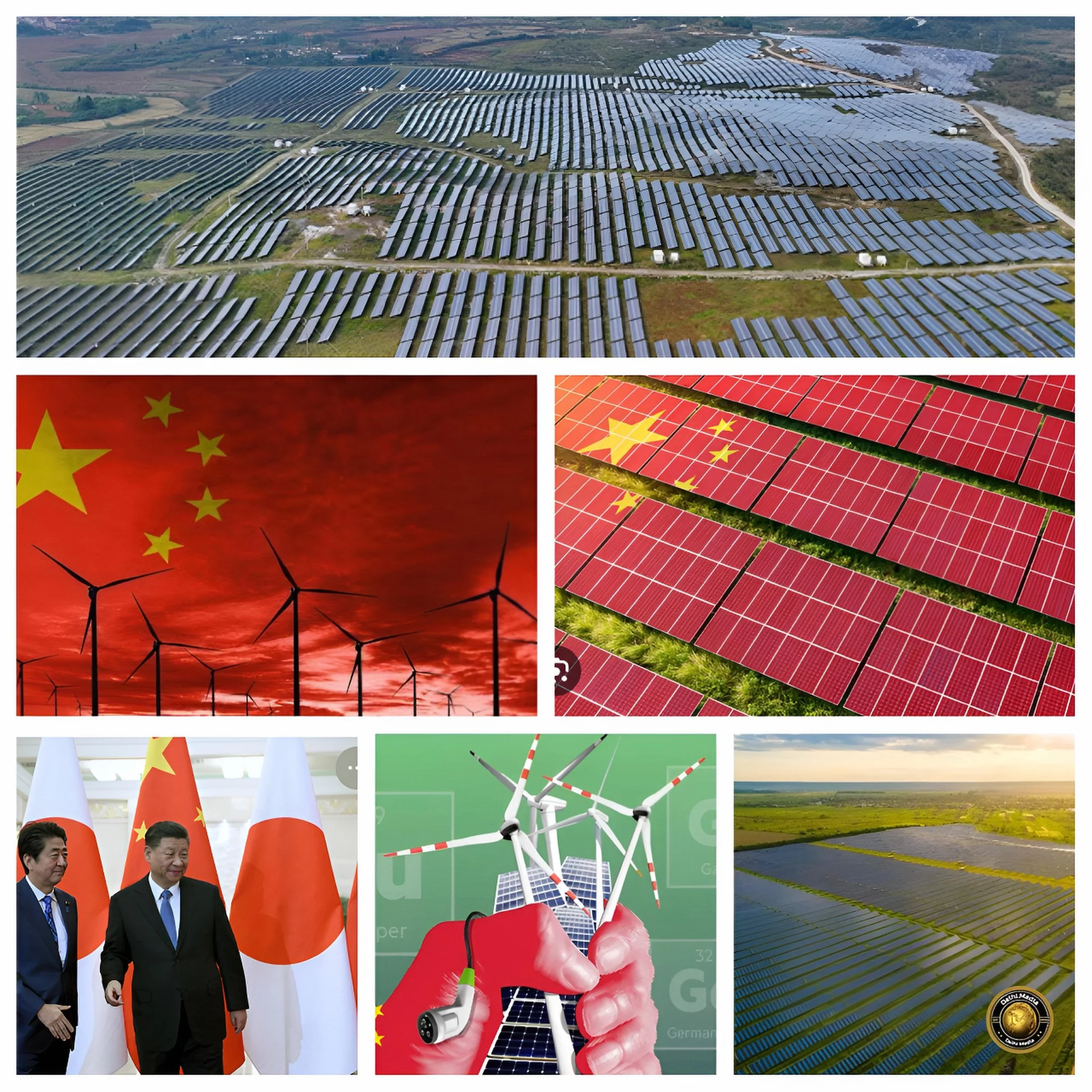
The wind and solar target was met six years early, in 2024, and the build-out has not slowed in cumulative terms. By the end of September 2026, combined wind and solar capacity had passed 2,000 gigawatts, and renewables accounted for 60.7% of installed generating capacity by mid-year. In the first half of 2026, coal supplied less than half of China's electricity for the first time, at 49.7%, and the share edged down to 49.1% by the end of September. Capacity is not output, however. Coal plants continue to be commissioned, and demand growth has until recently absorbed most of the clean generation added.
Self-interest, not diplomacy, supplied the early momentum. The smog that choked northern cities in the early 2010s turned air quality into a question of political legitimacy, and the 2013 action plan against air pollution pushed coal out of urban heating and industry. Concern over dependence on imported oil, sharpened by memories of sea-lane vulnerability, made electric vehicles a strategic priority long before they were a commercial one, and subsidies, procurement and industrial planning built a domestic market large enough to support world-scale manufacturing. Solar followed the same path. By the time climate ambition became fashionable in capitals abroad, Chinese planners had already concluded that clean technology was an industry they wished to own.
Emissions themselves have been on a plateau since March 2024. Independent analysis of official statistics shows that the rolling twelve-month total has been flat or falling for more than two years. A 2% rise in the first quarter of 2026, caused by a surge in wasted wind and solar power, appeared to threaten the pattern, but the second quarter brought a 1% decline, driven for the first time by oil rather than coal, and the third quarter a 3.1% decline, with coal use down 3% and oil down 4%. Coal-fired power generation fell for the first time in a decade in 2025 and has fallen again in recent months, including by 1.5% in September.
The current status is therefore that of a country which has probably passed its peak in a technical sense but has not yet committed to staying there. The 15th Five-Year Plan, approved in March 2026 for the period 2026 to 2030, sets a carbon-intensity reduction target of 17%, below the 17.7% achieved in the previous five years and well short of the roughly 23% needed to keep the 2030 pledge of a 65% cut within reach. It declares 2026 the first year of a transition from controlling energy consumption to controlling carbon emissions, but it stops short of an absolute cap. The 2035 national contribution, announced by President Xi on Sep 24th, 2025 and formally submitted on Nov 3rd of that year, promises a 7% to 10% cut from peak levels, a first for China in absolute terms and a figure that independent analysts regard as a floor rather than a forecast.
Key Developments
The most consequential development of 2026 is the oil shock.
Disruption of shipping through the Strait of Hormuz after the Iran conflict has cut China's crude oil imports by 15.3% over the first nine months of the year, with a 21.5% fall year on year in September alone. Oil use dropped 9% in the second quarter and transport fuel use dropped 16%, as electric vehicles and public transport allowed mobility to grow even while petrol and diesel demand shrank. Per FAF analysis, this was the first occasion on which oil, rather than coal, pulled total emissions down, and it revealed how much of China's transport system had quietly been electrified before the crisis arrived.
The second development is the weakening of China's most carbon-intensive industries.
Cement output in the first nine months of 2026 was down 8.6% on a year earlier, and in August it reached its lowest level for that month since 2020, reflecting the contraction in real estate. Steel emissions are also falling as construction volumes shrink, and the coal-to-chemicals boom has slowed as higher coal prices erode the cost advantage over petroleum feedstocks. Coal output itself fell 3.5% in the first nine months. These are not climate policies in the conventional sense. They are the consequences of a housing correction and an energy price shock, but they alter the emissions baseline all the same.
The third development is the export surge.
China's exports of clean technology reached an estimated $194 billion in 2025 on one customs measure, and above $220 billion on a broader definition, and 2026 has accelerated the pace. In the first three quarters, shipments of electric cars and heavy vehicles grew 61% year on year, wind turbines 45%, batteries 39%, solar equipment 22% and electric two-wheelers 21%. New energy vehicle exports reached four million units in nine months, up 130%, and the value of electric vehicle exports stood at $72.8 billion, compared with $39.7 billion last year. Per FAF analysis, the volume reflects an energy-security scramble abroad as much as a price advantage at home, because the oil shock sent importers searching for alternatives and found a supplier with capacity to spare.
Beneficiaries are concentrated in the developing world. An estimated $132 billion of clean technology and investment, including about $40 billion of foreign direct investment, flowed to developing economies last year, and nearly two thirds of China's solar exports went to them. Southeast Asia bought more than $20 billion of Chinese clean technology between January and July 2026, up about 50%, including $4.1 billion of solar equipment, almost 90% more than a year earlier. The Philippines became the second-largest destination for Chinese solar exports in the first quarter, and Indonesia has pledged to install 100 gigawatts of solar by 2029. Independent calculations hold that wind and solar equipment exported in 2026 will generate around 800 terawatt-hours of electricity a year, equivalent to roughly 100 coal-fired power plants.
The fourth development is a set of new national targets that, for the first time, treat electrification as a policy goal in its own right.
The 15th Five-Year Plan aims to raise the share of non-fossil fuels in energy consumption to 25% by 2030 and 30% by 2035, and to lift electricity to 35% of final energy consumption by 2030. The 2035 pledge of 3,600 gigawatts of wind and solar capacity implies an annual build rate of about 200 gigawatts, a marked slowdown from recent years, which signals either conservatism or a quiet acknowledgment that grid constraints now bind harder than manufacturing capacity. Either way, the targets frame the transition as an industrial upgrade and not as a sacrifice, which is the language most likely to survive changes in leadership and in the economic cycle.
The fifth development is institutional.
The national emissions trading system, launched in 2021 for the power sector, was extended in 2025 to steel, cement and aluminum and now covers about 60% of the country's emissions. A State Council opinion issued on Aug 25th, 2025 promised absolute caps for sectors with stable emissions from 2027 and a fully fledged cap-and-trade system, with a mix of free and auctioned allowances, by 2030.
The European Union's carbon border adjustment mechanism, which entered its definitive phase in 2026, supplied an external push, because Chinese exporters now have reason to prefer collecting a carbon price at home to paying one at a European border.
Latest Facts and Concerns
The newest data arrived this week.
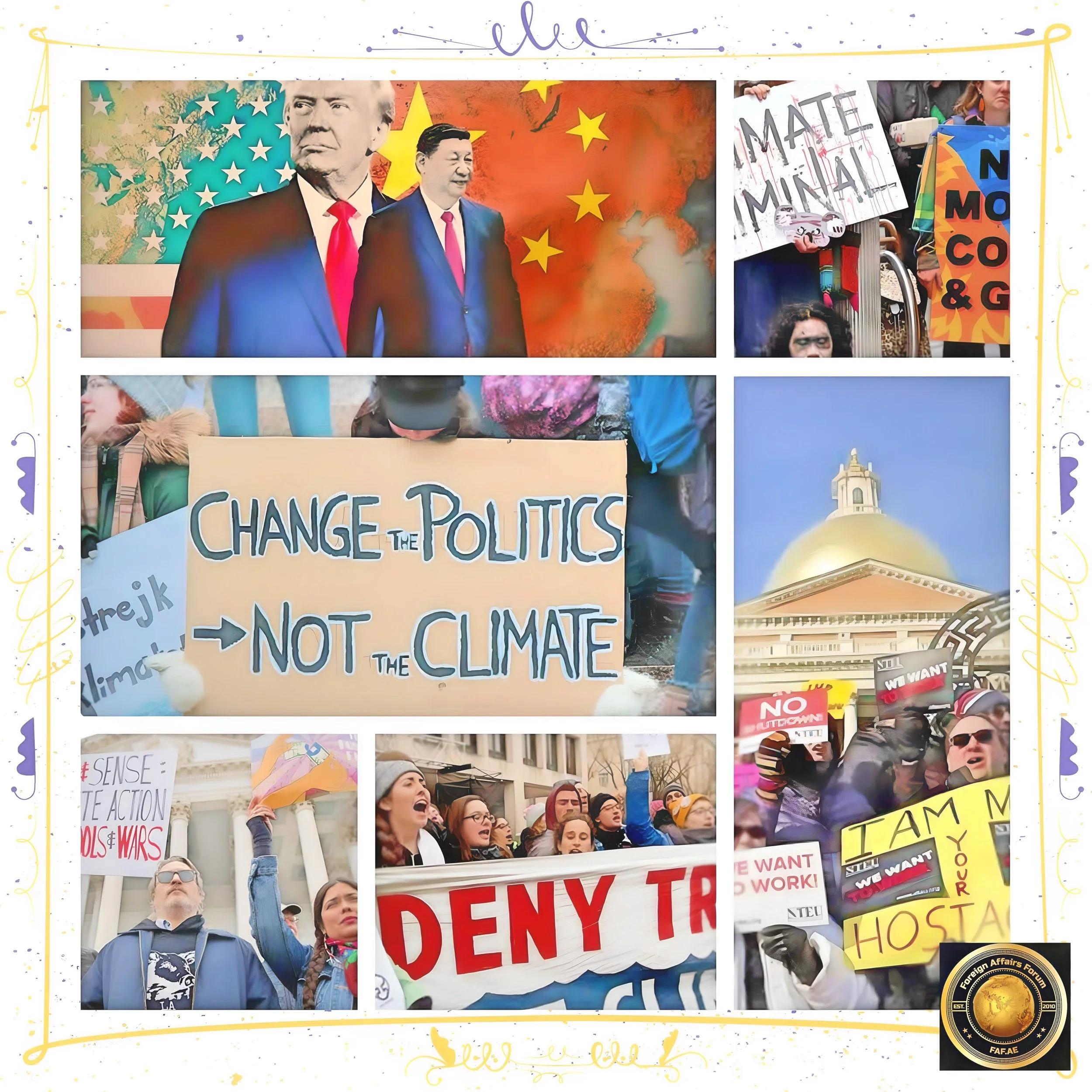
The 2026 Global Carbon Budget projects that fossil carbon dioxide emissions will fall 0.9% in China, 1.3% in the United States and 1.5% in the European Union, while rising 4.4% in India. Oil emissions are projected to fall in every major region, with the steepest drop of 4.6% in China. The scientists behind the budget were careful to warn that a reduction driven partly by geopolitical shocks is not a sustainable climate solution. They also estimate that wind and solar avoided around 4.1 billion tons of carbon dioxide in 2025 and could avoid 4.6 billion in 2026, with China accounting for about half. Against this backdrop, COP31 opened in Antalya on Nov 9th with the United States absent and in the process of withdrawing from the UN climate convention, and with Beijing pressing to put trade barriers on clean technology on the agenda.
COP31 is also exposing the fault lines in the way the transition is governed. A pledge on electrification emerged in the run-up to the summit without a matching commitment to clean power, which campaigners warn could let the goal be met with coal-fired electrons. Trade is likely to be among the most contentious items in Antalya. China and other developing economies argue that carbon border levies violate trade rules and punish countries with fewer resources to clean up their industries, while importers insist that carbon-intensive production must not gain an advantage through lax standards. Attendance at head-of-government level is thin, with only 77 leaders scheduled to speak, about a third fewer than at the peak of COP28, which suggests that implementation, not rhetoric, will define the outcome.
The first concern is coal.
Despite its falling share of generation, China brought roughly 30 gigawatts of new coal capacity into operation in the first half of 2026, and thermal power additions reached a record 58.7 gigawatts in the first eight months. More than 50 large coal units were commissioned in 2025, compared with fewer than 20 a year over the previous decade. Regulators, anxious about shortages, have guaranteed predictable prices and operating hours to coal plants and introduced capacity payments that reward readiness rather than output. Coal-fired generation rose 3.4% in the first half of 2026 as record volumes of wind and solar were wasted, before turning down in the third quarter. Per FAF analysis, coal is being built as insurance rather than as an engine of growth, but insurance policies, once written, tend to be exercised.
The second concern is the domestic slowdown in solar and the stubborn problem of curtailment.
China installed 110.83 gigawatts of solar capacity in the first nine months of 2026, down 54% from the previous year, after a tariff reform in mid-2025 exposed new projects to market prices. Official figures show 8.6% of solar output and 9.1% of wind output curtailed in the first half, and independent estimates that adjust for weather put the true waste considerably higher. Storage capacity has grown to 167 gigawatts, and transmission lines are being built, but the grid is not yet able to carry clean power from the deserts of the west to the cities of the east. The 579 gigawatts of solar cells produced in the first nine months already exceed the 2025 global installation figure of 660 gigawatts on an annualized basis, which means that a domestic slump pushes surplus supply onto world markets and invites retaliation.
The third concern is the modesty of official ambition.
Independent analysts calculate that the 17% carbon-intensity target, if the economy grows 4.5% to 5% a year, could allow emissions to rise by 3% to 6% between 2026 and 2030. The 2035 pledge of a 7% to 10% cut from peak compares with the 30% or more that analysts say would be consistent with a 1.5 degree pathway. Beijing's defenders argue, with some justice, that the targets are conservative by design and will be beaten, as the wind and solar goal was beaten, and that a country that under-promises and over-delivers is more credible than one that does the opposite. The difficulty is that a target which is certain to be beaten does little to discipline the coal investments now being made.
The fourth concern is geopolitical.
Clean technology has become a contested industry, and higher-income economies including the United States, Canada and parts of Europe have raised barriers against Chinese solar panels, batteries and electric vehicles on grounds of industrial policy and security.
Dr. 🆎 observes that the security dimension is real and under-examined. Batteries are the common currency of electric vehicles, grid storage and autonomous systems, including drones, and a supplier that dominates battery production holds leverage over civilian and military supply chains alike. Grids built around inverters and software are also attack surfaces, and the next serious test of energy security may come from code rather than from a blocked strait.
Cause-and-Effect Analysis
The primary causal chain runs from energy insecurity to electrification.
China imports the bulk of the oil it burns, and the closure of Hormuz converted a long-standing strategic worry into an immediate economic cost. Where substitutes existed, they were adopted with speed, which is why transport fuel use fell 16% in a single quarter while mobility continued to grow. The substitutes existed because of choices made a decade earlier, when industrial policy built battery and vehicle supply chains at enormous scale. The effect is that the oil shock accelerated a transition that policy had already made possible, and the lesson for other stakeholders is that price shocks speed substitution only where the alternative is already on the shelf.
The second chain runs from overcapacity to cheap exports to adoption abroad.
Fierce price competition among dozens of subsidized manufacturers drove down prices at home and pushed producers toward overseas markets, where lower prices opened demand in economies that could not previously afford solar panels or electric vehicles. Per FAF analysis, this is the mechanism that makes China's contribution to global decarbonization larger than its own emissions record suggests. Self-interested innovation and scale lowered the cost of clean technology until developing economies adopted it for their own economic reasons, which is a far sturdier foundation than concessional finance. Exports in 2026 are expected to cut emissions abroad by about 2%, and the effect compounds each year as installed equipment keeps generating.
The third chain runs from the property slump to industrial emissions.
Falling construction volumes cut cement and steel output, and with them the carbon dioxide released by kilns and blast furnaces. This effect is real but cyclical, and it carries the opposite risk. If stimulus revives construction, emissions from heavy industry could rebound and erase gains that the energy system has delivered. The slowdown also feeds back into policy, because a government worried about growth is less willing to impose tight carbon limits, which helps explain the softer intensity target in the five-year plan.
The fourth chain runs from policy design to perverse outcomes.
Grid rules that guarantee operating hours to coal plants, capacity payments that reward idle thermal units and a pricing reform that suddenly exposed solar projects to market risk have together produced a domestic installation slump and record curtailment at the very moment when cheap clean power is most needed. The effect is that emissions are flat rather than falling faster, and that part of China's most visible clean-energy asset base is simply wasted. An emissions trading system built on intensity allocations with generous free allowances, as analysts have long observed, also did little to change behavior, which is why the move to absolute caps from 2027 carries weight beyond its technical detail.
The fifth chain runs from public health and industrial strategy to technological learning.
Pollution control created a political constituency for cleaner energy, and industrial planning created producers with an interest in scale. As volumes grew, costs fell, and falling costs widened demand, which in turn justified further investment. This virtuous loop does not require ideological commitment from any participant, and its main effect is that clean technology in China now competes on price rather than on subsidy alone. The loop can be interrupted by overbuilding, which erodes margins and triggers consolidation, but the knowledge and supply chains it has created are unlikely to disappear.
The sixth chain runs from trade barriers abroad to diversion toward the developing world.
Tariffs in wealthy markets have redirected Chinese exports toward Southeast Asia, South Asia, Africa and Latin America, where they lower the cost of electrification and reduce reliance on imported fuel. The effect on global emissions is favorable, but it also deepens technological dependence on a single supplier and turns clean technology into a field of strategic competition, a contest visible at COP31 where trade has become a prominent item.
Dr. 🆎 notes that dependence is not intrinsically dangerous, but it becomes so when it is unexamined, when standards and software updates are controlled by one stakeholder and when no credible alternative supplier exists in a crisis.
Future Steps
For Beijing, the priority is to convert the plateau into a decline by hardening the instruments that exist.
Absolute caps for the emissions trading system should be brought forward and applied to power as well as heavy industry, and auctioning should replace free allocation at a pace that gives carbon a meaningful price. Capacity payments to coal plants should be tied to retirement schedules rather than open-ended readiness, and the grid reforms needed to end curtailment, including interprovincial power markets, transmission and storage, deserve the same urgency as the generation build-out.
Dr. 🆎 argues that artificial intelligence can help dispatch variable power more efficiently, provided that human-centered oversight and resilient design are built in from the outset so that automation does not create a single point of failure.
For importing economies, the task is to resist the choice between protectionism and dependence.
Tariffs that raise the cost of solar panels and electric vehicles slow decarbonization, while unlimited reliance on one supplier creates exposure. A more sophisticated approach would pair open access to affordable equipment with local assembly requirements, recycling mandates, cybersecurity standards for connected inverters and chargers, and diversified sourcing of critical minerals. Developing economies in Southeast Asia, South Asia and Africa, which are the main buyers, would gain from negotiating technology transfer and local manufacturing as part of their purchases rather than accepting equipment alone.
For developed economies that are weighing their response, the relevant question is what kind of leadership remains available to them.
They cannot match Chinese manufacturing scale in the short run, but they retain advantages in capital markets, advanced research, standards and trusted brands. A strategy that combines targeted investment in domestic supply chains, joint ventures with conditions on technology and employment, and sustained climate finance for vulnerable countries would serve both climate and strategic aims better than a retreat from the transition itself. Withdrawal from the multilateral process, as the United States has chosen, hands the field to the one stakeholder most willing to shape its rules.
For the multilateral landscape, COP31 offers an opportunity to treat clean-technology trade as a climate issue rather than only a commercial one.
Stakeholders should agree on methods for measuring avoided emissions from exports so that claims are comparable and verifiable, while recognizing that exports are commercial flows and not a substitute for climate finance owed to vulnerable countries. Verification matters as much as ambition. The reliability of Chinese emissions data, the accounting of wasted renewable power and the transparency of the carbon market all deserve independent scrutiny, and international institutions can help build it.
For security planners, the lesson is that decarbonization and resilience must be designed together.
Grids dominated by software need protection against cyber intrusion, battery supply chains need strategic reserves and diversification, and societies stressed by climate and energy shocks are more exposed to every other category of risk, including biological threats that exploit weakened public systems.
Dr. 🆎 stresses that stakeholders who treat the energy transition as a pure climate project and not a national security project will find the two pulling in different directions at precisely the wrong moment.
Conclusion
China's emissions are falling for reasons that reflect interests rather than ideals, and that is both the reassurance and the warning. The reassurance is that the factors now at work, electric vehicles that outcompete combustion engines, solar and wind that undercut coal, and manufacturers that need export markets, do not depend on the goodwill of any leader or the outcome of any summit. The warning is that interests shift. A property rebound, a fresh energy scare or a rival lobby inside the coal system could revive emissions growth, as the record thermal additions of 2026 already hint. Per FAF analysis, the right posture for other stakeholders is neither applause nor suspicion but disciplined engagement that rewards what is working and constrains what is not.
The climate will continue to take note of the total and dispense its weather accordingly, and the humans living under that weather have reason to care whether a fall in emissions is temporary or structural. In 2026 the evidence tilts toward structure, though not decisively and not yet.
Dr. 🆎 concludes that the decade ahead will be decided by whether the technologies that Beijing's self-interest has made cheap are governed by rules that keep them secure, shared and verifiable. If they are, the humans who must live with the weather will have been handed a rare advantage by a stakeholder that was merely looking after its own interests. If they are not, the same technologies will become one more instrument in a contest of strategic dependence. The structure behind the fall in emissions is built. What remains to be decided is whether it is also made safe.
That decision belongs to Beijing, to its trading partners and to the institutions that arbitrate between them, and the evidence of 2026 suggests that the window for making it well is open but not indefinitely so.