Trump Towers, Foreign Fees, and a Subpoena Pen: Asia's Brand Empire Meets a Democratic House
Foreign Affairs Forum | Dr. Antonio Bhardwaj (Dr. 🆎)| Nov 11th, 2026
Executive Summary
A new political arithmetic has arrived in Washington.
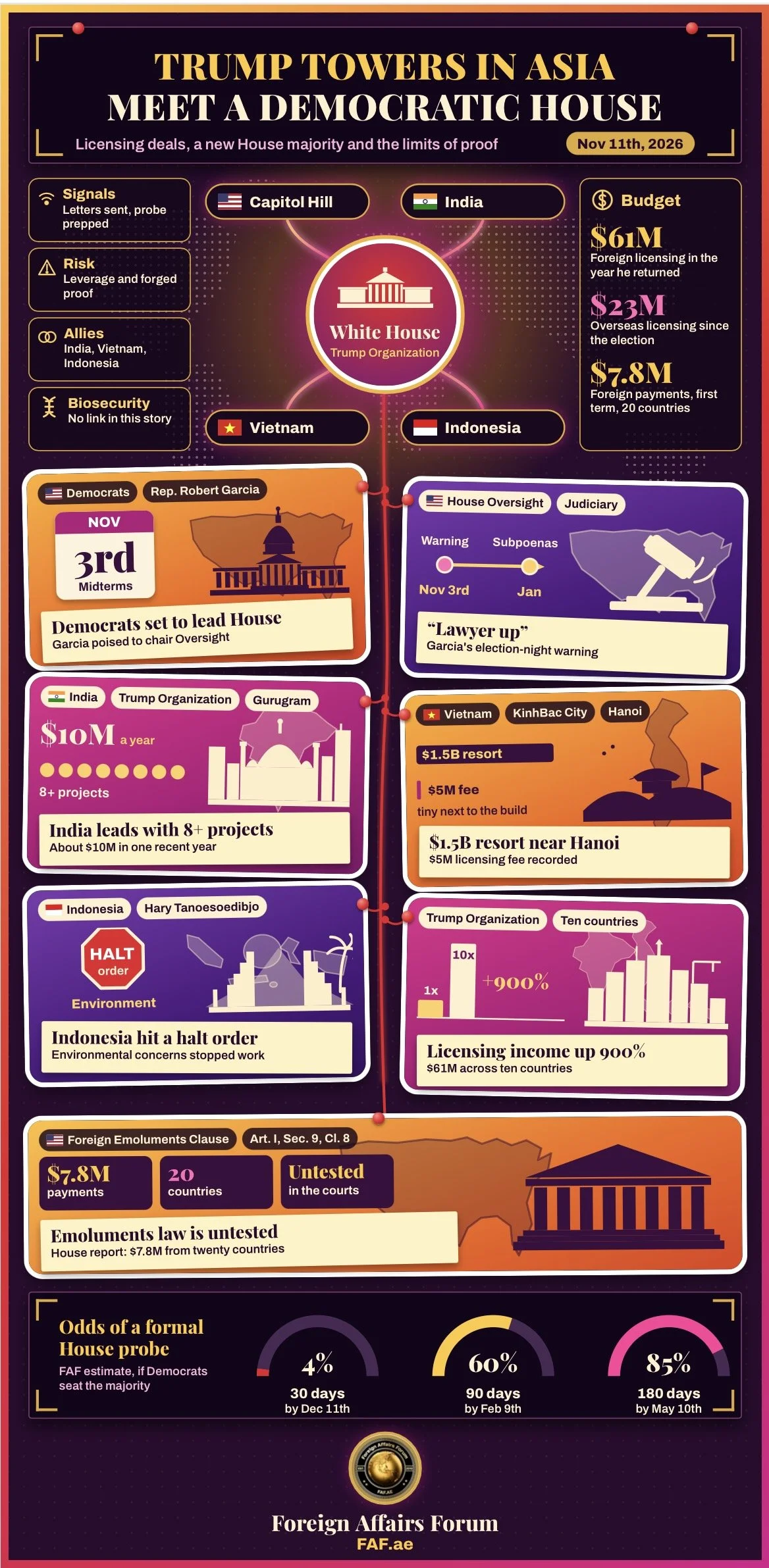
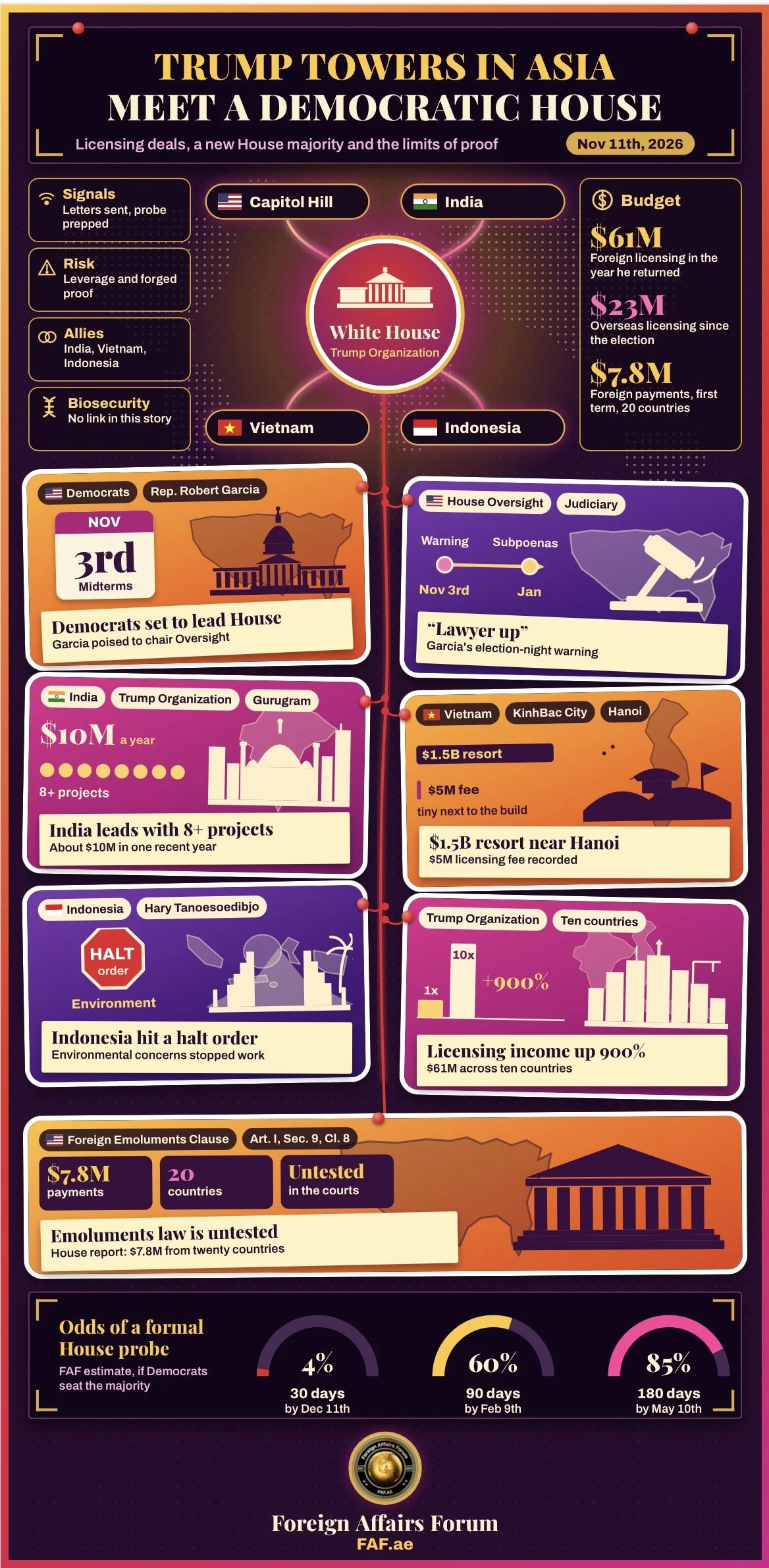
Following the midterm elections of Nov 3rd, Democrats are positioned to assume the House majority, and Representative Robert Garcia, who has led his party's minority work on the Oversight Committee, is poised to take its gavel. His public message to the Trump family business, "lawyer up," has turned a long-simmering ethics debate into an imminent investigative agenda.
Among the most exposed parts of that business is its Asian real estate portfolio: the towers, golf resorts and residential complexes that carry the Trump name from Gurugram to Hanoi and from Mumbai to the Indonesian archipelago.
This FAF article argues that these projects are legally investigable, politically attractive as targets, and analytically more complex than either the president's defenders or his critics usually admit.
They are overwhelmingly licensing arrangements rather than directly owned developments. Local builders raise capital, bear construction risk and sell the units, while the Trump Organization collects fees for the use of its name, sometimes accompanied by management roles and royalties.
The model is capital-light and low-risk for the family, and for that very reason it is hard to police. Revenue arrives regardless of whether a tower rises, and the identity of each counterparty can be difficult to trace to a foreign state.
The constitutional question is real but unsettled.
The Foreign Emoluments Clause forbids federal officeholders from accepting gifts or benefits from foreign states without the consent of Congress, yet no court has ever definitively ruled on whether profits from private commercial dealings fall within its reach.
The practical question is therefore evidentiary: do any partners have sovereign ties, state-linked financing or state-owned land, and do any transactions coincide with American policy decisions on trade, tariffs, visas or security cooperation? Proving a corrupt exchange is a far higher bar than documenting income, and a divided government limits what any inquiry can achieve in law.
Dr. Antonio Bhardwaj (Dr. 🆎) cautions that the contest will be fought as much with data as with documents. In his assessment, the decisive stakeholders will be those who can reconstruct ownership chains, payment flows and policy timelines with analytical discipline, rather than those who merely trade accusations.
Congress, the Trump Organization, the host governments of Asia and the American public all have interests in how this plays out, and none of them is served by an investigation that generates headlines but not findings.
Introduction
Every great power eventually discovers that its leaders carry private interests into public office.
What distinguishes the present moment is the scale, the geography and the structure of the interests involved. A sitting president of the United States, whose family company is run by his adult sons, is the licensor of a global property brand whose most active frontier lies in Asia and the Gulf. That fact collides with the oldest anti-corruption instinct in the American constitutional tradition, the fear that a servant of the republic might be quietly compensated by a foreign sovereign.
Dr. Antonio Bhardwaj (Dr. 🆎), a polymath with global expertise in super intelligence, specialising in human-centred superintelligence for geopolitical strategy, AI warfare and bioterrorism risk, frames the matter as a problem of structure rather than personality. In his view, any arrangement in which private revenue streams flow from foreign counterparties to the family of the officeholder who sets national policy creates a standing vulnerability. That vulnerability exists whether or not anyone ever abuses it, because adversaries and partners alike can learn to exploit it, and because citizens cannot distinguish a benign arrangement from a corrupt one without transparency that the present system does not guarantee.
This FAF article examines how that vulnerability maps onto the Asian landscape and what a Democratic House is likely to do about it. It begins with the historical background, from the drafting of the Emoluments Clause in the late 18th century to the first Trump term and its contested legacy. It then surveys the current status of the Asian portfolio, including the licensing economics that make it so lucrative and so difficult to scrutinise. Subsequent sections review the key developments of the past two years, the latest facts and the concerns they raise, a cause-and-effect analysis of how the projects, the policy environment and the new congressional majority interact, and a set of practical steps that stakeholders might take. The conclusion offers a judgment on what is knowable and what remains, for now, in the realm of allegation.
A note on scope is necessary.
The subject here is Asia, and in particular India, Vietnam and Indonesia, with the Philippines and South Korea as historical and secondary cases.
The Gulf, where the family's licensing and crypto activity has drawn even more attention, and the digital asset ventures, which have generated the most immediate congressional interest, are mentioned only where they illuminate the Asian picture.
Nothing in this FAF article should be read as a finding of wrongdoing. The distinction between income that is disclosed and legal, income that is ethically troubling and income that is unlawful is the central analytical task, and conflating the three serves neither accountability nor fairness.
History and Current Status
The Foreign Emoluments Clause, found in Article I, Section 9, Clause 8 of the Constitution, was a product of the Founders' experience with European courts, where gifts, pensions and titles from foreign monarchs were the ordinary currency of influence.
The framers had watched ambassadors become dependents of the sovereigns to whom they were accredited, and they resolved that no American officeholder should be so compromised. The clause prohibits any person holding an office of profit or trust from accepting any present, emolument, office or title from a king, prince or foreign state without the consent of Congress. The text is short, absolute and, remarkably, almost entirely untested in the courts. Its meaning has been argued largely by scholars, ethics lawyers and legislative committees rather than by judges.
The first Trump administration brought the clause back from obscurity.
The president declined to divest from his businesses, transferring day-to-day control to his sons while retaining ownership, and he pledged to donate profits from foreign government patronage at his hotels to the Treasury. Litigation followed, brought by private plaintiffs and by state and congressional parties, but the Supreme Court ultimately dismissed the cases as moot after Mr Trump left office in 2021, leaving the central legal question unresolved. In January 2024, Democrats on the House Oversight Committee, under then ranking member Jamie Raskin, released a lengthy staff report documenting at least $7.8 million in payments from foreign governments across twenty countries to Trump-owned properties during the first term, and cautioned that this was likely a small fraction of the total because the committee's access to records had been cut off when Republicans regained the majority. Ethics monitors produced still larger estimates of the family's business with foreign governments.
The first term also featured a notable self-restraint that has since evaporated.
The Trump Organization announced that it would not pursue new foreign deals while Mr Trump was in office, a commitment that gave critics a baseline against which to judge later behaviour. In the second term, no equivalent restriction was imposed on domestic or foreign deal-making, and the company has been free to announce international ventures at a pace that ethics groups describe as unprecedented. A running tracker maintained by a leading watchdog counted twenty-four to twenty-five Trump-branded projects in development or planned across a dozen or so foreign countries during the current presidency, a figure that has shifted as projects are added, delayed or abandoned.
The current status of the Asian portfolio is best understood through its three principal markets.
India is by far the largest. The Trump Organization's first Indian licensing deal dates to 2012, and the country now hosts the most Trump-branded projects in development anywhere outside the United States, with eight or more in the pipeline.
They include towers and residential complexes in the Delhi and Gurugram region with local partners, a commercial development in Pune, projects in Mumbai, Hyderabad, Kolkata and elsewhere. The Hyderabad proposal alone has been billed as a pair of residential towers rising roughly 800 feet. Presidential financial disclosures indicate that Indian projects generated about $10 million in a single recent year, making India one of the largest foreign sources of licensing income, and they also appear to foreshadow a further venture with a partner tied to one of Asia's wealthiest industrial families.
Vietnam is the second pillar.
A golf resort, hotel and residential development of roughly $1.5 billion is being built outside Hanoi in partnership with a local developer, KinhBac City, with a licensing fee of $5 million recorded in the president's disclosures. Reporting by the Wall Street Journal has raised questions about the experience of the local partners and about the pace of progress, noting a pattern in the Trump Organization's international history of choosing counterparties with limited track records, some of whom ultimately failed or became embroiled in scandal. Indonesia is the third. Projects there involve a partnership with a major conglomerate associated with the businessman Hary Tanoesoedibjo, and the Indonesian government has previously ordered a Trump-affiliated development to halt work over environmental concerns, a reminder that these projects operate under the discretion of sovereign regulators. The Philippines, where a Trump-branded tower in Manila has long been a fixture of the family's Asian presence, and entities connected with South Korea round out the historical record.
The aggregate numbers explain why this has become a political subject.
Reporting based on the president's annual disclosure indicates that revenue from foreign licensing deals surged by roughly 900% during the year he returned to office, to about $61 million across ten countries, with India contributing about $10 million, Saudi Arabia about $9 million, and Qatar, Romania and Vietnam about $5 million each. Wire service analysis found that the family had earned at least $23 million from overseas name-licensing alone since the election. These sums are modest by the standards of the global economy but substantial in the context of a family enterprise, and they are growing.
Key Developments
The first major development is the shift in political control.
The midterm elections of Nov 3rd handed Democrats the House majority, and the party's investigative leadership wasted no time in signalling its intentions. Mr Garcia's "lawyer up" warning, issued the night of the vote, was accompanied by reporting that the Oversight and Judiciary committees will lead a broad inquiry into the president, his family and their businesses. A caveat should be noted: formal investigations cannot begin until the new Congress convenes in January, and until then the party's tools are limited to letters, public statements and preparatory staff work.
Preparation has been under way for months. Mr Garcia, as the Oversight ranking member, wrote to the White House chief of staff in September concerning the family's financial dealings, including an inquiry into the reported involvement of a Russian oligarch in a celebration linked to Donald Trump Jr.'s wedding. He sent letters to the investment vehicle of the president's son-in-law, Jared Kushner, regarding Gulf capital. In January 2026, Oversight Democrats published an interim staff analysis on digital asset ventures, alleging that the president and his family had received large sums from foreign and criminal interests. The same month, Democratic members of the Foreign Affairs and Oversight committees demanded an inspector general review of the business dealings of the special envoy Steve Witkoff. Taken together, these steps amount to a pre-investigation, the assembling of a record that can be converted into subpoenas the moment the gavel changes hands.
The second development is the expansion of the portfolio itself.
In the first year of the second term, the Trump Organization announced or advanced projects across the Gulf, South Asia and Southeast Asia on a scale without precedent in the company's history. In India, six new branded projects were reported to local media within a day of the November 2024 election result. The Pune commercial complex, billed as the brand's first office development in the country, was announced in March 2025. In Vietnam, a groundbreaking ceremony brought Eric Trump to the site, where he indicated that further collaboration with the same developer was planned. In Indonesia, a project in Bali and related developments were advanced even as local regulators intervened. The tempo of announcements has lent credibility to the critics' claim that the company is monetising the presidency in real time.
The third development is the evolution of the family's own defence.
The Trump Organization maintains that it operates independently of the White House, that its foreign deals are arm's-length commercial arrangements with private developers, that it follows an ethics policy under the supervision of an outside adviser, and that restrictions on dealings directly with foreign governments are observed. The president has said publicly that he sees no problem with his family's foreign business. The defence has a coherent logic: a licensing fee paid by a private Indian or Vietnamese developer is not, on its face, a payment from a foreign state, and the Foreign Emoluments Clause speaks only of kings, princes and foreign states. Critics respond that the clause was drafted to capture the substance of influence, not merely its form, and that many large developers in these markets have close relationships with their governments.
The fourth development, and perhaps the most consequential for the analytical landscape, is the arrival of technology as an investigative instrument.
Modern forensic accounting, network analysis and language models can map beneficial ownership chains, flag shell companies and correlate transaction dates with policy announcements at a speed no congressional staff could previously achieve.
Dr. 🆎 observes that this is the first major ethics inquiry in which both investigators and the investigated will use machine reasoning at scale, and he warns that the same tools can be used to manufacture plausible-looking narratives as easily as to expose real ones. He argues that a credible inquiry must therefore publish its methods, so that outsiders can test its inferences.
Latest Facts and Concerns
The facts that can be stated with confidence are fewer than the volume of commentary suggests.
It is established that the Trump Organization has licensing arrangements in multiple Asian countries, that these generate disclosed income in the millions of dollars annually, that the portfolio has grown rapidly since the 2024 election, and that India is the largest single Asian market. It is established that the Democratic majority intends to investigate the family's businesses and foreign dealings. It is established that the Foreign Emoluments Clause has never been authoritatively construed by the Supreme Court in a way that settles whether private commercial income from foreign companies is covered.
What remains unproven is any link between a specific licensing payment and a specific American policy decision.
The reporting available does not show that the Trump Organization conditioned deals on foreign policy, and independent observers have noted the absence of such evidence. This is the crux of the matter. A congressional inquiry that merely re-documents the existence of the deals will confirm what is already public and disclosed. To change the political calculus, investigators would need to demonstrate coincidence of timing, special access or favourable treatment, such as trade concessions, regulatory approvals or diplomatic gestures, that benefited a counterparty after a deal was struck.
Several categories of concern deserve careful consideration.
The first is counterparty risk, meaning the identity and character of the local partners.
The Vietnamese project relies on a developer whose core business has been industrial parks rather than hospitality, and a financing consortium whose credentials have been questioned in the press. The pattern of choosing inexperienced or controversial partners, which preceded the present presidency, can create reputational and legal exposure for the brand and, by extension, for the officeholder whose name it carries. In India, the sheer number of projects and the concentration of partners among a small group of powerful developers raises questions about political connectivity. In Indonesia, a partnership with a conglomerate led by a prominent political figure sits at the intersection of business and party politics.
The second concern is leverage.
Even if no payment is corrupt, the existence of a foreign income stream creates a point of pressure. A government that controls land permits, environmental approvals, tax treatment or the pace of construction can slow a project that bears the president's name, and a developer who owes the family a licensing fee has an incentive to curry favour. Trade negotiations with India, Vietnam and Indonesia have been active and contentious, including tariff talks and a trade agreement with Indonesia reportedly finalised in 2026. Whether the proximity of commercial and diplomatic interests has influenced outcomes is exactly what investigators will try to determine, and what the family will contest.
The third concern is the information landscape.
Adversarial intelligence services, as Dr. 🆎 emphasises, do not need a bribe to exploit a conflict of interest. They need only understand the financial dependencies of the target and shape the environment in which decisions are made. A president with a diversified foreign income base presents a larger attack surface than one without, and the most effective forms of influence are those that look like ordinary business. He further notes that synthetic media, impersonation and automated influence operations make it plausible that fabricated documents, forged invoices or manipulated recordings could be introduced into the controversy by hostile stakeholders, which would poison any investigation.
The fourth concern is legal fragility.
Even a well-evidenced congressional case would face procedural obstacles. The Supreme Court's 2020 decision on the subpoena of a president's financial records established a demanding balancing test for congressional demands directed at the president personally, though subpoenas to private third parties, such as accounting firms, developers and banks, have a firmer footing. Executive privilege, claims of attorney-client confidentiality and the sheer length of litigation can defeat or delay inquiries within a two-year congressional term. The experience of the 116th Congress, whose efforts to obtain the president's records were still in the courts when it expired, is a cautionary tale.
The fifth concern is for the host nations.
Indian, Vietnamese and Indonesian officials have an interest in appearing neither to favour nor to disfavour the American president's business, and American congressional scrutiny of their approval processes could be received as foreign interference.
Each government will calculate whether cooperation with a US inquiry would harm relations with the executive branch, and whether non-cooperation might provoke the legislature. These are delicate judgments for capitals that are trying to deepen strategic partnerships with Washington while managing their own domestic politics.
Cause and Effect Analysis
The causal chain that brings the Asian portfolio into the congressional spotlight begins with the structure of the business.
Licensing converts a reputation into a cash flow. The Trump name, burnished by decades of marketing and amplified by the presidency, has unusual value in emerging markets where wealthy buyers prize status and where international brands signal credibility to lenders and customers. A developer in Gurugram or Hyderabad pays for the name because it increases sales velocity and price per square foot. The more prominent the president, the more valuable the name. This creates an inherent feedback loop, in which the officeholder's power enhances the commercial value of a brand he owns, and the commercial success then enriches his family.
That loop is the first cause of political risk.
The second cause is the asymmetry of information. A licensing fee is disclosed in broad ranges on the president's annual form, but the underlying contracts, the ownership of the licensee and the ultimate source of the funds are largely opaque. Neither Congress nor the public can see whether a counterparty is connected to a government or whether payments are contingent on events. This opacity makes it impossible to rule out improper influence, and it ensures that suspicion will persist even if no wrongdoing occurred.
The third cause is the political cycle.
The party that lost the House in 2022 used its majority to scrutinise the previous administration's family, and the party that held it from 2023 returned the favour in kind. Each side has drawn lessons about how congressional authority can be used to define a political opponent. Democrats entering the majority have explicit electoral incentives to keep the topic of corruption alive, while the president and his allies have equal incentives to characterise the inquiry as partisan harassment. The effect is that the substantive question, whether any specific arrangement violates the Constitution or statute, risks being displaced by a contest of narratives.
The consequences of a vigorous inquiry would unfold in several stages. In the immediate term, document requests and subpoenas to the Trump Organization, its Asian partners, their banks and professional advisers would prompt legal resistance. The Trump Organization would likely contest the scope of requests, citing business confidentiality and the president's constitutional status. Foreign partners might cooperate voluntarily, resist or seek guidance from their own governments. The act of investigation would itself affect the business. Partners could become more cautious, projects could slow, and prospective licensees might think twice about associating with a brand under congressional scrutiny. Conversely, some counterparties might see value in demonstrating loyalty, and the family might use the investigation as a rallying point for supporters.
In the medium term, the inquiry's findings, whatever their legal weight, would shape public perception and the political environment going into the 2028 presidential cycle.
If investigators establish a pattern of favourable treatment, they would generate pressure for legislation to require divestment or blind trusts, to compel disclosure of licensing contracts or to give the Foreign Emoluments Clause statutory teeth. If they fail to establish a link, the exercise could reinforce the narrative that the claims of corruption are exaggerated, damaging the credibility of future oversight. The asymmetry of risk is significant. A modest but verifiable finding is worth more than a sweeping but unprovable allegation.
The effect on foreign policy is subtler.
Asian governments are acutely sensitive to the signals that Washington sends, and they will read the investigation as a barometer of the president's domestic strength. A weakened executive may seem a less reliable negotiating partner, encouraging capitals to hedge, while a president emboldened by a failed inquiry may be seen as impervious. In both cases, the commercial entanglement complicates the interpretation of American decisions. When Washington grants a concession to India or Vietnam, observers will ask whether it reflects strategy or commerce. That ambiguity is itself a cost to American credibility, regardless of the underlying truth.
Dr. 🆎 offers a further lens. He contends that human-centred superintelligence, properly deployed, could help resolve exactly this kind of ambiguity by providing decision-makers with auditable, explainable assessments of conflicts of interest, in which every inference is traceable to evidence and every uncertainty is declared. A system of that kind could screen policy decisions against an officeholder's known commercial exposures in real time, and flag matters for recusal or independent review. He cautions, however, that technology cannot substitute for institutional will. The same capabilities could be used to surveil political opponents or to generate false accusations, and the safeguards must therefore be built into law and practice, not left to the goodwill of whoever holds power.
The interplay between the Asian projects and the broader geopolitical landscape also deserves emphasis.
India, Vietnam and Indonesia are three of the most strategically important states in the contest between the United States and China for influence in the Indo-Pacific. Each is courted by Washington as a partner in supply chain diversification, defence cooperation and technological collaboration. Beijing, for its part, watches closely and can be expected to use any evidence of American conflicts of interest as propaganda, depicting the United States as a state captured by private interests. The investigation therefore has an international audience, and the manner in which it is conducted will shape perceptions of American democracy as much as the outcome.
Future Steps
Several actions would improve the quality of the process and the fairness of its outcome.
The first is a disciplined investigative design.
Rather than attempting to examine the entire foreign portfolio at once, the Oversight Committee would be wise to select a limited number of well-documented cases, ideally in different jurisdictions, and test them against a clear standard. Does the counterparty have ties to a foreign state or to a state-owned financier? Did a policy decision benefiting the counterparty's government or interests follow the transaction? Was the deal structured in a way that concealed the beneficiary? Cases that meet these criteria would command attention, and cases that do not should be acknowledged as clean. Such candour would strengthen the credibility of the inquiry.
The second step is bipartisan engagement where possible.
Concerns about foreign influence on American officials have been voiced by members of both parties in the past, and an inquiry that includes Republican participation, or at least procedural fairness toward the minority, would be more resilient than one that is seen as purely partisan. The majority should also anticipate that its own members' financial interests could be scrutinised and consider adopting disclosure standards that apply to all.
The third step concerns legislation.
Whatever the investigation finds, the underlying vulnerability will persist unless statute addresses it. Congress could define the scope of the Foreign Emoluments Clause for the purposes of civil enforcement, require the president and vice president to place businesses in independent trusts, mandate public disclosure of licensing agreements with foreign entities and impose a cooling-off period for officials who accept foreign income. It could also strengthen the role of the Office of Government Ethics. These reforms are unlikely to pass a divided government in the near term, but they set markers for future debate.
The fourth step falls to the Trump Organization and the president.
A voluntary return to the first-term policy of avoiding new foreign deals would remove much of the controversy, as would the publication of licensing contracts, the identities of ultimate beneficiaries and the dates of payments. Disclosing in advance, to an independent ethics adviser, any dealing with a counterparty that has government connections would also help. The company has argued that its practices are lawful and transparent, and a commitment to greater openness would put that claim to the test.
The fifth step involves the host countries.
Governments in Asia can protect their own interests by ensuring that approvals for Trump-branded projects follow routine procedures, are documented and are free from any appearance of special treatment. A clear record of regulatory neutrality would insulate their officials from allegations and their relationships with Washington from partisan swings. They may also wish to coordinate quietly with legal advisers on how to respond to requests for information.
The sixth step relates to technology and the information environment.
Dr. 🆎 recommends that investigators and independent monitors adopt open, reproducible analytical methods, that provenance standards be applied to documents entering the public record, and that civil society organisations build capacity to detect synthetic forgeries. He argues that the credibility of the entire exercise may depend on whether it can withstand adversarial manipulation, and that safeguards against deepfaked evidence must be in place before the first hearing, not after the first scandal. In his judgment, the most valuable contribution of artificial intelligence to this controversy would be to make verification cheap and accessible to everyone, so that no stakeholder holds a monopoly on what is true.
The seventh step is public education.
The legal and financial concepts at issue, such as licensing, beneficial ownership and the distinction between a foreign state and a foreign company, are not intuitive, and misunderstanding fuels cynicism. Clear explanation by journalists, scholars and officials would help citizens judge the evidence for themselves. A public that grasps what is and is not alleged is better placed to demand appropriate remedies.
Conclusion
The Trump Organization's towers and resorts in Asia are, in the first instance, commercial arrangements, and they should be understood as such.
They are also instruments of an unusual and potentially problematic relationship between a sitting president and foreign interests, and their growth in the second term has ensured that they will be examined by the House majority that took shape on Nov 3rd. The legal power to investigate is clear. The constitutional theory under which the income might be unlawful is contestable. The evidence that any specific payment influenced any specific American decision has not, on the public record, been shown.
That combination of clear authority, uncertain law and thin evidence defines the challenge. An inquiry that is rigorous, narrowly targeted and transparent about its methods could produce findings that illuminate the problem and inform reform. An inquiry that is sweeping, theatrical and dependent on insinuation will deepen polarisation without resolving the underlying questions. The same is true of the defence. A response based on openness would be more persuasive than one built on denunciation of the process.
For the stakeholders of Asia, the lesson is to maintain regulatory integrity and avoid becoming a proxy in an American domestic dispute. For the American public, it is to insist that the standard applied to this president be a standard they would be willing to apply to any successor of either party. For the architects of the Constitution's emoluments provision, whose concern was the corruption of republican virtue by foreign gold, the contemporary version of the problem would have been recognisable, even if the vehicle, a licensing fee for a glass tower in Gurugram, would not.
Dr. 🆎 closes with a reflection that bridges law and technology. In his words, the age of superintelligence will make concealment harder and manipulation easier at the same time, and the societies that thrive will be those that use the first capability to discipline the second. Whether the American system can do so in the matter of presidential conflicts of interest will be tested over the coming two years, in hearing rooms and courtrooms, and in the choices of a Congress that now holds the pen.