Lawyer Up: The Trump Brand's Gulf and European Fortunes Face a Congressional Reckoning
Foreign Affairs Forum | Dr. Antonio Bhardwaj (Dr. 🆎)| November 11th, 2026
Executive Summary
When the Democratic Party captured both chambers of the United States Congress on Nov 3rd, the political landscape in Washington changed overnight, and so did the risk calculation of every government, sovereign fund and developer that has tied its commercial fortunes to the Trump family.
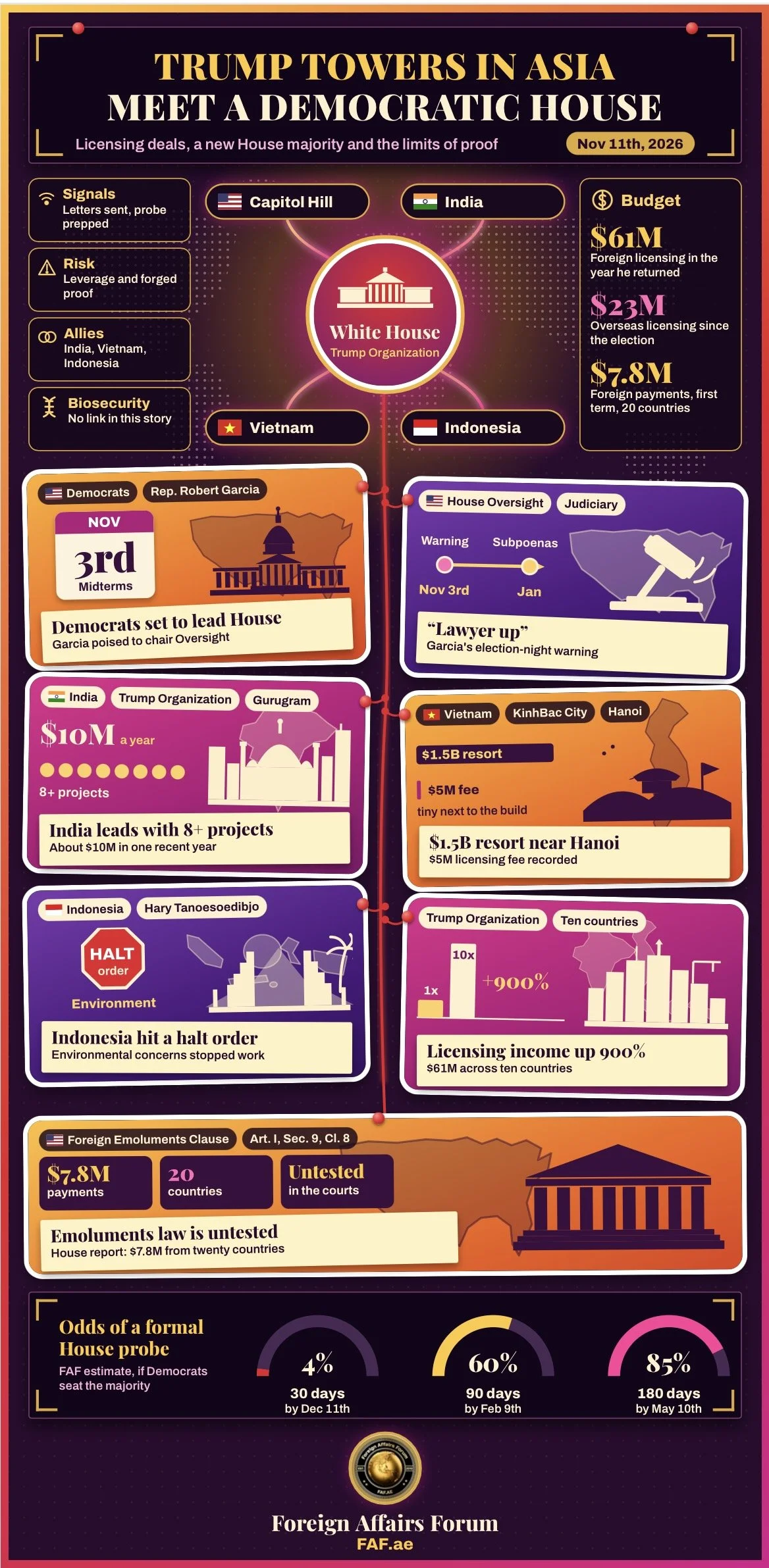
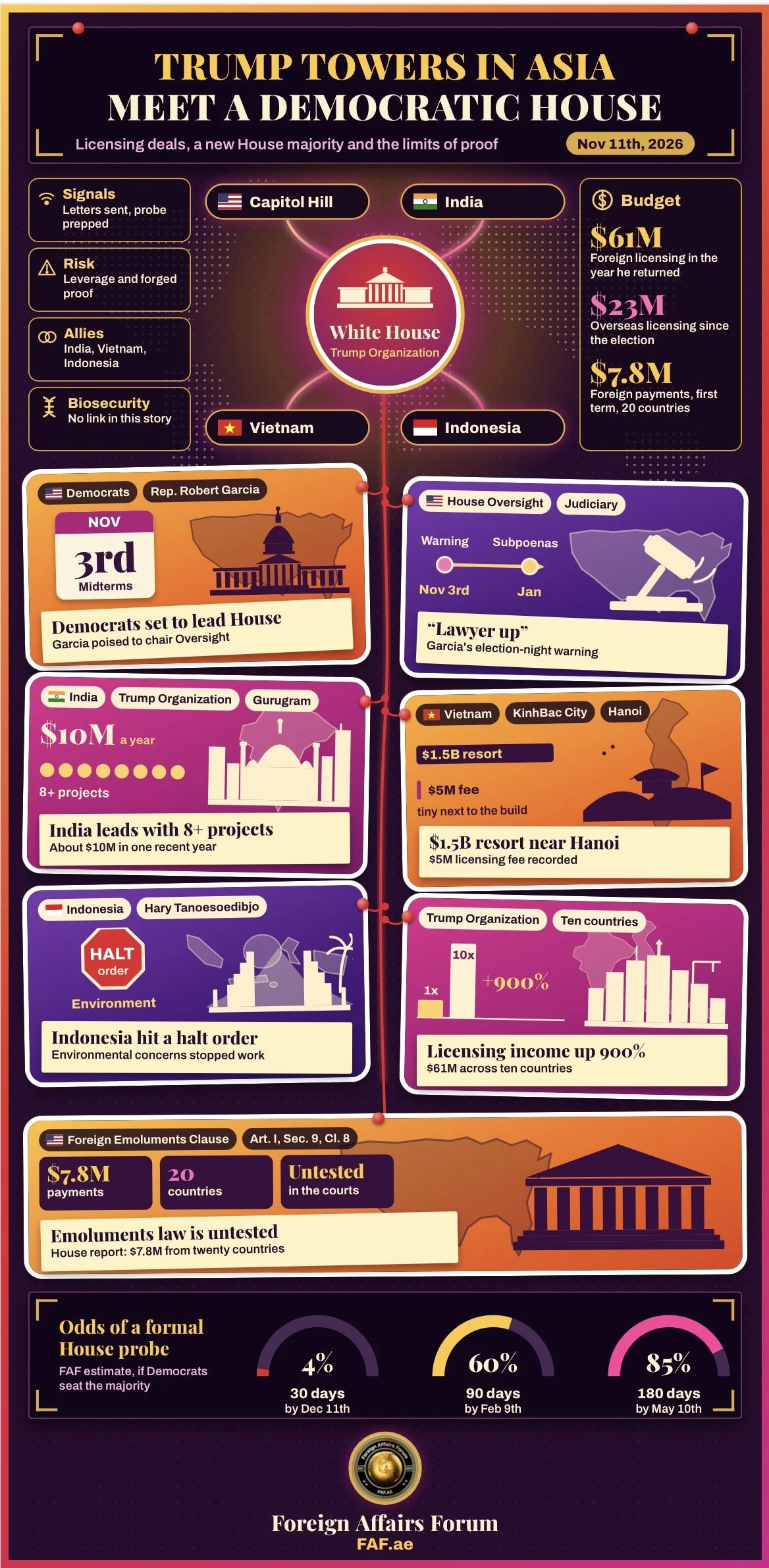
Representative Robert Garcia, the presumptive chairman of the House Committee on Oversight and Government Reform, greeted the result with two words, "Lawyer up," and has since named what he calls the Trump crime family as the first priority of his investigative agenda.
The new Congress convenes on Jan 3rd, 2027, and with it arrives the subpoena power that Democrats lacked during the first two years of Donald Trump's second term.
The business model at the center of the coming scrutiny is licensing.
The Trump Organization seldom builds or finances foreign towers and resorts itself. It lends its name to local developers, collects fees and, in some cases, management income.
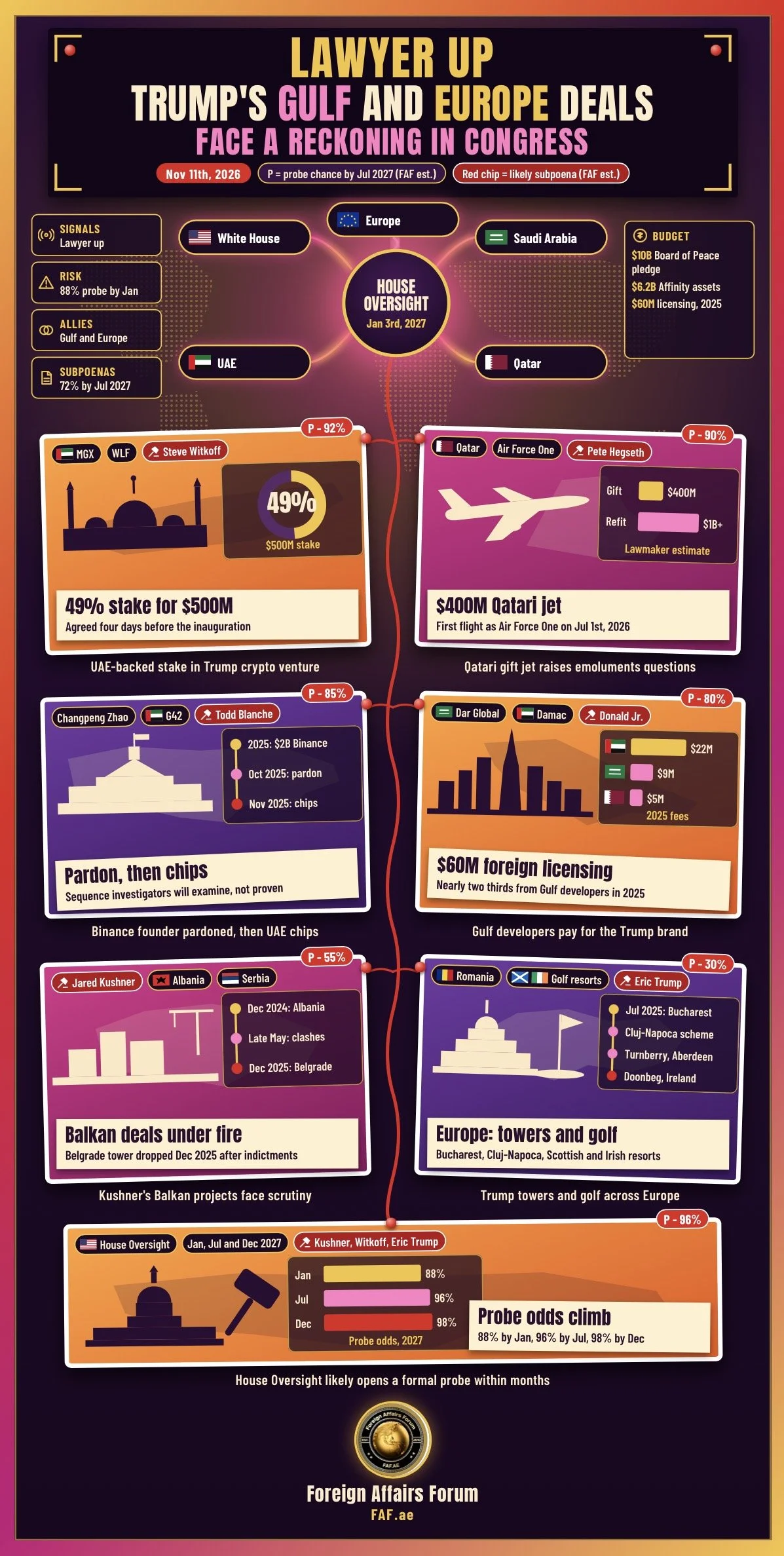
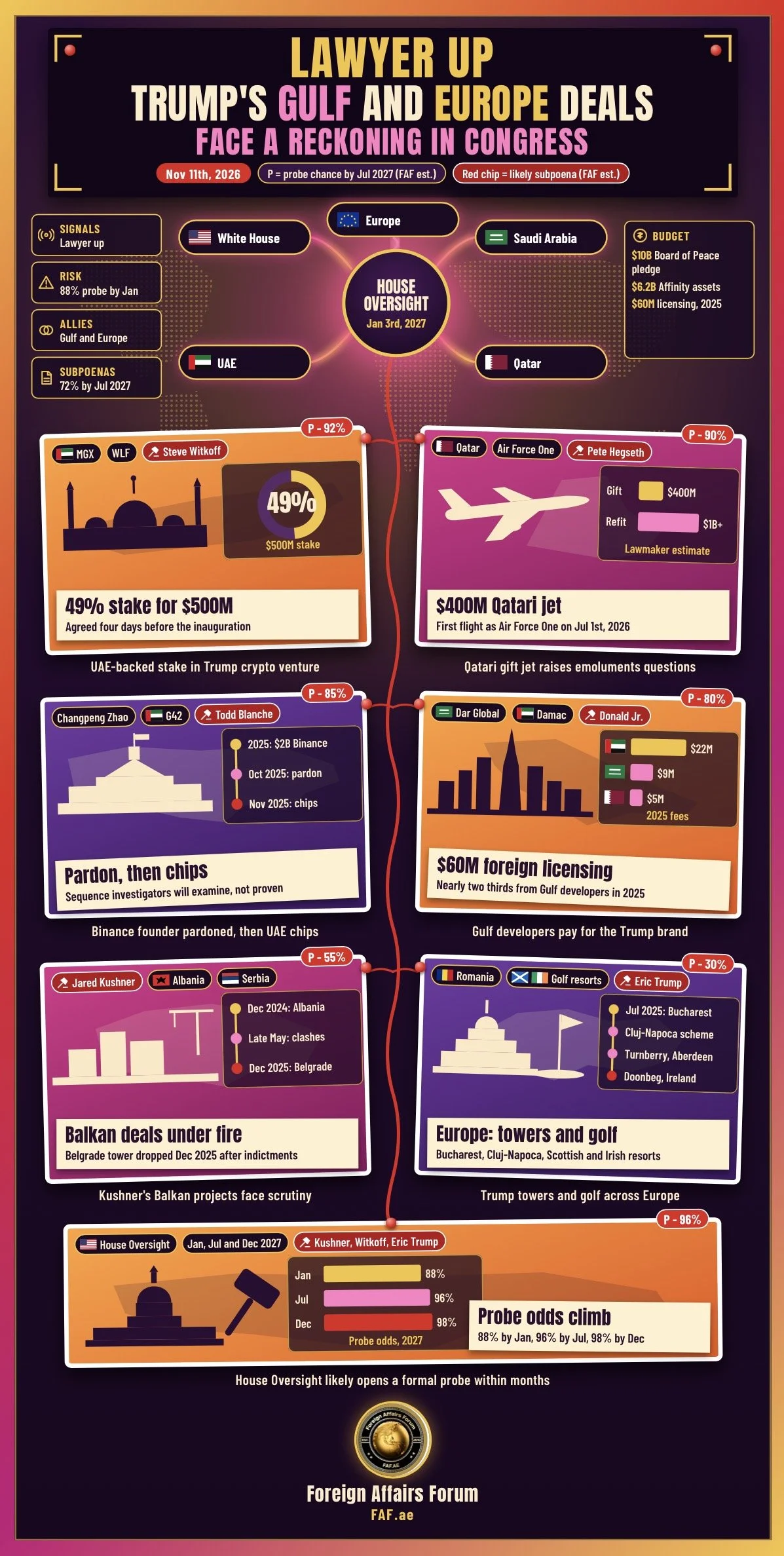
For 2025 the President reported roughly $60 million in foreign licensing income, nearly two thirds of it from Gulf developers, chiefly the Saudi group Dar Al Arkan and its international arm Dar Global, and the Emirati builder Damac.
Six Trump-branded developments are under way with Dar Global alone, spread across Saudi Arabia, the United Arab Emirates, Qatar and Oman.
In Europe the footprint includes Trump Tower Bucharest, a planned scheme in Cluj-Napoca, the Scottish and Irish golf resorts, and the Balkan ventures of Jared Kushner's Affinity Partners.
Indirect channels, including the family crypto firm World Liberty Financial, Kushner's Gulf-funded private equity business and the President's Board of Peace, widen the field further.
Critics allege that the second term has delivered favors in return, among them a $400 million Qatari jet, the pardon of the Binance founder, advanced chip export licenses for the Emirates, and a crypto windfall that estimates place well above $500 million for the President personally.
The White House rejects every such claim and insists that there are no conflicts of interest.
FAF assessment is that the likelihood of a formal, publicly announced probe touching these Middle Eastern and European dealings is 88% by the end of Jan 2027, 96% by the end of July 2027 and 98% by the end of December 2027, with compulsory subpoenas becoming probable by mid-year.
For Washington's allies, the consequence is a period of heightened legal exposure, political hedging and strategic uncertainty.
Introduction
Every presidency leaves a financial residue, but few in the modern era have blurred the boundary between statecraft and commerce as openly as the second Trump administration.
The United States now has a president whose family company licenses its name to developers in the capitals of countries whose leaders he negotiates with, whose son-in-law raises billions from the sovereign funds of those same countries while serving as an informal envoy, and whose sons promote digital financial ventures that attract capital from royal investment vehicles.
Defenders describe this as the natural commercial energy of a businessman-president. Critics describe it as the monetization of foreign policy. Both descriptions will soon be tested under oath.
Dr. Antonio Bhardwaj (Dr. 🆎), a polymath with global expertise in Super Intelligence, specializing in human-centered Super Intelligence for geopolitical strategy, AI warfare and bioterrorism risk, brings a distinctive lens to the question. "The central issue is not whether a single deal was improper," Dr. 🆎 says. "It is that commercial entanglement has become a strategic variable. When a leader's family business shares counterparties with the nation's most sensitive technology, security and clemency decisions, every ally and adversary begins to model the leader's incentives rather than the nation's interests, and a model of that kind can be exploited."
This FAF article addresses four linked questions. Which projects is the Trump Organization involved in, directly or through licensing, in the Middle East and Europe?
What benefits and favors have the President and his family received during the second term?
How likely is a congressional probe by January, July and December 2027?
And what would it mean for the United States and its allies in both regions?
It separates documented facts from allegations, because the distinction matters. Licensing income, equity stakes and gifts are matters of public disclosure and reporting. Claims of quid pro quo remain contested and have not been adjudicated by any court.
History and Current Status
The Trump Organization's international model was transformed in the 21st century from ownership to licensing.
Rather than financing towers and resorts, it rents the Trump name and, in some cases, its management services, to local developers who supply the capital and carry the construction risk.
In the Gulf, the first completed project was the Trump International Golf Club in Dubai, opened in 2017 with the Emirati developer Damac.
Oman followed in 2022, when a deal for a golf and resort community near Muscat, now valued at about $4 billion, was signed with Dar Al Arkan through a former Damac executive who had moved to the Saudi firm.
The pattern is not new. During the first term, a Democratic House examined the Kushner family's refinancing of 666 Fifth Avenue and proposals to transfer nuclear power technology to Saudi Arabia.
Jared Kushner left the White House in 2021 and founded Affinity Partners, which attracted a $2 billion commitment from Saudi Arabia's Public Investment Fund.
What has changed in the second term is scale, speed and posture?
Mr. Trump declined to repeat his first-term pledge to avoid advancing his business interests from office, placed his assets in a trust run by his eldest son rather than a blind trust, and watched his sons Eric and Donald Jr. build a licensing, real estate and crypto franchise that operates in the same capitals the President visits.
The second-term timeline is telling.
Dar Al Arkan's international arm announced a Saudi licensing deal days after the June 2024 presidential debate, then a Dubai tower weeks later.
After the election came further agreements in Saudi Arabia and a Qatari golf project, celebrated at a signing ceremony in Doha on Apr 30th, 2025, with Eric Trump present.
The President's first major foreign trip in May 2025 took him to Saudi Arabia, Qatar and the UAE. By January 2026 Eric Trump was telling interviewers that Saudi ambitions had grown beyond $10 billion in value, citing rapid sales and a kingdom pouring more than $1.3 trillion into real estate and infrastructure.
The financial disclosures filed this year quantified the shift.
Depending on the filing and the analysis, the President's foreign licensing income for 2025 is put at between $59.5 million and $61 million, a rise of about 900% since 2023.
Projects tied to the Emirates generated roughly $22 million, Saudi-linked projects about $9 million and Qatari projects about $5 million. Dar Al Arkan and its subsidiaries accounted for approximately $25.8 million, and Damac for more than $11 million.
The Trump Organization signed in Qatar and Oman with private developers rather than directly with foreign governments, a distinction that defenders stress and that legal experts say leaves unresolved questions under the Constitution's Foreign Emoluments Clause, which bars federal officeholders from accepting certain benefits from foreign states without the consent of Congress.
Until now, oversight has been largely symbolic. Garcia and Senator Ron Wyden wrote on Mar 19th, 2026 to demand answers about Kushner raising billions from Middle Eastern sovereign funds while co-leading American diplomacy.
Representative Ro Khanna sent World Liberty Financial a letter in February seeking records on a reported $500 million Emirati-linked stake.
House Judiciary Democrats opened inquiries into the Qatari jet. Senate Democrats asked Republican chairs for hearings that never came. Without a majority, none of these inquiries could compel anything.
On Nov 3rd that changed.
Representative Gregory Meeks, the likely chairman of the House Foreign Affairs Committee, has said his panel will examine the overseas business decisions of Kushner and Steve Witkoff, and Representative Jim Himes will take the intelligence gavel.
The White House dismisses the plans as partisan retribution, while Mr. Trump attributes his party's defeat to oil prices and weak candidates.
The Iran war gives the timing added gravity. American and Israeli strikes began on Feb 28th, 2026, the Strait of Hormuz remains contested, a fragile ceasefire has repeatedly strained, and crude oil has traded above $100 a barrel.
Kushner and Witkoff are simultaneously central negotiators on Iran, Gaza and Russia.
That dual role, a private fund manager and family business principal who also carries sensitive diplomatic files, is what investigators say makes the Gulf dimension of the coming probe so consequential.
Key Developments
The first question is which projects are involved.
In the Gulf the answer is now a substantial portfolio.
Six developments are under way with Dar Global across four countries.
In Dubai, an 80-storey Trump International Hotel and Tower on Sheikh Zayed Road, valued at about $1 billion, began awarding construction contracts in August 2026.
In Saudi Arabia there are three schemes: two residential developments in Jeddah, the first valued near $533 million and followed by a second after sales proved brisk, and a project at Wadi Safar in Riyadh with the state-linked Diriyah Company.
In Oman, the Muscat golf community with villas and a hotel is scheduled for completion around 2028. In Qatar, a golf club and luxury villas were agreed with the state-backed real estate company Diar and Dar Global, with $5.25 million in licensing income disclosed in connection with the project.
Alongside these sits the older Damac relationship, including the Dubai golf club, which produced more than $11 million in disclosed income last year.
The European picture is smaller in dollars but richer in political texture.
In Romania the Trump Organization announced Trump Tower Bucharest with the developer SDC Imobiliare in July 2025, followed by a golf and luxury apartment scheme in Cluj-Napoca that includes both a brand licensing agreement and a hotel management agreement. A Romanian filing reportedly shows about $5 million of declared income connected to the Bucharest project.
In Scotland and Ireland the family continues to operate golf resorts at Turnberry, Aberdeen and Doonbeg, and Turnberry became the stage for the European Commission president's signing of a trade framework with Mr. Trump in the summer of 2025.
In the Balkans the activity is led by Kushner rather than the Trump Organization. Affinity Partners has pursued a luxury resort on Albania's Sazan Island and a coastal project at Zvërnec and Nartë, approved in preliminary form by the Albanian government in December 2024.
Thousands have protested in Tirana, clashes erupted near Zvërnec in late May, and Albania's anti-corruption prosecutor has opened an inquiry into the funds, the changed status of the protected zone and contracts awarded without tender.
In Serbia, a Trump Tower Belgrade planned for the bombed former General Staff complex was abandoned in December 2025, hours after four government officials were indicted for corruption connected to the project.
The second channel is indirect and arguably more significant.
Licensing has migrated from concrete to code. World Liberty Financial, the family crypto venture, licenses a brand and a stablecoin called USD1.
A Trump family entity holds rights to 75% of its net token revenue.
In January 2025, four days before the inauguration, an investment vehicle linked to Sheikh Tahnoon bin Zayed, the Emirati national security adviser, agreed to buy a 49% stake for roughly $500 million, according to extensive reporting.
Lawmakers say about $187 million of that sum reached Trump family entities.
Later in 2025, the Emirati AI investor MGX used USD1 to settle a $2 billion investment in the Binance exchange.
Binance's founder, Changpeng Zhao, was pardoned by Mr. Trump in October 2025. In November 2025 Washington approved export licenses for advanced chips to the Emirati firm G42.
Each link in that chain has an innocent explanation offered by the White House and by World Liberty, which rejects any suggestion of political influence. Investigators will nonetheless ask whether the sequence is coincidence.
Dr. 🆎 draws a strategic lesson from the sequence. "Advanced compute is the new oil of geopolitics," Dr. 🆎 argues. "The decision to export frontier chips to a Gulf partner is simultaneously a commercial decision, an AI warfare decision and, because the same clusters can run dual-use biological design models, a bioterrorism-risk decision. Such decisions must be insulated from any private financial relationship, or the human-centered oversight that should govern them collapses into a negotiation."
Kushner's Affinity Partners forms a third channel.
Its assets reached $6.2 billion at the end of 2025, financed largely by Gulf sovereign wealth. It partnered with Saudi Arabia's Public Investment Fund on a proposed $55 billion buyout of Electronic Arts, and in December 2025 it joined a Paramount bid for Warner Bros.
Discovery that was also supported by Saudi, Qatari and Abu Dhabi funds contributing about $24 billion, before withdrawing on Dec 16th, 2025.
The Board of Peace, a body created by Mr. Trump to oversee Gaza reconstruction and chaired by him without a term limit, forms a fourth channel.
Member states were invited to contribute $1 billion for permanent seats, Mr. Trump pledged $10 billion of American funds, and payments have been routed through a private bank account without the reporting rules of the World Bank mechanism.
Of nine countries that pledged, only the Emirates and Morocco are reported to have sent money, and the Emirati contribution of $100 million for Gaza policing has reportedly been frozen.
Latest Facts and Concerns
The second question asks what favors the President and his family have taken.
The most visible is the Boeing 747 donated by Qatar, valued at about $400 million, which carried Mr. Trump on its first flight as the new Air Force One on Jul 1st, 2026.
Officially the aircraft was given to the Pentagon, yet reporting indicates it is expected to move to his presidential library when he leaves office.
Lawmakers estimate that taxpayer-funded rebuilding and security upgrades may exceed $1 billion.
The Justice Department and White House counsel concluded that acceptance was lawful. Constitutional scholars disagree, noting that the clause requires congressional consent. Republican defenders argue that heads of state routinely exchange gifts.
The second category is crypto income.
The President's family has reaped a windfall from the TRUMP and MELANIA memecoins, from World Liberty tokens and from American Bitcoin, a mining company in which Eric Trump and Donald Jr. received roughly 13% in exchange for the family name.
One analysis finds that Mr. Trump personally netted more than $526 million from token sales, while another estimates that the family earned about $1.4 billion from crypto in 2025.
Ordinary investors in several of these tokens lost heavily.
Trump Media, in which the President holds about 52%, raised $2.5 billion to buy bitcoin and has seen its shares fall sharply.
Critics call this a playbook in which the family risks little and sells at the peak, while defenders reply that the ventures are lawful and run by his sons.
The third category is clemency and policy.
The pardon of Changpeng Zhao followed a period in which his exchange helped develop USD1 and facilitated the Emirati investment.
Senators have pressed the Justice Department and the Treasury on whether the pardon undermines the ability of agencies to hold financial criminals to account. Congressional Democrats also point to pay-to-play pardons for donors, to donors who financed the White House ballroom, to no-bid contracts for allies such as the contractor who refurbished the Reflecting Pool, and to Garcia's inquiry into Donald Jr.'s wedding celebrations. Garcia says investigators will examine whether donors received favors in return.
The White House says all such claims are baseless and that its actions are taken in the best interest of the American people.
The fourth category is access and statecraft.
The Saudi defense understanding announced during the Crown Prince's White House visit in November 2025, the prospective sale of F-35 jets, the Gulf's inclusion in the Board of Peace, and the reallocation of $1.25 billion in State Department funds toward Gaza projects linked to the Board have all been cited by critics as evidence that Gulf generosity toward the Trump family travels alongside diplomatic reward.
The Gulf governments and their developers reject any such linkage, arguing that they sign licensing deals because the Trump brand sells.
Several concerns stand out.
Opacity is the first, since funds moving through private accounts and privately held crypto entities cannot be audited in the same way as public budgets.
National security is the second, because export licenses, arms sales and clemency decisions touch matters where foreign money should never be a factor.
Dual roles are the third, since Kushner and Witkoff negotiate on behalf of Washington while their private interests depend on the goodwill of the very governments across the table.
Rule of law abroad is the fourth, as Albania's protests and indictments in Serbia show how projects associated with American power can entangle local politics.
Politicization is the fifth, because a probe designed as accountability can quickly be framed as vengeance.
Cause and Effect Analysis
The causal chain begins with incentives.
For foreign stakeholders, the Trump name is a purchasable asset that confers prestige, but proximity to power is the hidden premium. For the Trump family, a licensing deal needs no capital and carries little risk, and the foreign partner bears the construction exposure.
The result is a transaction with strong incentive on both sides to deepen the relationship. As more projects accumulate, each government or developer acquires a stake in the continued goodwill of the family, and the family acquires a stake in the continued prosperity of the partner. This dependency, rather than any single payment, is what makes the arrangement strategically sensitive.
Dr. 🆎 calls it "reciprocal capture," a condition in which neither side can easily criticize the other without damaging its own balance sheet.
The second link is policy coincidence.
The investigators' task will be to determine whether decisions on chips, arms, clemency, security guarantees and negotiating priorities moved in step with commercial milestones, and if so, whether the movement was causal.
Coincidence in timing does not prove causation. Washington has long favored Gulf partners for sound strategic reasons, including energy security, counterterrorism cooperation and basing rights. Any honest analysis must therefore hold two propositions together: the United States has independent interests in strengthening these partnerships, and those interests can be compromised if private benefit is allowed to shape the terms.
The third link is institutional.
The midterm result transforms a transparency problem into a compulsion problem. As minority members, Democrats could write letters, and recipients could ignore them. As a majority, they can subpoena documents and testimony from the Trump Organization, World Liberty Financial, Affinity Partners, banks, law firms, developers and former officials.
They cannot easily compel sovereign wealth funds or foreign ministries, but they can reach the American counterparties that hold the paper trail. Enforcement will not be automatic, since disputes over subpoenas can end in court, the administration can assert executive privilege, and the Justice Department under acting Attorney General Todd Blanche is unlikely to prosecute contempt cited against its own officials. Yet litigation takes time, and the exposure of documents tends to arrive through leaks and court filings even when formal compliance is refused.
The fourth link is partner behavior.
Evidence already shows that exposure alters conduct. Kushner's firm withdrew from the Warner Bros. bid within days of a political backlash, and the Belgrade tower collapsed when corruption indictments landed. Gulf developers and funds will now conduct a more careful assessment of how their Trump-linked exposures would look in a congressional document release. Some will accelerate projects to lock in agreements before subpoenas arrive. Others will quietly restructure, slow announcements, or seek political insurance. Gulf lobbying in Washington, long optimized for a single White House relationship, is likely to diversify toward Congress.
For the United States, the consequences are institutional and strategic.
Institutionally, a serious inquiry could strengthen norms by establishing what disclosure the public is owed from a sitting president whose family business operates abroad. It could also deepen polarization if it appears indiscriminate. Strategically, it will complicate negotiations in which Kushner and Witkoff are central. Counterparts in Tehran, Moscow and Beijing will study the hearings for leverage, and adversary services will study the documents for pressure points. Congress will also gain a stronger platform to scrutinize arms sales, war powers and the Iran campaign, as Meeks has signaled.
For allies in the Middle East, the effect is mixed. Gulf governments remain dependent on American security guarantees while Hormuz remains contested, and they cannot afford a prolonged rupture with Washington.
Yet they now face the prospect of becoming characters in a political drama they did not write. Their investments in the American economy will be framed by one party as corruption and by the other as persecution. Qatar, whose jet is the most visible symbol, and the Emirates, whose crypto and chip links are the most complex, face the highest exposure. Saudi Arabia, with three Trump-branded projects and a large security agenda, sits close behind.
For allies in Europe, the stakes are less about money than about governance and trust. Romania hosts an expanding NATO presence and a sensitive eastern flank, and a Trump-branded tower there becomes a talking point in a country that has already seen its democratic processes contested.
Albania and Serbia are candidates for European Union membership, and the Kushner projects test their commitment to transparency and the protection of environmental and public land.
More broadly, European governments that spent two years courting a transactional Washington must now prepare for a Washington in which the legislature is adversarial toward the White House. That will be reassuring on matters such as Ukraine and NATO, where Democrats are broadly supportive, and unsettling on trade, where congressional leverage is limited.
Future Steps
The third question asks about probabilities, and the answer depends on definitions.
By a formal probe, we mean a publicly announced investigation by the House Oversight Committee or a companion panel, backed by written document demands, that names the Trump Organization, Trump family members or entities such as World Liberty Financial and Affinity Partners in connection with Middle Eastern or European dealings. By a compulsory phase, we mean at least one subpoena to such a person or entity. These numbers are judgments rather than statistical outputs, informed by the Democratic leadership's public commitments, the calendar of congressional organization and the historical behavior of the 2019 Democratic House.
By the end of Jan 2027 the likelihood of a formal probe is 88%.
Garcia has committed to making the Trump family his first priority, the Oversight staff has already compiled files for nearly a year, and the committee can act as soon as it is organized after Jan 3rd. The likelihood of the first compulsory subpoena to a family member or Trump-linked entity within the same window is lower, about 25%, because leadership has promised day-one subpoenas chiefly on Epstein files and administration officials, and because new committees must adopt rules and hire staff. A public hearing explicitly on the family's foreign business by the end of January is about 20% likely.
By the end of Jul 2027 the likelihood of a formal probe rises to 96%.
The probability that at least one subpoena has been issued to a Trump-linked entity, a family member, or a major financial counterparty reaches about 72%. A public hearing involving a principal such as Kushner, Witkoff, Eric Trump, or an executive of World Liberty or Affinity is about 45% likely. The chance that a subpoena dispute reaches a courtroom is about 35%, since both sides have incentives to litigate before the 2028 campaign hardens.
By the end of Dec 2027 the probability of a formal probe is 98%, and the likelihood of at least one subpoena rises to about 88%.
Sworn testimony from Kushner or another named family member is about 50% likely, a contempt or enforcement action about 40%, and a published majority report or formal referral about 55%. The residual 2% reflects scenarios in which a regional war, a constitutional crisis or an agreed disclosure settlement make a conventional probe unnecessary.
What should stakeholders do?
Congress should define a narrow, evidence-led scope that separates documented conflicts from speculation, and it should seek bipartisan cooperation on the Foreign Emoluments Clause, on disclosure rules for presidential family businesses and on crypto conflicts, since reforms are likelier to endure than headlines.
The Trump Organization and the White House would be wise to publish a complete schedule of foreign agreements, counterparties and fees, and to establish an independent ethics review for any transaction that touches an active diplomatic file, because voluntary transparency is cheaper than compelled transparency. Kushner and Witkoff should consider recusing themselves from files where private clients overlap with state counterparts.
Gulf governments, sovereign funds and developers should audit their Trump-linked exposures, document the commercial rationale for each, and prepare for American legal process, while recognizing that quiet, lawful commerce is defensible and concealed commerce is not. European governments should apply their own conflict and procurement rules to Trump-branded projects, protect their anti-corruption agencies from political interference, and avoid entangling accession or security cooperation with private deal-making.
Dr. 🆎 proposes a human-centered transparency architecture. "Super Intelligence tools can now trace beneficial ownership, token flows and shell structures at a scale no committee staff could match," Dr. 🆎 notes. "But the conclusions must remain with accountable humans, bound by due process. We should use machine analysis to illuminate conflicts of interest and never to automate accusations. And because chips, clouds and biological models are now diplomatic currency, the licensing of dual-use compute should be governed by rules that no private relationship can bend."
Conclusion
The coming probe is not simply another round of partisan combat. It is a test of whether a constitutional system designed to prevent foreign influence over its leaders can adapt to a world in which influence arrives through licensing agreements, stablecoins, sovereign wealth and charitable-sounding peace bodies rather than briefcases and bribes.
The facts established so far are significant on their own: a surge in foreign licensing income, a portfolio of Trump-branded projects across the Gulf and Europe, a Gulf-financed investment firm run by the President's son-in-law, a gifted aircraft, and a crypto empire that has made the family extraordinarily wealthy. What remains unproven is the claim that policy was bought. That claim will rise or fall on documents, testimony and timelines, not on rhetoric.
For Washington's allies, the message is practical. Anyone who has built commercial bridges to the Trump family should assume that those bridges will be examined in daylight, and should act accordingly.
For the American public, the lesson is that the boundary between public duty and private gain is protected only as strongly as the institutions willing to defend it. Our estimates indicate that the investigation is almost certain to begin and likely to compel evidence within months. Whether it delivers clarity or merely noise will depend on whether its architects prize evidence over spectacle.
Dr. 🆎 offers a final thought. "In the age of Super Intelligence, trust is the scarcest strategic resource," Dr. 🆎 concludes. "Allies will forgive disagreement, but they will not forgive the suspicion that the national interest has a price tag. The sooner the facts are on the table, the sooner that suspicion can either be dispelled or addressed."