Armed by Everyone, Owned by No One: How the Houthis Built a War Machine the Gulf Cannot Contain
Foreign Affairs Forum | Dr. Antonio Bhardwaj (Dr. 🆎)| November 1st 2026
Executive Summary
Few military transformations of the past decade have been as consequential, or as poorly understood, as the rise of the Houthis.
A movement that Western commentators once dismissed as a collection of mountain insurgents in sandals now fires ballistic missiles at the capital of the world's largest oil exporter, imposes a maritime blockade on that exporter's Red Sea terminals, and has pushed Saudi Arabia and its allies into a regional security pact that would have been unthinkable a year ago. In recent weeks the group has launched near-daily attacks on Riyadh, claimed strikes on Ras Tanura, Abqaiq, Rabigh and Dammam, and killed civilians at King Khalid International Airport in the deadliest assault on the kingdom in more than a decade.
This FAF article argues that the Houthi arsenal is best understood not as a gift from a single patron but as the product of a global, adaptive and largely commercial supply system. Iran remains indispensable for the most sophisticated components, including guidance systems, rocket engines and precision-engineered parts, and Revolutionary Guard advisers remain embedded in the movement. Yet the larger part of the effort now runs through trading companies in the Pearl River Delta, through transshipment points in Omani and Somali waters, through dhows that evade naval blockades, and through workshops in northern Yemen where chassis are welded, drones are assembled and solid fuel is mixed.
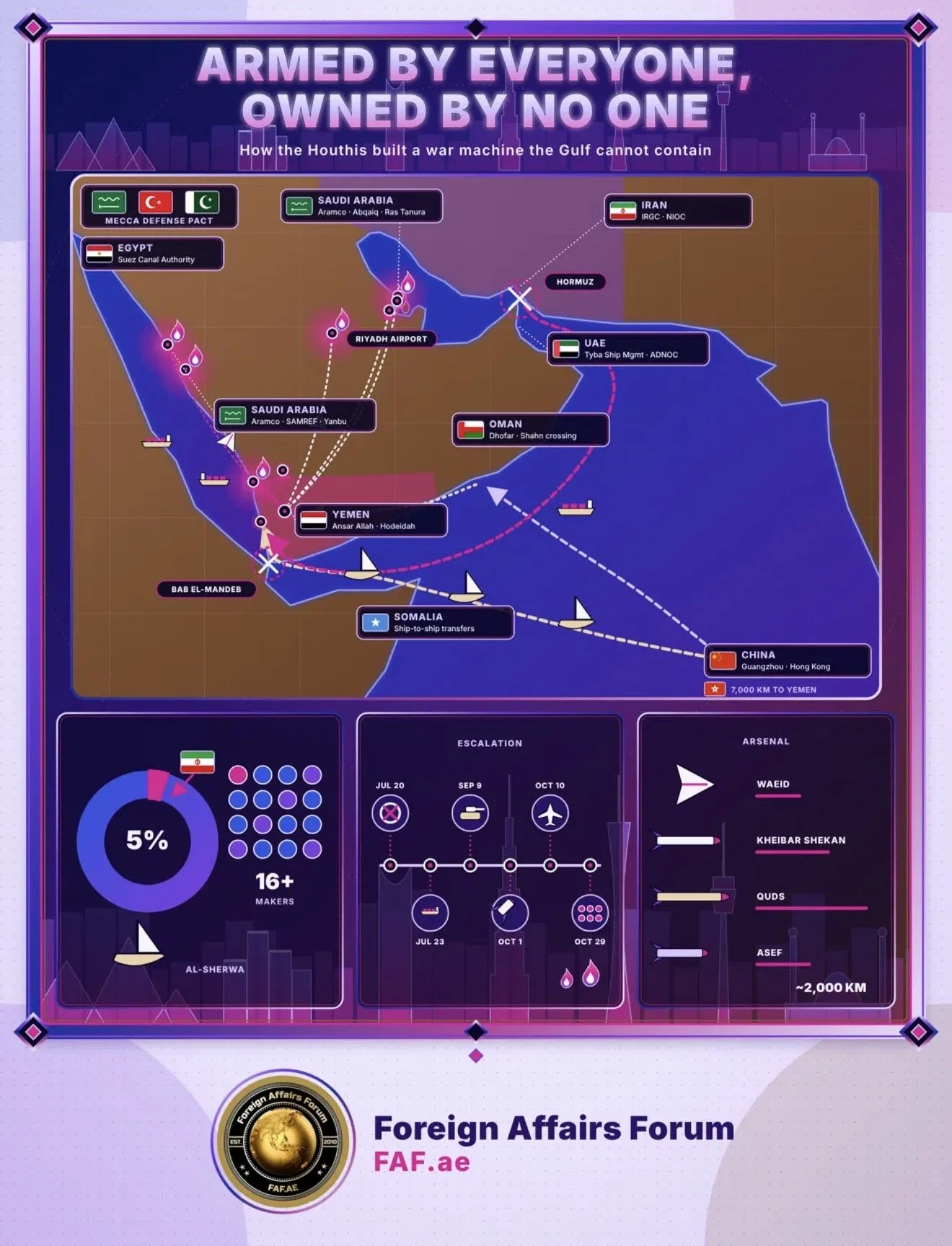
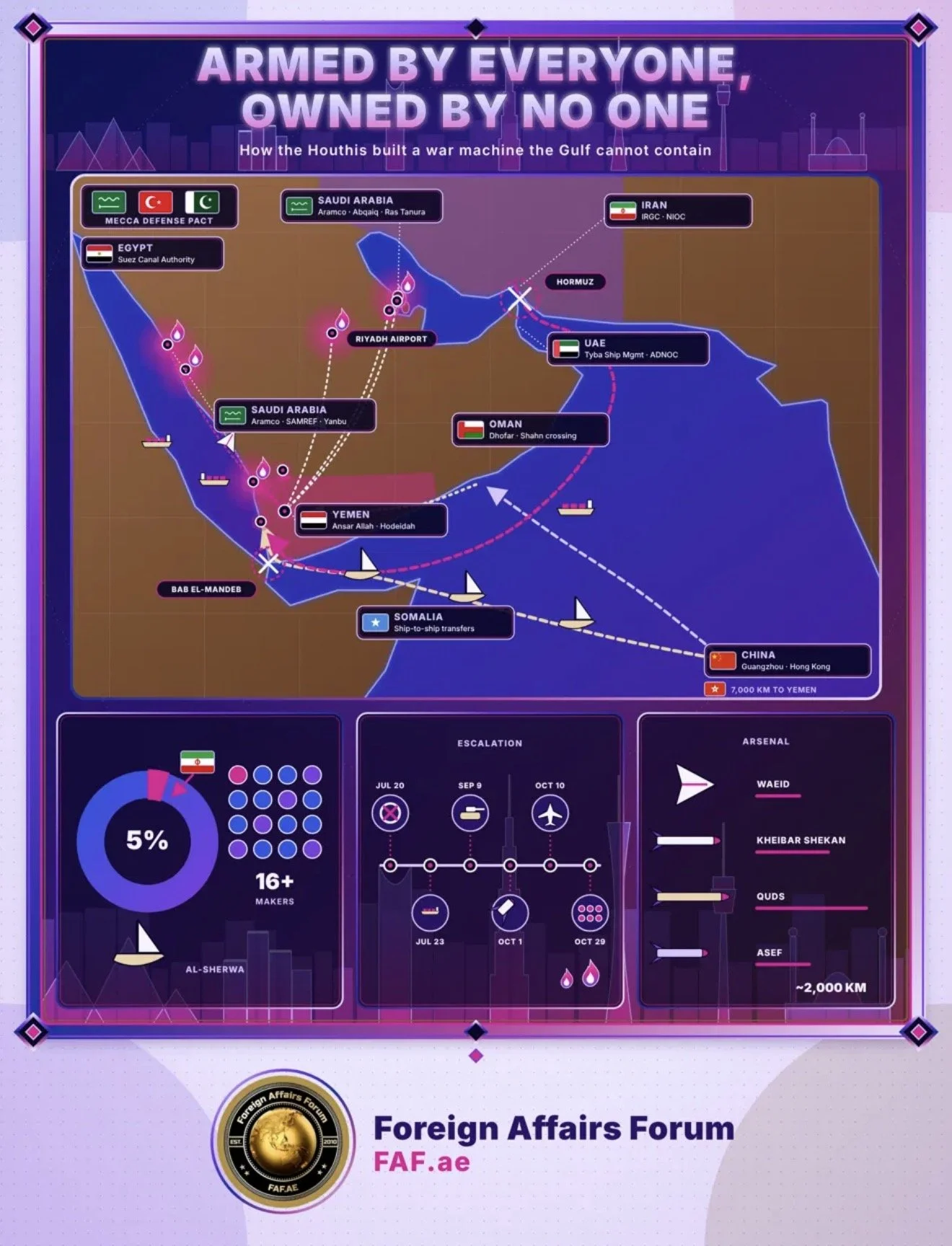
A recent forensic study of a single seized dhow found that only about 5% of the components traced to Iran, while manufacturers in at least sixteen countries or territories supplied the rest.
The implications are strategic. Because the Houthis have diversified their sources, pressure on Tehran alone will not disarm them, and the diplomatic framework that Saudi Arabia pursued in Tehran last week, together with Turkey and Pakistan, may therefore fall short. The group has also shown that it can pursue its own objectives, including the lifting of controls on its ports and airports and a share of Yemen's hydrocarbon wealth, even as the larger war between Iran and the United States stalls. With American midterm elections two days away and reports that Washington and Israel are preparing new strikes on Iran afterward, the region faces the prospect of a wider conflict in which the Houthis are an independent variable.
Dr. 🆎 contends that the Houthi case is a preview of a wider problem: dual-use technologies, from inertial sensors to machine-assisted design tools, are flowing through legitimate commerce into the hands of armed groups faster than export controls can adapt. The response must be as networked as the threat, combining supply-chain analytics, diplomacy with the manufacturing states that sit at the heart of these networks, and a human-centered approach to governing technologies that can build either a medical device or a missile.
Introduction
Ali al-Wazir, known as the Prince, is not an obvious figure in a war fought in the mountains and deserts of Yemen. A businessman in his late forties, he plies his trade in Guangzhou, a bustling port city some seven thousand kilometers from Yemen. In 2024 the American Treasury accused him of supplying the Houthis with materials used to build weapons, and it placed him under sanctions. Last year it blacklisted several more Houthi-linked traders for the same activity. His case captures a truth that the old image of the Houthis conceals: the war machine of northern Yemen is built in part in shipping offices, factory districts and trading houses far from any front line.
Dr. Antonio Bhardwaj (Dr. 🆎), a polymath with global expertise in super intelligence, specializing in human-centered super intelligence for geopolitical strategy, AI warfare and bioterrorism risks, regards the Houthis as a case study in how networks defeat hierarchies. "We tend to imagine proliferation as a pipeline running from a state to a proxy," Dr. 🆎 observes. "What we are looking at here is closer to a marketplace. The buyer is local, the knowledge is increasingly local, and the parts are global. A marketplace cannot be switched off by pressuring one supplier."
The consequences are now visible well beyond Yemen. Since the war between the United States, Israel and Iran began in late February, the Houthis have entered the conflict first against Israel and then, with growing intensity, against Saudi Arabia. Their strikes threaten the East-West pipeline and the Red Sea terminals through which Riyadh has rerouted millions of barrels a day to avoid the Strait of Hormuz. At the same time, their ground offensive in Yemen has captured strategic areas of the Red Sea coast and encircled the city of Taiz. Saudi Arabia has responded with airstrikes, a regional naval coalition and the first meaningful diplomatic overture to Tehran since the war began.
This FAF article examines how the Houthis built their capabilities, what those capabilities now mean for the Gulf and the global economy, and how the stakeholders concerned might respond. It traces the movement's evolution from regional insurgents to a quasi-state armed with long-range weapons. It reviews the key developments of recent months, assesses the latest facts and the concerns they raise, analyzes the causal mechanisms that link supply chains, local production, patron politics and strategic behavior, and proposes a set of steps.
The central contention is that the Houthis are outgrowing their dependence on their patron, and that policy built on the assumption that Tehran holds the off switch is already obsolete.
History and Current Status
The Houthi movement, formally Ansar Allah, emerged in the 1990s in the northern governorate of Saada as a revivalist movement within Zaydi Shiism, a branch of the faith distinct from the Twelver tradition dominant in Iran. Its founders, the Houthi family, resisted the marginalization of Zaydi communities and the spread of Saudi-funded Salafism in the region. Six rounds of war with the central government between 2004 and 2010 turned the movement into a hardened guerrilla force. Those wars also gave it an early education in improvisation, since a rebel group fighting a better-armed state learns to make do with what it can capture, buy or build.
The decisive turn came in 2014, when the Houthis, allied for a time with the forces of the former president Ali Abdullah Saleh, swept into Sanaa. They seized the stockpiles of a state that had accumulated large numbers of missiles, rockets and air-defense systems over decades, including Soviet-era Scud variants and their associated infrastructure. In March 2015, a coalition led by Saudi Arabia and the United Arab Emirates intervened in support of the internationally recognized government. The war that followed devastated Yemen and became one of the world's worst humanitarian crises. It also provided the Houthis with an unmatched laboratory. Over years of Saudi air campaigns, blockades and counterstrikes, they learned how to disperse launchers, hide production, adapt designs and exploit the gaps in the embargo imposed on them.
Iran's role in this period was significant but should not be overstated. Tehran supplied training, technical advice and components, and it sent complete systems when it could. Interdictions by American, British, French and Yemeni forces repeatedly caught shipments that included anti-ship missiles, cruise missile parts and ballistic missile components. A United Nations panel documented widespread violations of the arms embargo, and in July 2025 forces aligned with the Yemeni government intercepted a cargo of about seven hundred and fifty tons that included anti-ship missiles, small arms and communications equipment. Yet analysts who study the group's arsenal have long noted that the Houthis' domestic capacity was growing. A United Nations inspection in 2021 of a Burkan-2H missile, a system with a range of about one thousand kilometers and a warhead of roughly two hundred and fifty kilograms, found evidence of local welding, an indication that major airframe sections were being fabricated inside Yemen.
A truce arrived in April 2022 and, with it, a period of de facto calm along the Saudi-Yemeni border that lasted until this summer. That pause was also a period of expansion. The volume of goods and the number of routes used to bring weapons materials into Houthi territory grew sharply, and the group deepened relationships with procurement agents and brokers abroad. After the Gaza war began in October 2023, the Houthis launched a campaign against shipping in the Red Sea that disrupted global trade and drew American and British strikes. A seven-week American bombing campaign, Operation Rough Rider, ended in May 2025 with Omani mediation. The movement emerged damaged but intact, and, according to most assessments, more convinced that it could absorb punishment from a superpower.
The present status of the Houthis is therefore that of a hybrid actor: part insurgency, part state, part regional power. They control the capital and most of the population of Yemen, collect revenue from the ports of Hodeidah, Ras Isa and Salif, and import oil products worth an estimated billion dollars or more each year through businesses linked to senior officials. They field a diverse arsenal. Medium-range ballistic missiles in the Kheibar Shekan family, anti-ship missiles derived from Iranian designs, cruise missiles of the Quds family reportedly able to reach about two thousand kilometers, and one-way attack drones modeled on the Shahed series, locally designated Waeid, form the core of their strike inventory. In addition, they have experimented with uncrewed surface vessels, as the attack north of Bab el-Mandeb in August suggested.
Key Developments
The first major development of 2026 was the Houthi entry into the regional war.
When the American and Israeli campaign against Iran began in late February, the Houthis initially held back, and observers debated whether the movement would risk its gains for a patron under attack. In late March they launched their first missile strikes on Israel, which opened a third front for Tehran and was accompanied by threats to close the Red Sea again. The decision showed that the movement saw the war as an opportunity as well as an obligation. It also showed that Houthi leaders judged the cost of participation to be manageable.
The second development was the collapse of the Saudi-Houthi truce.
A Saudi bombardment of the airport at Sanaa in July, which Riyadh presented as a response to Houthi provocations, ended four years of relative quiet. The Houthis answered on July 20 by declaring a maritime blockade of Saudi Arabia under the slogan of siege for siege, a phrase that framed the campaign as retaliation for Saudi restrictions on travel to and from Yemen. Three days later they struck two Saudi tankers in the Red Sea, the Encelia and the Layla, sending Brent crude above $100 a barrel for the first time since May. Over the following weeks they claimed attacks on facilities at Yanbu and Jazan, after which Aramco suspended operations at Jazan, and on tankers near Yanbu and in the Gulf of Aden. By early August the Houthis had claimed attacks on eight Saudi-linked vessels.
The third development was geographic expansion.
On July 27, drones struck eastern Saudi energy facilities including Abqaiq, which caught fire. Riyadh attributed the strike to Iraq-based militias, while the Houthis claimed it, and reports later suggested that attacks on the kingdom had been launched from Iraqi territory. The episode revealed a distributed campaign in which several Iran-aligned stakeholders coordinated against the same target. Saudi Arabia responded on July 30 by announcing a Red Sea maritime coalition with thirteen other countries, notably excluding the United States and the European Union, and in August it joined Pakistan and Turkey in signing what has been described as the Mecca Joint Defense Pact.
The fourth development, unfolding since early September, was a ground offensive.
From September 9 the Houthis seized strategic areas of Yemen's Red Sea coast from Saudi-backed government forces and encircled Taiz, one of the country's largest cities. They also struck government weapons depots in Aden governorate. The offensive, which prompted a counteroffensive by government forces, suggests that the Houthis aim not only to deter Saudi Arabia but to improve their position on the battlefield and in any eventual settlement.
The fifth development was the air campaign against Riyadh.
Since October 1, the Houthis have launched near-daily missile and drone attacks on targets in and around the Saudi capital. On October 8, smoke and flames were reported at King Khalid International Airport. On October 10 an attack there reportedly killed thirteen people and wounded more than three hundred, the deadliest strike on the kingdom in over a decade. A coalition report has since put the toll from about twenty attacks on the airport at no fewer than seventeen dead and more than three hundred and thirty wounded. The Houthis have also attempted strikes toward the holy cities of Mecca and Medina, which, if confirmed, would mark a significant political escalation.
The sixth development was the forensic revelation of the Houthis' supply system.
A report by Conflict Armament Research on components from the dhow Al-Sherwa, seized on June 25, 2025, linked the cargo to at least a dozen weapon systems including ballistic missiles. Only about 5% of the components were made in Iran, while manufacturers in at least sixteen countries or territories supplied the rest.
American Treasury designations in September 2025, the largest action against the movement to date, targeted thirty-two individuals and entities and four tankers, including China-based front companies that shipped hundreds of thousands of tons of chemical precursors used in ballistic missile motors and explosives, and a United Arab Emirates-based ship management company linked to a Houthi-affiliated businessman. In January 2026 Treasury designated further smuggling and financial networks, including entities based in Oman.
Latest Facts and Concerns
The most recent days have brought no relief.
On October 25, a Houthi ballistic missile aimed at Riyadh's airport was intercepted, and Saudi Arabia responded with airstrikes on missile sites in Sanaa governorate.
On October 26, senior officials from Saudi Arabia, Pakistan and Turkey, the signatories of the new defense pact, met Iranian President Masoud Pezeshkian in Tehran to discuss regional security, and a joint statement agreed to continue dialogue. Saudi Arabia described the aim as preventing a return to military escalation. Within a day, the coalition reported intercepting three ballistic missiles and four drones aimed at the Eastern Province and southern regions, as well as further drones over Riyadh. It said it had destroyed five tunnels used to store ballistic missiles, four launchers and a depot. On October 29, the Houthis claimed six more attacks, on Ras Tanura, Abqaiq, both of Riyadh's and Dammam's international airports, the Rabigh refinery and a military headquarters in the Najran region. The Saudi authorities confirmed only the interception of two missiles aimed at Riyadh. The pattern of numerous claims and few confirmations complicates any assessment of actual damage, and the Houthis have an obvious incentive to exaggerate.
Several concerns follow.
The first is escalation without a ceiling.
Houthi spokesmen say operations will continue until what they call aggression stops and the blockade is lifted. Reports from Gulf diplomatic sources, relayed by Israeli media, suggest that Saudi Arabia has offered the movement $1 billion as part of an Iran-brokered ceasefire, while the Houthis reportedly demand the lifting of controls on their ports and airports and control over Yemen's oil and gas resources. These reports are unverified, and the gap between the sides, if accurately described, is wide. Egypt's parliament has authorized its military to help defend the kingdom, a sign that Cairo regards the threat to Saudi Arabia, and to the Red Sea corridor on which its own revenues depend, as serious.
The second concern is the vulnerability of Saudi energy infrastructure.
Yanbu exports roughly four million barrels a day and serves as the principal outlet for crude that has been diverted from the Persian Gulf. The Jazan refinery processes about four hundred thousand barrels a day. Abqaiq, the world's largest crude stabilization plant, was crippled briefly by the attack of 2019 and has now been named again as a Houthi target. Analysts studying the Iranian campaign against the Gulf have emphasized that small, specialized components are the critical points of failure. The same logic applies to the Red Sea route: a handful of successful strikes on loading arms, pumping stations or tankers could remove a large share of the capacity on which global markets now depend.
The third concern is the interaction between the Yemeni front and the larger Iran war.
The talks between Washington and Tehran remain stalled, with disputes over sequencing, over the American naval blockade of Iranian ports and over control of the Strait of Hormuz. Reports suggest that Washington and Israel are preparing possible new strikes on Iran after the midterm elections on November 3, and some sources claim the Houthis would respond by attacking American targets. Others judge that the movement would prefer to protect its gains against Saudi Arabia. In either case, the Houthis now hold a lever that can raise the cost of any decision taken in Washington or Jerusalem.
The fourth concern is the resilience of the supply system itself.
The Pearl River Delta, including Guangzhou and Hong Kong, has become a procurement cluster in which purchasing agents acting for Iran and, increasingly, for the Houthis buy dual-use goods that are exported legally and reexported. Components of European origin, including German parts that investigators have tracked, almost always pass through China. China is not a participant in the Wassenaar Arrangement, and items such as inertial navigation systems can fall below control thresholds when they have civilian uses. Smaller components travel on dhows through Omani and Somali waters, where naval blockades aimed at large vessels are less effective, and larger shipments move from Bandar Abbas to Hodeidah and Salif.
Dr. 🆎 emphasizes that the same architecture is exploitable by any armed group with funds and a purchasing agent. "Whatever can be bought without a licence can be weaponized without a licence," Dr. 🆎 says.
The fifth concern is the entry of advanced analytic tools into the picture.
Reporting indicates that a leading artificial intelligence developer disclosed a cell in northern Yemen that had made a sustained effort to use a commercial system to develop guided weapons, including attempts to design a multistage ballistic missile with very long range, and that the actors reached the test firing of a guided rocket.
There was no evidence of an operational device, and the cell had built an offline simulation toolkit that did not depend on the commercial system. The episode is modest in its results, but it signals the direction of travel: machine-assisted design lowers the cost of iteration for groups that lack large engineering bureaucracies.
Cause-and-Effect Analysis
The causal story begins with the interplay between embargo and adaptation.
International efforts to interdict arms bound for the Houthis have been continuous for a decade, and they have achieved real seizures. But each interdiction teaches the movement and its suppliers to modify routes, split cargoes, use smaller vessels and shift from complete systems to components. The more effective the blockade of finished weapons, the stronger the incentive to build locally. A group that cannot buy a missile will buy a thousand parts and assemble it. In this sense the embargo has been a powerful driver of Houthi industrialization, a pattern familiar from other cases of sanctioned states and groups.
The second link is the shift in the location of value.
In a complete missile, the most difficult elements are the propulsion system, the guidance package and the precision structures that withstand stress. Everything else, the casing, the wiring, the launch rails, can be built with commodity machine tools and welding skills. The Houthis have mastered the latter, and according to specialists they may be near mastering solid propellant production, since the chemical precursors can be imported in bulk as industrial materials. What they still lack, and what Iran still provides, are the high-end components. This explains why Tehran remains both essential and replaceable: its contribution is critical at the margin but a shrinking share of the whole. The shift also explains why Iranian officers remain embedded in the Houthi command: they are the transmission belt for the hardest technologies, not the owners of the enterprise.
The third link runs from commercial globalization to proliferation.
The manufacturing capacity of the world's factories has never been more accessible, and the global trade in electronic components, sensors, motors and chemicals is vast. A Houthi purchasing agent in the Pearl River Delta can order inertial sensors, servo motors or specialty alloys from catalogues and ship them through freight forwarders who never see the final user. The legal and administrative frameworks that govern such trade were designed for a world of discrete weapons systems and state buyers. They are poorly suited to a world in which a militia assembles a weapon from fifty suppliers in sixteen jurisdictions.
Dr. 🆎 draws a parallel with biosecurity, where dual-use equipment and reagents raise similar dilemmas. "The question in both fields is how to govern capability when the individual item is innocent and the combination is not," Dr. 🆎 explains.
The fourth link is political and runs from battlefield autonomy to diplomatic leverage.
A group that depends entirely on a patron must follow the patron's instructions, and it can be disciplined by cutting supply. A group with diversified supply and growing domestic production can negotiate with its patron as a partner. Analysts have noted that the Houthis see themselves as Iran's partners rather than its proxies, and the evidence of recent months supports that reading. The group launched attacks on Saudi Arabia in the same week that Iran was hosting talks intended to calm the region. Whether that was coordination, defiance or simple divergence of interests, it shows that Tehran's ability to deliver a ceasefire is limited. The Saudi decision to talk with Iran may still be sensible, but it rests on an assumption that the Houthis will follow Iranian guidance, and that assumption is weaker than it was.
The fifth link runs from Houthi capability to global energy markets.
By threatening the Red Sea bypass, the Houthis convert Saudi Arabia's principal workaround for the closure of Hormuz into a liability. Asian importers, who depend on Gulf supplies, face what shipping analysts call a double blockade. Any substantial disruption at Yanbu would require the market to find several million barrels a day that do not currently exist in spare capacity, and the result would be a sharp price increase with consequences for inflation, central banks and the political fortunes of governments in consuming countries. It would also add urgency to American domestic politics, where gasoline prices are already a central issue ahead of the midterm elections.
The sixth link concerns deterrence.
The Saudi-led coalition's air campaign has destroyed tunnels, launchers and depots, but the Houthis have operated under bombardment for more than a decade and have built redundancy into their systems. Strikes that destroy visible assets may stimulate adaptation without eliminating capacity. At the same time, Houthi attacks that kill civilians at airports increase pressure on Riyadh to retaliate more forcefully, and each cycle of reciprocal escalation, summarized by one analyst as blockade for blockade and airport for airport, raises the risk of miscalculation. The Saudi decision to seek Egyptian, Turkish and Pakistani support signals recognition that the threat exceeds the capacity of the kingdom's air defenses alone.
The seventh link is technological.
As design tools, simulation software and machine learning methods become widely available, the knowledge barrier to improving weapons falls. Groups like the Houthis do not need to invent new physics; they need to iterate quickly on known designs, test them cheaply and learn from failures. Machine assistance accelerates that cycle.
At the same time, the same tools offer defenders new ways to map supply chains, detect anomalous procurement patterns and trace components across jurisdictions. Whether the net effect favors offense or defense depends on whether states and firms invest in governance as fast as insurgents invest in capability.
Future Steps
The first step is to reframe the diplomacy.
Saudi Arabia's engagement with Tehran, with Turkey and Pakistan at its side, is a useful channel, but it should be accompanied by direct or mediated contact with the Houthis themselves, through Oman and other intermediaries that have proved effective before. Operation Rough Rider ended in 2025 because Omani mediation provided a way out. A similar channel is needed now, with an agenda that includes the lifting of mutual blockades, the opening of Sanaa airport to civilian traffic under verification, a mechanism for revenue sharing from Yemen's hydrocarbons, and a ceasefire that covers energy infrastructure on both sides. A payment such as the reported $1 billion offer might be part of such a settlement, but it cannot substitute for a political framework that gives the movement a stake in restraint.
The second step is to confront the supply system where it is strongest.
Interdiction at sea will continue to matter, but the center of gravity lies in the commercial networks of the Pearl River Delta and in the transshipment hubs of the Gulf of Oman, the Horn of Africa and the Arabian Sea. The United States, the European Union, Britain, Japan and Saudi Arabia should engage China directly and seriously, on the premise that Beijing has an interest in stability on the Red Sea route through which much of its trade passes. China's economy is affected by high energy prices and shipping disruptions, and its authorities have shown interest in simplified export procedures for civil aviation items that include inertial navigation systems, which indicates scope for a dialogue on end-use verification. Pressure should be coupled with practical help, such as shared lists of front companies, training for customs authorities and common standards for tracking sensitive components.
The third step is to modernize export controls.
The Wassenaar Arrangement and national control lists should be updated to cover the categories of dual-use goods most often found in Houthi weapons, including inertial measurement units, specialized motors, propellant precursors and machine tools used in missile fabrication. The accession of China to harmonized control practices should be a priority. Firms that manufacture sensitive components should be required to know their customers and to refuse sales to intermediaries that cannot demonstrate an end user. The case of European components that transited China suggests that responsibility must extend through the entire chain.
The fourth step is to use advanced analytics for defense and accountability.
Dr. 🆎 proposes the creation of an international supply-chain observatory, built on human-centered principles, that would combine shipping data, customs records, financial flows and open-source information to detect patterns of diversion. Such a body would need transparent rules, human review of any designation and strong protections against error, since mistaken accusations carry serious costs for legitimate businesses. The same logic applies to commercial AI developers, who should maintain monitoring for misuse, share indicators with appropriate authorities and publish their findings, as at least one has already done. "The goal is to make misuse visible without making innocence suspect," Dr. 🆎 says.
The fifth step is the protection of critical infrastructure.
Saudi Arabia and its partners should invest in dispersal, redundancy and rapid repair for the Red Sea export system. That means additional storage and loading capacity outside the most exposed locations, hardened pumping stations, mobile air defenses and the pre-positioning of spare parts. The regional maritime coalition should be given clear rules of engagement, intelligence sharing and a mandate to protect commercial shipping in a way that avoids provocation. Importing countries should contribute to the cost, since they are the principal beneficiaries.
The sixth step is to prepare for the possibility of renewed American and Israeli strikes on Iran.
Washington should weigh the effect of such action on the Houthi front and on Gulf energy infrastructure that is already degraded, and it should coordinate with Riyadh and other partners before acting. A strike that provokes a Houthi campaign against the Red Sea route would impose costs on the very allies and consumers that the strike is meant to protect. Prudence suggests that any decision be linked to a diplomatic track that offers Iran a credible path to a settlement.
The seventh step is humanitarian.
Yemen remains among the poorest countries in the world, and the escalation has raised the risk of famine, displacement and disease. Any political settlement should include provisions for aid access, for the payment of public salaries and for the reopening of Hodeidah and Sanaa to civilian traffic. A population that is starved and besieged is a population that armed movements can mobilize.
Conclusion
The Houthis have traveled a remarkable distance in a short time. They began the century as a regional rebel movement, became a de facto government in 2014, survived a decade of Saudi-led war and an American bombing campaign, and now conduct a strategic air and maritime campaign against the world's largest oil exporter.
Their capacity rests on a composite foundation: stockpiles captured from a collapsed state, advanced components from Iran, commodity parts from global factories, local fabrication skills honed over years, and a network of procurement agents and shippers who operate in the gaps between jurisdictions.
The central lesson is that the old model of proxy warfare, in which a patron arms a client and can therefore restrain it, no longer describes this case. Iran remains important, and its role in supplying the most demanding technologies should not be minimized. But the Houthis are increasingly able to pursue their own goals with their own means.
A policy that relies solely on pressure on Tehran will therefore miss much of the problem, and a policy that relies solely on military force against Yemen will repeat a decade of costly experience.
The path forward requires patient diplomacy that engages the Houthis as political stakeholders, serious cooperation with manufacturing states that host the procurement networks, modernized controls on dual-use technology, and investment in the resilience of the infrastructure on which the global economy depends. It also requires humility about the limits of external leverage.
Dr. 🆎 closes with a reflection on the broader significance of the case. "The Houthi story is not a story about one militia," Dr. 🆎 says. "It is a warning about what happens when the means of making weapons become as distributed as the means of making almost everything else.
The societies that adapt their institutions to that reality will keep their infrastructure and their citizens safe. Those that do not will find that the sandals have been replaced by supply chains, and that the supply chains run through their own markets."