Europe at the Edge of the Table: Five Pressures Testing the EU's Place in the World
Introduction
Five stories developed within days of each other: a peace process, an energy squeeze, a Canadian summit, a trade tool and a defence loan. Each looks like a separate file.
Together they ask one question. Can the European Union shape events, or will it stay a very large market that events happen to?
A seat in the room, but not at the table
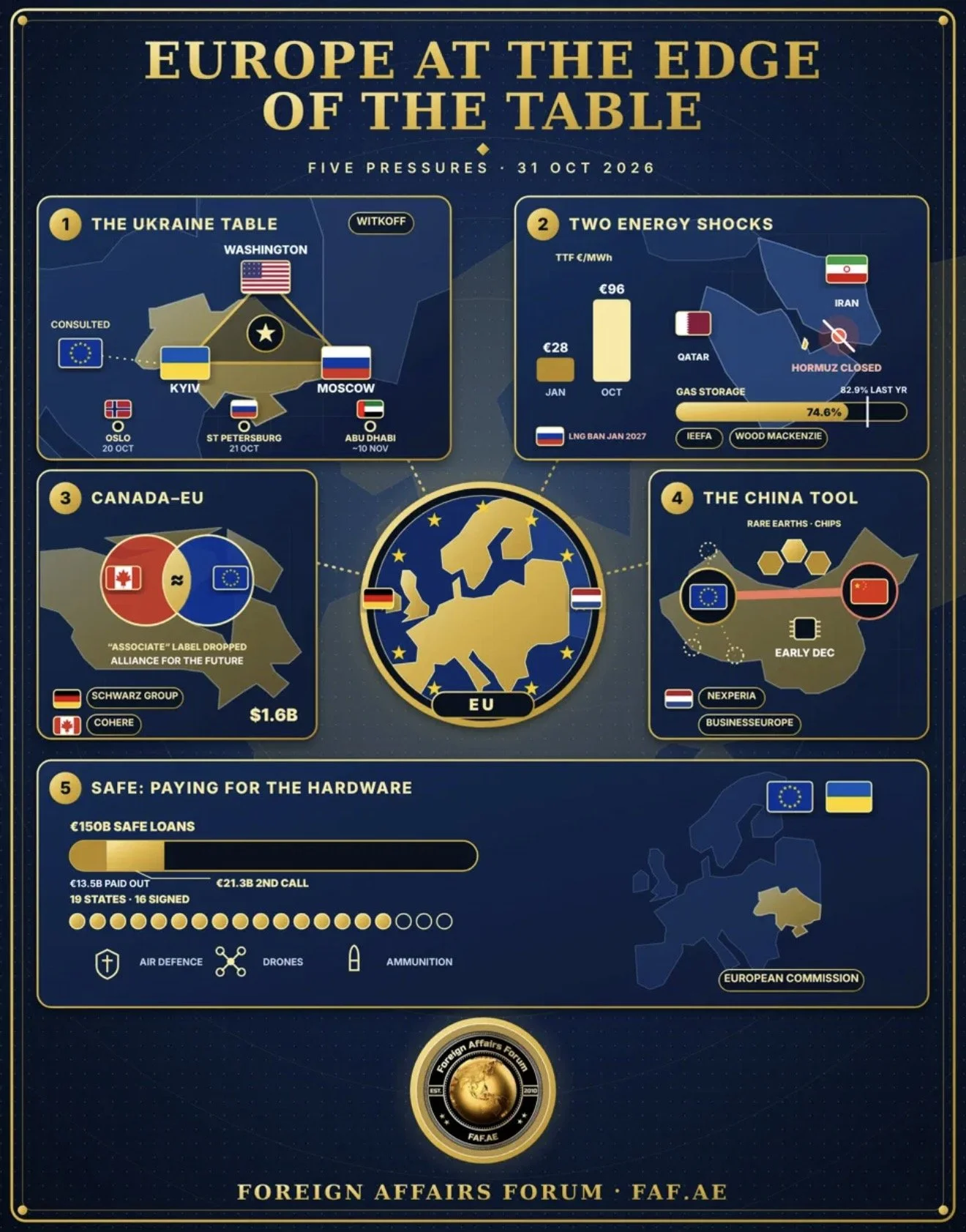
US envoy Steve Witkoff met Volodymyr Zelenskyy and European leaders in Oslo on 20 October.
The next day he spent nearly three hours with Vladimir Putin in St Petersburg.
Putin said Russia would join negotiations "in principle". Kremlin aide Yuri Ushakov has since said a US–Russia–Ukraine round will take place in Abu Dhabi after 4 November. He gave no exact date and said it depends "in part on battlefield conditions and the broader situation". Zelenskyy has said he hopes for around 10 November.
Russia has not finalised its delegation, though Ushakov says "the core is in place".
Europe's role is consultative. The Oslo meeting drew the prime ministers of Norway and Finland, with the EU and NATO represented, and Ushakov dismissed the European proposals as lacking substance. The core disputes remain: territory Russia holds, security guarantees for Ukraine, and Kyiv's path toward NATO.
Two outside variables could scramble the timetable.
US midterm elections are on 3rd November. Media reports say Donald Trump could resume heavy strikes on Iran afterwards, and Zelenskyy has voiced hope that Middle East escalation will not interfere.
Meanwhile Putin has confirmed he is exploring joint Arctic energy projects with US companies, and a Trump–Xi–Putin meeting has been discussed.
The risk for Brussels is a settlement negotiated by others and then presented to Europe for financing and enforcement.
Markets will trade on each headline, with European defence stocks and the euro the likeliest to move.
"Europe is paying for a peace it has not been invited to write. A continent that funds the outcome but does not sit at the table will find that others have already set the price."
— Dr. Antonio Bhardwaj
Two energy shocks at once
The Strait of Hormuz has been closed for roughly 240 days.
The Dutch TTF benchmark reached about €97.64 per MWh on 27 October, its highest since December 2022 and roughly triple its early-January level, though far below the 2022 peak above €340.
Qatari LNG, about 8% of EU LNG imports last year, has not arrived since May.
Storage was 74.6% full on 24 October against 82.9% a year earlier, the lowest for the time of year since records began in 2011, and injections have largely stalled.
Wood Mackenzie expects storage to fall to only 17–20% by the end of March, and lower in a cold winter. IEEFA says Europe may need to use about 7% less gas than last winter. Winter futures near €95 are almost three times last winter's average.
FAF article drew this from estimated about €715 extra per year for a typical gas-heated home, and it said prices may stay high until the global LNG market rebalances, possibly not until autumn 2028.
This collides with the Russian phase-out.
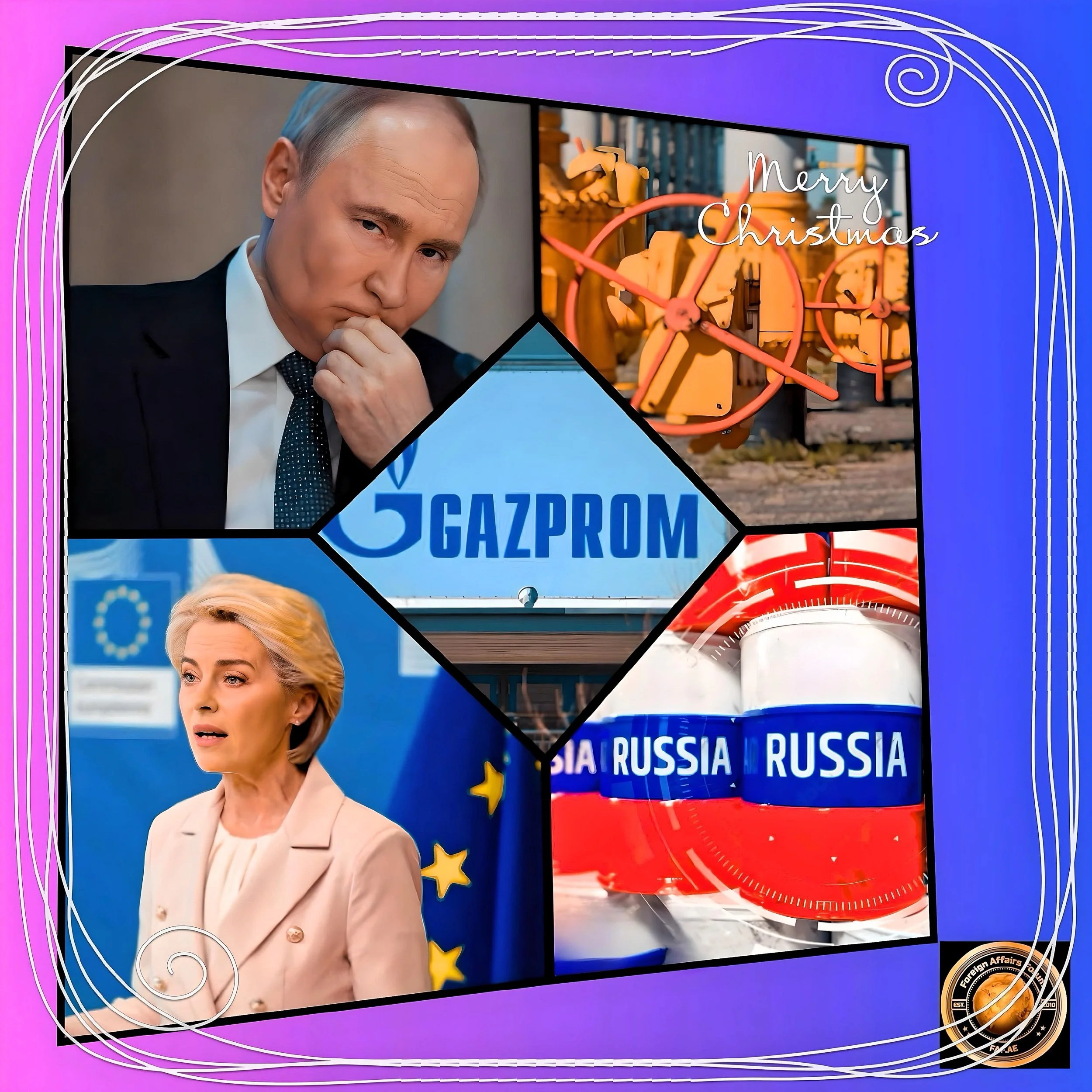
Russia's share of EU gas imports fell from 45% in 2021 to 19% in 2025. Russian LNG, about a fifth of EU LNG imports in the second quarter, faces a full EU ban from January 2027. Imports fell 46% in August and rebounded about 60% in September, at prices 73% above a year earlier.
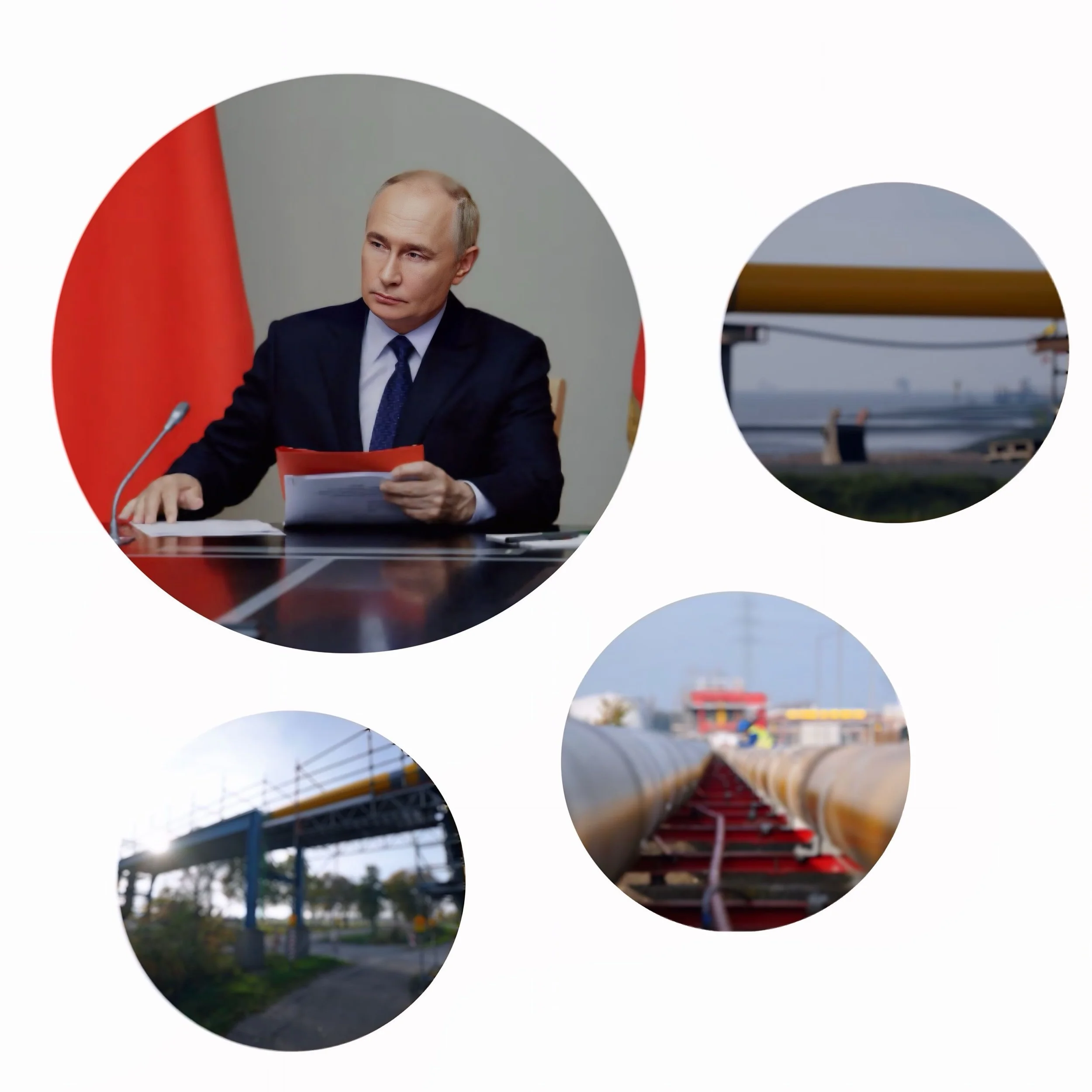
At the Gas Exporting Countries Forum on 27 October, Putin warned that excluding Russia from gas markets carries "serious consequences" for European consumers.
The politics are as awkward as the physics.
The Commission can suspend the short-term contract ban for only four weeks. Anything longer needs all 27 member states, which gives leverage to capitals that want sanctions eased.
Slovakia has called for that, and High Representative Kaja Kallas has rejected it.
Demand reduction is the main lever Europe controls, and winter will test whether the phase-out survives a cold snap.
"Association without accession", minus the label
The Canada–EU story needs the most care.
Ursula von der Leyen floated "associate member" status in September, and Mark Carney used the term this week. But according to Reuters and dpa reports, the joint draft statement no longer contained "associate member" or "associated membership". It speaks instead of an "ever closer association". Diplomats said German Chancellor Friedrich Merz and several other leaders pushed to remove the terms.
The two-day Montreal summit closed on 30 October with what Carney called an "alliance for the future", covering areas including AI and space.
The draft also included a joint initiative on subsea cables linking Europe, Canada and Asia, a feasibility study on Canadian LNG exports to Europe, and easier transatlantic work and study for young people.
Canada's government announced a stake of up to $1.6 billion in the AI firm Cohere.
Trump had called the associate-member idea "laughable". He also said that if he viewed it as a "hostile act", the US might stop trading with Europe on many things. That was a conditional threat, not a verdict, and patterns suggest no US reaction to the softened wording yet.
The episode still matters. The EU and Canada are openly hedging against US pressure. But the quick retreat on the label shows that the EU's capitals are cautious about anything that looks like defying Washington or reopening membership questions.
The anti-dependency tool
The Commission will present an instrument in early December, about a week before the leaders' meeting. It is meant to push companies to diversify away from single-country suppliers.
China is not named, but the tool follows Beijing's 2025 rare-earth export blocks and its cut-off of chips during the Nexperia dispute with the Dutch government.
The sectors, criteria and enforcement are undecided.
A minimalist version would cover a few sectors such as dual-use industries, healthcare and energy grids. A maximalist version would put tariffs on buyers above a set threshold from one source.
Trade Commissioner Maroš Šefčovič has told industry to factor in "the cost of resilience", and BusinessEurope warns that not every dependency is a problem. For some materials, rare earths above all, no alternative exists yet. The tool is also being prepared while trade MEPs visit China and the EU negotiates with Beijing on rebalancing trade.
"Resilience is not a slogan; it is a line item. Brussels can name the dependency it wants to cut, but unless it is honest about who pays, the policy will be fought in the capitals before it is ever tested against Beijing."
— Dr. Antonio Bhardwaj
Paying for the hardware
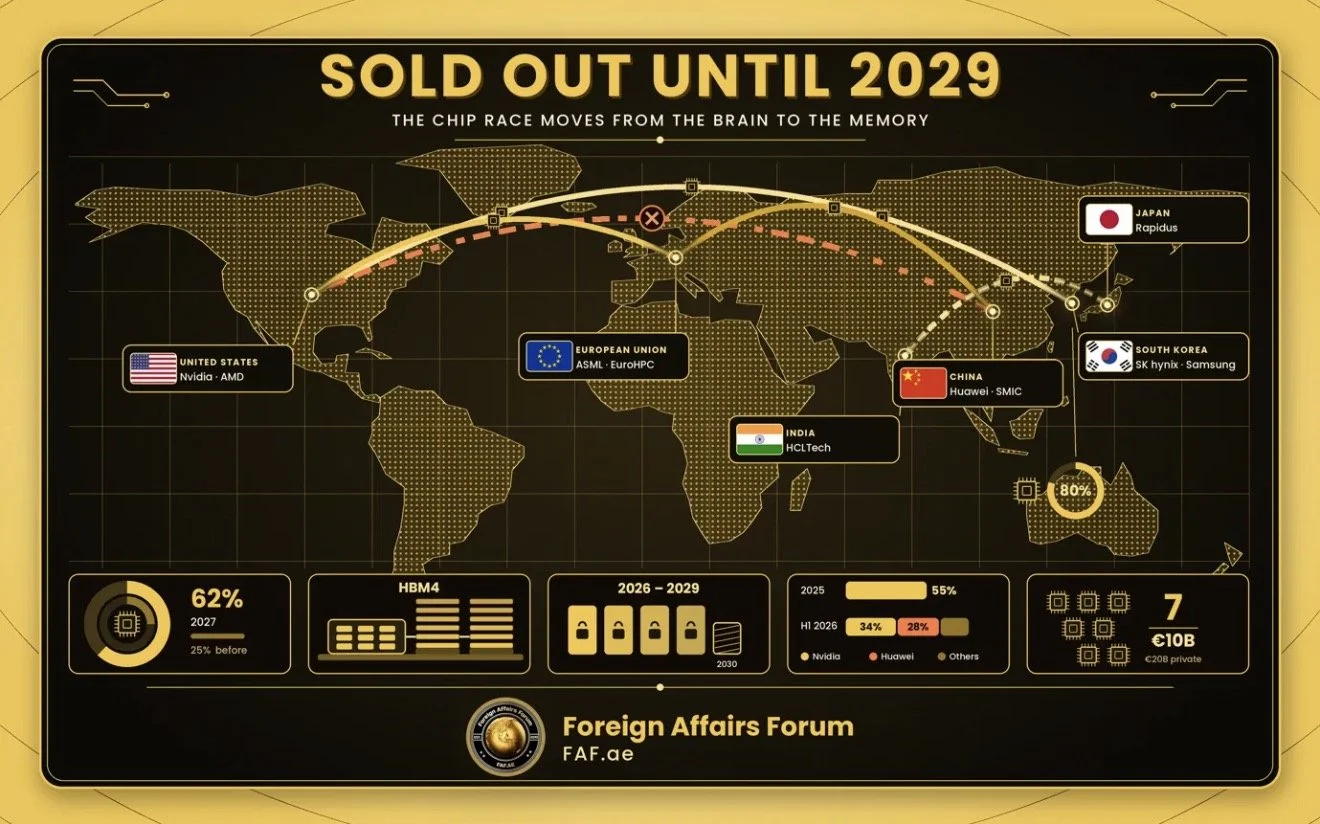
On 29 October the Commission opened a second call under SAFE, the €150 billion programme of long-term defence loans. The new round offers €21.3 billion, with priority on air and missile defence, drones and counter-drone systems, and ammunition.
States are encouraged to buy jointly with Ukraine. All 19 participating states have approved loan agreements and 16 have signed.
About €13.5 billion has been disbursed to 11 states, and some asked for less than they were allocated, which hints at fiscal limits.
What connects the five
In each story Europe holds real assets: money, regulation, a large market and an industrial base. In each it is also exposed to someone else's decisions.
Washington and Moscow are shaping the Ukraine talks. The Gulf and Russian producers drive the gas market. Beijing holds the rare earths. Washington's pressure explains both the Canadian outreach and the Canadian retreat on wording.
Europe's answer is the same everywhere: reduce exposure and build leverage. Each response is slow, expensive and contested between capitals.
The Canada episode is a reminder that even modest ambition can be trimmed to keep the peace with Washington.
Conclusion: the price of agency
Strategic autonomy has been a Brussels slogan for years. This week showed its bill: gas at triple last winter's price, tougher rules for business, new defence debt and arguments over a single phrase. It also showed the alternative, which is to wait while others decide.
The next two weeks will show how much weight Europe carries. The Abu Dhabi round, the 3 November US vote and any renewed strikes on Iran will set the backdrop. A cold December will test the gas policy against public patience. If Europe turns scattered measures into one posture fast enough, it will be an actor with partners and tools. If not, it will keep getting invited to Oslo, listened to politely, and left outside the room where decisions are made.