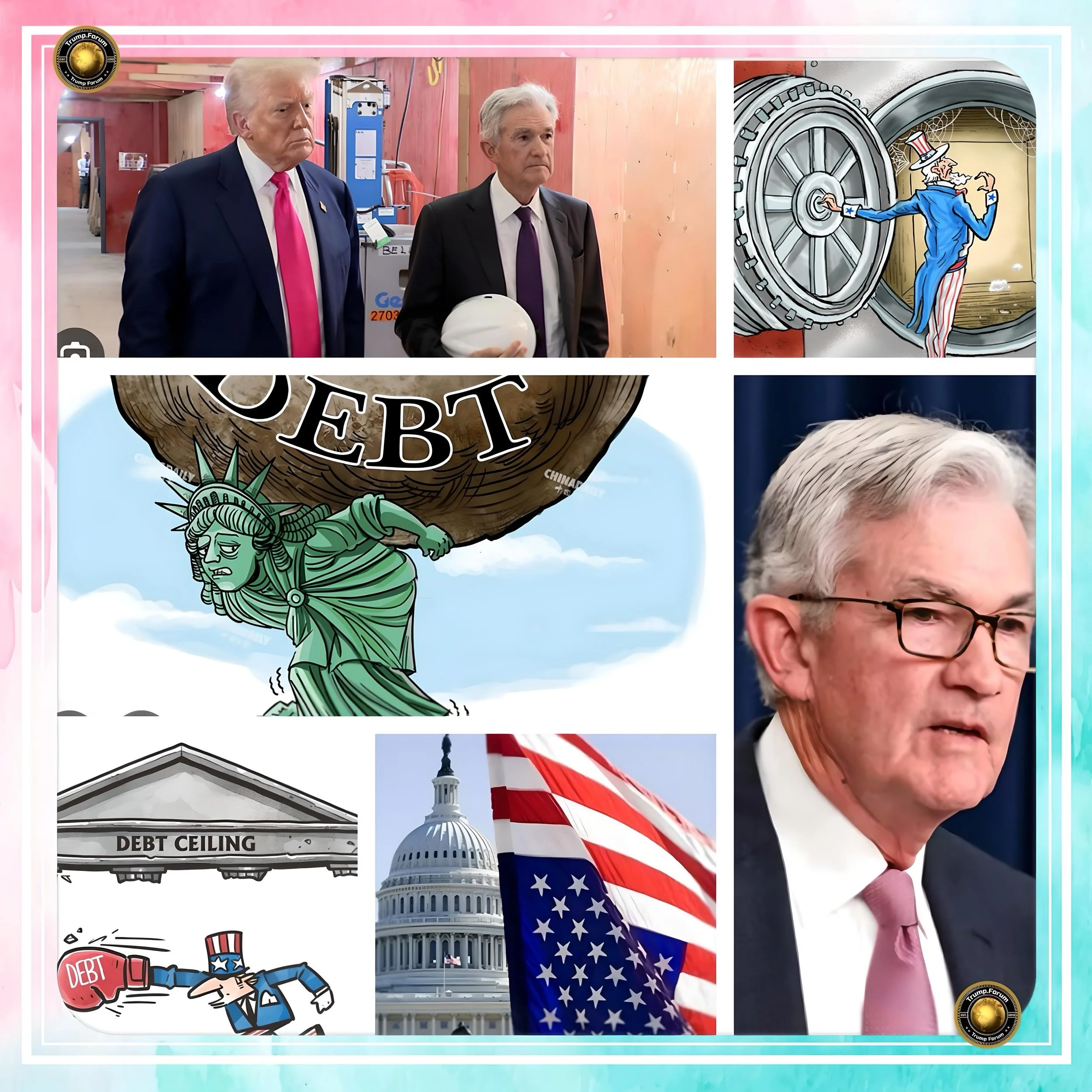
The Federal Reserve Confronts a Fiscal Dominance Crisis: How Washington's Debt Could Force the Central Bank to Abandon Its Inflation Mandate
Executive Summary
The Danger Washington Still Doesn't Understand: Why Emerging Markets' Fiscal Dominance Trap Awaits America
The American federal government confronts a structural fiscal crisis that threatens the independence of the Federal Reserve and the credibility of U.S. monetary policy.
At the ASSA conference in Philadelphia on January 4, 2026, prominent economists including former Treasury Secretary Janet Yellen, former Cleveland Federal Reserve President Loretta Mester, MIT economist Athanasios Orphanides, and UC Berkeley's David Romer issued a stark warning: the preconditions for fiscal dominance are strengthening.
This regime, wherein government financing needs override central bank inflation-fighting objectives, presents an existential threat to monetary stability and long-term economic growth.
With federal debt exceeding $38 trillion and consuming approximately 100% of GDP, coupled with annual interest payments approaching $1 trillion, the U.S. faces a confluence of demographic pressures, political challenges to central bank autonomy, and market fragility that could force the Federal Reserve to abandon its inflation mandate to accommodate government borrowing costs.
Introduction
The Structural Collapse of Fiscal Discipline: How American Debt Exploded from $5 Trillion to $38 Trillion in Two Decades
Fiscal dominance describes a macroeconomic pathology in which the size and unsustainability of government debt effectively dictate monetary policy rather than the reverse. Instead of the Federal Reserve maintaining price stability while the Treasury maintains fiscal discipline, the central bank becomes a passive accommodator of deficit spending, keeping interest rates artificially low to minimize the government's debt servicing burden.
This subordination of monetary to fiscal objectives has plagued emerging markets from Argentina to Turkey, where central bank independence eroded, inflation spiraled into double or even triple digits, and currency values collapsed. What once seemed an impossibility in the world's largest economy—that Washington might force the Federal Reserve into fiscal service—now occupies the serious concern of America's most respected economists.
The warnings issued at the January 2026 ASSA conference are not speculative. They are grounded in quantifiable deterioration: debt held by the public now exceeds $30 trillion, the federal deficit approaches $2 trillion annually, interest payments have surpassed $1 trillion per year, and the Congressional Budget Office projects a debt-to-GDP ratio of 156 percent by 2055.
More pressingly, the current Trump administration has made extraordinary efforts to constrain Federal Reserve independence through public pressure, attempted removal of dissenting governors, and promises to nominate a Fed Chair aligned with the administration's preference for looser monetary policy.
The convergence of structural fiscal unsustainability and acute political threats to central bank autonomy creates a scenario that Yellen herself characterized as one in which "the dangers are real and should be monitored."
Historical and Institutional Context
For three-quarters of a century, the Federal Reserve has operated as an island of monetary discipline in a sea of political expediency.
The institutional separation of monetary and fiscal authority, codified in the Federal Reserve Act and reinforced through cultural norms and legal protections, allowed the central bank to prioritize price stability over electoral cycles and budget pressures.
This independence was hard-won. After World War II, the Federal Reserve had been subordinated to Treasury objectives, keeping interest rates artificially low to facilitate government borrowing. It took a historic confrontation in the late 1940s, when Fed Governor Marriner Eccles resisted President Truman's demands for accommodative policy, to establish the principle that the central bank should not be an instrument of fiscal policy.
The independence that Eccles fought for proved consequential. When inflation erupted in the 1970s as a consequence of years of monetary accommodation, the Federal Reserve under Paul Volcker executed a wrenching but necessary tightening. Volcker's willingness to tolerate 10 percent interest rates and a severe recession to break the back of inflation was possible only because the Fed possessed sufficient autonomy to withstand the political outcry that ensued.
That autonomy has been institutionalized through overlapping board terms, a statutory dual mandate for price stability and full employment, and an international consensus that central bank independence correlates with lower average inflation and superior economic performance.
Yet independence is not guaranteed by statute alone. It rests upon a social contract in which elected officials respect the central bank's sphere of authority in exchange for the central bank maintaining credibility with markets and the public. That social contract is fraying.
The Trump administration has subjected the Federal Reserve to a level of public pressure and institutional attack unseen since the Truman era.
Trump has appointed multiple loyalists to the Federal Reserve Board, attempted to remove a governor through executive action, and threatened to replace Chair Jerome Powell with a candidate more amenable to rate cuts. He has publicly demanded that the Fed lower interest rates to ease the government's debt burden, explicitly linking monetary policy to his administration's fiscal and growth objectives.
The Trajectory of Federal Debt
The American fiscal position has deteriorated with remarkable speed. Twenty years ago, in 2006, federal debt held by the public stood at approximately $5 trillion, or roughly 35 percent of GDP. By the end of fiscal 2025, that figure had swollen to more than $30 trillion, or nearly 100 percent of GDP.
This ninefold expansion occurred through a combination of mechanisms: fiscal stimulus and banking system interventions during the 2008 financial crisis; nearly $6 trillion in COVID-related expenditure between 2020 and 2022; repeated tax cuts unsupported by commensurate spending reductions; and, most recently, the One Big Beautiful Bill Act signed into law in 2025, which the Congressional Budget Office estimates will increase deficits by $3.3 trillion over the next decade.
The Congressional Budget Office's official baseline projections, which assume current law and thus incorporate the effects of expiring tax provisions, paint a stark trajectory. Under these projections, federal debt held by the public will reach 122 percent of GDP by 2034—exceeding the previous postwar high of approximately 119 percent achieved in the immediate aftermath of World War II—and could rise to 156 percent of GDP by 2055. These are not worst-case scenarios; they reflect the CBO's expectation of stable policies and moderate economic growth.
Alternative scenarios, in which the Trump administration makes permanent the expiring provisions of the 2017 tax cuts while maintaining deficit-expanding tariff policies, project debt could exceed 200 percent of GDP within three decades.
This accumulation of debt has been accompanied by a dramatic escalation in interest payments. In fiscal year 2024, the federal government spent $881 billion on net interest payments, exceeding defense spending for the first time in peacetime. By fiscal 2025, that figure had risen to approximately $970 billion, and through the first two months of fiscal 2026, interest payments totaled $179 billion, up 12 percent from the comparable period a year earlier.
The Congressional Budget Office projects that interest payments will reach $1.5 trillion annually by 2032 and potentially $2.2 trillion by 2035 under a scenario of higher interest rates. By that point, interest payments would consume approximately one-fifth of all federal revenue, crowding out spending on defense, infrastructure, research, and domestic programs.
The Mathematics of Fiscal Dominance
Fiscal dominance emerges when the government's need to finance its debt becomes so pressing that it constrains the central bank's ability to conduct independent monetary policy.
The mechanics are simple but consequential. If the federal government runs persistent primary deficits—spending exceeding revenue before accounting for interest costs—the stock of debt grows. As the debt stock expands, the government must issue increasing quantities of new Treasury securities to roll over maturing debt and finance new spending. If markets perceive that debt is on an unsustainable path, they require higher interest rates to compensate for the risk that the government will either default or inflate away the real value of the debt.
The central bank, watching debt servicing costs spiral and facing political pressure to accommodate government borrowing needs, faces a choice. It can maintain its inflation-fighting mandate by keeping real interest rates positive, allowing yields on government securities to rise to whatever level markets demand. Or it can suppress interest rates below the level that inflation dynamics would otherwise justify, either through conventional monetary policy adjustments or through quantitative easing and debt purchases.
The latter option provides temporary fiscal relief to the government—lower borrowing costs, reduced spending on interest payments—but at the cost of compromising monetary credibility and eventually accelerating inflation.
Historical examples demonstrate the trajectory. Turkey provides a contemporary case study. Over the past decade, President Recep Tayyip Erdogan undermined the independence of the Turkish central bank, insisting on interest rate reductions despite accelerating inflation, on the theory that high rates cause rather than combat price increases.
The central bank, lacking the institutional protection to resist, capitulated. Turkish inflation exceeded 80 percent on an annualized basis, the Turkish lira depreciated by nearly half against the dollar in real terms, and the central bank's net foreign exchange reserves turned negative.
Argentina followed a different path but arrived at a similar destination. Persistent fiscal deficits, sustained by monetary accommodation, generated inflation that reached 160 percent and eventually triggered a currency crisis and debt restructuring.
The American Vulnerability
The United States faces exposure to fiscal dominance through multiple channels. First, the structural trajectory of the budget—with spending on entitlements and interest payments growing faster than revenues, which in turn grow slower than historical norms—implies persistent deficits at least through the end of the decade. The Committee for a Responsible Federal Budget estimates that the federal government is borrowing approximately $7 billion per day, a rate that would generate deficits exceeding $2.5 trillion annually within the coming years if current policies persist. No amount of growth can close deficits of that magnitude.
Second, the current administration has made an explicit assault on Federal Reserve independence. President Trump has repeatedly and publicly demanded that the Federal Reserve lower interest rates to ease the government's debt burden and stimulate economic growth.
He has appointed fellow loyalists to the Federal Reserve Board, including Christopher Waller, Michelle Bowman, and Stephen Miran. He has launched a legal effort to remove Governor Lisa Cook, a critic of his monetary policy preferences. Most significantly, he has signaled his intention to nominate a successor to Chair Jerome Powell when Powell's term expires in May 2026, and has made clear his preference for a Fed Chair inclined to accommodate his administration's policy objectives.
Third, the political economy of deficit reduction has become intractable. Congress has not passed a significant deficit reduction package since the late 1990s, when federal surpluses were temporarily achieved.
The constituency for spending cuts encompasses a growing share of the budget—roughly half of federal spending now flows to retirees in the form of Social Security, Medicare, and Medicaid benefits, while interest payments consume an escalating share. The constituency for tax increases is politically weak. The result is a structural bias toward deficit spending that cannot be overcome through conventional legislative processes.
Fourth, financial market stability is fragile. The bond market, which has historically absorbed vast quantities of U.S. Treasury issuance at yields consistent with modest fiscal discipline, is signaling stress. In early January 2026, following surprisingly resilient labor market data and expectations for elevated inflation from the administration's tariff policies, Treasury yields surged sharply.
The 10-year Treasury yield climbed above 4.30 percent, and bond analysts warned of a "yield shock" and the reemergence of "bond vigilantes"—investors who would demand ever-higher yields if they perceived that fiscal sustainability was being compromised. These yield movements translate directly into higher government financing costs, which in turn increase the political pressure on the Federal Reserve to accommodate deficit spending through lower rates.
The Institutional Assault on Independence
The Trump Administration's Assault on Federal Reserve Independence: Political Pressure, Institutional Decay, and the Threat to Central Bank Autonomy
The threat to Federal Reserve independence is not merely abstract. The Trump administration has mounted a multifaceted assault on the Fed's autonomy. Most directly, the president has demanded lower interest rates, using the same rhetoric of populist frustration that has succeeded in dismantling central bank independence in emerging markets. His chief economic advisor, Kevin Hassett, has suggested that the Federal Reserve is significantly behind the curve on rate cuts and that more aggressive easing is warranted. Hassett is a leading candidate to replace Powell as Fed Chair when Powell's term expires in May 2026.
Second, the administration has sought to remove Fed Governor Lisa Cook through executive action. Though federal courts have blocked this effort, the Supreme Court is expected to rule on the administration's appeal in early 2026. If the Supreme Court permits the president to remove a Fed governor, it would dramatically weaken the institutional protections that insulate the Federal Reserve from executive pressure.
Third, the administration's control over Fed appointments is expanding. With Powell's term ending in May 2026 and two additional Fed governor seats coming open, the Trump administration will have named at least three of seven governors by the end of 2026. Under these circumstances, the Fed's cohesion around a commitment to price stability cannot be taken for granted. The economists on the January 2026 ASSA panel expressed particular concern about this scenario.
Loretta Mester highlighted what she termed the "scariest" component of the current fiscal-monetary impasse: that the Trump administration may not understand the implications of fiscal dominance. Erdogan in Turkey, she noted, did not understand that central bank independence served his own long-term interests by anchoring inflation expectations. Instead, he viewed the central bank as an obstacle to his growth objectives and subordinated it to fiscal needs.
The consequences were currency depreciation, loss of purchasing power, and reduced living standards for Turkish citizens. Previous governments, Mester suggested, at least recognized that they were "on a precipice" even if they ultimately failed to act responsibly. The current administration shows no such recognition.
The Structural Constraints Ahead
Absent significant fiscal consolidation—which the political economy of the moment makes nearly impossible—the fiscal trajectory is locked in. The CBO baseline projects that the federal government will run deficits averaging $1.9 trillion annually between fiscal 2026 and fiscal 2035. These deficits will require the issuance of approximately $19 trillion in new Treasury securities over the decade.
At current and projected interest rates, the government will pay an average of 3.85 percent on this new issuance.
In a higher interest rate scenario, reflecting legitimate market concerns about inflation and fiscal sustainability, the cost rises substantially.
These deficits cannot be financed without either crowding out private investment, attracting large-scale foreign borrowing that increases the economy's vulnerability to currency shocks, or monetizing the debt through central bank purchases.
The first option reduces future economic growth by reducing the capital stock available to workers, lowering productivity and wages.
The second option increases the current account deficit and the nation's foreign liabilities. The third option—central bank financing—trades higher inflation today for unsustainable debt dynamics tomorrow.
The timing is particularly fraught. Federal Reserve Chair Jerome Powell's term expires in May 2026, precisely as the fiscal-monetary tensions are becoming acute.
The administration will nominate a replacement, and the Senate will confirm. Market participants, policymakers, and investors will be intensely focused on whether the incoming chair will maintain Fed independence or capitulate to political pressure. If the incoming chair signals a willingness to accommodate deficit spending through accommodative monetary policy, long-term interest rates could spike as investors demand higher yields to compensate for inflation risk.
Such a spike would paradoxically make the government's debt position less sustainable, not more, contradicting the administration's objective of easing the debt burden.
The Warnings from Philadelphia
The January 4, 2026 ASSA panel brought together four of America's most respected economists to assess these risks. Yellen, who served as both Fed Chair and Treasury Secretary, carried particular weight. Her statement that "the preconditions for fiscal dominance are clearly strengthening" was not a projection of distant risk but an assessment of the current trajectory. She further noted that the United States risks becoming a "banana republic"—a pejorative reference to emerging market economies with unstable fiscal and monetary policies—if the Trump administration succeeds in forcing the Federal Reserve to keep rates artificially low to ease debt servicing.
Yet Yellen also expressed conditional optimism. She suggested that a fiscal crisis—potentially triggered by the insolvency of Social Security and Medicare—could produce a moment of political clarity sufficient to motivate bipartisan fiscal consolidation. Crises can concentrate the mind and overcome partisan polarization.
Such a moment occurred in 1983 when Social Security faced near-term insolvency, prompting both parties to agree to benefit changes and tax increases. It occurred in 1990 and 1993 when deficit reduction packages, despite political pain, passed with bipartisan support.
David Romer, by contrast, expressed less optimism. He characterized the situation as a "fiscal problem" and stated bluntly that if the problem is not solved, it "will create problems for everybody, including the Fed." Romer's perspective, shaped by decades of research on fiscal dynamics, did not emphasize the stabilizing power of crisis. Instead, he underscored that the current trajectory is unsustainable and that the political system shows little inclination to address it voluntarily.
Mester's contribution emphasized the distinctiveness of America's current vulnerability. Fiscal dominance is not new; it has occurred throughout history and persists in many emerging economies. What distinguishes the current American predicament is the explicit refusal of the political leadership to acknowledge the constraints.
Previous governments, including previous Republican administrations, understood at some level that they were operating on a fiscal precipice.
The current administration appears to operate under a different theory: that growth can solve the problem, that deficits do not matter if they finance productive investment, or that the central bank can simply accommodate fiscal needs without consequence.
Avenues Forward
The panel discussion at ASSA did not conclude with a sense of inevitability. The economists acknowledged that the American political system has demonstrated an ability to execute significant fiscal consolidation when political will aligns. The Reagan era saw a reduction in the ratio of federal debt to GDP from the elevated levels of the early 1980s to the lower levels of the late 1980s, though through a combination of defense buildup and economic growth rather than primary fiscal consolidation.
The late 1990s saw a brief period of unified government surplus achieved through spending restraint and tax increases. Such episodes show that fiscal dominance is not predetermined.
What is required is a recognition by elected officials, the administration, and the public that the current fiscal path is unsustainable and that consolidation is necessary.
This recognition must be accompanied by a commitment to restore the political consensus that the Federal Reserve is an independent institution whose primary objective is price stability.
Markets require confidence that monetary policy will not be subordinated to fiscal needs. When that confidence erodes, as it has in Turkey and Argentina, the cost is borne through higher inflation, currency depreciation, and reduced living standards.
The Federal Reserve itself must maintain the credibility to resist political pressure. The institution's reputation is its primary asset. Powell and his successor, whoever that may be, must make clear that the central bank will not accommodate unsustainable fiscal paths.
This stance will be unpopular in the short term. It will generate criticism from those who prefer lower interest rates and faster growth. But capitulation to political pressure would ultimately undermine the Fed's ability to deliver stable prices and full employment—the objectives that justify its independence in the first place.
Conclusion
The Path to Credibility Remains Open—But Time Is Running Out to Take It
The warnings issued by Yellen, Mester, Orphanides, and Romer at the January 4, 2026 ASSA conference reflect a serious assessment of the American fiscal and monetary predicament.
The preconditions for fiscal dominance are strengthening, not as a matter of ideology or speculation, but as a consequence of structural budget dynamics and explicit political challenges to central bank autonomy.
The federal government is borrowing at unsustainable rates, interest payments are consuming an escalating share of revenues, and the current administration has made clear its intention to subordinate monetary policy to fiscal and growth objectives.
Yet the situation is not irreversible. The American political system, for all its flaws, has demonstrated the capacity to execute significant fiscal consolidation. Federal Reserve independence, though challenged, remains anchored in institutional law and international consensus about the benefits of central bank autonomy.
Market vigilance, evidenced by the sharp yield movements in early January 2026, provides a restraining force against indefinite fiscal expansion. And the dangers, however real, are at this moment still preventable.
A change in fiscal course—achieved either through crisis-induced political clarity or through voluntary recognition of fiscal constraints—combined with the nomination of a Fed Chair committed to price stability, would substantially reduce the risk of fiscal dominance.
The cost of delay, however, rises with each passing quarter. The interest rate environment tightens as debt accumulates and inflation risks increase. Political consensus becomes harder to achieve as more constituents come to depend on federal benefits and more creditors become concerned about repayment. The window for preventive action is narrowing. The warnings from Philadelphia should be treated with the seriousness they deserve.