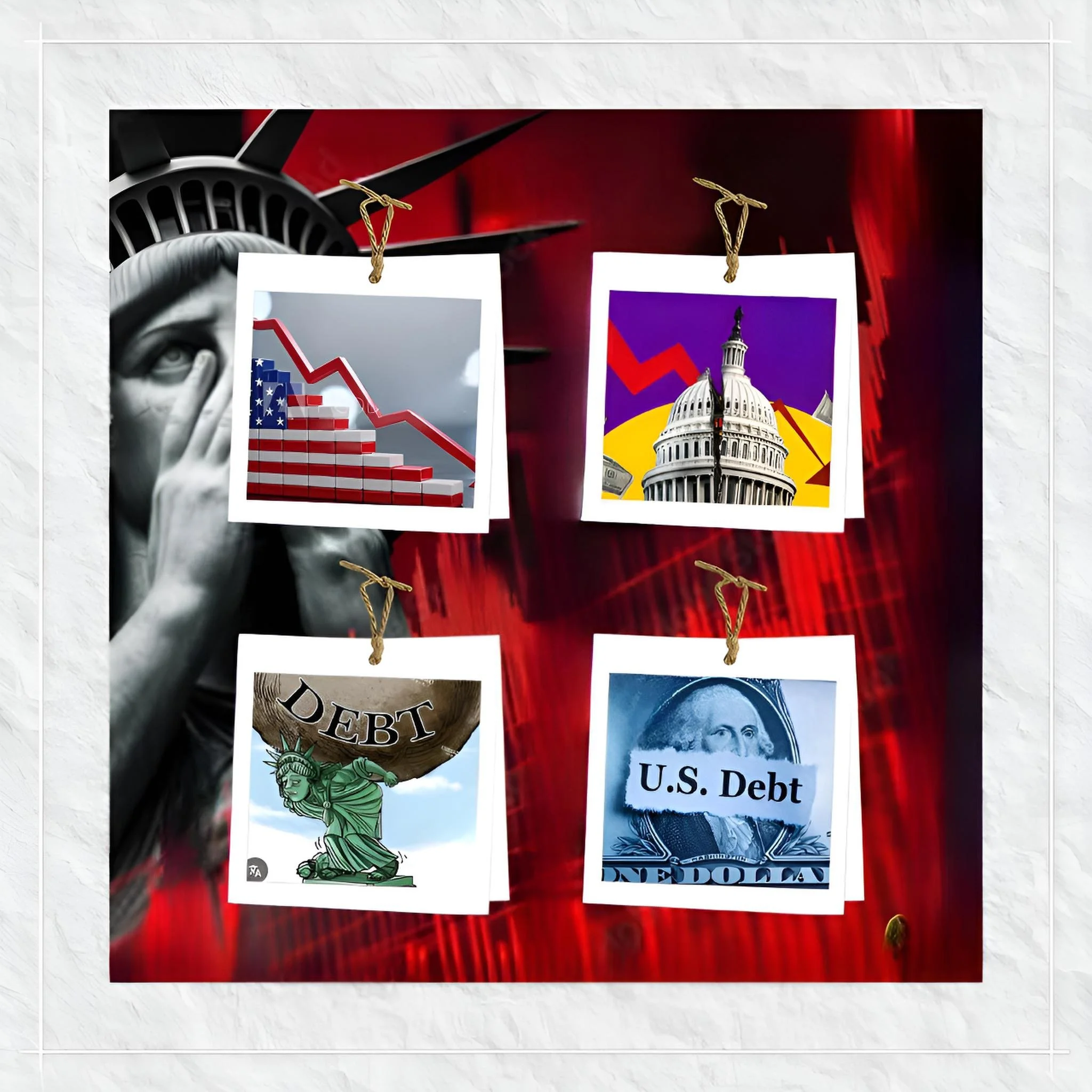
The United States Confronts Unprecedented Fiscal Challenges: How the One Big Beautiful Bill Act Deepens Structural Debt Vulnerabilities
Executive Summary
The United States government faces an escalating fiscal crisis that demands immediate policy intervention.
As of January 2026, the national debt stands at 38.4 trillion dollars, representing approximately 100 percent of gross domestic product—a threshold historically associated with severely constrained economic flexibility and elevated systemic risk. President Trump's One Big Beautiful Bill Act, signed into law in July 2025, compounds this predicament by adding an estimated $ 3.4 to $ 5.5 trillion to deficits over the next decade.
Concurrently, annual interest payments on the national debt have surpassed one trillion dollars for the first time, consuming an unprecedented share of federal revenues and crowding out productive investment.
FAF analysis examines the structural determinants of the current fiscal trajectory, evaluates the short-term and long-term consequences of recent legislative actions, and assesses the narrowing policy options available to elected officials confronting this mounting budgetary burden.
Introduction
The relationship between government debt, economic growth, and fiscal stability has animated economic policy debates for centuries. Yet contemporary American fiscal dynamics present novel challenges that transcend historical precedent.
The United States currently borrows approximately $8 billion daily to finance its operations—a debt accumulation velocity that reflects a structural disconnect between revenues and outlays.
Within this context, the Trump administration's One Big Beautiful Bill Act represents a consequential decision point: policymakers deliberately chose to extend tax cuts, increase defense and border enforcement spending, and reduce revenues through tariff uncertainty despite compelling evidence that such policies would exacerbate structural deficits.
Understanding this decision requires examining the confluence of three interconnected dynamics: the quantitative magnitude of existing debt obligations, the policy decisions embedded in recent legislation, and the economic mechanisms through which federal borrowing constrains productive activity.
This analysis provides decision-makers with a framework for comprehending the fiscal architecture underlying American economic policy and the real economic costs of current budgetary trajectories.
Historical Context and the Illusion of Growth-Led Debt Reduction
Contemporary American policymakers frequently invoke the post-World War II experience as precedent for managing elevated debt loads. In 1946, the national debt reached 106 percent of GDP—a level that declined to 23 % by 1974.
This historical narrative often attributes debt reduction primarily to economic growth exceeding interest rates on government obligations, fostering the belief that robust productivity gains can domestically offset fiscal imbalances without requiring politically contentious spending cuts or revenue increases.
Recent scholarship fundamentally challenges this interpretation. A rigorous analysis of the mechanisms underlying post-war debt reduction reveals that primary surpluses—government revenues exceeding non-interest spending—accounted for approximately 61% of the debt-to-GDP decline.
Between 1946 and 1974, the federal government maintained primary surpluses averaging 1.1 to 1.3 % of GDP annually.
Additionally, interest rate suppression orchestrated through Federal Reserve policy yielded profoundly negative real interest rates on government securities, artificially reducing the effective cost of debt service.
Pure economic growth, when controlled adequately for these interventions, contributed only 22% of the 83-point decline in the debt-to-GDP ratio.
This historical reinterpretation carries profound implications for current policy discourse.
The United States cannot reasonably expect to "grow out of" its fiscal obligations without implementing primary surpluses—a prospect made increasingly unlikely by the architectural choices embedded in the One Big Beautiful Bill Act and the continued political resistance to fiscal restraint that characterizes contemporary policymaking.
Current Fiscal Status
Dimensions of the Challenge
As of January 28, 2026, the American fiscal situation exhibits characteristics that warrant serious concern among economists, investors, and policymakers alike.
The debt ceiling, raised to $41.1 trillion through the One Big Beautiful Bill Act, will be reached within 12 to 24 months at current borrowing trajectories. Quarterly interest payments have reached $179 billion, representing the second-largest federal expenditure category after Social Security and having displaced national defense as the third-ranked budget item.
The primary deficit—government spending excluding interest payments on existing debt—totaled 805 billion dollars in fiscal year 2025.
This metric is particularly important because it indicates a structural imbalance independent of the compounding effects of rising debt service costs.
The Committee for a Responsible Federal Budget projects that primary deficits will persist at approximately $830 billion in 2026 and remain above $900 billion through the 2034 planning horizon, signifying that the government continues to spend substantially more than it collects in revenues even before servicing existing obligations.
The One Big Beautiful Bill Act's Fiscal Architecture
The One Big Beautiful Bill Act encompasses hundreds of provisions addressing taxation, spending, and debt management.
From a fiscal perspective, the legislation's most significant components include the permanent extension of individual tax reductions enacted in 2017, increased child tax credits, expanded deductions for state and local taxes, and substantial increases in defense and immigration enforcement spending.
The Congressional Budget Office estimates the legislation will increase deficits by $3.4 trillion over the ensuing decade through 2034, with some comprehensive analyses suggesting total costs approaching $5.5 trillion when accounting for secondary provisions and implementation timelines.
The bill simultaneously implements a stratagem predicated upon tariff revenue to offset its fiscal cost.
The Trump administration collected $195 billion in tariff duties in fiscal year 2025—a 150% increase relative to 2024 collections—and projects that ongoing tariff policies will generate $3 to 5.2 trillion in federal revenue over the decade.
However, this revenue projection confronts substantial legal vulnerability.
In May 2025, the U.S. Court of International Trade ruled that a significant portion of the Trump administration's tariff framework contravenes existing trade law, a decision currently pending Supreme Court review.
Should the Court affirm this ruling, projected tariff revenues would decline by approximately $2.2 trillion, fundamentally altering the fiscal mathematics underlying the legislation.
The Interest Payment Crisis: Crowding Out in Real Time
Federal interest payments constitute the fastest-growing component of the federal budget and represent perhaps the most consequential mechanism through which mounting debt constrains economic opportunity.
The federal government expended $970 billion on net interest in fiscal 2025, a sum that nearly doubled over the preceding four years despite modest economic growth.
The Congressional Budget Office projects that annual interest payments will reach $ 1.8 trillion by 2035, surpassing Medicare spending and consuming approximately 4.1% of GDP.
These escalating interest costs manifest through the economic phenomenon economists designate as "crowding out"—the mechanism by which government borrowing absorbs an expanding share of national savings, thereby reducing the capital available for private enterprise investment.
Federal Reserve analysis indicates that for each dollar of federal deficit, 33 cents represents a net reduction in productive private investment, with the remainder reflected through increased private savings and foreign borrowing.
As federal debt accumulated and interest costs escalated, this crowding-out mechanism increasingly constrained investment in productive capital, research and development, and infrastructure—the factors that historically have driven American productivity gains and wage growth.
The Peterson Foundation projects that by 2035, private investment will decline 13.6% relative to a baseline scenario in which deficits stabilize. This investment contraction will suppress real wage growth, reduce labor productivity, and depress economic output by an estimated 5.3% compared to fiscal stability scenarios.
In essence, current federal borrowing imposes an implicit tax on future generations through reduced productive capacity and wage opportunities.
Projections Under Alternative Scenarios
The Committee for a Responsible Federal Budget has developed scenarios to address the uncertainty surrounding tariff revenues and the permanence of temporary tax provisions in the One Big Beautiful Bill Act.
Under the CRFB's Adjusted August 2025 Baseline scenario, which assumes tariffs generate approximately $3 trillion in revenue and temporary provisions expire as scheduled, the national debt will reach 120 percent of GDP by 2035.
Annual deficits will rise from $1.7 trillion in 2025 to $2.6 trillion by 2035, representing 5.6 to 5.9% of GDP—levels that economic research has consistently associated with fiscal stress and reduced policy flexibility.
However, should the Supreme Court invalidate substantial portions of the Trump tariff regime, permanent extension of temporary provisions in the One Big Beautiful Bill Act, and long-term interest rates remain at current elevated levels, the CRFB's Alternative Scenario projects that national debt could reach 134% of GDP by 2035, with interest payments consuming 5 % of GDP and annual deficits approaching 3.5 trillion dollars.
Under this trajectory, interest payments alone would exhaust roughly 22 cents of every dollar the federal government collects in revenues, leaving diminishing resources for defense, infrastructure, scientific research, and the social insurance programs upon which millions of Americans depend.
Cause and Effect
The Fiscal-Monetary Feedback Loop
The escalating fiscal deficits and mounting debt load have already begun generating macroeconomic consequences that reinforce themselves through feedback mechanisms. Higher federal borrowing has elevated long-term interest rates, increasing the cost of capital for businesses and households.
Higher mortgage rates, in turn, have suppressed housing affordability and construction activity. Elevated corporate borrowing costs have reduced business investment and hiring intentions.
These contractionary forces offset the theoretical stimulus from government spending increases, resulting in net economic impacts that may prove damaging—a condition economists term "crowding out" when the displacement of private activity exceeds any demand stimulus from government spending.
Additionally, the persistence of elevated deficits and elevated interest rates has introduced currency pressures into American macroeconomics.
The U.S. dollar has depreciated approximately 10% against major currencies during the Trump administration, a trend reflecting market concerns about the long-term sustainability of American fiscal policies and the credibility of U.S. government obligations.
Should this currency depreciation accelerate, the dollar's status as the world's reserve currency could face a challenge, introducing additional complications into American financial markets and geopolitical positioning.
The Structural Challenges Confronting American Policymakers
Beneath the quantitative dimensions of the current fiscal crisis lie deeper structural challenges that constrain policy flexibility and complicate resolution.
The federal government's two largest mandatory spending categories—Social Security and Medicare—are expanding as the Baby Boom generation retires, projected to increase federal expenditures by approximately 1.0 to 1.5 % of GDP over the next two decades.
Simultaneously, defense obligations remain substantial and, according to current administration policy, are scheduled to increase.
These factors imply that even if policymakers achieved balanced budgets on discretionary spending, mandatory spending growth combined with rising interest costs would continue elevating overall federal expenditures relative to revenues.
Moreover, the political economy of deficit reduction has grown more intractable. Policymakers in both political parties have historically demonstrated resistance to the unpopular choices that structural deficit reduction requires: increasing broad-based taxes, reducing benefits in social insurance programs, or constraining defense spending.
The One Big Beautiful Bill Act exemplifies this political reality—enacted during a period of complete Republican control of government, the legislation extended tax cuts and increased spending rather than addressing the structural fiscal imbalance.
This pattern suggests that voluntary deficit reduction through the legislative process has become unlikely absent external pressure from financial markets or a severe macroeconomic shock.
Future Developments and Policy Trajectories
Multiple fiscal deadlines and policy decisions loom in the coming years, each with substantial implications for long-term budgetary outcomes.
In 2026, provisions for clean energy tax credits, tax-deferred education accounts, and various other incentives phase out if Congress fails to extend them.
A broader series of tax provisions from the One Big Beautiful Bill Act expires between 2026 and 2028, including provisions supporting border enforcement and defense spending.
Additionally, the debt ceiling will require raising or suspending again by 2027, potentially becoming a contentious congressional battle point in 2026 or 2027.
Economic growth remains the variable most consequential for fiscal dynamics, yet also the least reliably controlled through policy instruments.
Should the American economy achieve sustained real GDP growth of 3% annually—nearly twice the Congressional Budget Office baseline—deficits could be contained at $2.4 trillion or lower by 2035, stabilizing the debt-to-GDP ratio below 120%.
However, such growth would require not merely favorable economic conditions but a fundamental reversal of the crowding-out dynamics currently suppressing private investment.
The likelihood of sustained 3 percent growth, particularly given the fiscal burden of rising interest costs, remains constrained.
Conclusion
Toward Fiscal Stabilization
The United States stands at an inflection point in its fiscal trajectory. Current policies, embodied in legislation such as the One Big Beautiful Bill Act and sustained by continued primary deficits, place the nation on a course toward national debt exceeding 130-140% of GDP within a decade.
This debt load will fundamentally constrain policy options, elevate borrowing costs, and suppress private investment and wage growth.
Restoring fiscal sustainability will require actions that pose substantial political difficulties: raising federal revenues through broad-based tax increases or efficiency-improving tax reform; constraining the growth of federal spending through reforms to mandatory spending programs; or some combination of these politically challenging alternatives.
Historical precedent from the post-World War II era suggests that mere economic growth cannot resolve a fiscal imbalance of this magnitude without accompanying primary surpluses. The American political system has not yet demonstrated the capacity to implement such measures through voluntary legislative action.
The trajectory upon which current policy has placed the United States is unsustainable.
The convergence of rising interest payments, expanding mandatory spending, and constrained revenues creates a fiscal dynamic that will eventually force difficult choices upon American policymakers.
The question confronting the current generation is not whether such adjustments will occur, but whether they will be implemented through deliberate policy choice. At the same time, options remain abundant, or through the more traumatic adjustment mechanisms that historical episodes of fiscal crisis have imposed upon nations unable to address imbalances through political consensus.