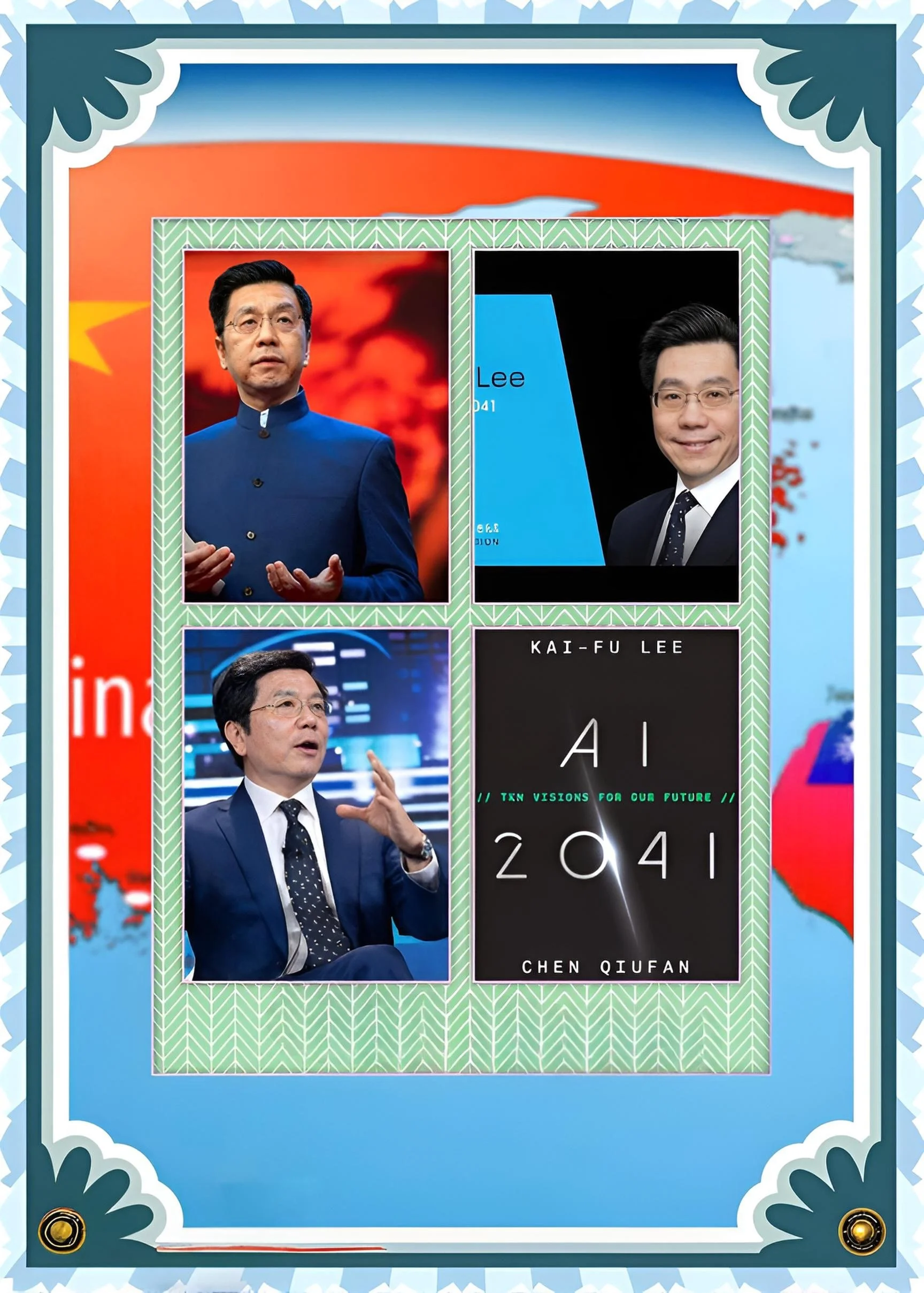
The Uncomfortable Truth Behind AI 2041: Why Your Job Is Disappearing and Nobody Is Prepared
Executive Summary
When Algorithms Rewire Civilization: Kai-Fu Lee's Prescient Warning About AI's Coming Reckoning
Kai-Fu Lee's "AI 2041: Ten Visions for Our Future," co-authored with acclaimed science fiction writer Chen Qiufan, presents a crucial inflection point in contemporary artificial intelligence discourse. Published in 2021 and refined through subsequent editions, the work transcends typical futurism by pairing speculative narratives with rigorous technological analysis. Rather than indulging in dystopian robotics fantasies or utopian singularity narratives, Lee and Qiufan construct ten interconnected visions spanning healthcare, education, finance, transportation, entertainment, and military domains, each grounded in technologies with demonstrable present-day trajectories.
The book's fundamental thesis asserts that artificial intelligence will fundamentally restructure global society within two decades—not through the arrival of superintelligent artificial general intelligence, but through the relentless application of narrow, optimized machine learning systems across every dimension of human activity.
By early 2026, Lee's prognostications have proven markedly prescient; his earlier predictions concerning job displacement, healthcare transformation, and the geopolitical consolidation of AI power have accelerated beyond even his own refined timelines, validating the book's urgency while simultaneously revealing the inadequacy of conventional policy frameworks to address the scale of impending disruption.
Foreward
Kai-Fu Lee occupies a singular position in contemporary technological discourse—a figure whose career trajectory uniquely positioned him to become one of the defining AI visionaries of the twenty-first century. As a computer scientist with foundational contributions to artificial intelligence research during an era when the discipline suffered multiple "winters" of diminished funding and interest, Lee witnessed the field's resurrection through deep learning, experienced the geopolitical consolidation of AI capabilities between American and Chinese technology ecosystems, and invested capital in the emergence of technologies that would subsequently reshape industries.
His "AI 2041" represents not merely a speculative exercise but a synthesis of decades of accumulated expertise, venture capital observations, and sustained engagement with the technological frontier.
The book emerged at an inflection point—published in 2021, precisely when generative AI capabilities were beginning their exponential climb toward the transformative breakthroughs that would define 2022 through 2026. While ChatGPT's public release in late 2022 would subsequently dominate media discourse and capture popular imagination regarding AI's potential, "AI 2041" had already mapped the conceptual terrain upon which such capabilities would operate.
The collaboration between Lee and Qiufan proved strategically brilliant, with Lee providing the technological literacy and prognostic framework, and Qiufan's narrative constructions rendering abstract technological trajectories as human experiences—anxiety, aspiration, moral dilemma, and consequences made concrete through fictional characters navigating algorithmic futures.
HISTORY AND CURRENT STATUS OF KAI-FU LEE'S INTELLECTUAL DEVELOPMENT
Understanding "AI 2041" requires excavating the intellectual foundations upon which Lee constructed his analytical framework. Born in Taipei on December 3, 1961, Lee immigrated to the United States at age twelve and eventually matriculated at Columbia University, where he earned a Bachelor of Science degree in computer science (summa cum laude) in 1983.
His doctoral research at Carnegie Mellon University proved foundational; his 1988 dissertation centered on Sphinx, the world's first large-vocabulary, speaker-independent continuous speech recognition system—a breakthrough that Lee pursued during an era when neural networks had fallen into disrepute following the publication of Minsky and Papert's devastating critique of their limitations. His parallel work developing Bill, a Bayesian learning system for the board game Othello, defeated the United States national tournament of computer players in 1989, providing early evidence that machine learning systems could surpass human performance in constrained domains.
This dual trajectory—advancing speech recognition while contributing to game-playing AI—established Lee as someone working at the intersection of pattern recognition and optimization, domains that would subsequently become central to the deep learning revolution. His subsequent career path traversed the American technology industry's most influential institutions: Apple (where he led speech recognition research during the nascent period of speech interface development), Silicon Graphics, Microsoft (where from 1998 to 2000 he established Microsoft Research China, later renamed Microsoft Research Asia, an institution that subsequently became recognized by MIT Technology Review as the "hottest research lab" and bred numerous Chinese AI leaders subsequently deployed across Alibaba, Baidu, Tencent, and Huawei), and Google (where from 2005 to 2009 he served as President of Google China, successfully establishing the search giant's presence in mainland Chinese markets).
This biographical arc proves essential for contextualizing "AI 2041" because it situates Lee's prognostications within someone who directly witnessed the institutional consolidation of AI capabilities, the emergence of data as the determining factor in machine learning performance, and the geopolitical bifurcation of artificial intelligence development between American and Chinese technology ecosystems. In 2009, Lee founded Sinovation Ventures, a venture capital enterprise through which he would invest in more than 300 portfolio companies and nurture over ten unicorn-valued enterprises.
This investor's vantage point provided Lee with unprecedented observational capacity regarding which technological trajectories possessed genuine commercial viability and which represented optimistic fantasies unsustainable in market conditions.
Lee's first major intellectual synthesis arrived through "AI Superpowers: China, Silicon Valley, and the New World Order" (2018), a non-fiction analysis that framed artificial intelligence as the defining technological competition between the United States and China. The book introduced Lee's "Four Waves of AI" framework—internet AI, business AI, perception AI, and autonomous AI—and advanced the provocative thesis that China possessed structural advantages in developing AI applications precisely because data abundance rather than algorithmic innovation would constitute the scarce resource in the coming decade.
This argument proved sufficiently original and contentious to generate substantial critical engagement, establishing Lee as a figure whose predictions merited serious consideration despite the speculative uncertainty inherent in technological forecasting. "AI 2041" evolved from this intellectual foundation but introduced a crucial methodological innovation: the synthesis of speculative fiction with technological analysis, permitting Lee to explore not merely what technologies would become possible but how such possibilities would reverberate through social, economic, and political arrangements structured around older technological assumptions.
KEY DEVELOPMENTS AND THE TEN VISIONS FRAMEWORK
"AI 2041: Ten Visions for Our Future" deploys ten narrative vignettes, each followed by analytical commentary, to explore distinct domains of AI application and consequence. Understanding these visions requires recognizing that they function simultaneously as cautionary tales and inspiration documents—each narrative presents plausible technological futures while simultaneously interrogating the human and social implications that purely technical analysis might overlook.
The opening vision, "The Golden Elephant," inhabits the consciousness of a young woman in Mumbai whose entire existence becomes subject to algorithmic optimization through deep learning systems deployed by her family's insurance company.
The narrative traces how machine learning algorithms trained on historical demographic data—which in India inevitably encodes caste hierarchies, neighborhood crime statistics, and income distributions—perpetuate and amplify existing social inequalities through the veneer of algorithmic objectivity. When she contemplates romantic involvement with a man from a historically marginalized neighborhood, the optimization algorithms structurally discourage the relationship through insurance premium mechanisms, creating what amounts to algorithmic enforcement of caste-inflected social boundaries.
Lee's accompanying analysis explicates how deep learning systems inevitably absorb the biases embedded in their training data, rendering such systems not neutral optimization mechanisms but rather crystallized expressions of historical prejudice deployed at algorithmic scale.
"Gods Behind the Masks"
engages with computer vision systems, generative adversarial networks (GANs), and deepfake technologies to explore scenarios in which visual authentication becomes fundamentally unreliable. As synthetic media generation reaches sophistication levels where visual and audio fabrication becomes indistinguishable from authentic documentation, the narrative interrogates questions of evidentiary validity, identity authentication, and the malleability of purported reality.
This vision proves particularly prescient given the subsequent explosion of deepfake technologies and the genuine challenges that such synthetic media generate for establishing factual claims in contested domains ranging from politics to crime investigation.
"Twin Sparrows"
engages with natural language processing, self-supervised learning paradigms, and the speculative possibility of artificial general intelligence emerging through systems like GPT-3 and their descendants. The narrative centers on an autistic character whose interaction with an AI companion provides him with forms of understanding and connection unavailable through conventional human social interaction, raising the question of whether human-to-AI companionship might constitute genuine connection or represents merely sophisticated simulation.
Lee's analysis addresses the philosophical question of consciousness itself—whether systems capable of generating syntactically and semantically appropriate responses to arbitrary queries possess genuine understanding or merely engage in extraordinarily sophisticated pattern matching.
This vision directly engages the central philosophical question animating contemporary AI debates: whether language understanding necessarily implies consciousness or comprehension, or whether human cognition might be fundamentally mischaracterizing the nature of linguistic intelligence.
"Contactless Love"
emerged from the peculiar conditions imposed by the COVID-19 pandemic, exploring scenarios in which isolation drives innovations in robotics, virtual reality, and AI-enhanced healthcare.
The narrative demonstrates how pandemic conditions paradoxically accelerated automation and AI deployment by reducing human contact to critical necessities.
Lee's subsequent analysis addresses AlphaFold—the protein-folding prediction system developed by DeepMind that achieved revolutionary breakthroughs in structural biology—as emblematic of AI systems capable of discovering novel scientific knowledge through pattern recognition across vast biochemical datasets.
The vision thus encompasses both the near-term reality of AI-enhanced healthcare delivery and the speculative possibility of AI systems functioning as genuine scientific discovery mechanisms.
"My Haunting Idol"
engages with augmented reality, virtual reality, mixed reality environments, and the emerging domain of brain-computer interfaces. The narrative traces a scenario in which artificial influencers and AI-generated entertainment personalities—possessing no organic existence but rather constructed through neural network-based character generation systems—become objects of genuine emotional investment and parasocial attachment.
This vision proves simultaneously technologically prescient (given the subsequent emergence of AI-generated content creators and virtual personalities) and sociologically troubling in its implications regarding authenticity, parasocial relationship formation, and the potential for algorithmic systems to manipulate human emotional responses at unprecedented scale.
"The Holy Driver"
projects the consequences of autonomous vehicle systems achieving full autonomy, transforming not merely personal transportation but fundamentally restructuring urban spatial organization, employment for millions of professional drivers, and ethical frameworks governing machine decision-making in scenarios where algorithmic systems must allocate risk and death.
The narrative explores a future where fully autonomous transportation systems enable new forms of urban planning, reducing parking requirements, decreasing traffic fatalities, but simultaneously displacing millions of professional drivers and forcing confrontation with the philosophical question of how algorithmic systems should make life-and-death decisions in unavoidable crash scenarios.
"Quantum Genocide"
represents the most explicitly dystopian vision, exploring scenarios in which quantum computing achieves sufficient advancement to break contemporary encryption systems, enabling unprecedented surveillance capabilities, and autonomous weapons systems achieve sufficient sophistication to conduct warfare with minimal human intervention.
The narrative centers on a Kazakh hacker who must prevent a European scientist from deploying autonomous drone systems capable of conducting mass assassination, framing quantum computing not primarily as a route toward solving previously intractable problems but as a mechanism through which security assumptions collapse and weaponry transcends human oversight.
Lee's analysis addresses the existential threat posed by autonomous weapons systems—not the hypothetical superintelligence that often dominates AI safety discourse, but rather relatively straightforward weaponization of existing AI systems through autonomous targeting and decision-making mechanisms.
"The Job Savior"
directly addresses the employment displacement that drives much of Lee's broader prognostication—exploring a future in which economic disruption from AI-driven automation necessitates societal restructuring through mechanisms like universal basic income, creative reconfiguration of work, and fundamental reconceptualization of labor's role in human identity and social organization.
Lee's analysis here revisits his earlier analysis from "AI Superpowers," distinguishing between jobs that involve high degrees of social interaction (which AI will find genuinely difficult to automate) and jobs characterized as "asocial" and "low dexterity" (which face immediate displacement risk).
"Isle of Happiness"
engages with privacy, data protection, surveillance capitalism, and emerging mechanisms like federated learning and trusted execution environments that might permit beneficial AI systems while preserving individual privacy protections.
The narrative traces how differential adoption of privacy-respecting AI systems versus unrestricted data collection creates divergent societal futures—one characterized by genuine privacy protection and distributed benefit-sharing, another by totalitarian surveillance and data concentration.
This vision proves particularly resonant given the subsequent intensification of debates regarding data protection, artificial intelligence surveillance systems, and the General Data Protection Regulation's role in establishing privacy frameworks.
"Dreaming of Plenitude"
represents the capstone vision, projecting a future in which AI-driven automation, robotics, and optimization systems generate such abundance that traditional economic scarcity becomes obsolete.
Rather than utopian in the conventional sense, the vision interrogates what human purpose and motivation might consist of in a world where material wants no longer impose the necessity of labor.
This final vision attempts to transcend the dichotomous framing of AI-driven futures as either dystopian unemployment or utopian abundance, instead suggesting that post-scarcity futures necessarily require fundamental reconceptualization of human values, purpose, and social organization.
LATEST FACTS AND EMERGING CONCERNS REGARDING LEE'S PROGNOSTICATIONS
The interval between "AI 2041's" publication in 2021 and the present moment in early 2026 has witnessed accelerated validation of Lee's core predictions alongside emergence of complications he anticipated but perhaps underestimated in severity.
His 2017 prediction that artificial intelligence would displace fifty percent of global employment by 2027 underwent progressive vindication during the 2024-2025 period.
By May 2024, when Lee engaged in public discussion regarding the prediction's accuracy, he characterized his earlier forecast as "uncannily accurate" given the emergence of generative AI capabilities that surpassed even optimistic technical expectations from the 2018 period.
Contemporary 2025-2026 forecasting from leading AI researchers, including Dario Amodei (CEO of Anthropic), substantially mirrors Lee's earlier prognostications, with particular emphasis on white-collar employment facing displacement far more rapidly than blue-collar occupations—a reversal of labor automation patterns that characterized previous technological transitions.
Lee's continued emphasis that artificial general intelligence lies decades away—rather than imminent—has become increasingly important as popular discourse simultaneously obsesses over superintelligent AI while failing to grapple with the genuine displacement and disruption driven by narrow, task-specific AI systems.
His argument that creating artificial general intelligence would require "dozens of big computer science breakthroughs" while only one major breakthrough (the successful training of deep neural networks) occurred in the past thirty years constitutes a crucial reality check against both utopian and catastrophic singularity narratives.
This position becomes more defensible as transformer-based language models have achieved remarkable capabilities through scaling and engineering optimization rather than fundamental algorithmic innovations, suggesting that AI progress may follow predictable engineering improvement curves rather than revolutionary breakthroughs.
Recent developments in generative AI have begun validating specific predictions embedded within "AI 2041's" ten visions. The emergence of sophisticated deepfake technologies aligns precisely with Lee and Qiufan's "Gods Behind the Masks" scenario, while the deployment of AI systems in medical diagnosis and drug discovery (particularly AlphaFold's revolutionary impact on protein structure prediction) substantiated the "Contactless Love" vision's speculations regarding AI-enhanced healthcare discovery.
The rapid proliferation of AI-generated content creators and virtual influencers has realized the "My Haunting Idol" scenario with remarkable fidelity. Autonomous vehicle development, while not yet achieving full autonomy at the scale Lee projected, continues advancing toward the "Holy Driver" scenario, particularly in controlled environments and through progressive expansion of operational domains.
However, Lee's 2025 assessment of China's AI development trajectory merits particular attention.
In March 2025, when evaluating DeepSeek's emergence as a competitive AI system achieving remarkable results on constrained computational budgets, Lee revised his earlier estimates regarding the China-United States AI capability gap downward from six to nine months to merely three months in core technological domains, with certain specific applications where Chinese systems actually lead Western competitors.
This reassessment reflects not merely technical progress but the fundamental insight that semiconductor restrictions, rather than decisively constraining Chinese AI development, have paradoxically compelled algorithmic innovation and efficiency improvements that subsequently proved exportable to Western contexts.
The subsequent emergence of multiple capable Chinese language models (DeepSeek R1, Qwen 3, Kimi K2) competing directly with American systems represents a partial vindication of Lee's original "AI Superpowers" thesis regarding Chinese structural advantages in data accumulation and optimization-focused engineering.
Lee's founding of 01.AI in March 2023—motivated by recognition that Chinese markets lacked access to OpenAI and Google's generative AI systems due to geopolitical restrictions—represented an attempt to directly validate his venture capital thesis. The company achieved unicorn valuation ($1 billion+) within months, subsequently generating revenues exceeding $15 million annually by 2024, and projecting significant growth throughout 2025-2026.
The January 2025 introduction of Wanzhi, a software platform designed to assist enterprises in deploying AI systems, exemplifies Lee's strategic pivot toward practical application infrastructure rather than foundation model development—a positioning consistent with his assessment that proprietary language models increasingly represent financially precarious ventures overshadowed by massive technology conglomerates and rapidly advancing open-source alternatives.
CAUSE AND EFFECT ANALYSIS: MECHANISMS THROUGH WHICH AI RESTRUCTURES SOCIAL ORGANIZATION
Lee and Qiufan's analytical framework illuminates the mechanisms through which AI systems generate social consequences that transcend purely technological considerations. Rather than treating AI as an autonomous force imposing consequences upon passive societies, the framework recognizes that AI systems constitute crystallizations of human values, biases, and priorities embedded within training data, optimization metrics, and deployment contexts.
The "Golden Elephant" vision exemplifies this analytical approach through demonstrating how deep learning systems trained on historical demographic data necessarily reproduce the social structures encoded within such data. Machine learning systems optimize for statistical patterns and correlations observable in training data; when such data reflects and encodes centuries of caste-based discrimination in India, algorithmic optimization systems will perpetuate and amplify such discrimination through premium mechanisms, loan decisions, and risk assessment frameworks.
The vision's critical insight consists in recognizing that such discrimination emerges not from explicit programming of prejudicial rules but from the neutral application of mathematical optimization to biased training data. This mechanism proves particularly insidious because it permits defenders to claim algorithmic objectivity while the system itself functions as crystallized historical prejudice.
Similarly, the recursive automation dynamics explored in "The Job Savior" demonstrate how AI-driven displacement cascades through economic structures. As AI systems automate routine cognitive and physical tasks, labor becomes concentrated among positions requiring high degrees of interpersonal connection, emotional intelligence, and creative synthesis—domains where human advantage remains demonstrable.
However, this occupational restructuring simultaneously presupposes educational infrastructure capable of retraining displaced workers into such higher-value domains, comprehensive social safety nets to cushion displacement during transition periods, and structural economic reorganization to accommodate potentially fifty percent employment displacement. Societies lacking such infrastructure face not merely technological disruption but genuine economic catastrophe as labor-force participation rates collapse among populations lacking marketable skills for the post-automation economy.
Lee's analytical framework further illuminates the geopolitical consequences of AI consolidation. The concentration of frontier AI capabilities among a handful of technology companies (principally OpenAI, Anthropic, and DeepMind in the American context, alongside Baidu, Alibaba, and ByteDance in Chinese markets) creates unprecedented dependency relationships where smaller nations and individual enterprises lack capacity to develop competitive systems.
The subsequent emergence of open-source models mitigates this concentration somewhat but simultaneously creates coordination problems as economies of scale in computational infrastructure become more pronounced. Lee's assessment that America remains losing the "AI hardware war" reflects recognition that semiconductor manufacturing capabilities, computational cluster construction, and energy infrastructure constitute genuinely scarce resources where geopolitical competition may prove as determining as algorithmic innovation.
CRITICAL PERSPECTIVES AND REMAINING LIMITATIONS
Critical engagement with "AI 2041" has identified analytical blind spots that merit acknowledgment. Reviewer Virginia L. Conn's analysis in the Los Angeles Review of Books argues persuasively that Lee's framing of artificial intelligence as fundamentally "neutral" technology onto which human values project themselves obscures the deeply embedded nature of AI systems within specific institutional, financial, and corporate contexts.
Lee's own venture capital interests in blockchain, cryptocurrency supercomputing, and AI applications introduce potential conflicts between his expressed concern regarding AI's negative externalities and his financial incentives to deploy such technologies regardless of societal consequences. The framework's emphasis on technological solutionism—the reflexive conviction that technological innovation provides appropriate responses to social problems—may obscure scenarios where social reorganization, political choice, and value reorientation constitute more appropriate responses than algorithmic optimization.
Additionally, Lee's occasional optimism regarding the capacity of human-centric AI applications (careers in healthcare, education, and social service sectors that emphasize emotional connection and interpersonal trust) to absorb displaced workers from automation may underestimate the genuine scarcity of such positions relative to the magnitude of potential displacement.
The ten visions collectively posit that two decades provide sufficient temporal interval for societies to restructure labor markets, educational systems, and social safety nets; this timeline may prove optimistic given the political economy of AI deployment, which generates incentives for accelerating automation while diffusing costs across vulnerable populations.
The book's analytical framework, while sophisticated, exhibits what might be characterized as a technologist's perspective regarding human agency and social change. Lee and Qiufan's scenarios suggest that technological trajectories largely determine social futures, with human choice and political organization mattering primarily at the margins.
A more fundamentally political analysis might suggest that the futures Lee projects are not inevitable outcomes of technological development but rather contingent consequences of specific choices about how to deploy, regulate, and distribute the benefits of AI systems—choices that remain genuinely open and contested.
FUTURE IMPLICATIONS AND STRATEGIC TRAJECTORIES
Looking forward from the present moment in January 2026, several trajectories merit analytical attention. First, the timing of genuine fifty-percent employment displacement remains contested; Lee's 2027 deadline increasingly appears to represent employment disruption at the margin rather than wholesale labor-force displacement, suggesting that the disruption may follow a longer trajectory than his 2017 projection anticipated.
This temporal ambiguity creates genuine policy challenges insofar as delayed displacement may generate complacency while accelerated disruption could provoke social instability.
Second, the geopolitical consolidation of AI capabilities between American and Chinese technology ecosystems appears likely to intensify, particularly if American semiconductor restrictions continue constraining Chinese access to cutting-edge computational infrastructure. Lee's assessment that Chinese companies have nonetheless achieved meaningful progress through algorithmic optimization and efficiency improvements suggests that geopolitical bifurcation of AI development may create distinct technological ecosystems optimized for different objectives and constituencies, rather than representing a decisive American victory in a zero-sum AI competition.
Third, the emergence of specialized, domain-specific language models (rather than frontier generalist systems attempting to excel across all tasks) appears increasingly likely as the viable path forward for enterprise AI deployment.
Lee's own pivot at 01.AI toward smaller, industry-specific models rather than competing with OpenAI's scale reflects recognition that the foundation model approach may encounter fundamental economic and scaling constraints.
Fourth, regulatory and governance frameworks governing AI deployment remain substantially underdeveloped relative to the pace of technological change. The European Union's AI Act represents the most comprehensive regulatory attempt, but remains contested and imperfectly specified. American approaches emphasize sectoral regulation (healthcare, financial services, government) while avoiding comprehensive governance frameworks.
Chinese governance operates through more direct state oversight of technology deployment but struggles with opacity regarding decision-making criteria.
Lee's frameworks do not, perhaps, adequately address the genuine difficulty of implementing meaningful governance over systems whose operations increasingly exceed human comprehension.
CONCLUSION
Kai-Fu Lee's "AI 2041: Ten Visions for Our Future," now five years into its publication history, has demonstrated remarkable prescience regarding the likely trajectories of artificial intelligence development and deployment.
Rather than offering speculative fiction divorced from technological reality or purely technical analysis abstracted from social consequence, the work succeeds through synthesizing both dimensions—demonstrating how abstract technical possibilities become concrete lived experiences through implementation in specific social, economic, and political contexts.
The book's central claim—that artificial intelligence will fundamentally restructure global society within two decades not through the arrival of superintelligent systems but through relentless optimization of existing narrow AI systems across all domains of human activity—has proven increasingly vindicated.
Employment displacement, healthcare transformation, entertainment restructuring, and geopolitical consolidation of AI power have all progressed along trajectories Lee outlined. Simultaneously, the book's publication timing positioned it precisely at the inflection point before generative AI's explosive emergence; a twenty-sixth century reader encountering "AI 2041" would likely be astounded at how prescient the analysis proved, while simultaneously recognizing how much remained unanticipated.
The work's most significant contribution may consist not in accurate prediction of technological specifics but in providing conceptual frameworks permitting serious engagement with AI's genuine societal implications.
Lee and Qiufan resist both techno-utopianism and catastrophism in favor of rigorous analysis of plausible futures, each characterized by distinct distributional consequences, social reorganization requirements, and ethical dilemmas. This analytical sophistication provides substantially more utility than either naive optimism or dystopian resignation.
For researchers, policymakers, and business leaders navigating the genuine transformations that artificial intelligence enables, "AI 2041" remains essential reading precisely because it situates technological development within human contexts and demonstrates that AI's true significance lies not in the technologies themselves but in their capacity to restructure every dimension of human society.
Whether that restructuring generates flourishing or devastation depends fundamentally upon the choices societies make regarding how to deploy, regulate, and distribute AI's benefits and burdens. Lee's framework illuminates the stakes of those choices without presuming their inevitability.