Keir Starmer's Strategic Recalibration: The United Kingdom's Pragmatic Pivot Toward Beijing in an Era of American Hegemonic Retrenchment
Introduction
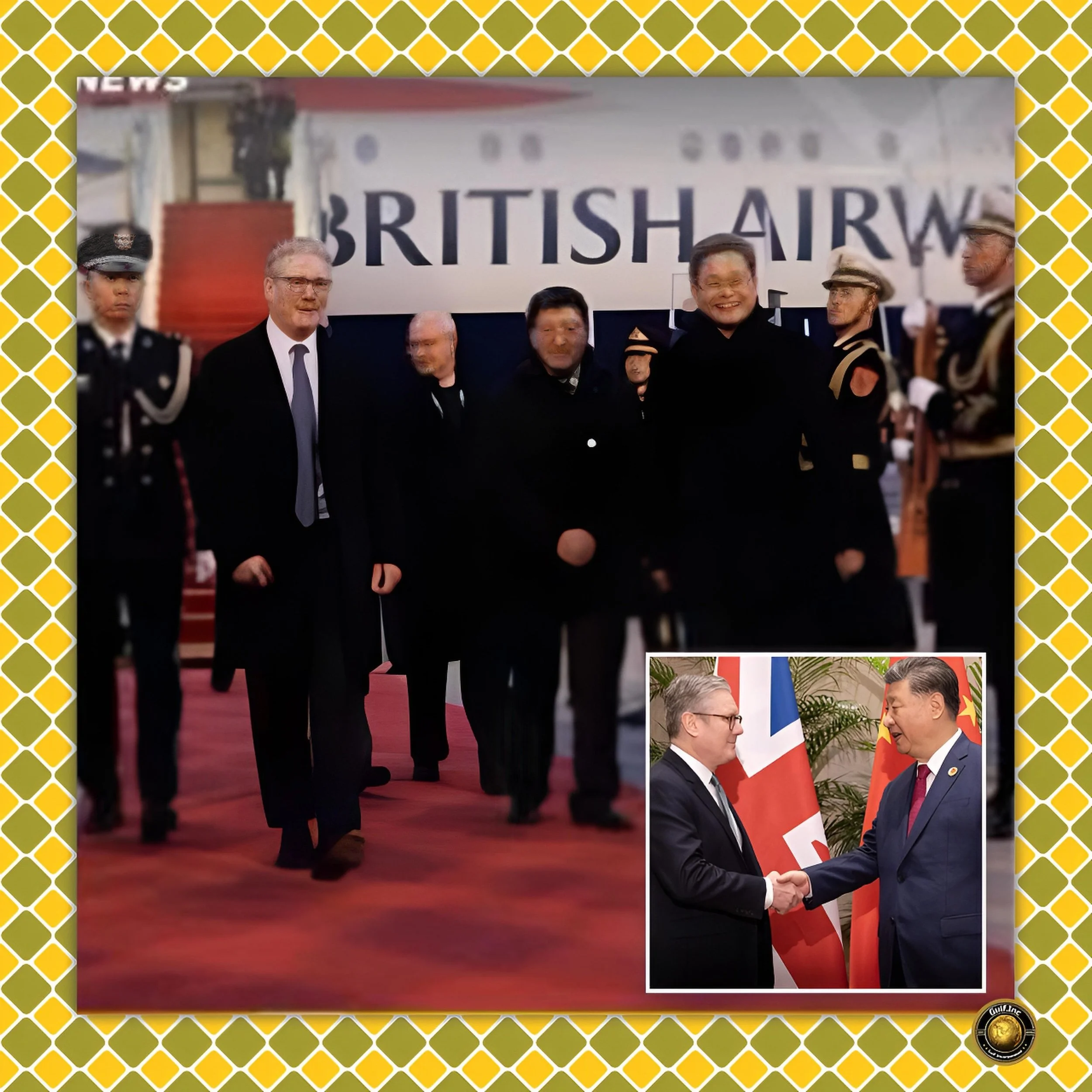
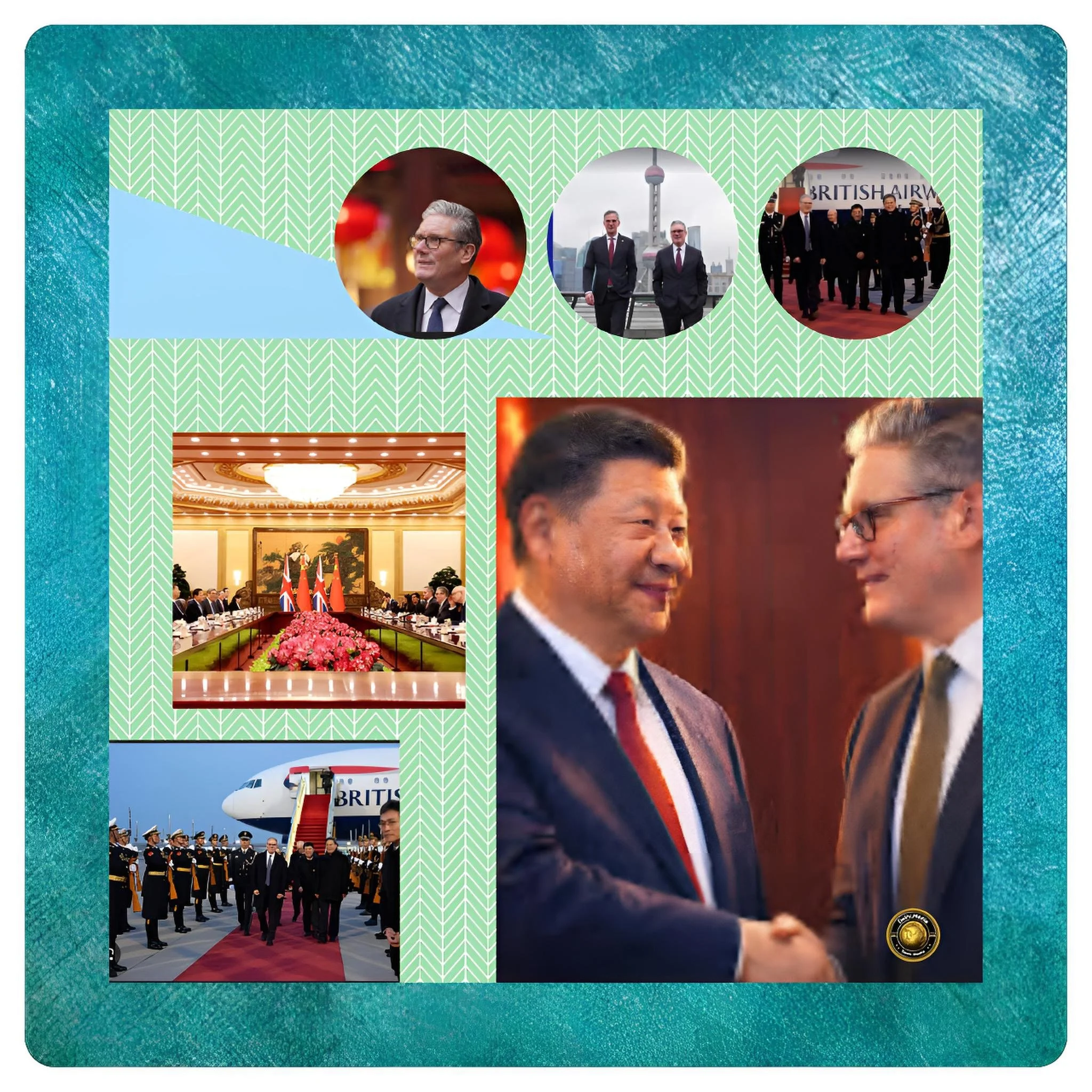
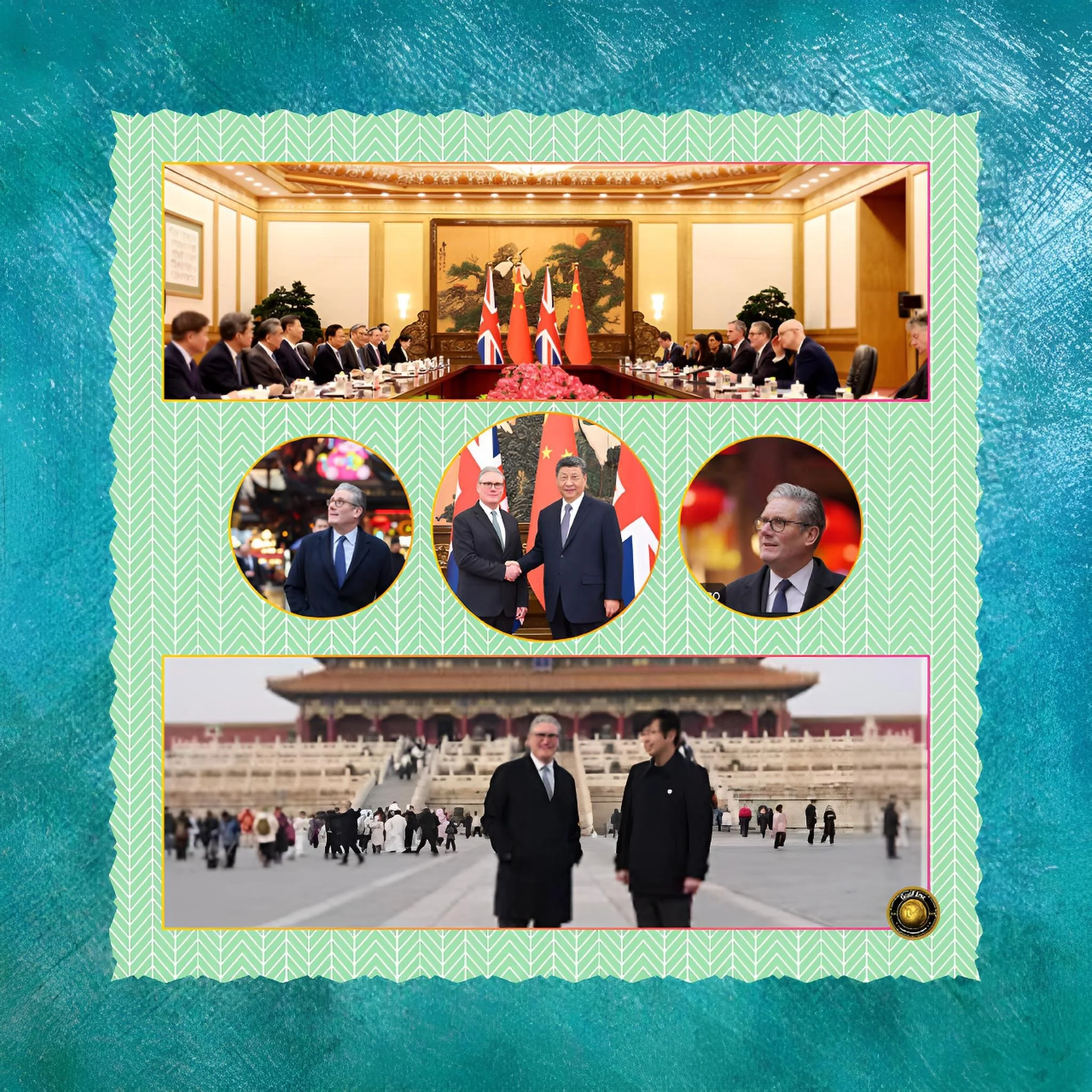
Between 28 and 31 January 2026, British Prime Minister Keir Starmer embarked upon a consequential diplomatic mission to the People's Republic of China—the inaugural visitation by a serving British premier to Beijing in 8 annum.
Accompanied by approximately 60 functionaries drawn from the financial, pharmaceutical, automotive, and cultural sectors, Starmer's itinerary encompassed bilateral consultations with President Xi Jinping, Premier Li Qiang, and legislative authorities, culminating in a tripartite arrangement comprising tariff modulations, visa-liberalization protocols, and institutional frameworks ostensibly designed to operationalize a "comprehensive strategic partnership" between the two polities.
This geopolitical maneuver, transpiring amid the relentless perturbations occasioned by the Trump administration's unilateral tariff interventions and its destabilizing rhetoric directed toward traditional NATO constituencies, represents a seminal inflection point in post-Brexit British foreign policy—one signifying a deliberate recalibration away from ideologically-inflected antagonism toward pragmatic transactional engagement with Beijing.
Historical Trajectory and Contemporary Status
The contemporary UK-China relationship constitutes a protracted arc of oscillation between rapprochement and rupture, commencing with the so-termed "Golden Age" initiated during David Cameron's premiership circa 2015, wherein bilateral relations attained their apotheosis through successive institutional partnerships and substantive Chinese financial commitments to nuclear infrastructure and metropolitan development initiatives.
This halcyon interlude proved ephemeral. The promulgation of Beijing's National Security Law in Hong Kong during 2020 precipitated an irrevocable epistemic rupture, engendering comprehensive policy recalibrations throughout Westminster and Whitehall.
Successive Conservative administrations, operating within the parameters established by American strategic preferences and augmented by intelligence community admonitions regarding Chinese espionage operations and technological predation, effectuated a systematic reorientation toward confrontational posturing, characterized by categorical proscriptions upon Huawei's participation in 5G infrastructure deployment and rhetorical escalations concerning human rights violations in Xinjiang and the suppression of democratic liberties in the erstwhile colony of Hong Kong.
Starmer's Labour government, ascending to office in 2024, inherited this fractured relationship alongside an economy exhibiting perceptible stagnation—a predicament for which Brexit-attributable structural vulnerabilities bore substantial responsibility.
Econometric analyses conducted by the National Bureau of Economic Research documented that Brexit-induced GDP contraction ranged from 4 to 8 percentage points, with attendant diminutions in foreign direct investment and employment metrics.
Goldman Sachs projections, as of 2026, forecast UK GDP expansion of merely 1.4 %, an insufficiency rendering Starmer's government highly vulnerable to parliamentary and electoral censure. Within this context of economic exigency, the Prime Minister commenced a comprehensive strategic audit of UK-China relations, ultimately determining that unqualified disengagement constituted an economically indefensible policy posture.
Key Developments and Concrete Agreements
The substantive outcomes of Starmer's Beijing consultations comprised 10 bilateral cooperation instruments encompassing trade, finance, health, educational interchange, and law enforcement cooperation.
Most significantly, the two principals committed to the establishment of a "comprehensive strategic partnership"—terminology circumscribing not only transactional commercial arrangements but also institutional mechanisms for systematic policy coordination.
The technical accords included the following provisions: the reciprocal extension of visa-free entry privileges for 30-day sojourns; the halving of Chinese tariff impositions upon Scotch whisky commodities, from 10 % to 5 %—an arrangement projected to generate £250 million in sterling value across a 5-year amelioration; and the signature by AstraZeneca, a pharmaceutical corporation of preeminent international standing, of a memorandum of understanding committing $15 billion in aggregate capital expenditure directed toward research, development, and manufacturing infrastructure expansion within the Chinese jurisdiction over the ensuing 4-year temporal interval.
Furthermore, the United Kingdom became the inaugural signatory to China's "Big Market for All—Export to China" initiative, thereby operationalizing a tripartite mechanism incorporating cooperative identification of high-value-added British commodities possessing export potential, enhanced informational dissemination, promotional endeavors, and ameliorated trade facilitation protocols.
Concurrently, a memorandum of understanding concerning the feasibility of a bilateral services trade agreement was executed, ostensibly catalyzing substantive commercial opportunities within creative industries, financial services, professional consultancies, and healthcare provisioning sectors.
The Joint Economic and Trade Commission, heretofore languishing in comparative desuetude, underwent institutional reinvigoration predicated upon a mandate to strengthen government-business engagement mechanisms and facilitate expedited resolution of commercial grievances emanating from enterprises operating within either jurisdiction.
Cause-and-Effect Analysis
Domestic and Geopolitical Ramifications
The manifest impetus propelling this policy reorientation derives from the conjuncture of three intersecting structural pressures: domestically, the intransigency of economic stagnation consequent to Brexit and fiscal austerity, rendering China's vast consumer markets and capital flows indispensable to remedial economic management; regionally, the demonstrable erosion of the transatlantic security architecture engendered by the Trump administration's capricious deployment of tariff instruments against traditional alliance partners; and globally, the coordinated recalibration undertaken by multiple Western polities toward China engagement as a hedging mechanism against American unpredictability.
The consequences attending this reorientation manifest across three analytically discrete dimensions.
First, regarding economic implications for the United Kingdom, Starmer's pragmatic engagement strategy offers the prospect of access to consumer markets encompassing 1.4 billion individuals and capital importations capable of facilitating manufacturing reinvigoration and technological sectoral advancement.
However, this calculus involves substantial asymmetries and vulnerabilities: China maintains approximately 80 to 90 % of global refining capacity for critical minerals essential to renewable energy infrastructure, rendering British industrial competitiveness hostage to potential Chinese economic coercion; furthermore, estimates suggest that approximately 90,000 employment opportunities within the automotive and battery manufacturing sectors face jeopardy contingent upon protracted supply chain interruptions originating from China.
The UK's strategic dependency upon Chinese inputs for semiconductors, solar panels, steel, and essential mineral concentrates thus constitutes a structural vulnerability not conventionally canvassed within policy deliberations.
Second, the geopolitical implications for Western alliance cohesion prove particularly consequential. Starmer's visit, occurring proximate to contemporaneous diplomatic missions undertaken by Canadian Prime Minister Mark Carney and French President Emmanuel Macron, signifies the emergence of a polycentric approach to great power engagement wherein middle-power democracies, confronting the chronic instability engendered by Trump administration tariff interventionism and diplomatic volatility, have determined that diversification of economic partnerships constitutes both strategically prudent and economically essential.
The European Union has simultaneously ratified trade agreements with the Mercosur bloc and India, transactional arrangements effected entirely ex nihilo the participation of the United States.
This diffusion of Anglo-American hegemonic authority, whilst conferring strategic benefits through alliance pluralization, simultaneously accelerates the decomposition of the post-1945 international order upon which American predominance was predicated.
Third, the implications for the People's Republic derive substantial strategic value from its portrayal as the preeminent exemplification of reliable, predictable state conduct within an international system increasingly characterized by unilateralist disruption emanating from Washington.
Beijing's success in attracting successive visitations from leaders representing developed democracies constitutes a propaganda victory of considerable magnitude, simultaneously augmenting Chinese economic leverage through trade integration mechanisms and reducing the efficacy of Western technological containment strategies predicated upon alliance cohesion.
Security Vulnerabilities and Strategic Concerns
Notwithstanding the manifest economic attractions undergirding Starmer's reorientation, substantial security vulnerabilities warrant careful strategic scrutiny.
The Security Service (MI5) has publicly declared that "Chinese state actors" constitute a perpetual threat magnitude operating at quotidian intervals, with operational scope encompassing systematic recruitment initiatives targeting British technical specialists, computational researchers, and biotechnological professionals.
The United Kingdom's domestic counterintelligence apparatus documented approximately 40 % rejection rates for prospective Chinese capital investments within sensitive technological domains—semiconductors, artificial intelligence, quantum computing—on security grounds, yet the government has demonstrably exhibited disinclination toward formal designation of China as a state security threat.
This incoherence stems partly from economic leverage considerations: British technological sectors remain substantially dependent upon Chinese supply chains for rare earth processing and component manufacturing, thereby rendering explicit security designation politically and economically inimical.
Articulated intelligently by former Chief of the Secret Intelligence Service Sir Richard Dearlove and reinforced by Canadian intelligence analyst Michael Kovrig, the UK-China relationship encompasses what Kovrig denominates "invisible leverage"—the capacity to exercise coercive influence through mechanisms of economic interdependence rather than overt confrontational instruments.
Beijing has repeatedly demonstrated its proclivity toward weaponizing trade instruments in response to perceived geopolitical affront, as evidenced by sanctions regimes imposed upon Australia following Canberra's inquiry into COVID-19 origins and restrictions upon Lithuanian commercial engagement subsequent to that polity's diplomatic recognition of Taiwan.
The constitutional structure of China's party-state system, coupled with comprehensive national security legislation, furnishes Beijing with formal and informal mechanisms for instrumentalizing ostensibly private commercial entities in pursuit of strategic objectives, thereby converting economic integration into a vector for intelligence operations and coercive statecraft.
Implications for the United States
Trump's bilateral response to the Starmer initiative proved characteristically inchoate and tendentious.
Initially framing Canadian Prime Minister Carney's contemporaneous Beijing visitation as commendable on 16 January ("That's what he should be doing"), Trump effectuated a dramatic reversal on 25 January, threatening "100 % tariff against all Canadian goods and products" contingent upon Canadian finalization of a trade agreement with Beijing.
Analogously, Trump cautioned Starmer against British engagement with China, articulating the assessment that such conduct constituted "very dangerous" policy.
These threats must be interpreted within the broader context of Trump's tariff interventionism: the administration previously threatened 10 % tariff impositions upon 8 NATO allies—Denmark, Norway, Sweden, France, Germany, the United Kingdom, the Netherlands, and Finland—contingent upon acquiescence to American acquisition of Greenland, subsequently retracting these threats following negotiations with NATO Secretary-General Mark Rutte.
The substantive implications of Trump's posture for American strategic interests prove decidedly deleterious.
The administration's chronic unpredictability, manifested through repeated policy reversals, tariff volatility, and unilateral denunciations of traditional allies, has precipitated precisely the geopolitical outcome contra-indicated by elementary strategic reasoning: the coalescence of traditional American allies around alternative partnerships and institutional arrangements explicitly designed to reduce dependence upon American economic and security guarantees.
Canadian officials have commenced articulation of diversification strategies encompassing military expenditure augmentation and strengthened European engagement; European Commission President Ursula von der Leyen negotiated what observers characterize as "one-sided" trade arrangements with Trump whilst simultaneously advancing intra-European military capability development; and Pacific allies including Australia and New Zealand have undertaken preliminary recalibrations of their strategic commitments predicated upon calculations of American reliability and commitment duration.
The broader architectural implication concerns the prospective emergence of bifurcated or triadic international order characterized by regional hegemonies and multiple centers of economic gravity—a configuration fundamentally inimical to American strategic preferences established during the post-1945 epoch.
Chinese manufacturer market share expansion, accelerated by Trump tariff policies which render American products less competitive whilst simultaneously providing market access for Chinese alternatives, has contributed to Beijing's achievement of a record trade surplus approximating $1.2 trillion during 2025.
This surplus concentration, rather than ameliorating American trade competitiveness through tariff barriers, has paradoxically augmented Chinese commercial position through market expansion and technological advancement facilitation.
Future Strategic Trajectories
The institutional mechanisms established through Starmer's visit—particularly the reinvigorated China-UK Joint Economic and Trade Commission and the services partnership agreement—presage intensified bilateral engagement across commercial, technological, and potentially security domains.
Starmer has explicitly foreclosed the prospect of artificial binary choice between American and Chinese partnerships, articulating instead a "mature" relationship predicated upon compartmentalized cooperation and disagreement.
Whether such compartmentalization proves sustainable or gradually dissolves into subordination to Beijing's preferences remains an open question, historically contingent upon the trajectory of Trump administration policy and the resilience of Western alliance structures.
The broader European context suggests that British recalibration represents merely the vanguard of a more comprehensive Western reorientation. German Chancellor Friedrich Merz is scheduled for a February 2026 visitation to Beijing; French-Chinese cooperation mechanisms are undergoing expansion; Italian leadership is contemplating similar diplomatic initiatives.
The cumulative effect—reinforced by trade agreements negotiated independently of American participation—suggests the emergence of what German analyst Noah Barkin characterizes as "a propaganda victory for Beijing," wherein the People's Republic successfully positions itself as the reliable, stable, rule-governed alternative to American capricious unilateralism.
The implications for international institutional architecture prove substantial. If multiple developed democracies systematically reduce their technological reliance upon the United States, divest from dollar-denominated financial instruments, and construct alternative trade frameworks, the post-1945 order predicated upon American monetary hegemony and technological primacy undergoes fundamental transformation. This represents not merely a recalibration of bilateral relationships but a potential reconfiguration of global economic governance.
Conclusion
Starmer's Beijing visitation represents a calculated, if politically fraught, determination that British economic interests necessitate pragmatic engagement with China notwithstanding substantive security reservations and manifest vulnerabilities attendant upon enhanced economic interdependence.
The immediate outcome comprises access to vast consumer markets and potential capital importations; the medium-term prospect encompasses enhanced technological capability and manufacturing reinvigoration; the long-term hazard involves the progressive instrumentalization of British policy preferences through mechanisms of economic leverage and supply chain dependency.
The visit must be contextualized not as an isolated bilateral initiative but as a constituent element within a broader reconfiguration of Western strategic alignment precipitated by American policy volatility and alliance erosion.
The Trump administration's tariff interventionism and rhetorical hostility toward traditional partners has catalyzed precisely the geopolitical outcome most inimical to American interests: the diffusion of Western hegemonic concentration and the emergence of alternative centers of economic gravity centered upon Beijing.
Whether this reconfiguration proves reversible through substantive American policy reformulation or constitutes an irreversible bifurcation of the post-war international architecture remains the predominant strategic question confronting American policymakers.
What appears unambiguous is that the transatlantic alliance, as constituted during the latter half of the twentieth century, has undergone fundamental transformation—one whose full implications will unfold across the coming decade.