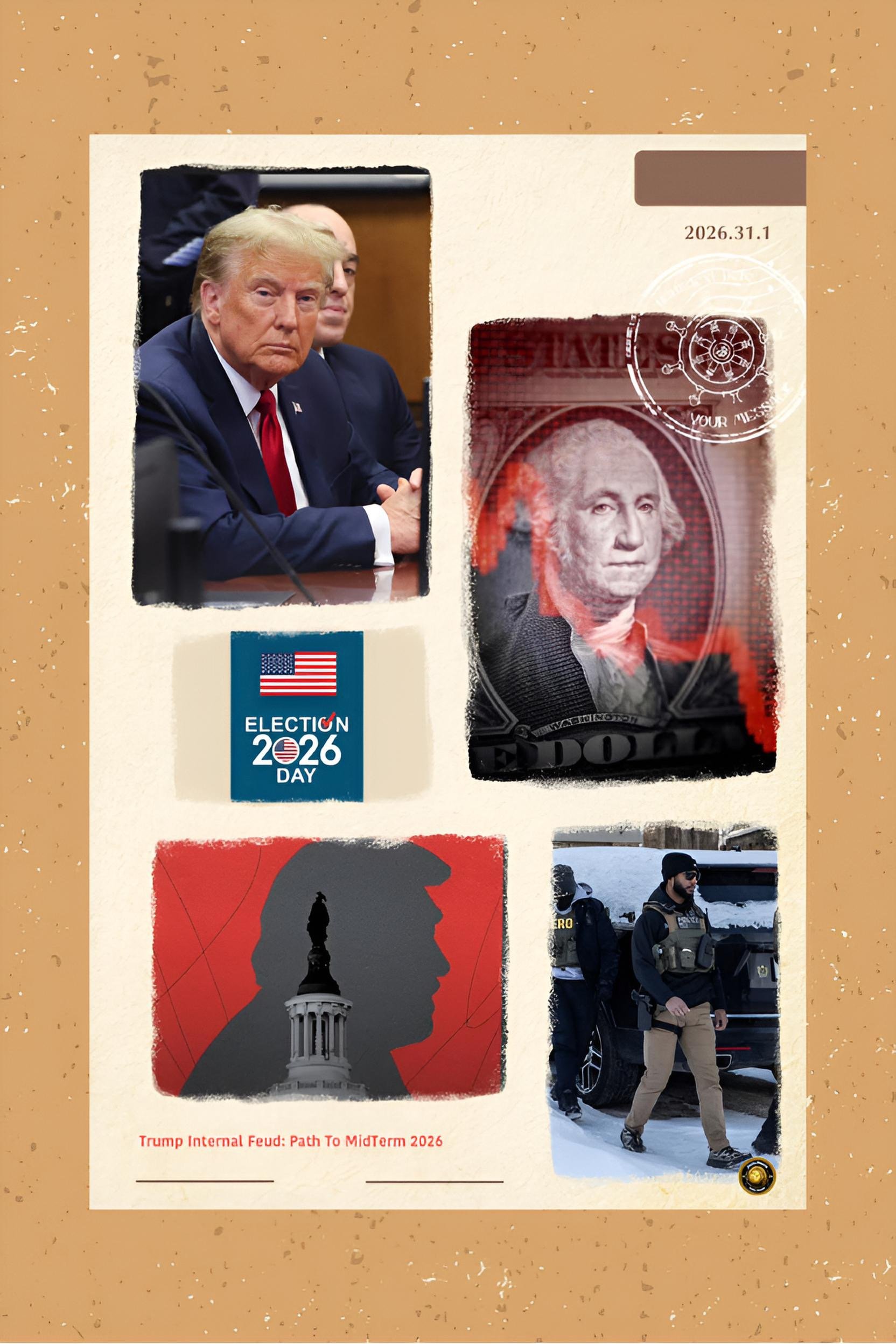
Trump's Political Battles Could Cost Republicans the 2026 Midterms
Executive Summary
President Trump faces serious problems inside the Republican Party that could hurt GOP chances in the November 2026 midterm elections.
Republican members of Congress are breaking ranks and voting against Trump on important issues.
The party's House majority has become dangerously thin, dropping from 220 seats to 218 seats after key resignations.
At the same time, voters worry about rising prices, unemployment fears, and Trump's popularity keeps sliding.
Election experts say there is about a 77% chance that Democrats will take control of the House.
The bottom line: Trump's wars with his own party members, combined with economic troubles and low approval ratings, could lead to a major Republican defeat.
Introduction
The Party Cracks
For years, Republican lawmakers have mostly followed Trump's lead without question. However, starting in late 2025 and continuing into January 2026, that obedience started to break down. Representatives and senators began voting against Trump's wishes on major issues.
The reasons vary: some wanted to help sick people get affordable health insurance, others worried about giving the president too much military power, and a few disagreed with Trump's plans to acquire Greenland.
What was once a unified party now looks like a group of politicians thinking about their own political survival.
The most shocking moment came when Representative Marjorie Taylor Greene, a longtime Trump ally who spent millions of her own money campaigning for him, announced she was leaving Congress.
Greene said Trump called her a "traitor" and tried to destroy her politically because she supported releasing files related to Jeffrey Epstein. Her resignation meant losing one of the most loyal MAGA supporters.
Losing loyal members while enemies still exist is typically a sign of serious internal problems.
How Many Seats Do Republicans Actually Have?
Imagine a classroom with 435 students where one group (Republicans) needs 218 votes to make decisions. That sounds comfortable—you need about half. But then 2 students leave, bringing the count down to 216 Republicans and 213 Democrats.
Now the Republican group only needs 216 votes to control things, but if even 3 Republicans refuse to vote, they lose. That is exactly the situation House Republicans face right now. This narrow margin means Trump cannot afford to lose anyone on important votes.
One Republican representative, Thomas Massie from Kentucky, frequently votes against Trump proposals. Another representative, Doug LaMalfa from California, died suddenly in January 2026.
These two events squeezed the Republican majority to an almost impossible level. Now, every single vote matters. When 17 Republicans broke with party leadership to vote for helping people pay for health insurance under Obamacare, that was a near-disaster for Trump's control of the House.
Breaking Point 1
Health Insurance Fighting
In December 2025, a key health insurance program expired. The Affordable Care Act had been providing discounts to help millions of Americans afford health insurance.
When the discounts disappeared on December 31, 2025, health insurance costs shot up. Imagine your monthly insurance premium jumping from 300 dollars to 500 dollars or more. That is what happened to millions of Americans.
Trump and Republican leaders wanted to create a new system. Instead of giving discounts directly to insurance companies, Trump suggested sending money directly to people so they could buy whatever insurance they wanted.
This might sound good in theory, but health insurance experts warned it would destroy the insurance marketplace. People with serious health conditions might not be able to find affordable coverage at all.
Democrats wanted a simple solution: keep the old discount system working for 3 more years while everyone figured out something better. Seventeen House Republicans, worried that their voters would blame them for rising insurance costs, voted with Democrats.
Think about this: a Democratic bill passed the House because some Republicans thought their own voters needed help more than they needed to obey Trump.
Breaking Point 2
Military Power Arguments
On January 8, 2026, Trump wanted to attack Venezuela and remove the leader, Nicolás Maduro. Trump believed he had the power to do this without asking Congress.
But 5 Republican senators disagreed. They said the Constitution gives Congress the power to declare war, not the president alone. They voted with Democrats to limit Trump's military authority.
Trump responded by attacking these senators on social media, saying they should "never be elected to office again."
The senators were Susan Collins from Maine, Lisa Murkowski from Alaska, Rand Paul from Kentucky, Josh Hawley from Missouri, and Todd Young from Indiana.
Some of these people are up for reelection in 2026. Imagine being a senator facing a tough election and having the president of your own party saying you should lose your job.
This kind of public attack makes other Republicans nervous too.
If you stand up to Trump, will he come after you next?
Breaking Point 3
The Resignation Shock
When Marjorie Taylor Greene announced in a video that she was resigning, many Republicans were stunned.
Greene was supposed to be the future of Trump's movement. She had fought for controversial things Trump wanted. But when she decided to support releasing the Epstein files (a campaign promise Trump had avoided keeping), Trump turned against her. He called her a traitor and said he would support someone else to run against her in 2026.
Greene said that Trump's attacks and the death threats that followed made it impossible to serve.
She wrote that she did not want to run a brutal primary fight against a Trump-backed challenger while knowing that Republicans would probably lose the House anyway. She calculated: If I stay and fight Trump in a primary, I will probably win, but then Republicans lose the House, and Trump gets impeached, and everything falls apart anyway. So why stay? Better to leave with dignity.
Her resignation was like watching a member of a sports team publicly quit because the coach turned against them. It sent a message to other Republican members: even the most loyal supporters can be turned on. This makes everyone nervous.
Why History Suggests Democrats Will Win
Political scientists have studied elections for 80 years. A clear pattern emerges: in 90% of all midterm elections since 1946, the president's party loses seats in the House. Let us look at recent examples:
In 2018, President Trump's first midterm, Republicans lost the House to Democrats. Democrats gained 40 seats.
In 2010, President Obama's first midterm, Republicans gained 63 seats and took control of the House.
In 1994, President Clinton's first midterm, Republicans gained 54 seats and took control.
The only times the president's party gained or held steady were in special circumstances.
In 2002, President Bush gained seats because of the 9/11 attacks, which made Americans want to support the president during a crisis.
In 1998, President Clinton gained seats because his approval rating was above 65%.
Trump's approval rating is currently between 36% and 44%.
That is dangerously low. When a president's approval is below 50%, historical records show his party always loses seats in the House. Always. There are no exceptions.
What About the Economy?
Trump won the 2024 election partly because voters blamed President Biden for inflation and high prices. Now voters are blaming Trump for the same problems. The price of vegetables jumped 40% under Trump's tariff policies. People cannot afford groceries, prescription drugs, or rent.
Consumer confidence hit its lowest level since 2014. Only 32% of voters think the economy will improve this year.
When people cannot feed their families, they do not reward the president's party in elections. It is that simple. Trump promised to fix inflation. Instead, his tariff policies made prices worse. Republicans running in 2026 will hear this argument over and over: "You said Trump would lower prices. Prices went up."
Only 14% of Americans support adding more tariffs. Even 56% of Republicans think the current tariffs are raising prices. Trump's signature economic policy is hurting his own party politically.
What Are Republicans Trying to Do?
Trump and Republican leaders are trying 4 main strategies to save the midterms:
Strategy 1
Redraw election maps. Republicans control some state governments and are redrawing House district maps to favor Republicans.
This has helped a bit—Republicans created 9 safe seats while Democrats created 6. But it is not enough to overcome national problems.
Strategy 2
Primary threats. Trump is endorsing candidates to run against Republicans who defied him.
This is supposed to scare people into loyalty. But it also makes it harder to win general elections. Moderate Republicans worry: if I vote against Trump on healthcare, will I lose my primary? If I vote for Trump, will I lose the general election to a Democrat?
Strategy 3
MAHA agenda. Trump brought in Robert F. Kennedy Jr. to champion "Make America Great Again and Healthy." This focuses on removing artificial food dyes, ending vaccine mandates, and promoting raw milk.
Kennedy's group launched a summit in January 2026 with Vice President JD Vance speaking.
The thinking is that this appeals to younger voters, women, and independents who might normally vote Democrat. Early polls show 21% of independent voters like MAHA ideas.
But here is the problem
Kennedy is unpopular. When asked, voters care more about lowering their health insurance costs than removing food dyes. MAHA is a creative idea, but it may not solve the main problem voters care about: affordability.
Strategy 4
Emphasize accomplishments. Republicans want to tell voters that they passed the "big beautiful bill" (the tax and spending law) which will eventually create jobs and raise wages.
The problem is that people do not feel better yet. The bill will take months or years to help ordinary families. Elections happen in November 2026. Voters judge based on what they feel in their wallets today, not promises about tomorrow.
The Paths Ahead: Win or Lose?
Democrats Win Scenario (Most Likely)
The economy does not improve. Prices stay high. Trump's approval stays below 40%. Republicans lose 25 to 45 seats, and Democrats take control of the House.
When this happens, Democratic leaders will investigate Trump's finances, his business dealings, and his administration's actions.
They might even impeach him again.
Trump will spend his final 2 years in office fighting investigations instead of governing.
Congress becomes gridlocked. Republicans are demoralized.
Republicans Hold House Scenario (Less Likely)
The economy suddenly improves. Tariff policies create competition that lowers prices on groceries and medicines. Trump's approval rises to 45%. MAHA messaging unexpectedly resonates with younger voters.
The redraw election maps help Republicans keep enough competitive seats. Republicans lose only 5 to 10 seats but keep House control. Trump avoids investigations, finishes his term, and declares victory. But this requires multiple things to go right simultaneously.
Worst Case for Republicans (Possible)
Everything goes wrong. The economy worsens. Trump's approval drops to 30%.
Some scandal emerges. Democrats gain 40+ seats and win the House by a large margin. Republicans lose the Senate too. Trump faces multiple investigations. Congressional paralysis follows.
Why This Matters
If Democrats win the House, Trump's second term changes dramatically. Instead of passing legislation, he would spend time defending himself against investigations. Instead of reforming government, he would fight with Congress. Instead of governing, he would face impeachment threats. For Republicans, it means losing power, which leads to lost influence over policy for 2 years.
For Democrats, it would mean the chance to investigate Trump administration actions, pass legislation, and provide a check on Trump's power.
For voters, it would mean continued conflict and gridlock rather than progress on problems like inflation, healthcare, or jobs.
What Trump's Internal Battles Tell Us
Trump's problems with his own party reveal something important: even very powerful politicians have limits. Trump can threaten primary challenges, but he cannot force senators and representatives to vote against their own voters' interests.
Greene could not stay in Congress when her own party's leader turned against her so publicly. Other Republicans are questioning whether total loyalty to Trump is worth losing their seats in Congress.
The Republican Party is splitting into groups:
The Trump loyalists, who follow whatever Trump wants.
The moderates, who worry about suburban voters and health insurance costs.
The ideological conservatives, the Freedom Caucus, who want Trump to go even further on immigration and spending cuts.
The old-school Republicans, who worry about democracy and constitutional limits on presidential power.
These groups are fighting each other, and Trump is fighting all the moderates. When a party is fighting itself, it is hard to fight the other party.
Conclusion
The Likely Outcome
Based on 80 years of election history, current polling, economic conditions, and visible party fractures, Democrats have a strong advantage in the race for House control.
Republican defections on healthcare, military power, and other issues show that the party unity Trump enjoyed for the first year of his second term is breaking down. The 218-213 House majority is simply too narrow to survive when members vote their conscience or their districts' interests instead of party line.
Trump's internal battles with his own party members have exposed the limits of his political power. Even though Trump commands loyalty from many Republicans, he cannot prevent all defections, cannot control economic conditions, and cannot solve inflation with tweets. The economy and voter dissatisfaction are bigger forces than party loyalty.
The most likely scenario is that Democrats will flip the House in November 2026, just as they did in 2018. This would trigger investigations, potential impeachment, and gridlock. It would frustrate Trump, empower Democrats, and leave most Americans unhappy with Congress.
Trump still has time to change this outcome. If the economy improves dramatically by October 2026, if inflation falls, if his approval rating climbs, if unity returns to the Republican Party, then Republicans could hold the House.
But none of those things look likely right now. And that is why election experts say that losing the House is the probable outcome for Republicans in 2026.