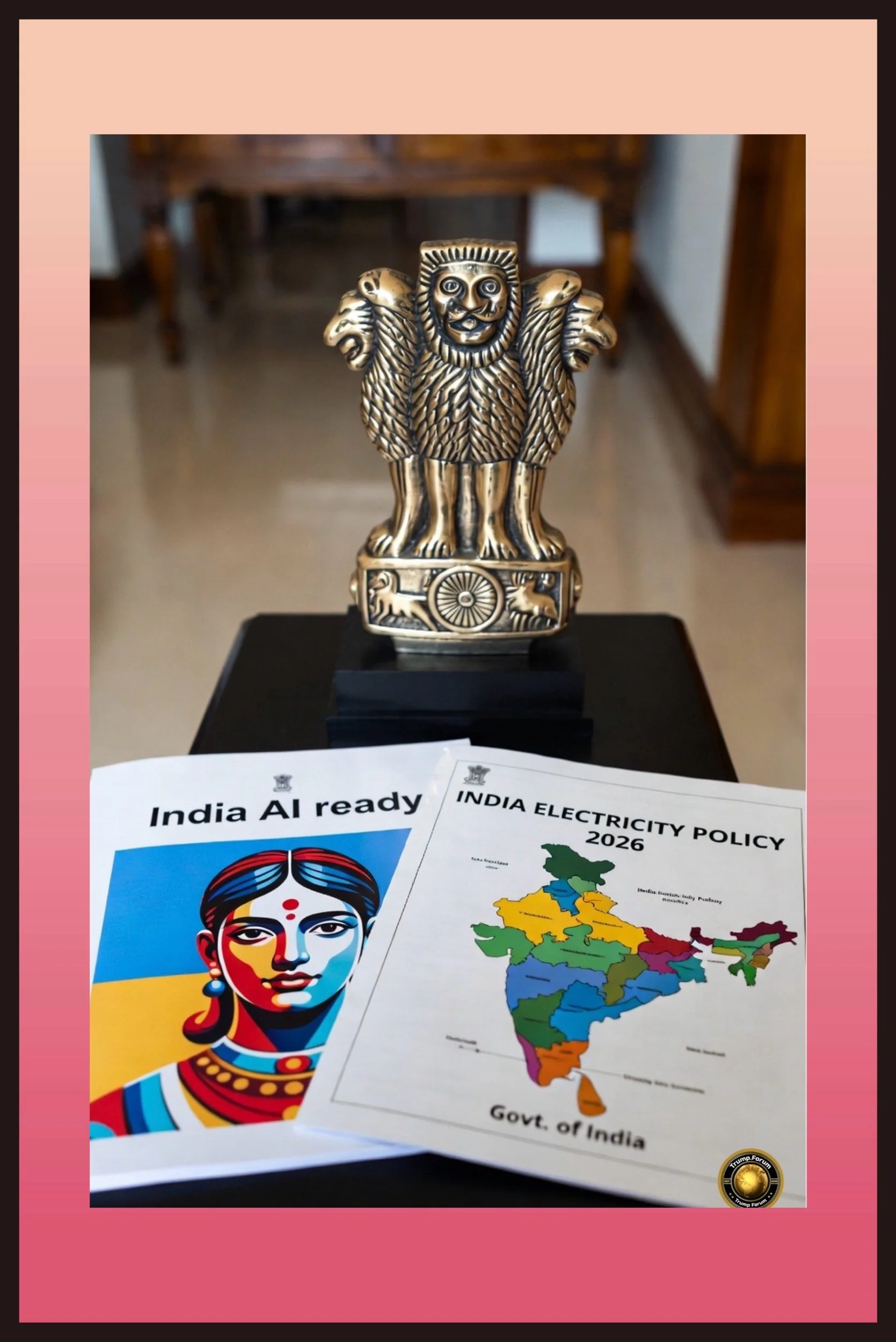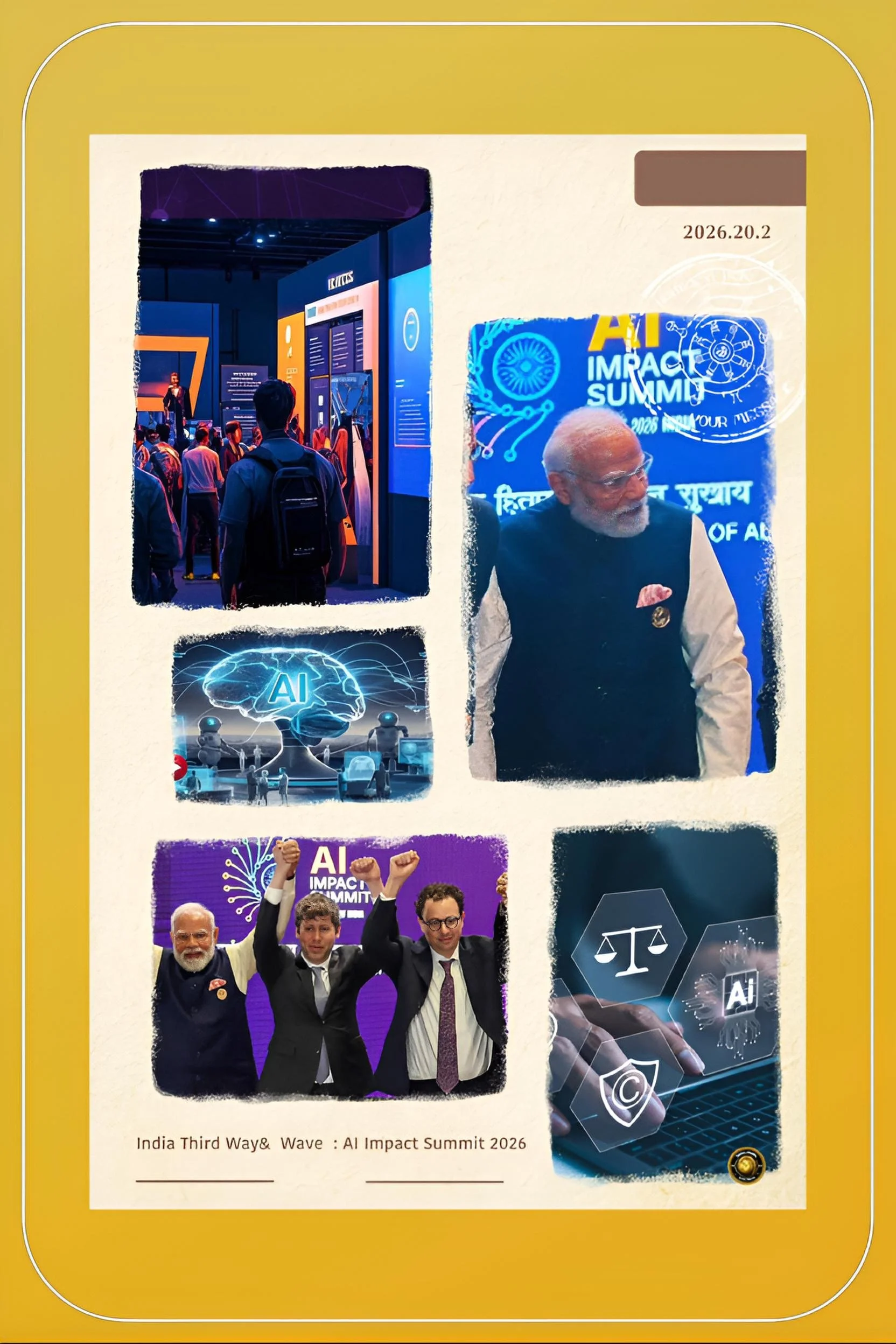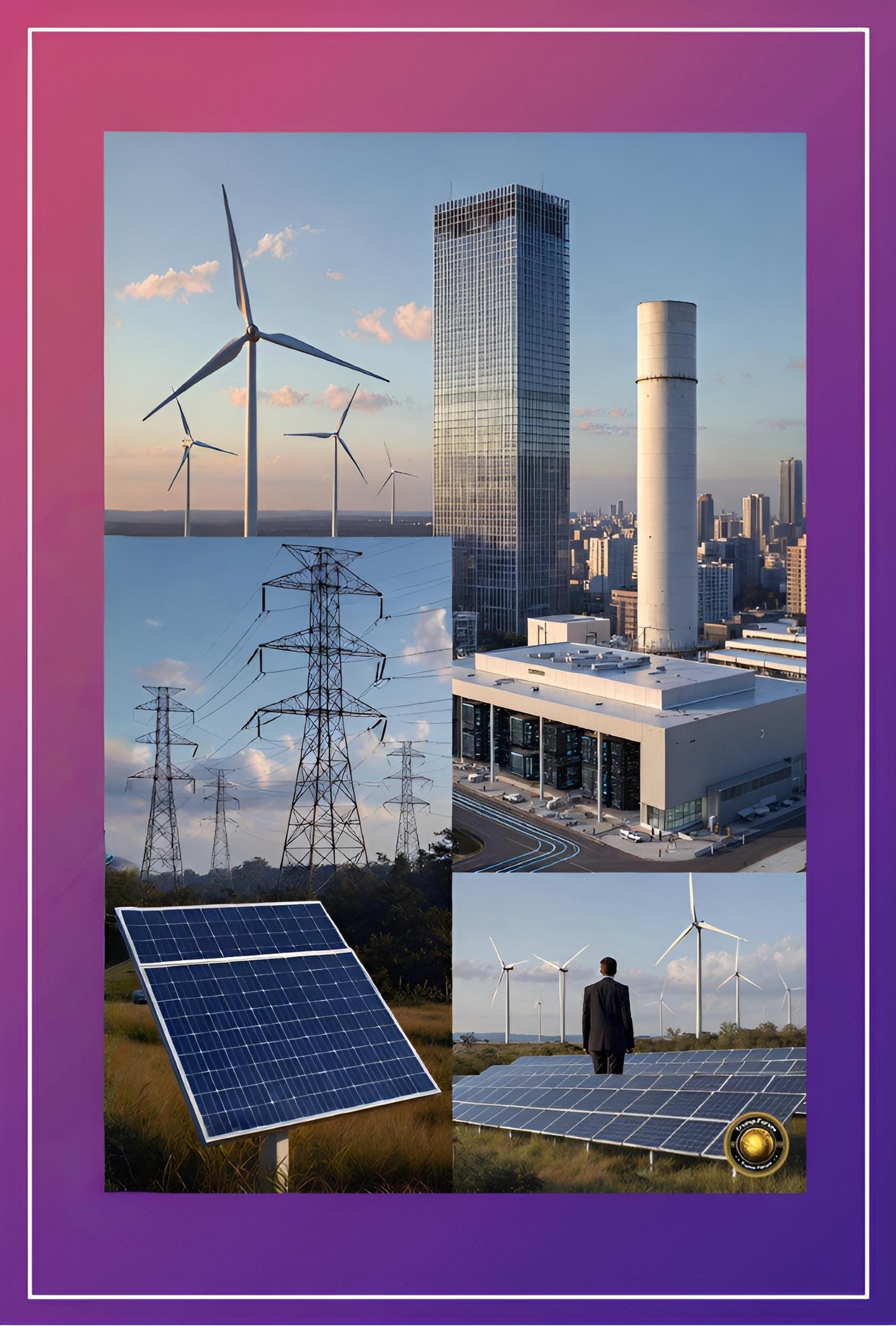
India’s Electricity Policy In 2026 And AI Readiness
Executive summary
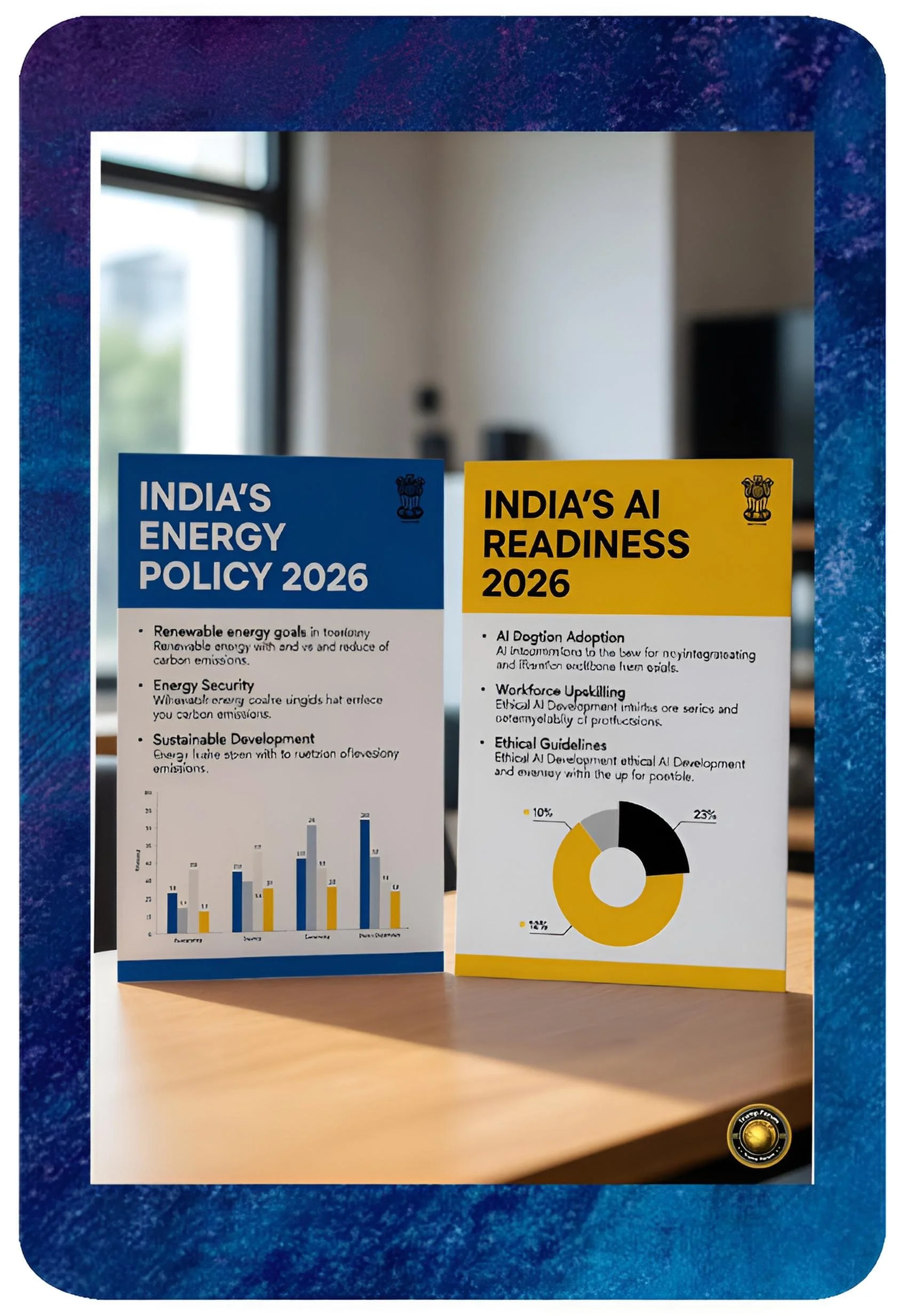
India in 2026 is attempting a dual transformation: decarbonising and expanding its power system while positioning itself as a serious, though still second‑tier, actor in the global AI race.
The Draft National Electricity Policy 2026 (NEP‑2026) and the broader Power Vision 2047 signal an aggressive push for higher electricity consumption, extensive renewable build‑out, and a striking pivot towards nuclear power, framed explicitly around net‑zero by 2070 and energy security.
At the same time, the IndiaAI Mission is scaling national GPU capacity from an initial target of 10,000 chips to tens of thousands, embedding subsidized AI compute in public‑private clouds, and constructing a regulatory and data infrastructure that mixes digital sovereignty with cautious liberalization.
Taken together, these moves mean India is not yet “AI‑ready” in the way that the US or China is. Still, it is rapidly moving from experimentation to system‑level capability.
Power reliability, grid modernisation, and clean‑energy integration are becoming binding constraints for data centres and AI supercomputing clusters, while data‑protection law, localisation rules, and institutional fragmentation shape who can build powerful models on Indian soil.
India’s trajectory is that of a large, late‑moving federal democracy that is compressing into one decade changes that took advanced economies far longer, with all the associated execution risks and political frictions.
Introduction
India 2026 between megawatts and model weights
The 2026 debate about whether India is “AI-ready” cannot be separated from the electricity policy. AI is an energy‑intensive general‑purpose technology: training state‑of‑the‑art models requires dense clusters of GPUs, hyperscale data centres, and stable, relatively cheap power.
India’s per capita electricity consumption, at around 1,460 kWh in 2024‑25, remains barely a third of the global average. Yet, the state now targets roughly 2,000 kWh by 2030 and over 4,000 kWh by 2047, implying a 2.7x step‑up in little more than two decades.
This scale of demand growth is driven not only by households and manufacturing but by cloud, data‑centre, and AI workloads.
Simultaneously, the IndiaAI Mission and associated initiatives aim to build a national AI stack: sovereign compute, datasets, models, and skills.
The government has budgeted more than $1.3 billion for AI over five years, with roughly 40–45% devoted to GPU‑based compute infrastructure. Initially targeting 10,000 GPUs, the first phase now includes nearly 19,000, with later statements touting totals closer to 38,000 GPUs by 2025‑26.
This is the backbone for start-ups, research institutions, and public agencies that would otherwise have no economical access to high-end chips such as the NVIDIA H100 or AMD MI300.
Against this background, Bengio’s Davos remarks, placing India in a “second tier” of AI powers, are analytically correct but incomplete.
The key question is not whether India is already a peer of the US or China—it is not—but whether its electricity and AI policies are mutually reinforcing enough that, by the early 2030s, it can sustain world‑class AI ecosystems on Indian soil rather than merely consuming foreign models.
History and current status of India’s electricity policy
India’s contemporary power policy began with the original National Electricity Policy of 2005, designed in an era of chronic capacity deficits, high technical losses, and state electricity boards on the verge of insolvency.
Subsequent National Electricity Plans and sectoral programmes focused on adding coal and gas capacity while gradually bringing in renewables.
By the mid‑2010s, New Delhi reset its ambitions, targeting 175 GW of renewable capacity by 2022 and 450 GW by 2030.
This aligned with India’s commitments under the Paris Agreement, including a goal that at least 50% of cumulative power‑sector capacity would be from non‑fossil sources by 2030 and that emissions intensity of GDP would fall 45% below 2005 levels by that date.
However, the implementation lagged ambition. While solar and wind capacity grew rapidly, coal remained the backbone of both grid and captive power, and distribution companies (DISCOMs) retained structural weaknesses.
As of the mid‑2020s, climate modelers tracking India’s power system noted that more than 100 GW of additional renewable capacity would need to be installed by 2026‑27 to hit interim targets under the National Electricity Plan 2023, which envisaged 57% of installed capacity from renewables by 2026‑27 and 66% by 2031‑32.
In 2025 and early 2026, the Ministry of Power released the Draft National Electricity Policy 2026, accompanied by Power Vision 2047, to update the 2005 framework for a world of rapidly rising demand, explicit net‑zero commitments, and new technologies such as AI, green hydrogen, and small modular reactors.
NEP‑2026 projects per capita consumption rising to 2,000 kWh by 2030 and beyond 4,000 kWh by 2047, and links these projections to both quality‑of‑life improvements and industrialization. It foregrounds low‑carbon pathways but accepts that coal will remain a key resource for reliability in the medium term.
Key developments in NEP‑2026 relevant to AI
Several features of NEP‑2026 matter directly for AI readiness.
First, the policy makes an explicit pivot toward nuclear power, treating it as a central pillar of long‑term energy security. It seeks a tenfold increase in nuclear capacity, from roughly 8.8 GWe today to 100 GW by 2047, with specific emphasis on advanced technologies such as small modular reactors and the reuse of retired coal plant sites for nuclear installations.
Nuclear is attractive for AI because it provides a high‑capacity‑factor, low‑carbon baseload that can feed 24×7 data‑centre loads without associated volatility.
Second, the policy doubles down on large‑scale renewables and storage. It envisages accelerated deployment of utility‑scale solar and wind, backed by grid‑scale batteries and pumped hydro storage, to accommodate both conventional and digital‑economy loads.
Given that India’s data‑centre capacity is expected to roughly double from 0.9 GW in 2023 to around 2 GW by 2026, driven by data localization mandates and digital‑service expansion, the integration of intermittent renewables with data‑centre clusters becomes a nontrivial grid‑planning problem.
Third, NEP‑2026 recognises that per‑unit tariffs and grid reliability are core to competitiveness. It calls for tariff‑stability mechanisms, rationalisation of cross‑subsidies, and reduction of technical and commercial losses so that industrial and commercial consumers, including hyperscalers and AI clusters, can obtain predictable, globally competitive power costs.
For AI, where power can be a double‑digit share of total operating cost in large training runs, this is not an abstract issue.
Finally, the policy embeds India’s climate commitments, including net‑zero by 2070 and a 45% reduction in emissions intensity by 2030, into the power‑sector roadmap.
AI and data‑centre power demand will be scrutinised for their climate footprint. Investors and regulators will expect AI growth to be coupled to green‑power procurement and efficiency standards, rather than coming at the cost of coal‑lock‑in.
Latest facts and concerns in the energy‑AI nexus
On the infrastructure side, India’s telecom and data‑network backbone has improved dramatically.
By February 2025, 5G services were available in nearly all districts, supported by about 469,000 5G base stations and serving roughly 250 million users; 5G covered 99.6% of districts by that date.
Overall, Internet subscribers approached 970 million, with broadband users crossing 940 million by March 2025, placing India among the fastest 5G rollouts globally.
From an AI‑readiness perspective, this means that last‑mile digital connectivity, a prerequisite for deploying AI in healthcare, agriculture, education, and logistics, is no longer the primary bottleneck.
On the compute side, the IndiaAI Mission has progressed from announcements to concrete tenders and deployments. The mission was initially allocated around $1.3 billion, built on seven pillars, including compute, datasets, skills, startups, and safe AI regulation. Under the compute pillar, MeitY floated an RFE in August 2024 for AI cloud infrastructure with at least 10,000 GPUs, implemented via public‑private partnerships.
Shortlisted bidders, including Jio Platforms, Tata Communications, NxtGen, Yotta, and others, pledged GPU capacity across high‑end chips such as NVIDIA H100, H200, A100, L40S, and AMD MI300, as well as Intel Gaudi series accelerators.
By early 2025, ministers announced that the planned capacity of 10,000 GPUs would be expanded to about 18,693 GPUs, with an aggressively subsidised price of roughly Rs. 100 per GPU hour, compared to global benchmarks around $2.5–$3 per hour, meaning an 80–90% reduction in cost for domestic users.
Independent analyses suggest that by late May 2025, India’s national compute capacity had exceeded 34,000 GPUs, and later government communications claimed that by late 2025, up to 38,000 GPUs were deployed under the mission.
This still pales in comparison to single firms like Meta, which aims for computing equivalent to 600,000 H100 chips by 2025, but it is a nontrivial base for a developing economy.
At the data‑policy layer, India enacted the Digital Personal Data Protection Act (DPDPA) in 2023, followed by draft rules in 2024–25 that define conditions for cross‑border data transfers and sector‑specific data‑localisation regimes.
The rules give the Union government broad discretion to restrict or block data flows to or from countries, and require certain classes of “Significant Data Fiduciaries” to store specified personal and traffic data only in India.
This builds on earlier localisation mandates from the Reserve Bank of India for payments and sectoral regulators. The net effect is that AI firms operating in or targeting India must increasingly design architectures with domestic data fallbacks and local storage.
Yet legal scholars and policy think tanks warn that excessive or poorly specified localisation can fragment data, deter investment, and paradoxically decelerate AI innovation by preventing the aggregation of diverse datasets and complicating cross‑border cloud architectures.
They also note that India’s security agencies have broad access powers, raising concerns that localization may trade foreign surveillance for expanded domestic surveillance, without necessarily enhancing privacy.
Cause‑and‑effect analysis
How electricity and policy shape AI readiness
The interaction between NEP‑2026, data‑centre policy, telecom infrastructure, and the IndiaAI Mission generates a web of cause‑and‑effect relationships that determine India’s AI readiness.
First, rising electricity demand is both a cause and a consequence of AI growth. NEP‑2026’s projection of per capita consumption more than doubling by 2047 reflects, among other drivers, the expected surge in data‑centre and AI workloads.
Data localization rules, Digital India programmes, and the IndiaAI Mission all push more data processing, storage, and inference into Indian facilities, increasing baseload demand. In turn, the availability of cheap, reliable power will dictate where AI clusters are sited and whether India can attract global‑scale cloud investments. If power remains expensive or unstable in key states, hyperscalers may cap their India‑based capacity despite policy incentives.
Second, the nuclear pivot and renewable‑storage expansion aim to address AI’s need for low‑carbon baseload. Coal‑heavy grids face increasing international pressure and potential border‑carbon adjustments. If India meets its nuclear target of 100 GW by 2047 and reconfigures its generation mix to meet the NEP 2023 renewable‑capacity shares, it will be able to power AI clusters with a cleaner mix, enabling export‑oriented digital services that satisfy ESG‑conscious clients.
Conversely, delays in nuclear deployment or in the build‑out of storage would force continued reliance on coal for data‑centre power, inviting criticism and possibly regulatory friction in trade negotiations.
Third, the subsidised AI compute platform changes the economics of model development but does not yet close the global gap. At Rs. 100 per GPU hour, an Indian startup can run experiments that would be financially prohibitive on global clouds, lowering barriers to entry and nurturing an ecosystem of niche models in Indian languages and sectors.
However, the sheer scale of compute in frontier labs abroad—hundreds of thousands of top‑end GPUs—means that India’s mission, even at 38,000 GPUs, supports a mid‑tier rather than frontier‑tier capability.
This shapes expectations: India is more likely to excel in application‑layer innovation and domain‑specific models (e.g., agriculture, health, governance, vernacular LLMs) rather than immediately rivaling GPT‑class frontier systems.
Fourth, data‑localisation and DPDPA rules have a dual effect. They push investment into domestic data centres and AI facilities, enlarging the domestic market for power, land, and connectivity, and strengthening India’s bargaining position vis‑à‑vis global platforms. But they also introduce regulatory uncertainty, especially where subordinate rules and exemption criteria are undefined or highly discretionary.
Smaller firms, which lack the capital to build fully redundant domestic architectures, may find compliance costs high, making them less attractive to investors and more dependent on government‑subsidised compute platforms. In AI, where rapid iteration and cross-border data flows are the norm, unclear rules can be as damaging as restrictive ones.
Finally, the 5G rollout and digital inclusion directly condition the diffusion of AI. Rapid expansion of 5G coverage to almost all districts and high broadband penetration create a user base that can consume AI‑enhanced services, making local models commercially viable. Without this connectivity, AI would remain confined to elite pockets. But connectivity alone does not guarantee capability: education, governance capacity, and industrial policy still determine whether India produces enough skilled engineers and researchers to exploit GPU clusters and data.
Future steps
What India must do to become AI-ready
India’s next decade will determine whether current trajectories converge into a coherent AI‑ready state or fragment into isolated successes amid structural constraints. Several future steps stand out.
On the electricity front, India must translate NEP‑2026’s targets into credible annual capacity‑addition pipelines, especially in renewables, nuclear, and storage.
That entails resolving bottlenecks in land acquisition, grid interconnection, and DISCOM financial reform. For AI‑specific loads, regulators could develop dedicated green‑power corridors and tariff regimes for data‑centre clusters, encouraging co‑location of AI facilities with renewables and nuclear units where feasible.
India’s state‑level data‑centre policies, which already offer subsidised tariffs, dual‑grid connections, and incentives for green data centres, will need to be harmonised with national electricity planning to avoid regional fragmentation.
On the compute side, India will need to move beyond raw GPU counts toward a unified, supplier‑agnostic AI supercomputing fabric. Commentators have argued for connecting the 30,000+ GPUs already acquired into a national, low‑latency cluster rather than leaving them fragmented across providers, enabling the training of larger models and more efficient utilisation.
This requires investment in high‑bandwidth fibre networks, standardised orchestration layers, and governance frameworks for scheduling, priority access, and export controls.
On the policy side, refining the DPDPA rules to reduce uncertainty, clarify the scope of localisation, and protect privacy while enabling innovation is critical.
A sector‑based approach, where specialised regulators define targeted localisation for high‑risk domains (e.g., financial data) while allowing freer flows elsewhere, offers a way to balance sovereignty with AI‑ecosystem growth.
At the same time, India will need to invest in cybersecurity capacity, especially given evidence that even state‑run telecom servers subject to localisation were breached in 2024, underscoring that localisation alone does not guarantee security.
Human capital will be the ultimate constraint. The IndiaAI Mission’s skills pillars, such as the FutureSkills programme and competency frameworks for public officials, acknowledge this, but scaling high‑quality AI education across a system as heterogeneous as India’s remains a formidable challenge.
Without sufficient cohorts of researchers, engineers, and product builders, GPU clusters and electricity reforms will underperform.
Conclusion
Is India AI-ready in 2026?
India in 2026 is structurally underpowered, underconnected, and undercomputed relative to frontier AI powers—but it is moving faster than most emerging economies to close those gaps.
NEP‑2026 sharpens the long‑term vision for electricity, nuclear, and renewables; the IndiaAI Mission and associated GPU tenders operationalise a national compute strategy; 5G and broadband rollout provide the digital last mile; and data‑protection and localisation rules, albeit contested, signal a determination to shape, not simply endure, the global AI order.
India is thus not yet fully AI-ready, which means the ability to conceive, train, and deploy frontier‑scale, independently general models at will.
It is, however, increasingly AI capable: able to host substantial compute, run sovereign or co‑developed large models tailored to its linguistic and socio‑economic realities, and embed AI into governance and industry at scale.
Whether it ascends from Bengio’s “second tier” to a more central position will depend less on slogans and more on the mundane but decisive work of implementing NEP‑2026, coordinating energy and data‑centre planning, refining data policy, and building human capital.
The direction of travel is favourable; the test will be execution.