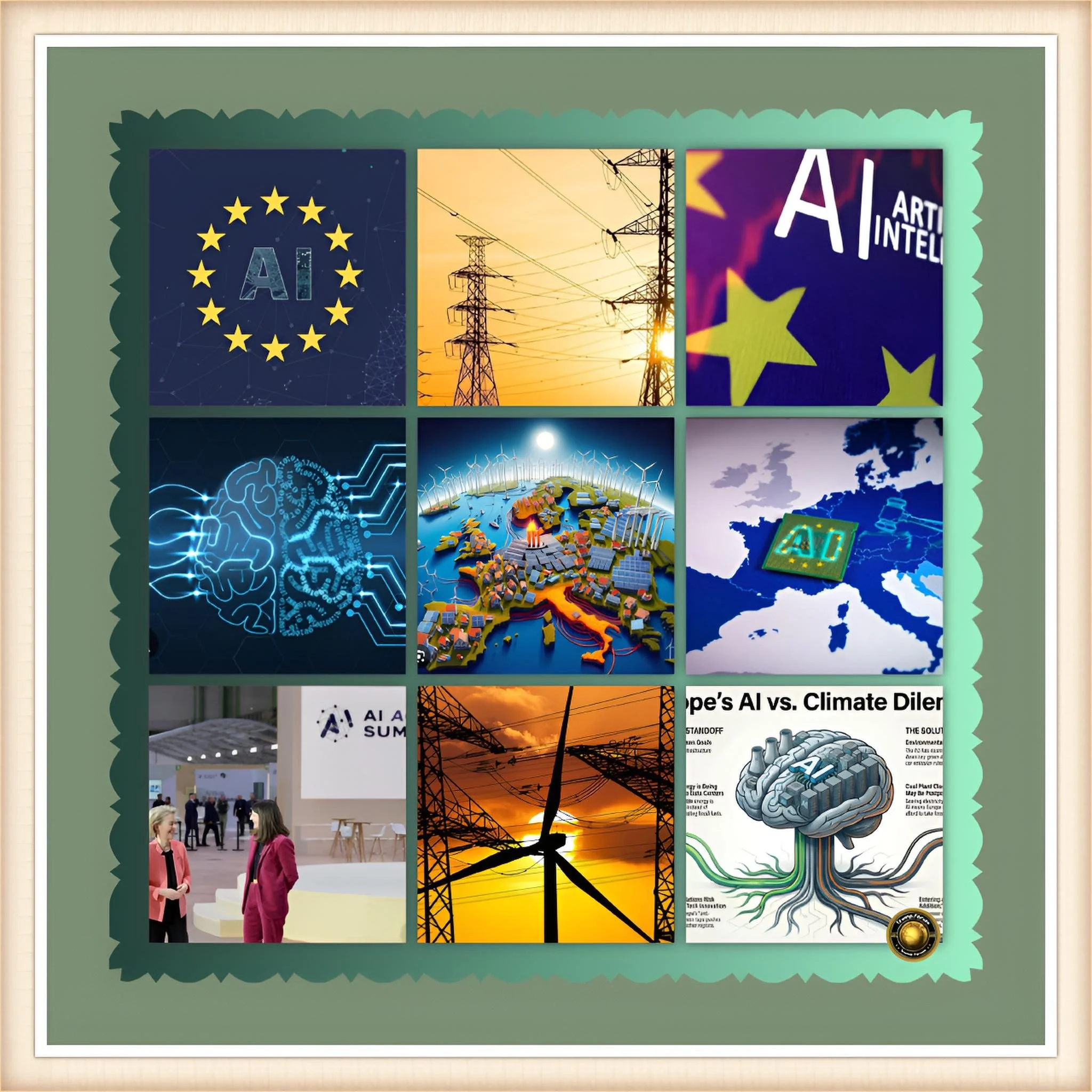
Europe's Power Problem: Why Giant AI Computers and Green Energy Do Not Mix
Summary
Why Europe's Big AI Plans Are Hitting a Power Shortage Wall: What It Means for Everyone
Europe is trying to build giant computer centers for artificial intelligence, like Microsoft and Google are doing.
These computers need massive amounts of electricity to run, and Europe has a big problem: it does not have enough electricity right now, and it cannot make enough renewable energy fast enough to power these new computers. This is becoming a serious crisis that could stop Europe's AI dreams.
Think about it like this.
Europe says it wants to triple the number of AI computer buildings by 2030. That means they want to go from having a certain amount of computer power to having three times as much.
In numbers, data centers in Europe use 70 terawatt-hours of electricity today. That is a huge amount—imagine enough electricity to power millions of homes.
By 2030, Europe needs 115 terawatt-hours. That is a 64 percent increase in just six years.
To understand how big that is, Spain uses 275 terawatt-hours for its entire country.
So Europe's data centers would use almost half of what Spain uses for everything—homes, factories, cars, everything.
Where does this electricity come from today?
Some comes from solar and wind. Some comes from nuclear plants. But most comes from natural gas. Natural gas is a fossil fuel.
Europe says it wants to stop using fossil fuels and switch to clean energy. But here is the problem: solar only works during the day. Wind only works when there is wind.
Data centers need electricity twenty-four hours a day, all day and all night, and they need it instantly. If the power cuts out even for a second, the computers stop working and crash. So even if Europe builds lots of solar panels and wind turbines, they still need natural gas plants that can turn on and off quickly to provide power when the sun is not shining and the wind is not blowing.
Europe has a contradiction.
They say they want to build AI computers. They say they want to stop using fossil fuels. But to build AI computers at the speed they want, they need to use more fossil fuels. That is a real problem with no easy answer.
Water is another big problem.
AI computers get very hot. You need water to cool them down, like how a car engine needs coolant.
The most efficient way to cool computers uses water that flows directly through the computer chips, takes the heat away, and comes back out. But Europe has a water shortage.
Some parts of southern Europe, like Greece and Italy, have droughts. They do not have enough water for drinking and farming already. Now Europe wants to add millions of gallons of water for cooling computers. That does not make sense.
So what does Europe do?
They make rules that say "you cannot use the best water-cooling technology in areas that do not have enough water." That sounds good, right? But it has an unintended consequence. If computers cannot use the best cooling system, they have to use a worse cooling system that uses more electricity to do the same job.
So instead of having a water problem, you have an even bigger electricity problem. You cannot solve one scarcity by creating another scarcity. You are just moving the problem around.
Where are these computer centers going to be built?
Europe's big cities like Frankfurt and London do not have space on the electrical grid for new computers. These cities already use most of their available electricity. So the computers are moving to other places.
Poland is becoming a big center. The Nordic countries (Sweden, Norway, Finland) have cold climates, which helps because cold means you need less cooling water. But even in these countries, the electrical grid is getting stressed.
Finland raised taxes on data center electricity so much that Google is pausing a massive project there.
Money is another constraint.
Europe says it will spend 200 billion euros on AI infrastructure. That sounds like a lot. But the United States is spending 500 billion dollars. That is roughly 450 billion euros.
The United States is spending more than twice what Europe is spending. And the United States also spends more money on renewable energy and grid improvements.
Europe has to spend money on the military (because of Russia), on pensions for old people, on hospitals, on climate transition projects, and on AI computers. That is a lot of things to pay for with one budget. Something has to give.
The computer chips themselves are another problem.
The best chips for AI come from Taiwan or the United States. Europe wants to make its own chips so it does not depend on other countries. But building a chip factory costs 40 billion dollars.
Europe would need to build about twelve chip factories to be independent. That would cost 400-600 billion euros. Europe does not have that kind of money to spend on chip factories when they also have to pay for everything else.
Russia is also making things more complicated.
Russian military hackers have been attacking European power plants and computer infrastructure. They have cut undersea cables in the Baltic Sea that carry internet. They have done sabotage against European energy infrastructure. This means Europe has to spend money protecting the computer centers and power plants from Russian attacks. That is more money Europe needs but does not have.
What are next steps
Europe announced a big plan to build AI computers and compete with the United States and China. But the plan has many problems.
The electricity grid cannot handle the power they need. There is not enough water in some places.
Renewable energy cannot be built fast enough. The money is not there when you count all the other things Europe needs to spend money on. Russia is attacking critical infrastructure. The chip supply comes from other countries that could cut off supply.
What might happen?
One option is that Europe says "we have to slow down and admit we cannot do as much as we said." That is called managed decline. Europe would still build some AI computers but not as many as it announced.
Another option is that Europe says "AI infrastructure is so important that we will spend whatever it takes, even if it means less military spending or less money for pensions."
That is possible but politically difficult because Europeans want military protection from Russia and want their pensions paid.
A third option is that Europe keeps announcing big plans while actually doing less, and just accepts that it will fall behind the United States and China in artificial intelligence. That is what is happening now.
Europe real problem
The honest answer is that Europe faces a real choice. It cannot do everything it announced. Something has to give. The question is what will Europe choose? The answer will come in the next two or three years.
Will Europe make hard choices, or will it continue pretending it can do everything at once?
That answer will determine whether Europe stays competitive in AI or falls further behind.