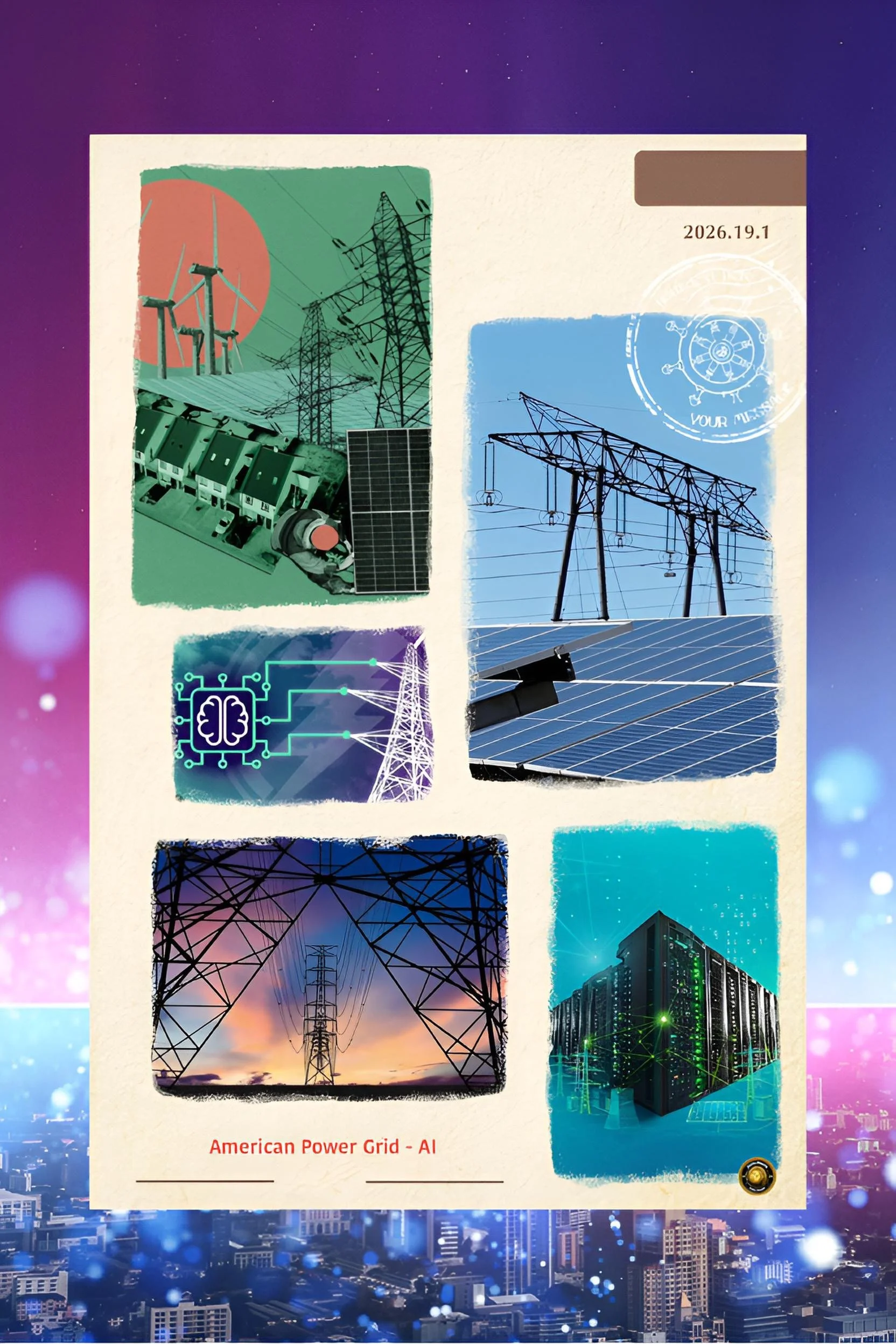
The Race America Cannot Afford to Lose: Why Electrical Infrastructure Will Decide AI Dominance
Summary
The twenty-first century's defining competition is not occurring in laboratories or venture capital funds. It is occurring in the vast, unglamorous infrastructure systems that determine where ambitious technological projects can actually exist. Artificial intelligence development represents perhaps the most energy-intensive computational challenge humanity has ever attempted. Training a single frontier AI model can consume as much electricity as a small city.
Operating that model at scale requires sustained power consumption that most regional electrical grids struggle to supply. Yet this critical infrastructure crisis barely registers in public discourse about technological competition, where attention focuses on chip design, algorithm innovation, and venture capital investment. Goldman Sachs researchers have cut through the noise to identify the essential truth: grid capacity constraints may ultimately determine which nation leads artificial intelligence development.
This assessment is not speculative. China is demonstrating the reality of infrastructure-driven advantage through systematic action. In 2024, China added four hundred twenty-nine gigawatts of new electrical generation capacity while the United States added fifty-one gigawatts. This eightyfold disparity represents a deliberate strategic choice to build the foundational infrastructure required for AI deployment at scale.
By 2030, Goldman Sachs projects China will possess four hundred gigawatts of spare electrical capacity—more than triple the total electricity demand for all global data centers combined. Concurrently, the United States faces a situation in which peak demand for electricity will outpace supply by 2028 and the gap could reach one hundred seventy-five gigawatts by 2033.
These disparate trajectories create an asymmetric strategic situation that will inevitably reshape the global AI competition. American companies continue to lead in frontier AI model development, semiconductor chip design, and data center architecture. Yet leadership in these domains is meaningless if American companies cannot obtain sufficient electrical power to operate their systems at the scale required for continued innovation and commercial deployment.
China, conversely, is systematically solving this problem through state-directed investment in electrical infrastructure, regardless of innovation capabilities. The result is a scenario where American technological superiority becomes academically interesting but commercially irrelevant.
The crisis became acute in January 2026 when the White House convened an emergency meeting with governors and grid operators to address unprecedented electricity shortfalls and record-breaking price spikes in capacity markets. Google publicly acknowledged that interconnection timelines for data center projects now exceed a decade in some regions, making expansion constrained by infrastructure rather than technology or capital.
PJM Interconnection, the grid serving the mid-Atlantic region, faces reserve margin shortfalls after 2028 that could threaten rolling blackouts. This is not distant speculation about 2040 or 2050. This is occurring now, in early 2026, as data center operators scramble to adjust timelines and locations based on electricity availability.
The American response has centered on emergency measures: accelerated permitting for new transmission, auction mechanisms to incentivize power generation, on-site power solutions using fuel cells, and pressure on grid operators to prioritize data center projects.
These measures address tactical symptoms rather than strategic causes. Permitting acceleration may reduce timelines from twelve years to eight years, but China's permitting timelines for equivalent projects are measured in months. On-site generation helps individual projects but increases costs and reduces geographic flexibility that grid-connected infrastructure provides. Emergency auctions increase incentive prices but do not resolve the fundamental physical capacity constraint of transmission infrastructure.
The deeper problem is that American electrical grid development has been optimized for a century-old model of steady growth managed through distributed utility decision-making and regional coordination. This model worked when electricity demand grew predictably and gradually. It does not work when demand surges discontinuously around a transformative technology.
China's centralized planning model is designed precisely for this scenario—rapid resource mobilization, decisive decision-making, and subordination of local concerns to national strategic priority. This creates an almost inexorable advantage in a competition where electrical infrastructure is the binding constraint.
The clock is ticking. By 2030, the infrastructure trajectories of the United States and China will have diverged sufficiently that remedying American deficits will become substantially more difficult. Projects that connect to the Chinese grid and benefit from low-cost electricity will gain compounding advantages as electricity costs drive operating margins in data centers.
American projects that ultimately connect to the grid after decade-long permitting processes will have lost years of operational advantage. Developers will increasingly locate projects in China or other jurisdictions with adequate electrical infrastructure rather than waiting for American grids to catch up.
The outcome is not predetermined, but it requires recognizing that artificial intelligence leadership is not determined solely by innovation. It is determined by innovation multiplied by infrastructure capacity multiplied by the speed at which that infrastructure can be deployed. On the latter two dimensions, China is moving decisively ahead.
The United States must respond with equivalent decisiveness or accept gradual loss of leadership in the technology that will define the remainder of the century.