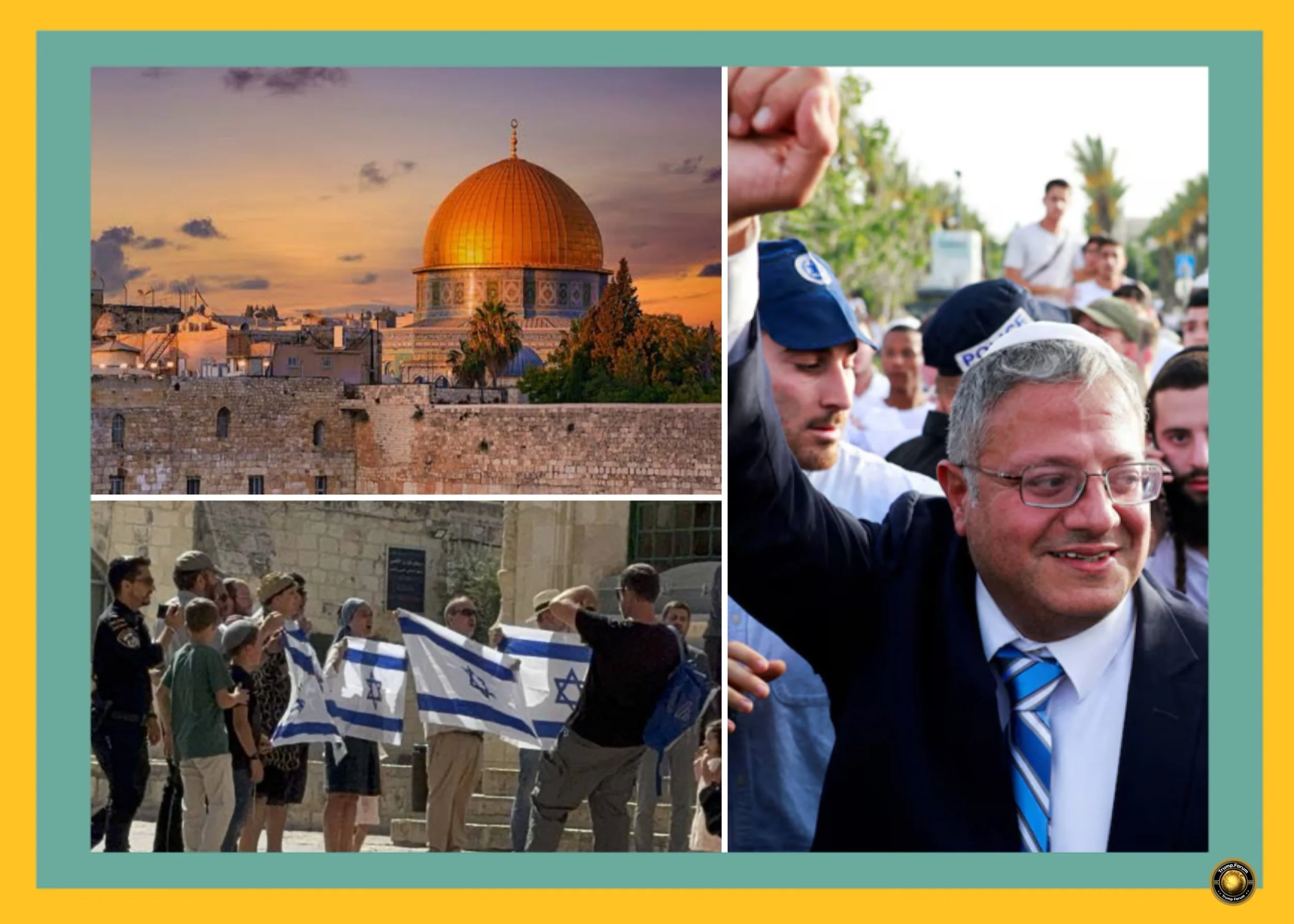
Ben-Gvir, Israel's national security minister, visits Al Aqsa Mosque to pray. When will people learn to co-exist?
Introduction
It has been reported that Itamar Ben-Gvir, Israel's Minister of National Security, recently visited the Al-Aqsa Mosque for prayer.
This action raises critical questions about intercommunal relations and the ongoing challenge of coexistence in the region.
When will humanity recognize the importance of mutual respect and tolerance in diverse societies?
History
Israeli Jews are prohibited from praying within the Al Aqsa Mosque compound (known to Jews as the Temple Mount) due to a “status quo” arrangement established in 1967 between Israel and Jordan, which currently administers the site.
According to this agreement, while Jews and other non-Muslims are allowed to visit the compound, only Muslims may perform prayers there.
Outcome
This restriction is intended to mitigate religious tensions and violence at this historically sensitive location, ensuring Muslim sovereignty and fostering peace among the diverse religious communities in Jerusalem and the broader region.
Recent events
Recent events have raised questions about this policy, particularly regarding actions taken by Israeli officials such as Itamar Ben-Gvir, Israel's far-right National Security Minister.
On August 3, 2025, the compound, overtly violating the established status quo, was a significant escalation for a government minister.
His actions were strategically timed to coincide with Tisha B’Av, a day of mourning for Jews, during which he expressed intentions to pray for victory over Hamas and the safe return of Israeli hostages from Gaza.
Ben-Gvir has consistently advocated for Jewish prayer and the assertion of Israeli sovereignty at the site.
The implications of Ben-Gvir's actions are multifaceted.
Domestic Implications in Israel
Ben-Gvir's actions aim to challenge existing restrictions and promote a narrative of increased Jewish presence and rights on the Temple Mount.
This appeals to his far-right constituents who view the prayer ban as an infringement on religious freedoms and Jewish sovereignty.
Additionally, he leveraged this occasion to advocate for more aggressive policies against Hamas and to emphasize Israeli dominion over the area.
International and Regional Impact
The act of leading Jewish prayer within the Al Aqsa/Temple Mount is perceived as highly provocative in the Muslim world. It signals a readiness to modify long-standing arrangements.
It serves as a declaration of Israeli control over all of Jerusalem, directly undermining Palestinian claims and those of the broader Muslim community.
This act drew immediate condemnation from Jordan, Saudi Arabia, and the Palestinian Authority, among others, who characterized it as a violation of international law and a provocative escalation that could ignite further regional conflict.
Controversy Over the Status Quo
Officially, the Israeli government maintains that Ben-Gvir’s positions do not reflect the state’s policy.
Prime Minister Benjamin Netanyahu has reiterated Israel's commitment to the status quo to mitigate potential violence and appease international criticism.
Conclusion
Historically, violations of the status quo at the Temple Mount have incited unrest, as the site is central to both national identity and religious beliefs for Palestinians and Muslims globally.
Such acts, particularly when sanctioned by prominent Israeli officials, are viewed as attempts to assert Jewish primacy and are likely to escalate tensions, potentially leading to broader regional conflicts akin to those witnessed in the past.
In summary, Ben-Gvir's actions directly challenge an arrangement designed to maintain peace in one of the world’s most sensitive geopolitical arenas.
While it sends a message of religious-nationalist assertion to his supporters in Israel, it simultaneously poses a significant provocation to the region and the international community.
From a philosophical, theological, and, more importantly, humanitarian perspective, this scenario illustrates humanity’s struggle with the divisions created by religious identities.
Despite the shared belief in a singular divine creator, human interpretations of faith have often led to discord and conflict.
The historical fragmentation along religious lines has resulted in a landscape where peaceful coexistence is increasingly difficult.
Humanity must recognize the finite nature of existence and the importance of fostering tolerance and understanding rather than perpetuating cycles of hatred and division.
This reflection highlights a broader existential question: Given the limitations of our mortal lives, when will humanity choose paths of peace over those of conflict?
Ultimately, the legacy left behind may hinge not on differences but on the collective pursuit of unity, emphasizing that hatred and division only serve to hasten the end of an era.