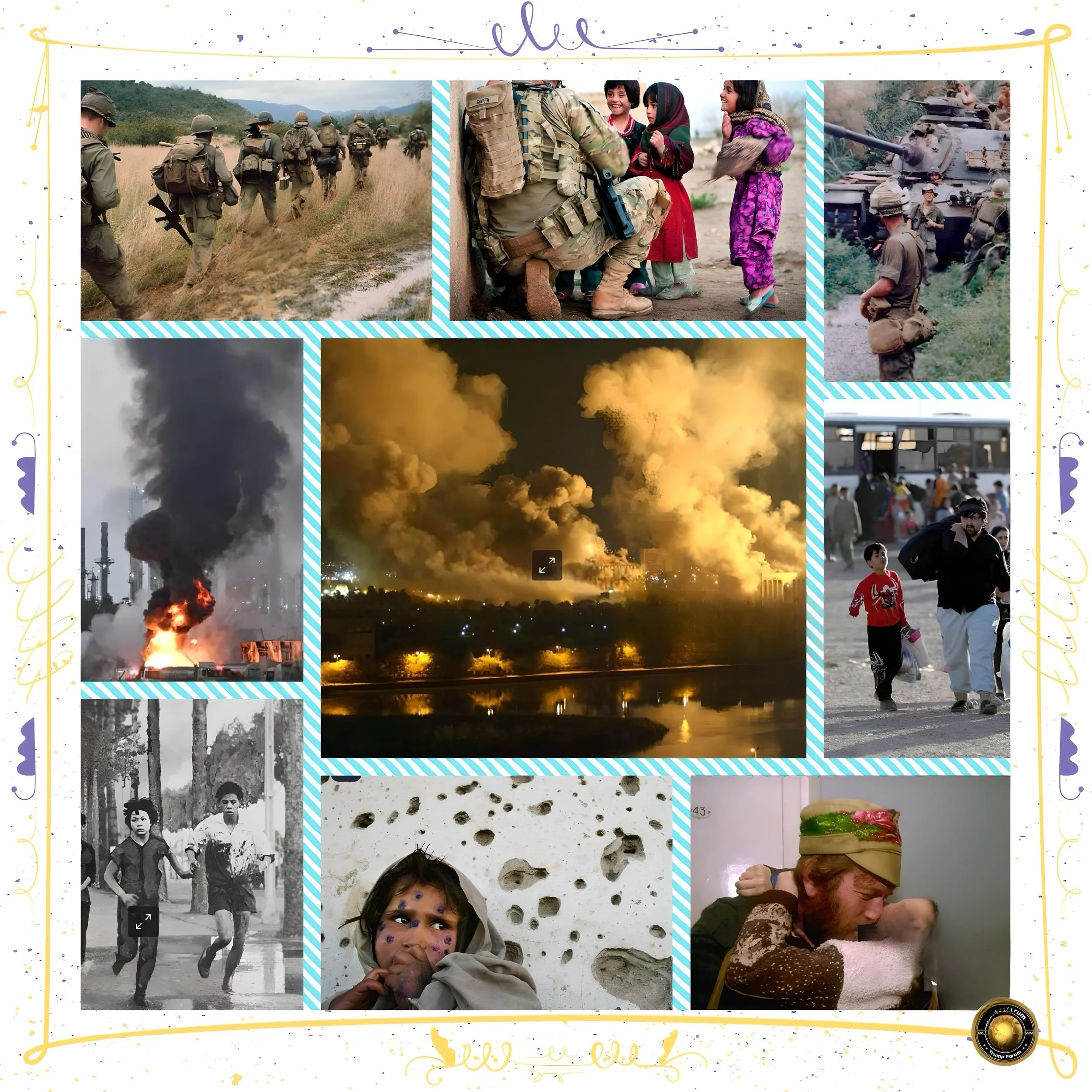
Hubris Invites Collapse: Modern Geopolitical Lessons - The Impermanence of Empires - Part II
Introduction
The age-old adage “hubris invites collapse” is particularly relevant in the current geopolitical milieu.
As both emerging and established powers grapple with multifaceted global challenges, the historical patterns of overconfidence, overextension, and strategic miscalculation that precipitated the downfalls of empires such as Rome, imperial Britain, and the Soviet Union are reemerging in contemporary forms, posing substantial risks to the international order.
Contemporary Manifestations of Imperial Hubris
NATO Expansion and Strategic Overreach
The post-Cold War eastward expansion of NATO serves as a quintessential case of institutional hubris leading to perilous miscalculations.
Despite assuring Soviet leaders during the German reunification discussions that NATO would refrain from further eastward moves, successive U.S. administrations have intensified the alliance's proximity to Russian borders.
Critics label this expansion as “hubris expressed by NATO leadership,” which has been identified as a critical catalyst for the Ukraine crisis.
George Kennan, the chief architect of the American containment policy, warned in 1998 that NATO's expansion would be “a tragic mistake” likely to provoke a defensive response from Russia.
Current analysis posits that “NATO’s arrogant, tone-deaf policy toward Russia over the past quarter-century” set the stage for Putin’s 2022 invasion of Ukraine.
The war has starkly illuminated the miscalculations inherent in the Western expectation of a swift takeover of Kyiv, which proved catastrophically erroneous.
China-U.S. Strategic Competition and the “Thucydides Trap”
The intensifying rivalry between the United States and China typifies how immense power hubris can engender perilous feedback loops. Both nations display traits of “peaking powers” – states experiencing economic decelerations that may resort to aggressive policies in a bid to sustain their momentum.
China’s rapid economic ascent has cultivated a sense of confidence, resulting in increasingly assertive territorial claims in the South China Sea and the implementation of aggressive “wolf warrior” diplomacy.
Conversely, U.S. responses exemplify their form of hubris, marked by sweeping sanctions on technology and combative trade measures that threaten to fragment the global economy.
The Biden administration’s persistence with the tariffs initiated during Trump's presidency and the escalation of semiconductor restrictions reflect a bipartisan conviction in America’s capacity to contain China’s technological advancement through economic coercion.
BRICS and the Challenge to Dollar Hegemony
The expansion of the BRICS (Brazil, Russia, India, China, and South Africa) bloc poses a direct challenge to U.S.-led global institutions. It is fueled in part by frustration with what member states deem Western arrogance.
Comprising nearly 40% of global GDP and including significant energy producers like Saudi Arabia and Iran, BRICS reflects a “tectonic shift in influence” away from Western-dominated decision-making processes.
Russian President Putin has framed BRICS as representative of the “global majority” in opposition to Western hegemony.
However, the bloc’s limitations underscore that challenging existing power structures necessitates more than mere grievance—it requires sustainable alternatives and genuine cooperation among diverse members with often conflicting interests.
Regional Examples of Democratic Hubris and Backsliding
European Union: Brexit and Institutional Overconfidence
Brexit epitomizes how institutional hubris can incite a nationalist backlash. The EU’s presupposition that European integration was an irreversible process was proved incorrect when British voters opted to depart in 2016.
Research indicates that the chaotic implementation of Brexit deterred other populist movements in Europe, leading nationalist parties to moderate their anti-EU rhetoric as the repercussions of leaving became evident.
Similarly, the eurozone crisis exposed the hubris embedded within the European monetary union, where the expectation that a common currency could function without fiscal integration proved naive.
This institutional overconfidence has catalyzed populist movements across Europe, as voters have blamed EU constraints for their governments’ inability to navigate economic shocks effectively.
Democratic Backsliding in Eastern Europe
Hungary and Poland exhibit how democratically elected leaders can systematically dismantle institutional checks through legal mechanisms.
Following rapid democratic advancement post-1989, their subsequent backsliding is particularly notable.
Viktor Orbán’s consolidation of power in Hungary and the Law and Justice party’s judicial reforms in Poland illustrate how misplaced confidence in democratic stability can obscure gradual erosions of democratic frameworks.
The COVID-19 pandemic has exacerbated these trends, with both nations leveraging emergency powers to weaken democratic institutions further.
The EU’s sluggish response reflects its institutional hubris—the flawed assumption that membership would inherently ensure adherence to democratic norms.
Emerging Powers and Authoritarian Drift
Turkey’s gradual shift toward autocracy under President Erdoğan illustrates how success can precipitate dangerous overconfidence.
Initially lauded for economic reforms and EU negotiation efforts, Erdoğan's governance has transformed. It is characterized by increasing authoritarianism, the curtailment of civil liberties, and the erosion of judicial independence and media freedom.
This trajectory underscores the complexities faced by emerging powers as they negotiate between democratic aspirations and autocratic tendencies.
India’s Democratic Erosion Under Modi
India's shift from “the world’s largest democracy” to an “electoral autocracy,” as classified by V-Dem, exemplifies a significant instance of democratic erosion in the contemporary era. Prime Minister Narendra Modi's tenure, spanning over a decade, has been characterized by systematic undermining of press freedoms, weaponization of law enforcement against political adversaries, and discrimination against the nation’s substantial Muslim minority, comprising approximately 204 million individuals.
This transformation is particularly notable given India's historical robustness as a multi-party democracy.
Modi’s administration has employed legal mechanisms to intimidate opposition figures while presenting a veneer of electoral contestation, illustrating the peril of democratic institutions being subverted from within.
Observers from the international community caution that a potential third term for Modi could hasten this democratic decline.
Brazil’s Populist Experiment and Recovery
The presidency of Jair Bolsonaro (2019-2023) serves as a poignant case study of right-wing populist governance, revealing its inherent limitations.
Bolsonaro's antagonistic approach, dismissal of scientific consensus during the COVID-19 pandemic, and repeated assaults on democratic institutions culminated in his electoral defeat.
His experience underscores the concept of populist hubris, wherein the perception of charismatic leadership is believed to transcend institutional limitations, a belief that encounters natural limitations in functional democracies.
The peaceful transition of power to Luiz Inácio Lula da Silva in 2023 underscored Brazil’s democratic resilience while revealing the detrimental impact that populist leaders can exert on democratic institutions and societal cohesion throughout their governance.
Climate Change as a “Threat Multiplier
Climate change poses a fundamental challenge that disrupts traditional geopolitical paradigms. It functions as a “threat multiplier” that magnifies pre-existing vulnerabilities.
Over the last decade, weather-induced disasters have forced approximately 220 million internal displacements, with projections anticipating this figure could soar to 1.2 billion by 2050.
Viewing climate displacement as a future concern rather than an immediate crisis carries significant geopolitical ramifications. Most forcibly displaced individuals reside in nations highly susceptible to climate change, engendering compound crises that strain current institutional responses.
The inadequacy of international legal frameworks addressing the plight of “climate refugees” highlights the broader hesitance of established powers to reconcile existing systems with emerging realities.
Economic Sanctions and Strategic Overextension
The extensive employment of economic sanctions, particularly towards Iran and Russia, illustrates how policy instruments can devolve into ends unto themselves, demonstrating institutional hubris regarding the efficacy of economic coercion.
U.S. sanctions on Iran have precipitated severe humanitarian consequences without materially altering Iranian governmental conduct, suggesting that “maximum pressure” strategies may fall short of their intended goals.
The unprecedented breadth of sanctions implemented against Russia following its incursion into Ukraine represents a crucial examination of Western economic clout.
While these sanctions have imposed significant costs on the Russian economy, they have concurrently accelerated the advent of alternative financial systems and diminished confidence in dollar-based transactions among non-aligned states.
Lessons for Contemporary Policymakers
The historical trend of hubris leading to systemic collapse proffers several pivotal lessons for contemporary leaders:
Institutional Humility
Multilateral organizations such as NATO, the EU, and even the UN must continuously reassess their underlying assumptions and adapt their strategies to evolving global circumstances rather than resting on the laurels of past methodologies.
Strategic Restraint
Great powers should recognize the finite nature of their influence and eschew overextension that could exhaust resources and erode credibility. The American experiences in Afghanistan and Iraq serve as cautionary tales regarding the costs stemming from strategic overreach.
Inclusive Governance
The trajectory of democratic backsliding often initiates when leaders perceive institutional constraints or minority rights as disposable. Maintaining comprehensive checks and balances demands relentless vigilance against complacent assumptions about democratic robustness.
Crisis Adaptation
Effective governance in the face of pandemics, climate change, or economic shocks necessitates acknowledging uncertainty and a commitment to flexibility, in contrast to rigid adherence to established paradigms.
Coalition Building
In an increasingly multipolar international environment, no single entity can dictate global resolutions. Sustainable influence hinges upon cultivating genuine partnerships and collaborative decision-making rather than pursuing unilateral supremacy.
Conclusion
Staying Attentive to Recurring Historical Patterns
The modern geopolitical terrain underscores a striking truth: the core dynamics of arrogance and subsequent decline that have characterized historical empires are remarkably enduring.
This is evident in recent events where NATO's strategic expansion eastward has exacerbated tensions, culminating in the ongoing crisis in Ukraine.
Similarly, the troubling trend of democratic erosion is observable in nations once hailed as paragons of mature democracy, raising alarms for those attentive to these developments.
Such hubris, which ultimately invites downfall, transcends individual actors; it manifests at institutional and systemic levels.
Throughout history, entire organizations, coalitions, and political frameworks have succumbed to the hubris that previously led to the fiscal missteps of ancient Rome, the imperial overreach of Britain, and the flawed economic strategies of the Soviet Union.
These examples remind us that overconfidence can blind decision-makers to their vulnerabilities, setting the stage for significant crises.
Acknowledging these historical patterns provides a vital opportunity for corrective action. Still, such a shift requires leaders to harness humility, recognize their limitations, and display the wisdom to adapt proactively rather than reactively, forced by crises into uncomfortable changes.
In our interconnected global landscape, the implications of missteps are more severe than ever.
The intertwined nature of climate change, the proliferation of nuclear arsenals, and the complexities of global economic interdependence mean that the collapse of significant powers or institutions could trigger a domino effect, destabilizing the entire international system.
The ancient adage that “no empires last forever” should not be viewed as a pessimistic outlook but rather as a compelling call to consciousness.
It serves as a pivotal reminder that unchecked power, untempered strength, and blind confidence—without the guiding forces of prudence, wisdom, and humility—remain the most reliable paths toward inevitable decline.