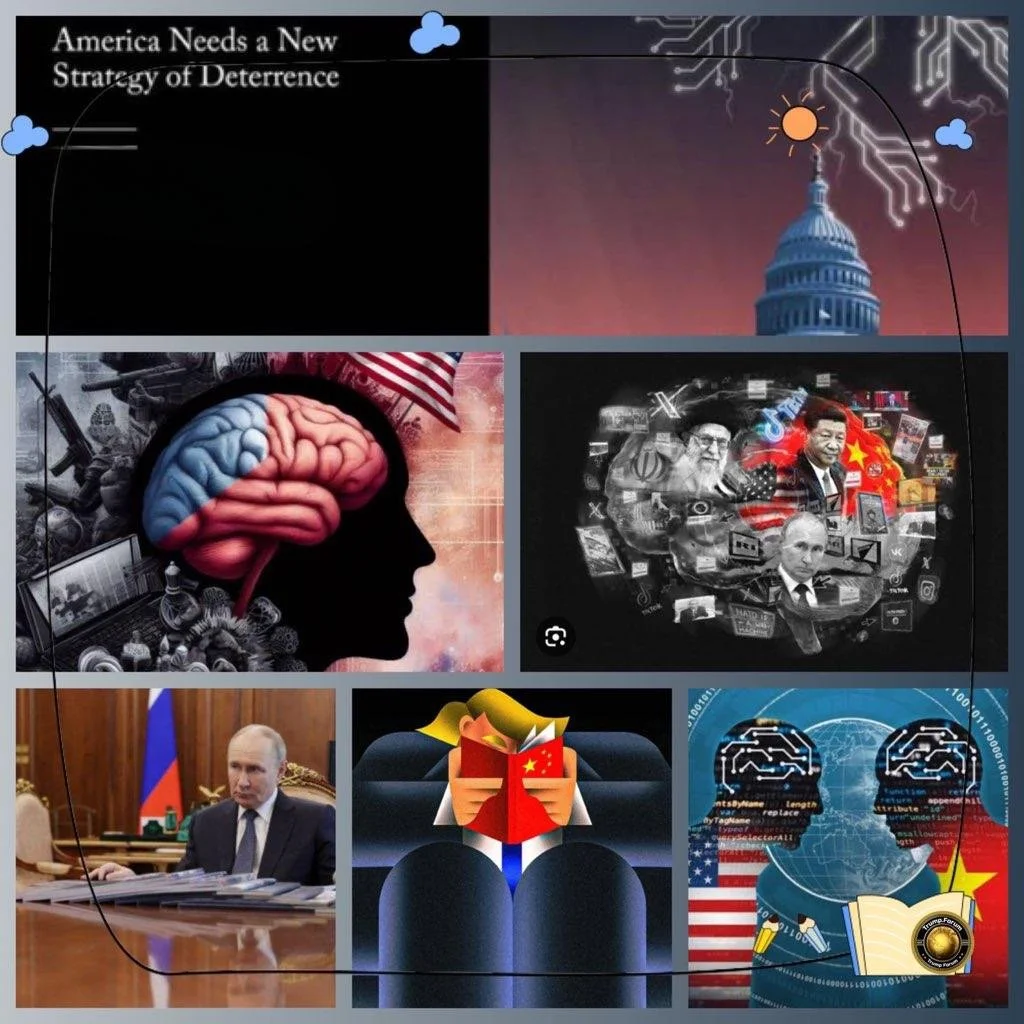
America's Poly-Crisis: An In-Depth Examination of Socio-Economic and Political Challenges Alongside a Deterrence Deficit
Introduction
Executive Summary
The United States faces an unprecedented convergence of socio-economic and political challenges that fundamentally threaten its global leadership position and internal stability.
This crisis manifests across multiple interconnected dimensions: economic competitiveness, defense industrial capacity, technological leadership, workforce displacement, political polarization, and institutional integrity.
The comprehensive analysis reveals a nation experiencing what can only be described as a “polycrisis” - multiple crises occurring simultaneously and reinforcing each other.
Economic Competitiveness and Global Leadership Decline
The United States is experiencing a significant erosion of its economic dominance globally. The trade deficit with China reached $295 billion in 2024, representing the largest bilateral trade imbalance with any country.
This deficit persists despite aggressive tariff policies, with the US imposing tariffs as high as 145% on Chinese imports, while China has retaliated with tariffs up to 125%.
The trade war has escalated to levels not seen in decades, with the average implied US tariff potentially reaching heights not witnessed since the early 20th century.
More troubling is the structural shift in global economic leadership. According to multiple assessments, China has achieved or is approaching parity with the United States in several critical technological sectors.
A comprehensive 20-month study by the Information Technology and Innovation Foundation found that “Chinese innovation ecosystem is significantly more robust than previously recognized”.
China now leads in electric vehicles, nuclear reactor deployment (10-15 years ahead of the US), battery production, and industrial robotics.
The country installed more industrial robots than the rest of the world combined in recent years, indicating massive automation across their manufacturing landscape.
Defense Industrial Base Deterioration
The American defense industrial base has experienced what experts describe as a “steady deindustrialization” since the 1970s.
The consolidation of defense contractors has been dramatic - from 51 major prime contractors to fewer than 10 today.
This consolidation has created monopolistic conditions that reduce competition and innovation while increasing costs and reducing responsiveness to national security needs.
The Pentagon’s first-ever National Defense Industrial Strategy reflects bipartisan concern about these vulnerabilities.
The US defense industry is now more isolated from the broader commercial economy than at any time in history.
The shipbuilding industry exemplifies this decline - the US largely ceased producing commercial oceangoing vessels while becoming dependent on ocean transit for critical supplies.
The submarine production pace is lagging due to workforce challenges and a fragile domestic supply chain with numerous “single points of failure”.
Defense spending inefficiency costs an estimated $50 billion annually, while the overall weakening of the defense industrial base threatens military readiness and deterrence capabilities.
The Heritage Foundation warns that “American industrial capacity has been in decline since the 1970s and with it the arsenal of democracy”.
Massive Job Market Disruption and Workforce Displacement
The American workforce is experiencing unprecedented disruption. In just the first five months of 2025, nearly 700,000 jobs were eliminated - an 80% increase from the previous year.
This represents approximately 65,000 jobs away from matching the entire layoff count for 2024.
The technology sector alone lost 74,716 jobs, with major companies like Amazon, Google, Meta, and Microsoft implementing significant workforce reductions.
The drivers of this displacement are multifaceted
Automation and AI Impact
Research indicates that up to 30% of hours currently worked across the US economy could be automated by 2030.
A McKinsey study projects that 45 million people (approximately 25% of the workforce) will lose their jobs to automation by 2030.
The robotics revolution is accelerating, with North American companies ordering a record 29,000 robots in the first nine months of 2021, representing a 37% increase.
Sectoral Breakdown
Government employment has seen dramatic cuts, with federal agencies implementing over 150,000 layoffs.
The retail sector experienced a 274% increase in job cuts, while the services sector saw an 80% increase.
Manufacturing continues its long-term decline, having lost 7.1 million jobs (36% of the workforce) since 1979.
Geographic and Demographic Disparities
Workers in lower-wage jobs are up to 14 times more likely to need occupational transitions than those in highest-wage positions, and women are 1.5 times more likely to need to change occupations than men.
Immigration Policy and Economic Growth
The Trump administration’s immigration policies are having measurable negative effects on economic growth.
Federal Reserve analysis indicates that reduced immigration will cause GDP growth to be 0.8 percentage points below baseline in 2025.
Under more aggressive deportation scenarios, annual GDP growth could be nearly 0.9 percentage points lower by the end of 2025, and 1.5 percentage points lower in subsequent years.
Immigration has driven over 95% of labor force growth since the mid-1990s, with immigrants accounting for 23% of STEM workers and 55% of unicorn startup founders having at least one immigrant founder.
The Congressional Budget Office estimates that higher immigration levels expected between 2024-2034 would boost GDP by $8.9 trillion.
Mass deportation of the estimated 11 million unauthorized immigrants would cost more than $150 billion, with an additional $15 billion annually needed for border security.
Political Polarization and Democratic Backsliding
American political polarization has reached historically dangerous levels.
The percentage of Americans self-identifying as politically moderate has reached a record low of 34%, while unfavorable views of the opposing party have doubled since 1994.
Among Republicans, 77% now self-identify as conservative, while 55% of Democrats identify as liberal.
This polarization is not merely ideological but has become “affective” - characterized by deep emotional dislike and distrust of political out-groups.
Research indicates that economic inequality and political polarization are mutually reinforcing, with evidence suggesting that “group polarization can be contagious, and a subpopulation facing economic hardship in an otherwise strong economy can tip the whole population toward polarization”.
The implications for democratic governance are severe.
Majorities of Americans predict 2025 will be a year of political conflict, economic difficulty, and international discord.
Political scientists warn that the US is exhibiting characteristics of “competitive authoritarian regimes,” with erosion of rule of law, hollowing of state bureaucracy, and systematic firing of those perceived to have the “wrong” political views.
Federal Reserve Independence Under Threat
The independence of the Federal Reserve - a cornerstone of American monetary policy credibility - faces unprecedented political pressure.
President Trump has repeatedly called for Fed Chair Jerome Powell to resign, using derogatory terms like “dumb,” “stubborn mule,” and “fool”.
The administration has seized on cost overruns in the Fed’s $2.5 billion headquarters renovation as potential grounds for dismissal.
Treasury Secretary Scott Bessent has confirmed that a formal process to replace Powell is underway, with plans to announce a nominee by fall 2025.
Deutsche Bank warns that removing Powell could cause “both the currency and the bond market to collapse as inflation expectations move higher”.
The politicization of monetary policy represents a fundamental threat to the institutional framework that has underpinned American economic stability.
Technology Leadership and Strategic Dependence
The United States is losing its technological edge across multiple critical sectors.
China is expected to surpass the US in technological innovation by 2025 and could outgrow America’s tech sector eight-fold by 2029.
Chinese companies like DeepSeek have demonstrated the ability to create AI models comparable to ChatGPT at a fraction of the cost, causing massive disruption in US tech stock markets.
The implications extend beyond commercial competition. The US now faces what experts describe as a “deterrence deficit” - the gap between global threats and American power continues to grow.
In nuclear technology, China is 10-15 years ahead of the US in deploying fourth-generation reactors at scale.
In semiconductors, while China lags 2-5 years behind global leaders, their progress under sanctions demonstrates concerning adaptive capacity.
The iPhone Pricing Controversy and Consumer Impact
The reported price increase of the iPhone 17 Max Pro to $2,500 (from $1,200 for the iPhone 16 Max Pro) exemplifies the broader economic pressures facing American consumers.
This dramatic price escalation reflects multiple converging factors: Trump’s threatened 25% tariffs on foreign-manufactured goods, supply chain disruptions, and the concentration of high-end manufacturing in Asia.
The pricing controversy illustrates how trade policies directly impact consumer affordability and access to technology.
In India, the expected price of Rs. 1.73 lakh ($2,000+) may drive consumers toward more affordable alternatives, demonstrating how American trade policies can reduce the competitiveness of US companies globally.
Systemic Risk Assessment
The analysis reveals a crisis severity score of 25 out of 30, with five categories classified as “Critical” and five as “High” impact.
The total annual economic cost of these converging crises is estimated at $1 trillion, with a potential GDP impact of -4.8%, translating to approximately $1.3 trillion in lost economic output.
These challenges are not isolated but form an interconnected web of vulnerabilities
Economic-Defense Nexus
Manufacturing decline weakens both commercial competitiveness and defense production capacity
Technology-Security Linkage
Loss of technological leadership creates strategic dependencies on potential adversaries
Political-Economic Feedback Loop
Economic hardship fuels political polarization, which impedes effective policy responses
Institutional-Market Interaction
Political interference in independent institutions undermines market confidence and economic stability
Conclusion
Systemic Implications and Path Forward
The United States is currently navigating a complex and interwoven series of crises characterized by significant social, economic, and political dimensions, often conceptualized as a "poly-crisis."
This term underscores the intricate, overlapping nature of these challenges, where each element exacerbates the others.
On the social front, the nation grapples with severe issues such as escalating inequality, racial tensions, and a pronounced urban-rural divide.
These fractures contribute to a pervasive feeling of disillusionment among various demographic groups, particularly younger populations that perceive themselves as marginalized and politically disenfranchised.
Economically, the landscape is burdened by persistent inflation, stagnant wages, and structural shifts in the labor market driven by technological advancement and globalization.
While certain sectors experience growth, many workers face heightened economic insecurity, struggling to adapt to the rapid changes, which fuels anxiety about future prospects.
From a political perspective, polarization has reached alarming levels, paralyzing effective governance and fostering conditions ripe for misinformation.
This dynamic poses a significant challenge to the integrity of American democracy, as citizens increasingly lose trust in institutions and electoral processes.
Additionally, there is a notable deterrence deficit regarding national security—a reflection of the United States’ waning capacity to deter adversaries as global power dynamics shift.
This is rooted in the nation’s strategic posture and its responses to both state and non-state threats, signifying an urgent need for a comprehensive reassessment of defense strategies and international alliances.
Collectively, these elements portray a nation at a pivotal juncture, where each crisis reinforces the others in a cyclical manner that necessitates rigorous analysis and strategic intervention to address these formidable challenges.
Historically, as Niall Ferguson posits, the U.S. faces an “imperial overstretch”—a condition marked by the simultaneous presence of multiple crises that overwhelm institutional responses.
The interplay of economic downturns, political fracturing, and institutional decline generates a perilous feedback loop, amplifying the severity of each crisis.
The potential loss of Jerome Powell, widely acknowledged as a stabilizing force within the U.S. economic landscape, could catalyze the adoption of "reckless economic strategies" that might exacerbate macroeconomic instability.
This convergence of crises demands immediate, comprehensive, and bipartisan action to safeguard American economic preeminence and the integrity of democratic institutions.
Without decisive intervention, there is a grave risk of a fundamental shift from global hegemon to a declining power beset by internal divisions and external competition.
The window for effective response is narrowing rapidly as the accumulated damage from these interconnected crises becomes increasingly intractable.
This analysis indicates that the U.S. is not merely confronting a series of policy challenges but is facing a critical crisis of national capacity—an ability to concurrently sustain economic competitiveness, military robustness, technological leadership, and democratic governance.
The outcome of this poly-crisis is poised to shape America’s position within the global order in the 21st century.