The Perfect Storm Pushing Zimbabwe Toward Crisis
Introduction
Zimbabwe finds itself at a critical juncture as President Emmerson Mnangagwa’s controversial “2030 agenda” to extend his presidency beyond constitutional limits has ignited unprecedented political tensions, fracturing the ruling party and threatening to plunge the nation into a more profound crisis.
The standoff that brought the country to a halt on March 31, 2025, represents more than just another protest—it signals the convergence of multiple destabilizing forces that could fundamentally reshape Zimbabwe’s political landscape.
The March 31 Standoff: A Nation Paralyzed
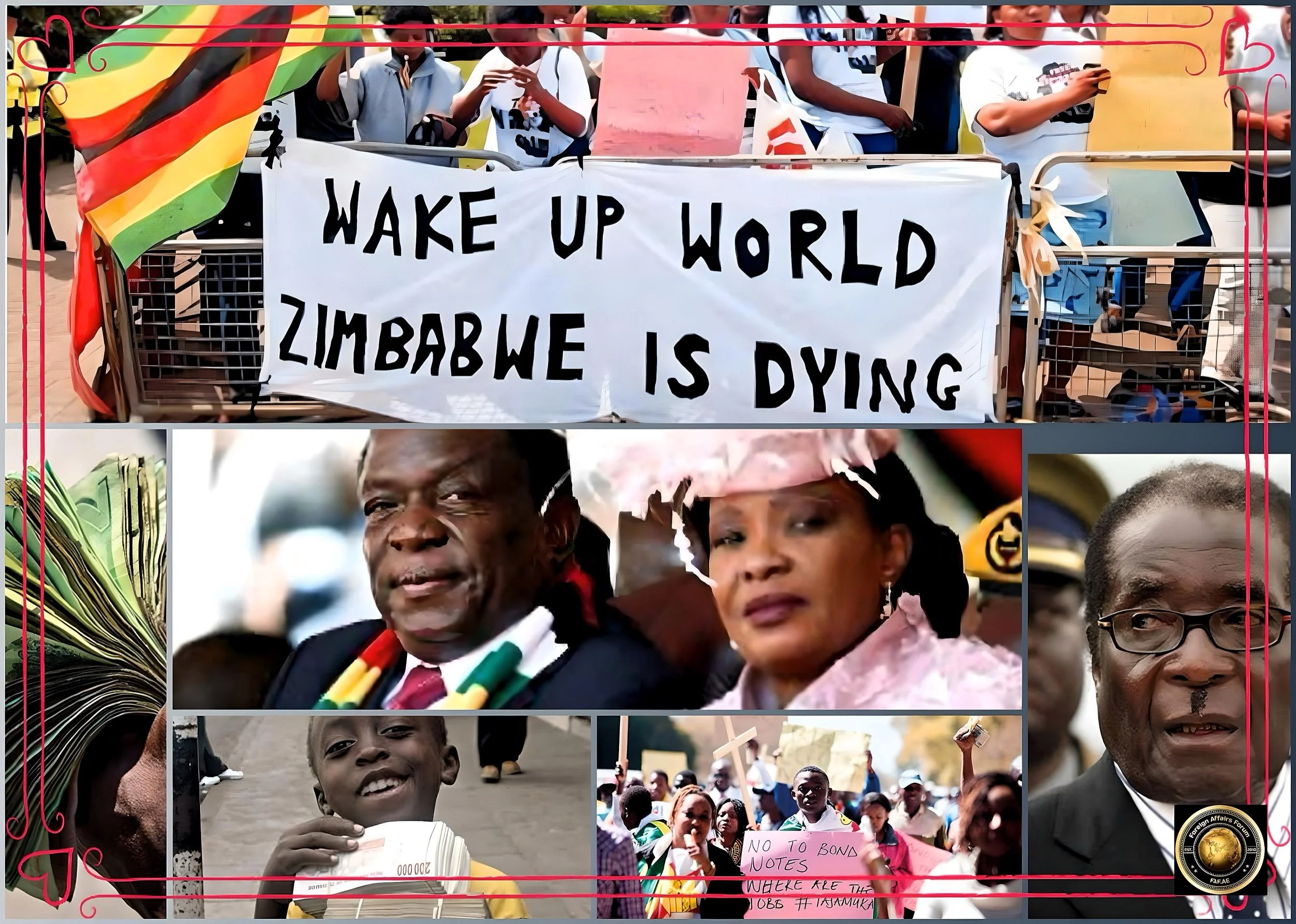
The March 31 protests marked Zimbabwe’s first mass demonstration since 2019, with citizens participating in a nationwide “stayaway” that shut down schools, public transport, and businesses nationwide.
Despite calls for street protests by Blessed “Bombshell” Geza, a former ZANU-PF Central Committee member, most Zimbabweans chose to stay home rather than risk confrontation with heavily deployed security forces.
The government’s response was swift and severe.
Police arrested 98 protesters in Harare alone, with authorities using tear gas to disperse demonstrators who had gathered at Freedom Square and later barricaded key intersections.
The Zimbabwe Peace Project documented over 1,000 people who experienced violations of their rights to freedom of assembly and association in connection with the protests, including 14 severe assault cases.
The crackdown extended beyond physical force to include systematic intimidation and surveillance. Security forces were deployed preemptively to intimidate citizens and arrest activists, while online spaces were policed to silence dissent.
Journalist Blessed Mhlanga was arrested and denied bail twice for broadcasting interviews with Geza, demonstrating the government’s determination to control the narrative.
The Constitutional Crisis: Mnangagwa’s Power Play
At the heart of the current crisis lies Mnangagwa’s attempt to circumvent Zimbabwe’s constitution, which explicitly limits presidents to two five-year terms.
The 82-year-old president, whose second term is set to end in 2028, is pursuing what supporters call the “2030 agenda”—an extension of his current term that would provide time to amend constitutional term limits and enable a formal third term.
The ruling ZANU-PF party has openly declared its intention to initiate constitutional amendments. Justice Minister Ziyambi Ziyambi confirms the government’s readiness to proceed once lawmakers introduce the necessary bill.
The process requires publication of the bill, a 90-day public debate period, a two-thirds parliamentary majority, and ultimately a referendum—a complex procedure that opposition leaders argue will be difficult to complete before 2028.
However, the constitutional amendment process faces significant obstacles.
While ZANU-PF holds a two-thirds majority in parliament, opposition leader Douglas Mwonzora has indicated that multiple referendums may be required, and his Movement for Democratic Change party will campaign vigorously against any extension.
The legal complexity of the process, combined with growing political opposition, makes success far from guaranteed.
The War Veterans’ Revolt: Fracturing ZANU-PF’s Foundation
Perhaps most significantly, the 2030 agenda has triggered an unprecedented split within ZANU-PF itself, particularly among the war veterans who have long served as the party’s enforcement arm and ideological backbone.
These aging guerrilla fighters, who helped end white minority rule in 1980, have historically provided ZANU-PF with both legitimacy and muscle for political control.
Blessed Geza, the primary organizer of the March 31 protests, represents a faction of war veterans who have turned against Mnangagwa.
Geza, expelled from ZANU-PF in March for “fanning factionalism,” has hidden while using social media platforms to mobilize opposition to the president.
His background as a liberation war veteran and former Central Committee member gives his rebellion particular potency within ZANU-PF’s power structure.
The war veterans’ influence extends deep into Zimbabwe’s security apparatus, with many occupying key military and intelligence services positions.
Their historical role in enforcing ZANU-PF rule through various means, including political violence, makes their defection particularly threatening Mnangagwa’s authority.
Recent tensions have emerged over the government’s attempt to restructure the Zimbabwe National Liberation War Veterans Association, with veterans expressing concern that ZANU-PF is trying to weaken their independent capacity to advocate for their interests.
The Chiwenga Factor: A Dangerous Rivalry
Adding another layer of complexity is the growing tension between Mnangagwa and Vice President Constantino Chiwenga, his former ally in the 2017 coup that ousted Robert Mugabe.
Chiwenga, a former army general who played a crucial role in Mnangagwa’s rise to power, reportedly expected to be passed the presidential baton in 2028 as part of their original power-sharing arrangement.
Chiwenga has emerged as a prominent opponent of the 2030 agenda, refusing to chant slogans supporting Mnangagwa’s term extension and publicly denouncing corruption.
His criticism appears targeted at controversial business people like Wicknell Chivayo, who has benefited from lucrative government contracts, including a $100 million Zimbabwe Electoral Commission deal with allegedly inflated invoices of 30,000%.
The Mnangagwa-Chiwenga rivalry is perilous given both men’s deep connections to Zimbabwe’s security establishment.
Their relationship, forged through decades of involvement in state security and political manipulation, has now devolved into what analysts describe as a “bitter succession battle” that threatens to destabilize the entire power structure they once controlled together.
Civil Society Under Siege
The political crisis unfolds against a systematic assault on civil society and democratic institutions.
In April 2025, Mnangagwa signed the Private Voluntary Organizations (PVO) Amendment Act, which significantly restricts rights to freedom of association and expression.
The law grants the government sweeping powers to suspend NGO executive committees and forbids organizations from supporting or opposing political parties.
The European Union responded to this crackdown by suspending 2025 funding originally intended to support good governance initiatives in Zimbabwe.
In 2023 alone, the government used previous PVO legislation to deregister 291 organizations, demonstrating the systematic nature of the assault on civil society.
However, there has been some legal pushback, with the High Court striking down provisions of the Patriotic Act in June 2025, ruling that sections criminalizing criticism of the government were unconstitutional.
Opposition in Disarray
The crisis occurred when Zimbabwe’s political opposition was particularly weak and fragmented.
The main opposition Citizens Coalition for Change (CCC) has been devastated by internal divisions and what leader Nelson Chamisa described as systematic infiltration by ZANU-PF agents.
Chamisa resigned from the party leadership in January 2024, leaving the opposition without effective coordination at a critical moment.
The CCC’s parliamentary presence has been systematically eroded through a controversial recall process initiated by Sengezo Tshabangu, who claimed to be the party’s interim secretary-general.
Despite being labeled a “fake” by Chamisa, Tshabangu successfully engineered the removal of numerous opposition MPs and councillors, potentially helping ZANU-PF regain the two-thirds parliamentary majority needed for constitutional amendments.
Economic Dimensions of the Crisis
Zimbabwe’s political upheaval occurs against a complex economic backdrop that contributes to and could be severely affected by political instability.
The country’s economy is projected to grow by 6% in 2025, recovering from the 2% growth rate in 2024, which was severely impacted by El Niño-induced drought.
However, significant macroeconomic vulnerabilities persist.
The introduction of the Zimbabwe Gold (ZiG) currency in April 2024 was followed by significant devaluation in September, contributing to inflation spikes and ongoing exchange rate pressures.
Fiscal pressures have intensified due to higher public sector wages, capital spending for hosting a SADC summit, and debt servicing costs.
The mining sector, which contributes 60% of total export revenues, remains a bright spot with strong gold prices and new lithium investments.
However, the broader economy continues to face power shortages due to drought-related impacts on hydroelectric generation, limiting industrial growth and formal sector development.
Regional and International Implications
The crisis in Zimbabwe has significant implications beyond its borders, particularly for regional stability and economic integration. Zimbabwe’s strategic position in Southern Africa and its role in regional organizations like SADC make political instability a concern for neighboring countries.
The country’s commodity markets and mining sector are increasingly integrated into regional value chains, which means that a prolonged political crisis could disrupt broader economic networks.
Migration flows represent another critical dimension. Zimbabwe continues to experience negative net migration, with approximately 60,528 people leaving the country in 2024.
Political instability and economic uncertainty could accelerate these outflows, placing additional pressure on neighboring countries, particularly South Africa, which has historically absorbed large numbers of Zimbabwean migrants.
The Perfect Storm
Converging Threats
The current crisis represents what can accurately be described as a “perfect storm” of converging threats to Zimbabwe’s stability.
The combination of Mnangagwa’s constitutional overreach, the fracturing of ZANU-PF’s core support base among war veterans, the dangerous rivalry with Chiwenga, the systematic assault on civil society, and the weakness of the political opposition creates unprecedented risks.
Previous political crises in Zimbabwe have typically involved conflicts between the ruling party and external opposition.
The current situation is fundamentally different because it involves fractures within ZANU-PF itself, particularly among the security-connected elites traditionally serving as the system’s enforcers.
When the dividing line between party and state is already nebulous, such internal divisions create the potential for either state paralysis due to competing factions or significant outbreaks of violence.
Potential Scenarios and Consequences
The trajectories emerging from this crisis could range from continued authoritarian consolidation to system collapse.
If Mnangagwa successfully navigates the constitutional amendment process and overcomes internal opposition, Zimbabwe could witness the entrenchment of increasingly authoritarian rule.
However, the fractures within ZANU-PF and the military establishment make this outcome far from certain.
Alternative scenarios include a military intervention similar to the 2017 coup, potentially led by Chiwenga and his allies among the war veterans. Such an outcome would likely involve significant violence and could plunge the country into extended instability.
The precedent of 2017, when the military intervened to remove Mugabe, demonstrates that Zimbabwe’s security forces are willing to act when elite consensus breaks down.
A third possibility involves gradual state paralysis as competing factions within ZANU-PF cannot govern effectively.
This scenario could lead to economic collapse, humanitarian crisis, and regional spillover effects.
The combination of political instability, economic vulnerability, and social tension creates widespread hardship and potentially large-scale population displacement.
Conclusion
The End of an Era?
The crisis may well mark the end of the hope accompanying Mugabe’s removal in 2017.
Rather than representing a genuine democratic transition, the events of recent months suggest that Zimbabwe is entering a new chapter of ZANU-PF’s grip on power, characterized by even more desperate measures to maintain control.
The convergence of constitutional crisis, elite fragmentation, civil society repression, and economic vulnerability creates unprecedented risks for Zimbabwe’s future.
Whether the country emerges from this perfect storm with its institutions intact, or descends into deeper authoritarianism or open conflict, will depend mainly on how the competing factions within the ruling elite resolve their differences, and whether Zimbabwe’s beleaguered civil society and opposition can find ways to reassert democratic principles in an increasingly hostile environment.
The stakes extend well beyond Zimbabwe’s borders, with the outcome of this crisis potentially affecting regional stability, economic integration, and migration patterns.
As the situation continues to evolve, the international community faces difficult choices about how to respond to what appears to be the systematic dismantling of Zimbabwe’s remaining democratic institutions.