NextGenerationEU: Europe’s Ambitious Recovery and Transformation Program
Introduction
NextGenerationEU (NGEU) represents the European Union’s most ambitious and transformative economic initiative in recent history.
This groundbreaking program addresses pandemic recovery needs and aims to fundamentally reshape Europe’s economic and social landscape.
Below is a comprehensive analysis of this landmark initiative from FAF.
Origins and Purpose
NextGenerationEU was born out of necessity during one of Europe’s most challenging periods.
The program was created specifically to help repair the immediate economic and social damage brought about by the COVID-19 pandemic.
It represents a significant departure from the austerity policies adopted after the 2007-2008 financial crisis, offering a bold investment approach to stimulate recovery and growth instead.
The European Commission proposed this recovery package, which the European Council agreed upon in principle on July 21, 2020, following 90 hours of intense negotiations among EU leaders.
The program was formally adopted on December 14, 2020, setting in motion what would become the largest stimulus package the EU has ever undertaken.
Budget and Financial Structure
NextGenerationEU commands an impressive financial arsenal
Total allocation
€750 billion in 2018 prices (approximately €806.9 billion in current prices)
Funding structure
€390 billion in grants and €360 billion in loans
The funding is distributed through several mechanisms
Recovery and Resilience Facility (RRF)
€672.5 billion (€312.5 billion in grants, €360 billion in loans)
ReactEU
€47.5 billion for cohesion policy programs
Additional funding for other programs including Horizon Europe (€5 billion), InvestEU (€5.6 billion), and Rural Development (€15 billion)
This funding approach is revolutionary because the European Commission, on behalf of the EU, will borrow funds from the capital markets to finance the program.
The repayment is scheduled through 2058, demonstrating the long-term commitment to this transformational initiative.
Timeline and Implementation
NGEU operates within a clearly defined timeframe:
Operational period
2021 to 2026
Legal commitments must be made by December 31, 2023
All related payments must be completed by December 31, 2026
Key Focus Areas
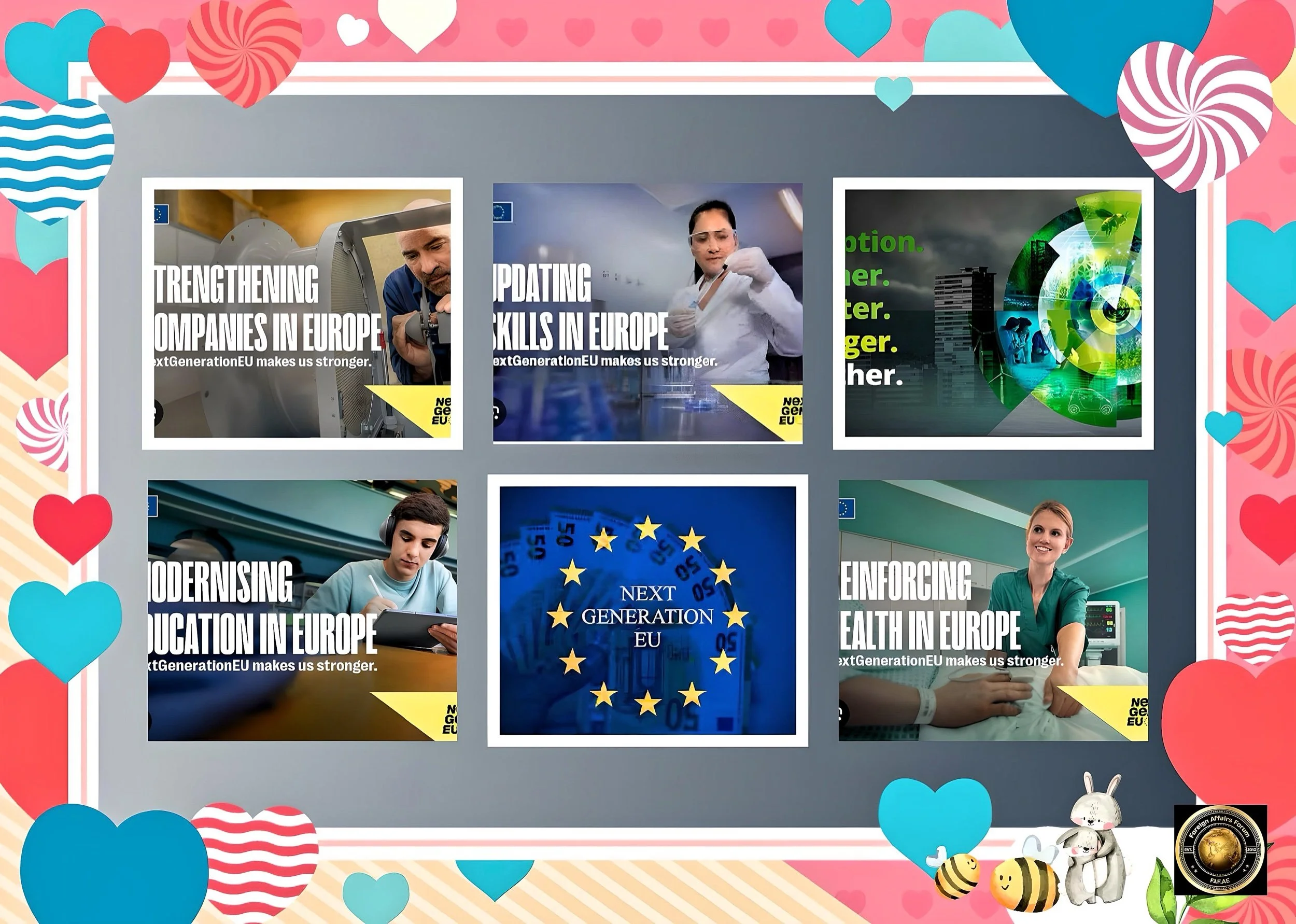
The program’s transformative vision is built around six pillars
Green Transition
37% of funds are earmarked for climate objectives, supporting Europe’s ambition to become the first climate-neutral continent by 2050
Digital Transformation
20% of the budget is dedicated to digitalization projects, aiming to boost Europe’s technological sovereignty and competitiveness
Social and Territorial Cohesion
Reducing disparities between regions and ensuring no one is left behind
Health and Economic Resilience
Strengthening healthcare systems and building economic buffers against future crises
Education and Skills Development
Supporting young people through education, training, and employment opportunities
Support for SMEs and Innovation
Assisting over 2.8 million businesses, tiny and medium enterprises that form the backbone of the European economy
Leadership and Governance
While the European Commission spearheads the initiative, the implementation follows a collaborative model:
European Commission President Ursula von der Leyen has been the program’s primary champion
The Commission provides the framework and financing mechanisms
Member states develop their own National Recovery and Resilience Plans (NRRPs) that the Commission must approve
Countries receive funding based on achieving pre-agreed milestones and reforms, ensuring accountability
This structure balances central coordination with national implementation flexibility, allowing each country to address its specific needs while pursuing common European objectives.
Impact and Results So Far
By May 2025, the program has already begun showing tangible results
€250 billion has been disbursed under the program, according to recent milestones reported by Ursula von der Leyen
Over 7.5 million young people have received support for education, training, and employment
More than 47 million people now have access to new or modernized healthcare facilities
9.8+ million people are better protected against natural disasters
Energy efficiency improvements resulting in 34 million MWh/year in primary energy consumption savings
Enhanced digital connectivity for over 14.7 million homes and buildings
The Vision for a Renewed Europe
NextGenerationEU represents more than just economic recovery- it embodies a vision for Europe’s future. The program aims to:
Create a more resilient Europe better equipped to face future challenges
Build a greener economy aligned with climate goals
Develop digital and technological sovereignty
Foster innovation and entrepreneurship
Strengthen social cohesion and reduce inequalities
Position Europe as a global leader in sustainable and inclusive growth
Conclusion
NextGenerationEU stands as a testament to European solidarity and vision during a crisis.
Far beyond a simple recovery mechanism, it represents a once-in-a-generation opportunity to transform the European economy and society.
By leveraging this massive investment to drive short-term recovery and long-term structural changes, the EU aims to emerge stronger, more resilient, and better positioned for future challenges.
As Ursula von der Leyen noted, “NextGenerationEU is much more than a recovery plan. It is a once-in-a-lifetime chance to design a Europe that works for everyone.”
The program’s success will ultimately be measured not only by economic indicators but also by its ability to create a more sustainable, equitable, and prosperous Europe for future generations.