The China-Trump Tariff War: Economic Impacts and Global Implications- Stock, Crypto and Gold markets reactions
Introduction
The recent escalation in trade tensions between China and the United States under President Donald Trump’s administration has sparked significant economic consequences across global markets.
As of April 9, 2025, the trade conflict has reached unprecedented levels with record-high tariffs imposed by both nations.
FAF report examines the current state of the China-Trump tariff war and analyzes its factual impacts on both economies, European markets, and various financial sectors.
Current State of the China-Trump Tariff War
The trade relationship between China and the United States has deteriorated dramatically in recent weeks, with both nations implementing punitive tariffs at historically high levels.
On April 9, 2025, President Trump’s 104% tariff on Chinese goods came into effect, representing a massive escalation in trade tensions. In direct retaliation, China announced an increase in its tariffs on US goods from 34% to 84%, scheduled to take effect on April 10, 2025.
This latest exchange marks the most severe phase of trade hostilities between the world’s two largest economies.
The Chinese Ministry of Finance characterized the US approach as “a mistake compounded by another mistake,” which significantly undermines China’s interests and disrupts the established rules-based multilateral trading system.
Meanwhile, the Trump administration has defended its actions, claiming that persistent US trade deficits have hollowed out the manufacturing base and undermined critical supply chains.
Chronology of Recent Tariff Escalations
The current crisis has unfolded rapidly
April 2, 2025: President Trump announced a comprehensive tariff policy, declaring a “national emergency” under the International Emergency Economic Powers Act of 1977.
April 5, 2025: A baseline 10% tariff on all imports entering the US took effect.
April 8, 2025: The US government announced an increase in tariffs on Chinese goods from 34% to 84%.
April 9, 2025: Country-specific “reciprocal” tariffs on approximately 60 nations came into effect, including the 104% levy on Chinese imports.
April 10, 2025 (scheduled): China’s retaliatory 84% tariff on US goods will take effect.
This rapid-fire exchange of tariff measures has created significant market uncertainty and prompted urgent diplomatic activity, with several nations sending delegations to Washington to negotiate exceptions or reductions.
Economic Impacts on the United States
Inflation and Consumer Prices
The implementation of all 2025 tariffs has dramatically affected US price levels.
According to research from Yale University’s Budget Lab, the average effective US tariff rate after incorporating all 2025 tariffs has reached 22.5%, the highest since 1909. The immediate impact on consumer prices has been substantial:
The aggregate price level from all 2025 tariffs is projected to rise by 2.3% in the short-run.
This translates to an average per household consumer loss of $3,800 in 2024 dollars.
Households at the bottom of the income distribution face annual losses of $1,700.
Specific sectors show disproportionate price increases, with apparel prices rising 17% under all tariffs.
Food prices are projected to increase by 2.8%, with fresh produce rising by 4.0%.
Motor vehicle prices have increased by approximately 8.4%, equivalent to an additional $4,000 to the price of an average 2024 new car.
These price increases are already affecting consumer behavior, with reports of Americans stockpiling goods in anticipation of further inflation.
Thomas Jennings, a 53-year-old shopper, told Reuters he’s “purchasing double of everything - beans, canned items, flour, you name it” before prices rise further.
GDP and Economic Growth
The tariffs have significantly dampened economic growth prospects for the United States:
Real GDP growth is projected to be 0.9 percentage points lower in calendar year 2025 from all tariffs implemented to date.
In the long run, the US economy is expected to be persistently 0.6% smaller, equivalent to $160 billion in 2024 dollars annually.
US exports specifically are projected to be 18.1% lower in the long run under all tariff actions.
The tariffs are estimated to raise $3.1 trillion over 2026-35 conventionally-scored, but this is offset by $582 billion in negative dynamic revenue effects.
The probability of a recession has increased substantially, with JPMorgan raising the chances of a US recession this year from 40% to 60%, while Goldman Sachs elevated its recession forecast to 45% from 35%.
Employment and Household Income
Former Treasury Secretary Lawrence Summers has issued stark warnings about potential job losses:
The US is “more likely than not” to experience a recession that could claim 2 million jobs nationwide.
Average American families could lose upward of $5,000 in household income.
The tariff burden is disproportionately affecting lower-income households, with the impact on the second income decile being 2.5 times that of the top decile (-4.0% versus -1.6%).
Stock Market Performance
US financial markets have reacted severely to the tariff announcements:
The Dow Jones Industrial Average suffered consecutive losses exceeding 1,500 points for the first time in history, with a staggering drop of 2,231 points recorded on Friday, April 4.
The S&P 500 experienced its largest single-day decline since March 2020 and is nearing bear market territory, defined as a drop of at least 20% from its recent peak.
The S&P 500 has lost almost $6 trillion in market value since the tariffs were announced just a week ago, marking the steepest four-day decline since the index’s inception in the 1950s.
The tech-focused Nasdaq has officially entered bear market status.
US Government Debt and Bond Market
The tariff situation has created unusual instability in typically stable US government debt markets:
Investors are selling off US government bonds due to concerns about the economic impact of tariffs.
The yield on US 10-year bonds reached 4.5% on Wednesday, April 9, the highest since February, resulting in increased borrowing costs for the United States.
Some experts suggest the Federal Reserve may need to intervene with emergency purchases of US Treasuries to stabilize the bond market.
George Saravelos, global head of FX research at Deutsche Bank, noted that the bond market indicates investors have “lost faith in US assets”.
Safe Haven Assets: Gold and Cryptocurrency Performance
Gold Prices
Gold has functioned as a traditional safe haven during this market turmoil:
Gold prices have continued to rise, reaching $3,131.25 per ounce.
Gold has surged 18% year-to-date, cementing its status as a preferred safe-haven asset amid uncertainty.
Experts suggest gold prices could potentially reach $3,300 in the upcoming months due to safe-haven purchasing driven by geopolitical uncertainties.
Cryptocurrency Market
The cryptocurrency market has shown a mixed response to the trade tensions:
Bitcoin’s price has declined from almost $110,000 earlier in 2025 to $84,327 as of April 4, 2025.
The cryptocurrency has entered a bearish channel with resistance at $87,000 and $92,000.
Some experts suggest Bitcoin could eventually emerge as a viable alternative to traditional safe havens like gold.
Zach Pandl, Head of Research at Grayscale, believes that “Tariffs will weaken the dominant role of the dollar and create space for competitors including Bitcoin”.
Economic Impacts on China
Export and Manufacturing Impacts
The tariffs pose significant challenges to China’s export-driven economy
Tariffs upwards of 35% will wipe out all profits that Chinese businesses make when exporting to the US or South East Asia.
Growth is expected to be much lower since exports contributed between 20% to 50% of China’s growth since the COVID pandemic.
Chinese companies are scrambling to adjust supply chains, but with most countries affected by Trump’s tariffs, firms report difficulty finding alternatives.
The Chinese logistics sector is already experiencing disruptions, with reports of declining freight volume and halted construction projects in countries like Cambodia where Chinese businesses have relocated.
Countermeasures and Strategy
China has implemented several measures to respond to US tariffs:
The 84% retaliatory tariff on US goods demonstrates China’s commitment to “fight to the end” against US tariffs.
China has prohibited several American firms from operating in China and halted chicken imports from major US agricultural exporters.
The Chinese government has called for global unity against Trump’s tariffs, attempting to build alliances with Japan, South Korea, and other Asian economies.
China's central bank asks state lenders to reduce dollar purchases.
China has left the door open for negotiations but has set preconditions, including addressing trade and tariff issues before agreeing to deals on other matters, such as the proposed TikTok sale.
Currency Effects
The tariff war has impacted China’s currency management:
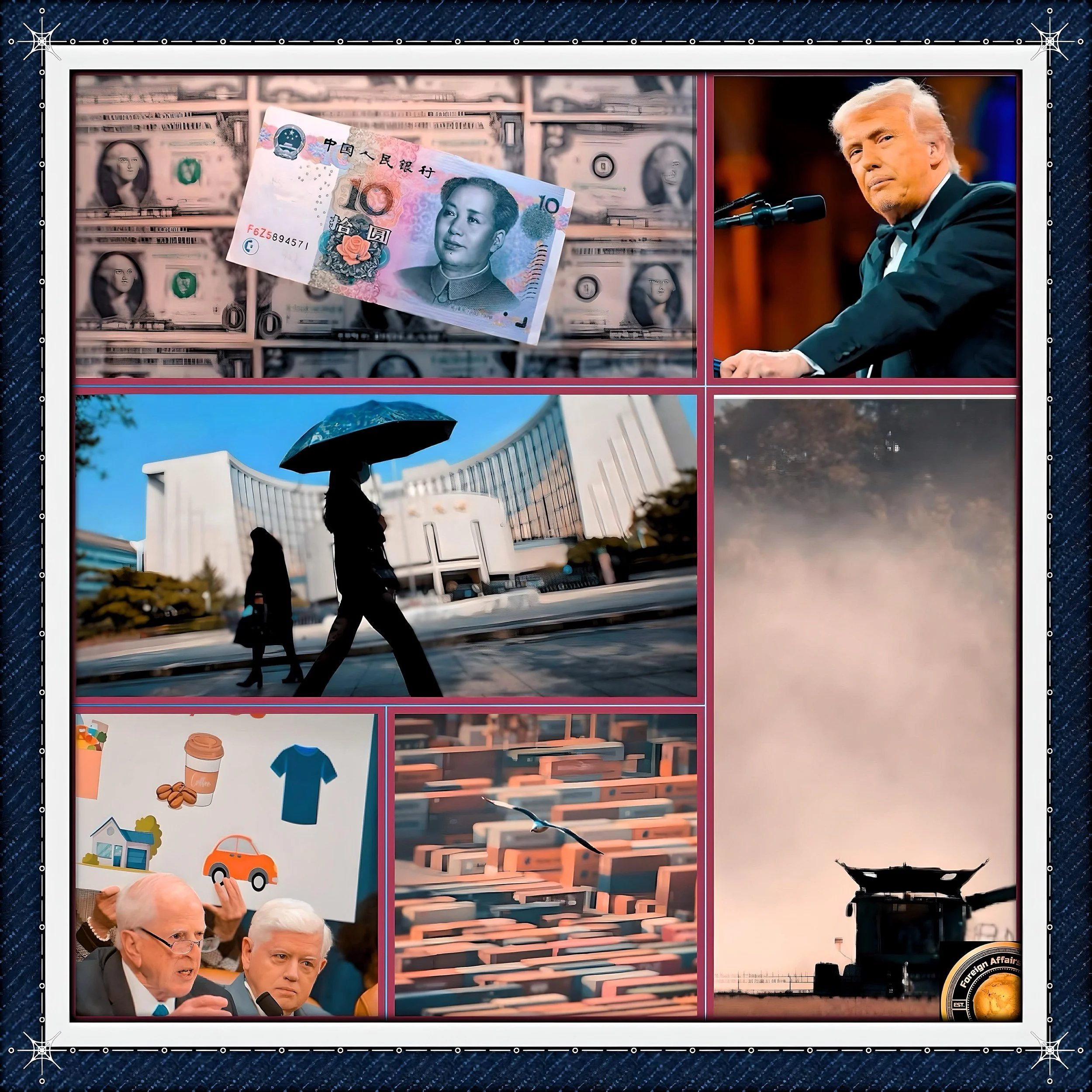
The People’s Bank of China (PBOC) has weakened the Yuan fixing against the US dollar for five consecutive sessions.
The USD/CNY pair rose to 7.35, a level not seen since September 2023.
Analysts expect the central bank to weaken the Yuan gradually to avoid disorderly movements that could trigger capital outflows.
Effects on European Markets
Stock Market Performance
European financial markets have been severely impacted by the escalating trade tensions:
As of April 9, 2025, at 11:00 CET, the Euro STOXX 50 was down 2.54%.
The broader STOXX 600 fell 2.96%.
France’s CAC 40 declined 2.53%.
Germany’s DAX dropped 2.99%.
London’s FTSE 100 declined 2.55%.
European automobile manufacturers were particularly affected, with Volkswagen AG shares falling 1.06%, Mercedes-Benz Group AG down 1.31%, and Ferrari N.V. losing 1.06%.
EU Trade Response
The European Union has responded assertively to US tariffs:
The EU implemented its initial retaliatory measures against President Trump’s tariff actions on Wednesday, April 9.
These measures target over 20 billion euros worth of US goods including soybeans, motorcycles, and beauty products.
The EU tariffs will be implemented in three stages: some will go into effect in mid-April, another list will be imposed in mid-May, and a third is scheduled to start on December 1.
US imports affected include corn, wheat, rice, motorcycles, fruits, wood, apparel, and dental floss.
The 27-member bloc is currently dealing with 25% tariffs on steel, aluminum, and vehicles, alongside new overarching tariffs of 20% that are applicable to a majority of other products.
Global Implications and Future Outlook
The escalating trade war has significant implications for the global economy:
The sweeping nature of Trump’s tariffs, affecting not just China but nearly all trading partners, has disrupted global supply chains and trading relationships established over decades.
South Korea unveiled a US$2 billion emergency package to support its carmakers in response to Trump’s 25% tariffs on automobiles.
The tariffs have sparked concerns about a global recession, with economists warning that the impacts could spread beyond directly affected countries.
Financial markets globally have experienced significant volatility, with Asian markets such as Hong Kong’s Hang Seng Index, Japan’s Nikkei 225, and South Korea’s Kospi all recording substantial losses.
Several countries are attempting to negotiate with the Trump administration to mitigate the tariff impacts
South Korea and Japan are sending delegations to Washington for trade discussions.
Vietnam’s deputy prime minister is scheduled to meet with Trump’s Treasury Secretary Scott Bessent.
Italian Prime Minister Giorgia Meloni is slated to visit Washington next week.
Conclusion
The China-Trump tariff war has rapidly escalated to unprecedented levels, creating significant economic disruption across global markets.
The United States faces rising inflation, reduced economic growth, potential job losses, and severe market volatility.
China confronts challenges to its export-driven economy and is implementing both retaliatory measures and strategic adaptations.
European markets have been caught in the crossfire, experiencing market declines and implementing their own retaliatory tariffs.
The long-term impacts remain uncertain, but the immediate effects have already proven substantial.
If the trade tensions persist or escalate further, economists warn of potential recessions, continued market turbulence, and lasting damage to the global trading system.
The coming weeks will be critical as negotiations unfold and markets adjust to this new and volatile trade environment.