China’s Strategic Resolve in the U.S.-China Trade War: An Analysis of Beijing’s Unyielding Stance
Introduction
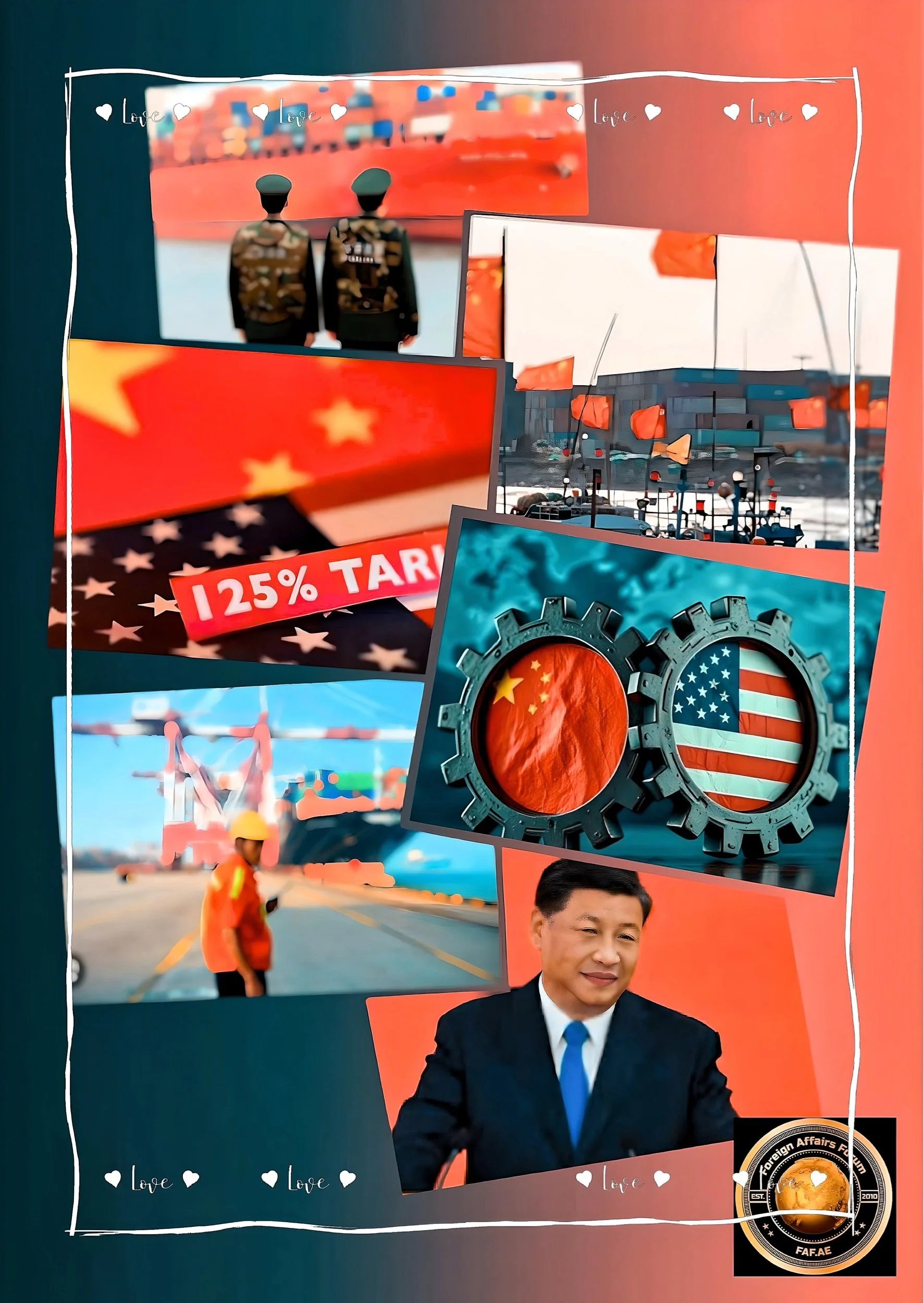
The U.S.-China trade war reignited in 2025 with reciprocal tariff escalations exceeding 125% on both sides, and it has become a defining test of geopolitical and economic endurance.
Despite significant economic vulnerabilities, China has refused to concede, driven by political calculus, strategic preparation, and ideological framing.
FAF examines the multifaceted reasons behind Beijing’s steadfast position, drawing on recent developments and expert analyses to unravel the motivations shaping China’s defiance.
Political Survival and Nationalist Mobilization
Xi Jinping’s Consolidation of Power
China’s refusal to back down is inextricably linked to Xi Jinping’s political strategy. Having abolished presidential term limits and centralized authority, Xi has positioned himself as the paramount leader of the Communist Party, requiring a posture of unwavering strength to maintain legitimacy.
Any perceived capitulation to U.S. demands would risk inflaming internal criticism from party hardliners, who view compromise with the U.S. as a betrayal of China’s rise.
China expert Gordon Chang noted that Xi has “configured the Chinese political system in such a way that only the most hostile responses are considered acceptable.”
This political entrenchment leaves little room for diplomatic flexibility, as concessions could undermine Xi’s carefully cultivated image of invincibility.
Nationalist Rhetoric as a Unifying Force
The Chinese government has weaponized nationalist sentiment to frame the trade war as a patriotic struggle against U.S. hegemony.
State media outlets like People’s Daily have compared U.S. actions to “a gang of pirates,” while diplomats emphasize China’s historical resilience, invoking Mao Zedong’s defiance during the Korean War.
Beijing redirects domestic frustrations over economic slowdowns and unemployment toward an external adversary by casting the conflict as a defense of national sovereignty.
This narrative has gained traction on social media, where seven of the top ten trending topics in early April 2025 focused on tariffs. Users overwhelmingly endorse a “fight to the end.”
Such rhetoric consolidates public support and justifies the CCP’s authoritarian measures as necessary for national survival.
Economic Preparations and Strategic Endurance
Reducing Dependency on the U.S. Market
Over the past decade, China has systematically reduced its reliance on U.S. exports, lowering the share of U.S.-bound exports from 20% in 2018 to 13% in 2025.
This diversification strategy includes relocating manufacturing to Southeast Asia, expanding trade with RCEP partners, and investing in domestic innovation sectors like semiconductors and AI.
While the U.S. remains a critical market, these efforts have mitigated the immediate impact of tariffs.
For instance, Chinese manufacturers absorbed 75–81% of tariff costs during the 2018 trade war, a tactic now being replicated through state subsidies to exporters.
As economist Zwei Zhang noted, Beijing views further tariff hikes beyond 125% as “pointless” because they would render U.S. imports economically irrelevant in China.
Fiscal and Monetary Leverage
Beijing retains significant tools to cushion the trade war’s domestic impact. The government has signaled readiness to deploy fiscal stimulus, including tax cuts for affected industries and increased infrastructure spending. At the same time, the People’s Bank of China could further lower interest rates or allow yuan depreciation to boost export competitiveness.
State-backed entities like Chengtong and Huijin have already intervened to stabilize stock markets, contributing to the Shanghai Composite’s 1.1% gain amid global declines. Such measures reflect Premier Li Qiang’s assertion that China is “fully capable of hedging against adverse external influences.”
Strategic Patience and Asymmetric Pressures
Exploiting U.S. Political Vulnerabilities
Chinese leadership perceives Trump’s tariff strategy as politically unsustainable due to impending U.S. elections and inflationary pressures.
Unlike Xi, who faces no electoral constraints, Trump must balance trade aggression with voter concerns over rising consumer prices.
Treasury Secretary Scott Bessent acknowledged that U.S. tariffs could disrupt supply chains for critical goods like smartphones and pharmaceuticals, constituting 9% of U.S. imports from China.
Beijing calculates that American households, already grappling with a 20% tariff-induced price hike on Chinese goods, will pressure Trump to de-escalate before the 2026 midterms.
Long-Term Vision of a Post-U.S. Order
China’s defiance is rooted in a broader ambition to reshape the global economic architecture.
By positioning itself as a defender of multilateralism, Beijing seeks to isolate the U.S. and accelerate the transition to “globalization minus the U.S..” Diplomatic outreach to the EU, ASEAN, and Latin America aims to cement alternative trade blocs and reduce reliance on dollar-denominated exchanges.
During his meeting with Spain’s Prime Minister Pedro Sánchez, Xi stated that China’s development has been built on “self-sufficiency and diligence,” not external assistance.
This vision aligns with the CCP’s narrative of inevitable Chinese ascendancy, framing the trade war as a temporary obstacle in a century-long march toward dominance.
Diplomatic Maneuvering and Global Alliances
Countering Isolation Through Partnerships
While Trump’s 90-day tariff pause for other nations initially isolated China, Beijing has responded with a diplomatic offensive.
Xi’s upcoming visits to Vietnam, Malaysia, and Cambodia aim to reinforce regional supply chains disrupted by U.S. tariffs. At the same time, Premier Li’s talks with EU officials emphasize collaboration in renewables and smart infrastructure.
Although European allies like Germany remain cautious, China’s offer to expand market access for Airbus and luxury goods has created fissures in transatlantic unity.
These efforts portray the U.S. as a rogue actor destabilizing the WTO-led system, a framing reinforced by China’s ambassador to New Zealand, who labeled U.S. tariffs “unilateral and protectionist.”
Leveraging Economic Interdependence
China’s retaliatory measures extend beyond tariffs, including export controls on rare earth metals and anti-monopoly investigations against U.S. firms.
By targeting sectors where the U.S. lacks self-sufficiency—such as gallium and germanium for semiconductor production—Beijing underscores the mutual destructiveness of decoupling.
Simultaneously, China’s vast holdings of U.S. Treasury bonds ($1.1 trillion as of 2024) provide latent leverage, though weaponizing this would risk destabilizing the yuan.
Conclusion: A Calculated Gamble with Global Repercussions
China’s refusal to back down stems from ideological conviction, strategic preparation, and confidence in its political system’s resilience.
While economists warn of a potential 2.4% GDP contraction and 10–20 million job losses in export sectors, Beijing bets that its centralized governance and control over public discourse can outlast U.S. political cycles.
However, this stance risks exacerbating domestic economic strains, particularly if the property market crisis and youth unemployment worsen.
The trade war’s ultimate legacy may lie in accelerating global economic fragmentation. As the U.S. and China cement rival blocs, nations like India and Vietnam face both peril and opportunity, navigating a reshaped landscape where supply chain loyalty replaces free trade principles.
For Xi Jinping, the conflict is not merely about tariffs but about affirming China’s place as a co-equal superpower—a goal for which short-term economic pain is deemed an acceptable cost.