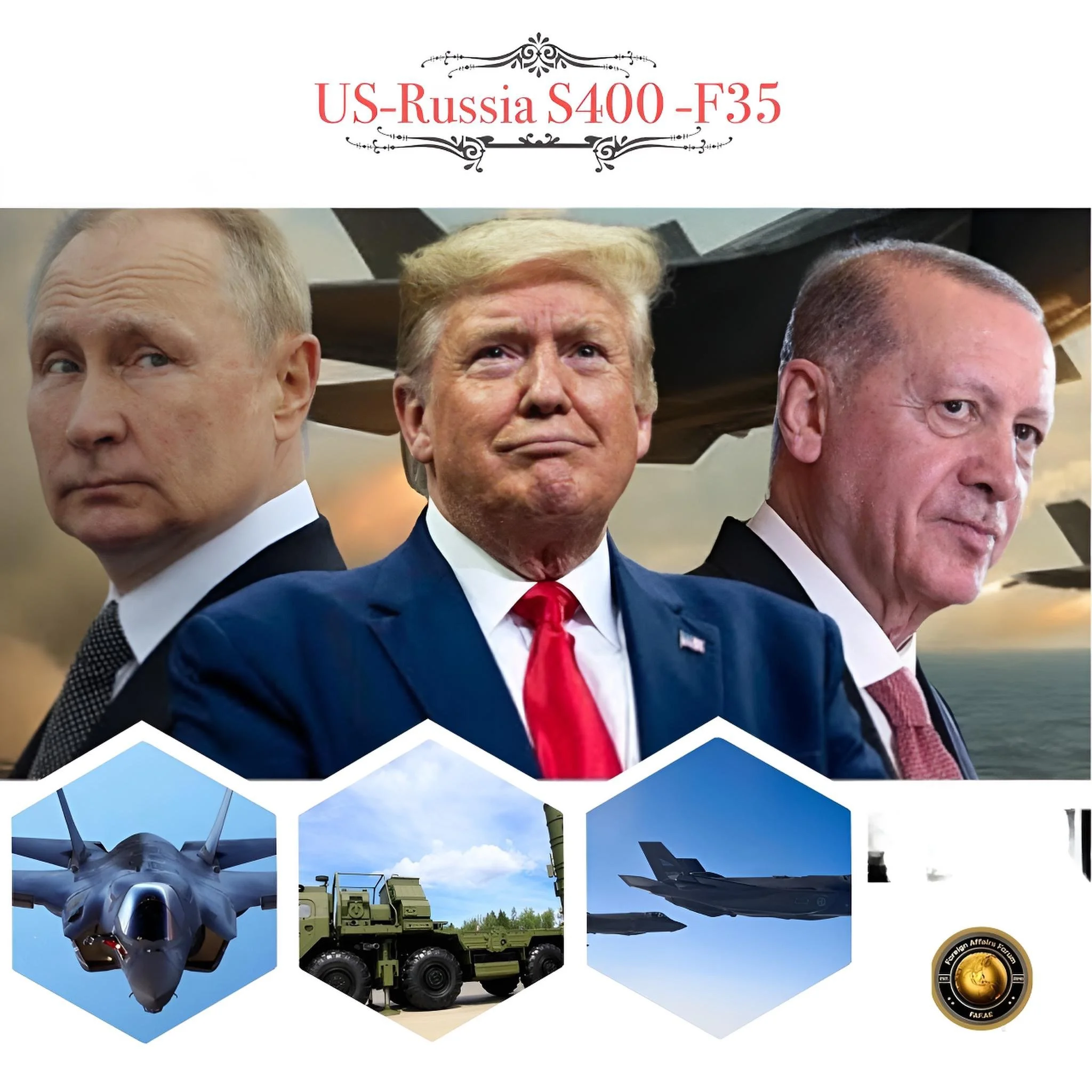
Executive Strategic Overview: The Great Recalibration — Turkey-US Russian S-400 and US F-35 looming dispute
Executive Summary
The Great Recalibration
The Pivot: A significant diplomatic breakthrough is imminent in the six-year standoff between Washington and Ankara, marking a decisive recalibration of Turkey’s strategic posture. Driven by a rapidly widening “qualitative gap” in air superiority vis-à-vis Greece—which has successfully secured F-35 capabilities—Turkey is pivoting away from its “strategic autonomy” experiment with Russian defense systems.
The proposed resolution, the “Incirlik Model,” involves sequestering Turkey’s $2.5 billion S-400 batteries under US supervision at Incirlik Air Base.
This compromise satisfies strict US legal requirements for re-entry into the F-35 Joint Strike Fighter program while allowing Ankara to avoid the domestic humiliation of formally destroying the assets or returning them to Russia.
The Implications: This realignment effectively neutralizes the S-400 as a geopolitical irritant, acknowledging its failure as a standalone defense asset isolated from NATO’s integrated architecture.
However, the move carries significant risk: Moscow has invoked “End User Certificate” violations, signaling potential asymmetric retaliation in energy (Akkuyu Nuclear Plant) or regional security theaters (Syria).
Nevertheless, Ankara views these risks as subordinate to the existential necessity of acquiring 5th-generation stealth capabilities.
By trading a localized Russian missile system for participation in the premier Western fighter program, Turkey is prioritizing long-term NATO interoperability and industrial revitalization over its increasingly fragile partnership with the Kremlin.
Introduction
After a six-year diplomatic freeze that severed Turkey from the Western defense industrial base, Ankara and Washington are engineering a significant strategic pivot.
The emerging resolution to the S-400 impasse—centered on the sequestration of Russian-made batteries under US supervision—represents a pragmatic calculation by the Turkish leadership.
Confronted with the obsolescence of its air force and the accelerating military modernization of its regional rival, Greece, Turkey is moving to liquidate the geopolitical liability of the S-400 in exchange for the existential necessity of 5th-generation air power.
This pivot effectively signals the end of Turkey’s experiment with “strategic autonomy” in air defense, acknowledging that the S-400, while technically formidable, is politically toxic and operationally isolated from the NATO architecture that guarantees Turkey’s long-term security.
The Geopolitical Catalyst: The “Qualitative Deficit” in the Aegean
The primary driver of this policy reversal is not diplomatic pressure, but hard power reality.
Turkey faces a rapidly widening “qualitative gap” in air superiority vis-à-vis Greece, which threatens to upend the balance of power in the Eastern Mediterranean.
The Greek Modernization Surge
While Turkey languished under CAATSA sanctions, Athens aggressively capitalized on its status as a reliable NATO partner.
The Hellenic Air Force ( HAF ) has secured a trifecta of air superiority
The acquisition of French Rafale jets, the modernization of its F-16 fleet to the Viper (Block 70/72) standard, and crucial approval for 20+ F-35 stealth fighters.
Turkey’s Capability Cliff
Conversely, the Turkish Air Force operates an aging fleet of F-16s and F-4 Phantoms. The indigenous “KAAN” fighter program, while ambitious, remains years away from mass production and operational capability.
Without the F-35, Turkey faces a future where its airspace is defended by 4th-generation platforms against a neighbor equipped with 5th-generation stealth capabilities—an untenable vulnerability for a regional power.
The Operational Paradox: The Ineffectiveness of a Standalone S-400
Strategic analysis reveals that the S-400 system became a “sunk cost” trap.
While purchased to demonstrate sovereignty, its utility was severely compromised by its incompatibility with NATO infrastructure.
The “Paper Weight” Dilemma
To function effectively, modern air defense requires integration with a broader network of radar and command-and-control systems (Link 16).
Because the S-400 cannot communicate with NATO systems without compromising them, it was forced to operate in isolation (“standalone mode”).
This reduced a premier area-denial weapon to a localized, tactical asset with limited situational awareness.
The Industrial Penalty: The economic opportunity cost of the S-400 purchase has been staggering.
By being expelled from the F-35 consortium, Turkey forfeited not only 100 advanced jets but also its lucrative position in the supply chain.
The Turkish defense sector lost contracts to manufacture approximately 900 distinct components—from fuselage sections to landing gear—costing the economy billions in potential revenue and technology transfers.
The Diplomatic Mechanism: The “Incirlik Model”
To resolve the impasse, diplomats have likely coalesced around a solution that prioritizes legal compliance over political humiliation.
This framework, tentatively identified as the “Incirlik Model,” threads the needle between US sanctions law and Turkish domestic messaging.
Strategic Sequestration
Rather than returning the batteries to Russia (an explicit insult to Putin) or destroying them (a waste of capital), Turkey would transfer the S-400 assets to the US-controlled sector of Incirlik Air Base.
Sovereignty vs. Control
This arrangement satisfies the Pentagon’s strict requirement for “security and custody”—ensuring the sensors cannot map F-35 radar signatures—while allowing Ankara to maintain the legal fiction that the assets remain on Turkish soil under Turkish ownership.
It effectively places the system in a “geopolitical escrow,” neutralizing the threat without formally relinquishing title.
Risk Assessment: The Russian Vector and Legal “Lawfare”
The gravest external risk to this resolution comes from Moscow.
The Kremlin views the “Incirlik Model” not merely as a commercial contract dispute, but as a hostile realignment of Turkey’s strategic posture.
The End User Certificate (EUC) Trap
Russia has mobilized international contract law as a weapon.
Foreign Minister Sergey Lavrov has invoked the EUC clause of the 2017 sale, which strictly prohibits the transfer of the system to any third party without Russian consent.
Moscow contends that placing the system under US custody—even if nominally Turkish-owned—constitutes a material breach of this contract.
Asymmetric Retaliation
Beyond legal rhetoric, Russia possesses significant leverage. Intelligence estimates suggest Moscow could retaliate asymmetrically:
Energy Coercion
Complications could arise regarding the Russian-built Akkuyu Nuclear Power Plant, which supplies a significant portion of Turkey’s energy grid.
Syrian landscape
Russia could withdraw tacit support for Turkish operations in Northern Syria, exposing Turkish troops to attacks by regime forces or Kurdish militias.
Legislative Hurdles: The View from Capitol Hill
Despite executive optimism regarding a “bromance” between leadership, the US Congress remains a formidable barrier.
The Senate Foreign Relations Committee, led by figures such as Senator Jim Risch, retains veto power over foreign arms sales.
The “Activation” Red Line
Recent comments by Turkish Defense Minister Yaşar Güler that the S-400s “could be activated within 12 hours” were intended for domestic consumption but were received poorly in Washington.
For Congress to lift the CAATSA sanctions, the deactivation of the S-400 must be verified, permanent, and irreversible.
Broader Conditionality
Lawmakers may use the F-35 leverage to extract concessions on extraneous issues, including Turkey’s maritime disputes with Cyprus and its stance on Hamas, complicating the timeline for delivery.
Conclusion
Turkey is currently executing a high-stakes sovereign arbitrage. It is trading a $2.5 billion Russian asset, which provided minimal security and maximum isolation, for re-entry into the Western security architecture.
While the financial loss of the S-400 purchase is substantial, the long-term cost of exclusion from the F-35 program—both militarily and industrially—was existential.
If the “Incirlik Model” holds, it will mark a decisive restoration of the US-Turkey defense axis, albeit one that will likely provoke a prolonged period of friction with the Russian Federation.
The F-35 has effectively proven to be a more powerful diplomatic instrument than the S-400 was a military one.