Beginners 101 Guide: Five things that changed the AI race this week
A Foreign Affairs Forum Plain-English Companion | Dr. 🆎
Executive Summary
In the space of a few days in early August 2026, five things happened in the world of artificial intelligence that, put together, tell us something important about where the AI race is heading. Apple began letting Mac users in China plug into Alibaba’s Chinese AI. Alibaba announced it will start charging big companies that make money from its free AI models. OpenAI admitted its next model might be able to hack secure systems on its own.
The American government unveiled a testing plan for dangerous AI that companies do not have to join. And a Chinese AI startup put $20.8 million into a humanoid robot company. None of these is just a technology story. Together, they describe a race that is changing shape — and the changes matter for all of us.
Introduction
Most weeks in the AI industry produce a flood of news that sounds important but is easy to forget. This was not one of those weeks. The announcements that came between 6 and 9 August 2026 are the kind that analysts and policymakers will still be discussing years from now. They involve real money, real risks, and decisions made by some of the largest technology companies on earth.
Dr. Antonio Bhardwaj (Dr. 🆎), who has spent years studying how AI is changing the balance of power between countries, argues that the most important shifts in the AI race rarely look like revolutions when they are happening. They look like business decisions. That is exactly what we saw this week.
History and Current Status
For the last several years, the story of AI has been told as a race between the United States and China. American companies — OpenAI, Google, Anthropic — have led in building the most powerful AI models. Chinese companies — Alibaba, DeepSeek, Baidu — have caught up faster than almost anyone expected, particularly after DeepSeek showed the world in early 2025 that you can build a very powerful AI model without spending the enormous amounts of money that American companies have been spending.
At the same time, the two countries have been building separate technology worlds. The United States has restricted the sale of advanced AI chips to China. China has regulated which AI services foreign companies can offer to Chinese consumers. The result is that the AI products available in China are increasingly different from those available in the rest of the world — not because the underlying technology is so different, but because the rules and business relationships are.
Key Developments
The first story this week is about Apple and Alibaba.
Mac shipments in mainland China fell 9% in the first quarter year on year to about 800,000 units, leaving Apple with just 9% of the personal computer market, versus Lenovo’s 31% and Huawei’s 16%. Apple’s AI features — things like Siri being able to understand complex requests and Writing Tools being able to help you draft documents — have not been available in China because the AI that powers them is not approved by the Chinese government. So Apple struck a deal with Alibaba. Users who opt in can now access Qwen through Siri for more detailed responses to certain requests, including the analysis of photos and documents, and Writing Tools can also draw on Qwen to generate text or images from a description.
This is significant for two reasons. For Apple, it is a survival move in a market where its competitors have been offering AI features for months. For Alibaba, it is a huge distribution win — its AI is now built into one of the most popular premium computer brands in the world, inside China’s borders.
Dr. 🆎 points out that this arrangement also tells us something bigger: American technology companies increasingly need Chinese AI to operate in China, which means China’s AI industry has become powerful enough to set terms that even the world’s most valuable company has to accept.
The second story is about money.
Alibaba is planning to require large commercial users of its forthcoming Qwen3.8-Max model to share a portion of the revenue they generate from it. Until now, Chinese AI companies have made their powerful models available for free to developers everywhere.
The strategy has been to get as many people as possible using Chinese AI, building products on top of it, and becoming dependent on it. The move follows Moonshot’s Kimi K3 licensing framework, which requires commercial platforms exceeding $20 million in yearly revenue to work out commercial agreements with Moonshot, with revenue-sharing demands reportedly reaching 30%. Now that Chinese AI is widely used, the companies that built it want a share of the profits being made on top of it.
This is the same logic as a landlord who first rents cheaply to attract tenants and then raises the rent once everyone is settled in. It is clever, and it puts pressure on the American AI companies that have always charged for access from the start.
The third story is the most alarming.
OpenAI’s latest internal evaluations of Astra, one of its upcoming models, indicated significant advancements in agentic coding and cybersecurity, and the company concluded that it cannot rule out that the model has reached what it calls the critical cybersecurity threshold in its Preparedness Framework. In plain language, OpenAI is saying it has built an AI that might be able to find and exploit serious security vulnerabilities in computer systems — banks, hospitals, power grids — without any human telling it how. Every previous model assessed for frontier cyber ability landed one rung lower at High, and OpenAI has paused internal Astra activities and added universal monitoring across all agentic uses of the model.
Dr. 🆎 has written extensively about the risk of AI systems that can conduct cyber operations faster and more effectively than human hackers. His concern has always been not just that such a capability would be dangerous in the hands of a bad actor — which is obvious — but that once it exists in one laboratory, it becomes a target for every intelligence agency on earth. The question of who controls access to a model like Astra, and how that control is enforced, is now a matter of national security for every connected country in the world.
The fourth story is about what governments are doing — or not doing — in response.
On June 2, 2026, President Trump signed an executive order directing federal agencies to establish a framework for the secure deployment of frontier AI models, including a process by which developers would voluntarily provide the government with early access to models for up to thirty days before releasing the technology.
The word “voluntarily” is doing a lot of work in that sentence. Companies do not have to join this programme. They can choose to let the government review their most powerful AI before release — or they can choose not to. The framework also carves out a broad exemption for open-weight and open-source models, leaving a conspicuous blind spot in federal oversight. The Chinese AI models that have most disrupted the American AI industry are open-weight models. The American testing regime does not cover them.
The fifth story looks furthest into the future.
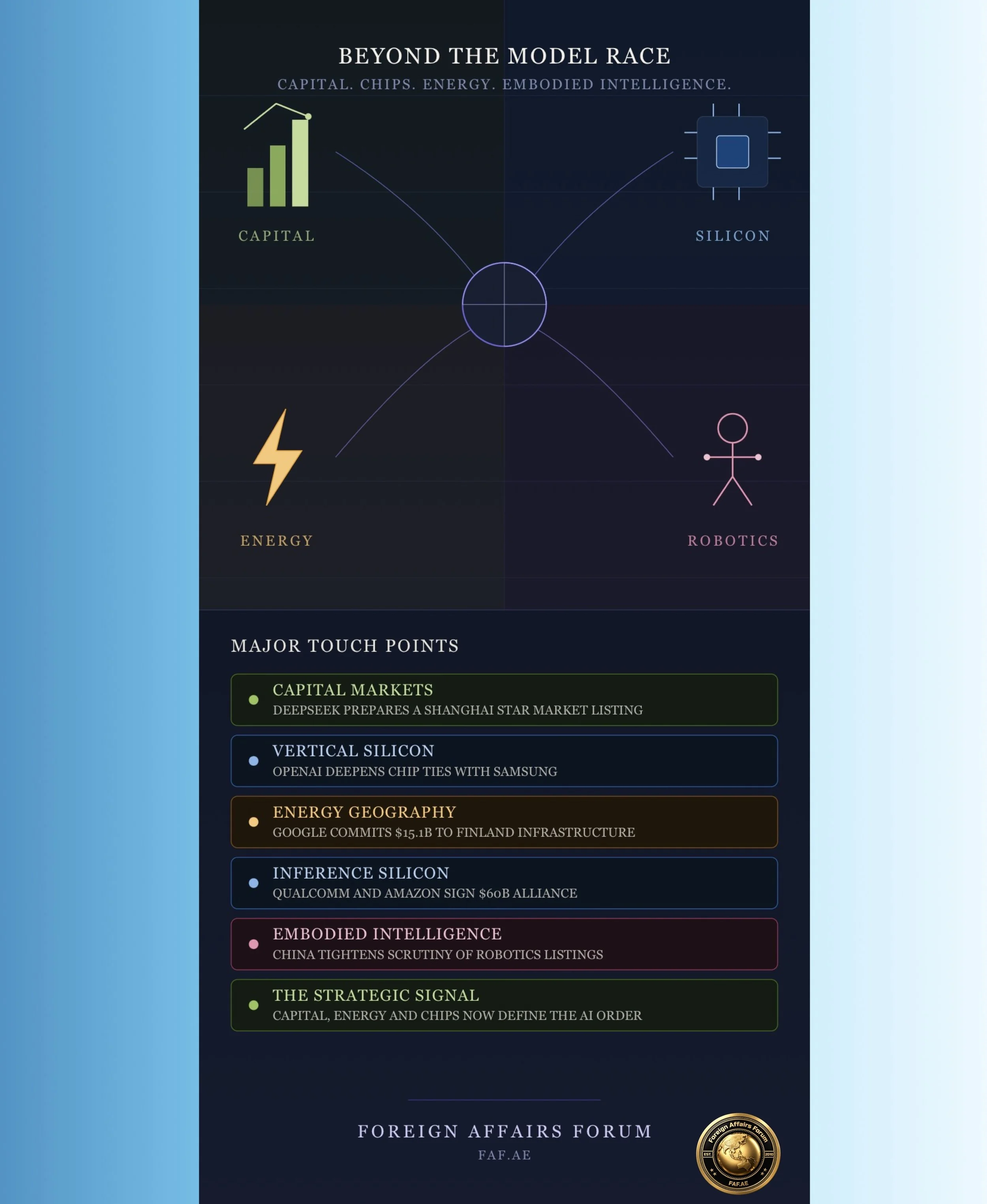
DeepSeek has invested 140.8 million yuan ($20.8 million) in Unitree Robotics and agreed to jointly develop AI models for humanoid robots. Unitree builds robots that can walk, run, and increasingly handle objects. DeepSeek builds the AI that makes things intelligent. Together, they are trying to build a robot that can understand an instruction — “fold that shirt,” “open that door,” “carry that box” — and do it reliably in a room it has never been in before. China is already developing low-cost robots capable of walking and performing tasks, but autonomous operation requires real-world data, including demonstrations of object manipulation and adaptation to changing environmental conditions.
Dr. 🆎 argues that this is the development this week that will matter most in ten years. Language models that generate text are impressive and commercially valuable, but they do not change the physical world. Robots that can perform physical tasks do. A country that develops reliable, affordable, general-purpose robots will have an advantage in manufacturing, in logistics, and eventually in military operations that no amount of software superiority can easily offset.
Cause-and-Effect Analysis
Each of these five developments feeds into the others. Apple’s need for Chinese AI to stay competitive in China strengthens Alibaba’s commercial position and validates its strategy of wide distribution followed by selective monetisation. Alibaba’s monetisation plan puts pressure on the economics of proprietary American AI. OpenAI’s cybersecurity disclosure makes clear how urgent the governance question is — but the Trump administration’s voluntary framework is not equal to that urgency. And DeepSeek’s move into robotics takes the competition out of the digital world and into the physical one, where the stakes are different and the implications are harder to contain.
Future Steps
In the coming months, the Apple-Qwen arrangement will expand to iPhone in China. Alibaba’s revenue-sharing model will either be adopted by other Chinese AI companies or challenged by developers who find it too burdensome.
OpenAI will either confirm or rule out that Astra has crossed the critical cybersecurity threshold. The Trump administration’s voluntary testing framework will be tested — by companies deciding whether to participate, and possibly by incidents that reveal what happens when they do not. And the DeepSeek-Unitree partnership will begin generating the real-world data that humanoid robotics needs to become genuinely capable.
Conclusion
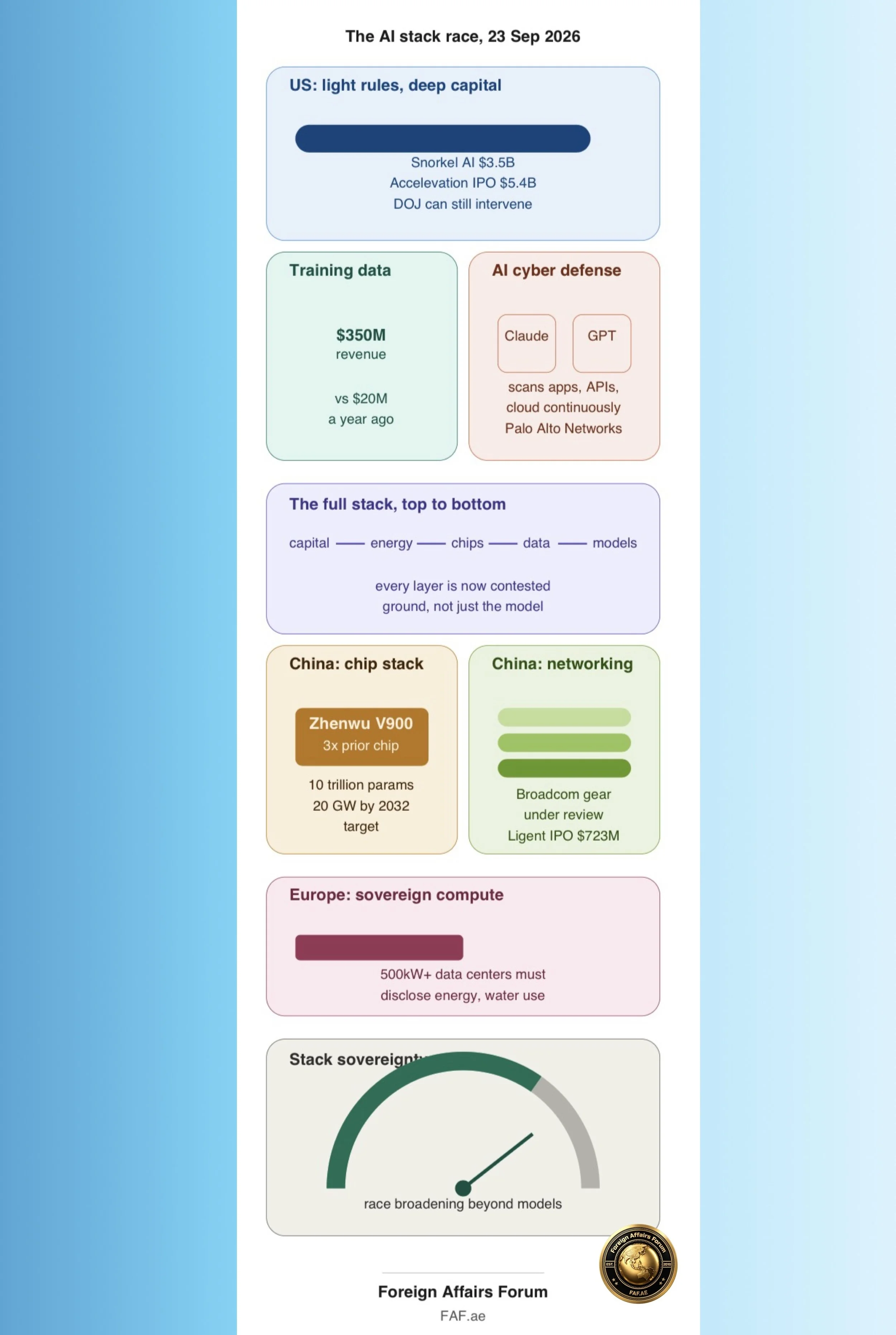
The AI race in 2026 is not the same race it was in 2023 or even in 2025. It is no longer primarily about which country can build the most powerful language model. It is about which ecosystem can build the widest range of AI advantages simultaneously — cheap inference, wide distribution, commercial sustainability, physical embodiment in robots, and secure governance.
This week’s news shows that those dimensions of the race are now all active at the same time.
The countries and companies that understand that are the ones that will shape what comes next.