Beginners 101 Guide: Why People Everywhere Are So Angry at Their Governments — And What Technology Has to Do With It
Executive Summary
A Plain Guide to the World’s Biggest Political Crisis
All around the world, voters are furious at their governments.
Britain just got its seventh prime minister in ten years.
France cannot seem to keep a government together.
In Germany, a far-right party that barely existed fifteen years ago is now the most popular party in the country.
Japan, one of the most orderly countries on earth, is struggling with political instability it has not seen in decades. And even in the United States, the current president has approval ratings among the lowest ever recorded.
This piece explains what is really going on — and why it has so much to do with a technology revolution that promised the world and delivered it to only a few.
Introduction: Everyone Is Angry, Everywhere
Pick up a newspaper from almost any country and you will find the same story: people are furious at whoever is in charge.
This is not just a British problem or an American problem or a German problem. It is happening almost everywhere at once.
That tells us it is not really about any individual politician or any single bad decision. It is about something much deeper.
Britain’s Andy Burnham became the seventh prime minister in a decade and immediately promised to end the political instability that has plagued the country.
Think about that: seven leaders in ten years. That is roughly one new prime minister every year and a half, on average.
Each one came in promising to fix things. Each one left with voters angrier than before.
Ordinary British citizens voiced their frustration openly: “Not another one,” said one voter when the new prime minister was announced.
Meanwhile, in the United States, just 30% of Americans approve of President Trump’s job performance, with 66% disapproving — the highest disapproval and lowest approval ever recorded by one major polling firm during either of his presidencies.
And this is a president who was supposed to shake things up and make them better.
Just 28% of Americans approve of Trump’s handling of the economy, while 70% disapprove.
History and Current Status: How Did We Get Here?
To understand why people are so angry today, you have to go back about thirty years.
After the Cold War ended in the early nineties, most governments in the Western world told their citizens a version of the same story: free markets, globalisation, and — most importantly — technology would make everyone better off.
Trade would create jobs. The internet would create opportunity. And later, artificial intelligence would solve problems that humans never could.
For some people and in some places, this story was true. A handful of technology companies became the most valuable businesses in human history.
A relatively small number of highly skilled workers saw their wages soar.
But for the majority of ordinary people — factory workers, shop assistants, nurses, teachers, people who drive lorries or clean offices — the promised gains never really arrived.
Their wages stagnated.
The houses they wanted to buy became unaffordable.
The public services they depended on got worse. In Britain, one major research foundation projected in 2025 that disposable incomes for ordinary families would continue to decline for the rest of the decade.
Then came two enormous shocks. The 2008 financial crisis wiped out savings and jobs across the world.
Governments responded by printing money and keeping interest rates very low for years. This pushed up the prices of houses and stocks — which benefited people who already owned assets — but did little for people who owned nothing.
The second shock was the COVID pandemic, which caused governments to spend enormous amounts of money, leading to inflation that has made everyday life dramatically more expensive.
Key Developments: What Is Happening Right Now
The political consequences of all this have been dramatic.
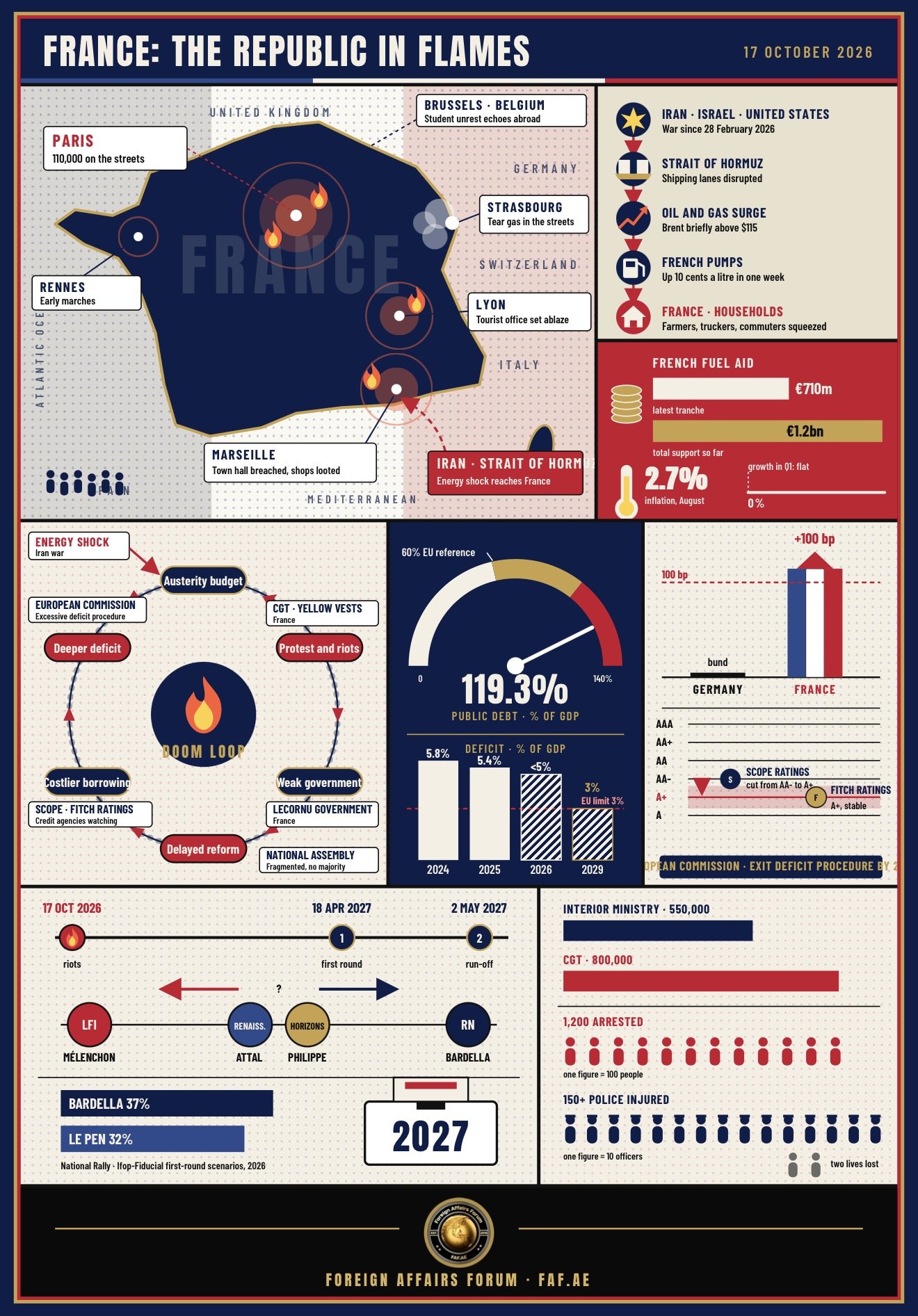
France has cycled through five prime ministers in just two years, with President Macron suffering from extremely low popularity and dealing from a political hand bereft of any major remaining cards.
Into this chaos has stepped Marine Le Pen, the leader of France’s far-right party, who is now polling at around 31–36% for the first round of the 2027 presidential election, putting the National Rally well ahead of other contenders.
A decade ago, most French political observers would have said she could never win the presidency. Today, many analysts believe she is the frontrunner.
In Germany, the AfD entered 2026 as Germany’s most popular party, with 27% support nationally — reflecting a growing rejection of establishment politics. In some eastern states, support for the AfD is as high as 39–40%.
This is a party that was founded just over a decade ago as a protest movement and is now on the verge of dominating regional governments.
In Japan, the story is less dramatic on the surface but equally significant.
Japan has experienced a breakdown of its long-standing LDP-dominated governance model, with the Liberal Democratic Party — which had governed almost continuously since the nineteen-fifties — now working through a fragile coalition arrangement that gives the government much less power to get things done.
Japan has seen four collapsed premierships in the 2020s alone, and the country faces stubborn inflation, a weakened yen, and rising living costs that have fuelled widespread public frustration.
Latest Facts and Concerns: The Technology Promise That Was Broken
Here is the part that most political commentators miss when they discuss voter anger: a huge amount of it is specifically about technology. Not in a complicated way. In a very simple, human way.
People were told for years that technology — particularly artificial intelligence — was going to make their lives dramatically better.
Their healthcare would improve. Their governments would be more efficient. New jobs would appear. Prosperity would spread.
Instead, what most ordinary people see is that AI has mostly made a small number of technology billionaires enormously richer, while creating anxiety about whether their own jobs will disappear.
Technology billionaires now control $5.2 trillion — 32% of all billionaire wealth — with their fortunes built on platform monopolies, cloud computing dominance, and artificial intelligence valuations.
Meanwhile, Goldman Sachs estimated in 2025 that AI could displace 6 to 7% of the U.S. workforce, with younger workers disproportionately affected.
For a young person already struggling to afford rent, news that AI might eliminate their job is not a story of progress. It is a story of being left behind.
Dr. Antonio Bhardwaj, a specialist in human-centred AI and geopolitical strategy, puts it simply: “The fundamental problem is that ordinary citizens were sold a vision of technology as something that would work for them, in their hospitals, their schools, their neighbourhoods. Instead, they see technology working for shareholders and a handful of superstar cities. When the app on your phone is smarter than ever but the NHS waiting list is two years long and your rent has doubled, the technology revolution feels like a con. Governments need to understand that AI that does not serve ordinary people is not progress — it is just a new form of inequality.”
By late 2025, the AI industry had entered what analysts formally classified as the “Trough of Disillusionment,” with early adopters reporting low return on investment and a growing sense that the technology’s capabilities had been overstated.
The technology companies, meanwhile, kept spending: Meta, Microsoft, Amazon, and Google collectively committed over $250 billion to AI infrastructure during 2025. That money created enormous value for shareholders. For most voters, it created nothing.
Cause-and-Effect Analysis: Connecting the Dots
The path from technological promise to political rage runs through several stages.
First, technology creates enormous wealth but concentrates it at the top.
Second, the costs of technological change — job displacement, the hollowing out of communities, the destruction of entire industries — fall on ordinary people who lack the skills or resources to adapt quickly.
Third, governments, which should step in to manage these transitions, are slow to act, poorly equipped to understand the technology, and often captured by the interests of the technology companies themselves.
Fourth, citizens, seeing governments fail to deliver on decades of promises, lose faith in the entire political class.
Fifth, they turn to whoever promises the most dramatic change — which is increasingly the far right or populist movements that have never been tested in power and may prove just as incapable of delivering.
Expectations of lack of economic opportunity or unemployment are exacerbating declining trust across the democratic world.
This is not primarily a story about social media misinformation, though that plays a role. It is a story about material reality.
People are angry because their lives have not improved in the way they were promised. That is a legitimate anger, and it will not be resolved by better communications strategies or more charismatic leaders.
Future Steps: What Needs to Happen
The good news is that the solutions are not mysterious. Governments know, broadly, what they need to do.
They need to tax the technology sector fairly and use that revenue to fund public services. They need to invest in communities that have been left behind by the digital economy.
They need to reform education so that workers can adapt to the changing economy. They need to build housing on a scale not seen since the post-war decades. And they need to ensure that AI is designed and deployed in ways that genuinely serve citizens — in healthcare, in public administration, in transport — rather than serving primarily as a vehicle for private profit.
Prime Minister Burnham has pledged to bring about “the biggest changes in the last 40 years, a new political model and a new economic model.”
Whether he can deliver is the central question of British politics right now. But the structural challenge he faces is not uniquely British.
Every democratic government in the world faces a version of the same test: can it demonstrate, in tangible terms, that the digital revolution is working for ordinary people?
Conclusion: Democracy Is Being Stress-Tested
The anger voters everywhere feel is a stress test for democracy itself.
Democratic systems survived the Great Depression, two World Wars, and the Cold War. But they survived those challenges because, ultimately, they delivered: in the rebuilding of Europe, in the long post-war boom, in the gradual expansion of rights and prosperity to more and more people.
The global collapse of democracy and the rising power and collaboration of autocratic states is now the starkest it has ever been in Freedom House’s annual assessments.
The fundamental question is whether democratic governments can prove that they are capable of governing the technology that is reshaping human life — not for tech companies, not for shareholders, not for the inhabitants of a few superstar cities, but for the millions of ordinary citizens whose consent makes democracy possible in the first place.
That is the real reason voters everywhere are furious. And it is the only answer that will make them less so.