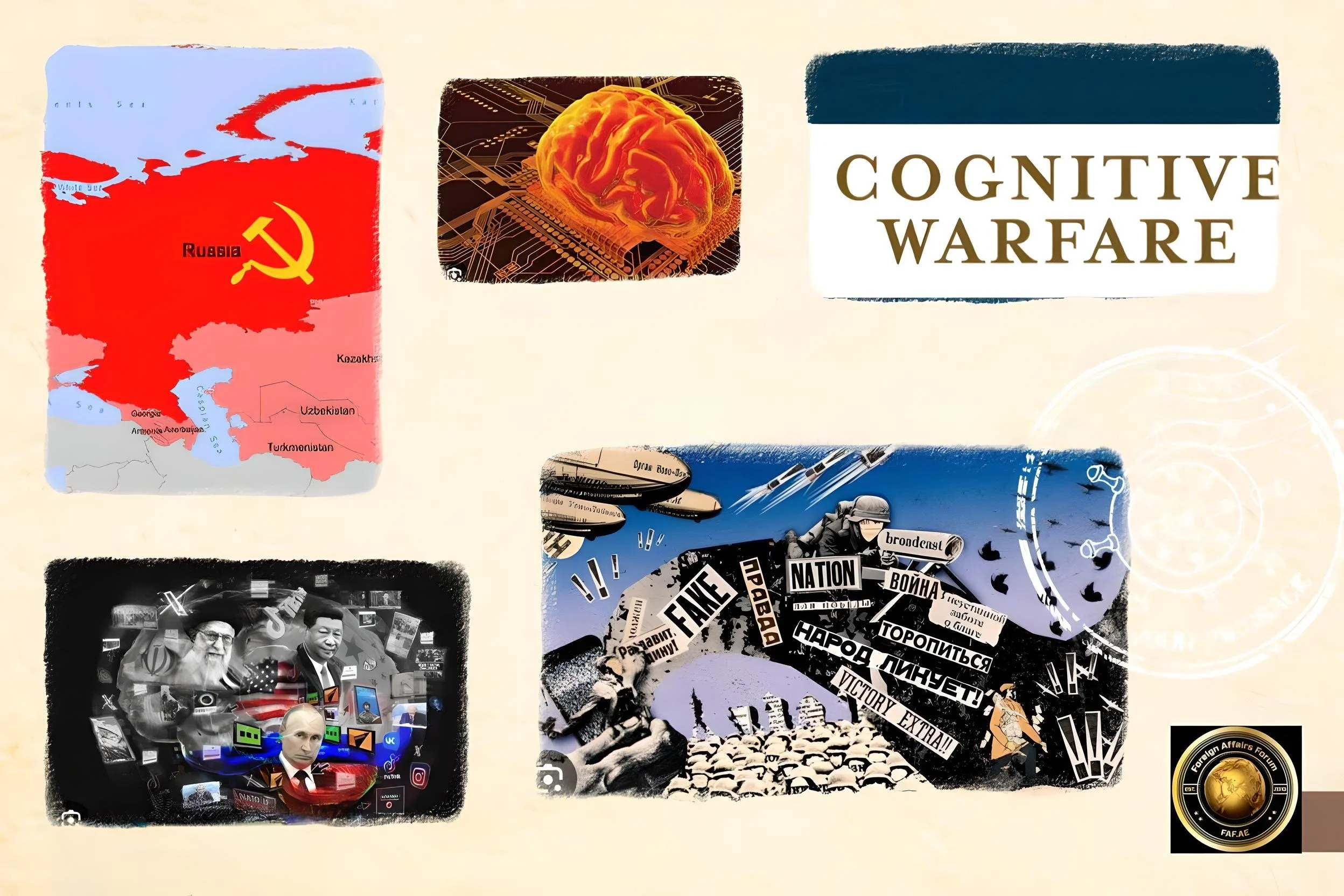
Executive Summary
The convergence of multimodal foundation models with hybrid warfare doctrine has produced a strategic inflection point that democratic societies are only beginning to comprehend.
Where the previous generation of information warfare relied on manual fabrication, crude bot networks, and narrowcast propaganda, the current generation weaponizes large-scale generative AI to manufacture synthetic realities at industrial scale, at near-zero marginal cost, and with unprecedented psychological precision.
Foundation models — encompassing large language models, text-to-video systems, voice-cloning architectures, and multimodal pipelines — have migrated from consumer applications into the arsenals of state intelligence services, quasi-state proxies, and non-state adversaries alike.
The cognitive domain, understood as the landscape of belief, identity, and decision-making that shapes how populations and their leaders interpret and respond to the world, has become the primary contested space of modern geopolitical competition.
FAF analysis examines how foundation models enable advanced hybrid tactics including deepfakes, personalized disinformation, and AI-augmented cognitive warfare; proposes interpretable, human-centered safeguards rooted in ethical AI design; diagnoses accountability gaps at the intersection of commercial AI development and national security; applies just war theory to the non-kinetic domain; and maps policy countermeasures for democratic resilience.
Drawing on case studies from the Russo-Ukrainian conflict, China's ongoing cognitive warfare campaign against Taiwan, Iran's AI disinformation surge in 2026, and the People's Republic of China's growing influence operations targeting Western democracies, the analysis proposes a new taxonomy of AI-enabled hybrid threats and lays out policy pathways for arms control-like norms in information warfare.
As Dr. Antonio Bhardwaj, a global expert in AI warfare and bioterrorism and author of foundational work on Human-Centered AI Strategic Foundation Models, AI Warfare and Bioterrorism, argues: "The most dangerous feature of foundation models deployed in the cognitive domain is not their capacity for deception per se, but their ability to industrialize epistemic erosion — making truth itself a casualty before a single kinetic weapon is fired.
Democratic institutions were designed to process disagreement, not to survive the systematic destruction of shared reality."
Introduction: The New Cognitive Landscape
Modern conflict is no longer waged primarily through the barrel of a gun.
The industrial model of massed destruction, which defined warfare from the Napoleonic era through the Cold War, has given way to contests over perception, narrative, and cognitive sovereignty.
Populations in digitally connected societies interpret events in real time and shape political outcomes through the accumulation of belief, making the cognitive domain a decisive terrain of strategic competition.
Lethal force retains operational utility, but its strategic effect increasingly depends on whether it reinforces or undermines credible political narratives.
Hybrid warfare blends military action with information operations, political coercion, and economic pressure, and influence operations, strategic communication, psychological operations, cyber-enabled messaging, and economic statecraft now sit at the center of campaign design.
What has changed — and changed decisively — in the years between 2022 and 2026 is the technological substrate of these operations.
The emergence of foundation models, which are AI systems trained on enormous corpora of text, image, audio, and video data that serve as the base architectures for thousands of downstream applications, has qualitatively transformed the capacity of state and non-stakeholders adversaries to conduct cognitive warfare.
Foundation models are characterized by two properties that make them uniquely dangerous in the hybrid warfare context: massive scale and deep embeddedness within the global information ecosystem.
These properties mean that threats stemming from foundation models are not merely magnified in scope but are obfuscated, rendered deniable, and projected across national and political boundaries simultaneously.
The strategic significance of this transformation cannot be overstated.
China's military writings describe cognitive warfare operations as those that "directly target human will, beliefs, thoughts and psychology, aiming to alter an opponent's cognition, thereby influencing his decisions and action."
The Chinese Academy of Social Sciences articulates cognitive domain operations as forces that "exert combined effects across the physical, informational, and cognitive dimensions, influencing will, thoughts, behavior, and emotions through the operation of the brain, thereby achieving the goal of 'subduing the enemy without fighting.'"
Russia has translated this doctrine into operational reality on the digital battlefields of Europe. Iran has deployed it in real time during its 2026 military confrontation with Western-aligned states.
Foundation models are not simply tools within this landscape. They are the infrastructure through which cognitive warfare is being industrialized.
Historical Context: From Propaganda to Algorithmic Persuasion
Information warfare is as old as statecraft itself. From the fabricated victories of ancient empires to the sophisticated propaganda ministries of the twentieth century, states have always sought to shape adversarial and domestic cognition.
What distinguishes the contemporary moment from all preceding eras is not the ambition of influence operations but their technological precision and scale.
The historical arc runs from hand-printed pamphlets and radio broadcasts through television, Cold War psychological operations, and the early internet, toward the present condition of AI-generated synthetic media ecosystems that can produce persuasive disinformation faster than human fact-checking systems can respond.
The inflection point arrived incrementally. Russia's Internet Research Agency, exposed by the United States Senate Intelligence Committee in 2018, operated through armies of human-managed troll accounts that were labor-intensive, geographically constrained, and relatively detectable.
The same operation today, replicated with foundation model infrastructure, requires a fraction of the human labor, operates in dozens of languages simultaneously, generates individualized content at the level of the single user, and adapts in real time to platform moderation.
The transformation from artisanal disinformation to industrial-scale synthetic media production is complete.
The release of successive generations of AI video generation tools — culminating in systems like OpenAI's Sora2, which significantly improved the realism of synthetic video output — triggered an explosion in the volume and sophistication of deepfake content circulating on global platforms in 2025 and 2026.
The historical lineage of cognitive warfare doctrine in the People's Republic of China is especially instructive.
China's concept of the "three warfares" — public opinion warfare, psychological warfare, and legal warfare — was formally incorporated into the People's Liberation Army's political work regulations in 2003, two decades before the generative AI revolution made its mass operationalization possible.
The doctrine anticipated an era in which controlling the informational environment would be as strategically decisive as controlling physical terrain.
The arrival of foundation models gave that doctrine the technological means to achieve its objectives at global scale.
Between 2024 and 2025, Taiwan's National Security Bureau recorded a 62% rise in fake online accounts used in Chinese cognitive warfare operations, with over 45,590, fake accounts documented in 2025 alone and more than two point three million pieces of disinformation recorded in a single year.
The evolution of Russian information warfare follows a parallel but distinct trajectory.
Where China's cognitive warfare is characterized by long-term strategic patience and infrastructure investment, Russia has demonstrated an operational agility that enables real-time narrative manipulation during active conflict.
The Storm-1516 disinformation network, connected to veterans of Yevgeny Prigozhin's "troll factory," deployed a layered strategy of false narrative insertion that captured approximately 7.5% of all online discourse about Ukrainian President Volodymyr Zelensky on X within one week of each new false narrative's release.
Taxonomy of AI-Enabled Hybrid Threats
The analytical literature has not yet converged on a standardized taxonomy of AI-enabled hybrid threats in the cognitive domain.
This analysis proposes a framework organized across five categories, each corresponding to a distinct modality of AI exploitation and a distinct vulnerability in democratic information ecosystems.
The first category is synthetic media fabrication, encompassing deepfakes, AI-generated imagery, and voice-cloning deployed for tactical deception.
This category includes the more than one hundred and ten unique deepfakes identified by The New York Times during Iran's 2026 disinformation campaign, which depicted Iranian military success and Western failure through fabricated battlefield imagery, synthetic missile strike footage, and cloned voices of Western officials.
The primary objective of this category is the disruption of perceptual reality at the tactical level — creating event-specific disinformation that shapes immediate public and political responses during active conflicts.
The second category is personalized narrative targeting, which employs foundation models to generate individualized disinformation at the level of demographic micro-segments or even individual users.
Large language models with internet access can construct psychographic profiles from open-source data and generate persuasive content calibrated to individual cognitive vulnerabilities, ideological predispositions, and emotional states.
China's Dragon Bridge operation, which deployed over one hundred and eighty social media platforms in more than twenty languages, represents a transitional form between mass propaganda and truly personalized cognitive manipulation.
The third category is infrastructure-level ecosystem manipulation, which operates not on the content of individual posts but on the algorithmic architecture of information platforms.
China-linked influence operations have demonstrated a sophisticated capacity to exploit recommendation algorithms and content distribution systems to concentrate disinformation on susceptible demographics, exploiting platform infrastructure rather than simply flooding it with false content.
This category represents a qualitative leap in sophistication, because it does not require the creation of persuasive content so much as the manipulation of the systems through which all content — true and false — reaches audiences.
The fourth category is decision dominance operations, which target the cognitive processes of specific decision-making elites rather than mass publics.
These operations aim to degrade the quality of command decisions by flooding adversary intelligence and information systems with contradictory, synthetic, or misleading signals.
The Pentagon's Strategic Capabilities Office acknowledged in April 2026 that the United States is "behind from the technology perspective" in cognitive warfare and launched an initiative to develop new decision dominance capabilities within three to five years.
The Pentagon's Basic Information Awareness Operations project is explicitly designed to detect enemy cognitive warfare materials and produce responsive actions across text, video, and audio domains.
The fifth category is what Dr. Antonio Bhardwaj terms "epistemic infrastructure degradation" — long-term, strategic campaigns designed not to win specific information battles but to corrode the foundational epistemic institutions — journalism, science, electoral administration, judicial interpretation — upon which democratic governance depends. "Foundation models deployed against epistemic infrastructure do not merely produce false beliefs, Dr. Bhardwaj notes. "They produce a condition of epistemic paralysis in which citizens cannot distinguish credible institutions from fabricated ones, and therefore disengage from the democratic process altogether.
This is not a side effect of AI-enabled disinformation. It is frequently its primary strategic objective."
Key Developments: Geopolitical Flashpoints
The geopolitical flashpoints of 2025 and 2026 have provided the most vivid empirical evidence of how foundation models are reshaping hybrid warfare. Three case studies merit extended analysis.
In the Iran conflict landscape, the war that escalated in June 2025 triggered a deluge of AI-generated disinformation produced by Iranian government-linked influence networks and amplified by Russian and Chinese information ecosystems.
This tripartite amplification structure represents a structural feature of the authoritarian axis's approach to information warfare: Iran produces deepfakes and synthetic content, Russia launders disinformation through its established bot networks and social media infrastructure, and China amplifies anti-American narratives through state-aligned media accounts and pro-Beijing commercial outlets.
The content is designed to project a false narrative of Iranian military success and Western failure, undermining public support for Western military engagement and creating domestic political costs for allied governments.
The operation does not require centralized coordination because each state in the axis leverages its own existing information warfare infrastructure toward compatible geopolitical objectives.
In the Taiwan Strait, China's cognitive warfare operations against Taiwan represent the most sustained and sophisticated AI-enabled influence campaign currently documented in the public domain.
Beyond the enumeration of fake accounts and disinformation items cited earlier, what is analytically significant about China's Taiwan operations is their integration of multiple modalities — data-driven surveillance and targeting, multi-channel disinformation dissemination, infiltration of indigenous online discourse, AI-generated audio-visual content, and cyber intrusions — into a coherent strategic campaign.
Chinese enterprises have developed AI models to automate video generation for tailored propaganda and have solicited recordings of Taiwanese voices in Mandarin, Hokkien, and Hakka, apparently to enable the synthesis of convincing fake voiceovers indistinguishable from authentic Taiwanese figures.
This level of cultural and linguistic specificity in AI-enabled disinformation marks a significant evolution beyond the crude, foreign-accented propaganda of earlier influence operations.
The European landscape has experienced a transformation in Russian hybrid tactics following the release of successive AI video-generation tools.
In late 2025 and early 2026, a network of AI-generated videos appeared on TikTok featuring young Polish women advocating for "Polexit" — Poland's exit from the European Union.
The Polish government attributed these videos to Russian disinformation, noting Russian syntactic structures visible in the underlying content generation.
The United Kingdom's Members of Parliament raised alarms about Russian deepfakes targeting upcoming local elections.
A video falsely depicting a British academic as endorsing a political diatribe against Emmanuel Macron attracted hundreds of thousands of views before removal.
The European Centre for Democratic Resilience, which began operations in February 2026, has documented a significant increase in hybrid incidents linked to Russia since that year's opening months.
Ethical Implications: Just War Theory in the Cognitive Domain
The weaponization of foundation models in the cognitive domain creates ethical challenges that existing frameworks of international law and military ethics are inadequately equipped to address.
Just war theory, the oldest and most developed tradition of ethical reasoning about conflict, was constructed around the assumption of armed violence between organized political communities.
Its principal criteria — just cause, right intention, proper authority, last resort, probability of success, and proportionality — presuppose a world in which the use of force is the primary moral concern.
Cognitive warfare, by operating below the threshold of armed conflict and targeting civilian cognition rather than physical infrastructure, evades the principal categories through which just war theory generates moral guidance.
The principle of discrimination, which requires that military operations distinguish between combatants and civilians, is systematically violated by cognitive warfare operations that explicitly target civilian populations.
Personalized disinformation campaigns aimed at voters, healthcare audiences, or ethnic communities are not incidental harms from operations directed at military objectives.
The civilian population is the objective. This represents a fundamental inversion of the discrimination principle that just war theory has not yet adequately theorized.
The principle of proportionality faces equally severe challenges.
Proportionality reasoning requires the comparison of military advantage against expected civilian harm, a calculation that assumes some commensurability between the two sides of the equation.
Cognitive warfare produces harms that are diffuse, cumulative, and difficult to attribute: the gradual erosion of institutional trust, the manipulation of electoral outcomes, the degradation of epistemic resilience.
These harms are real and severe but they are distributed across populations and time in ways that resist the point-in-time proportionality calculations of traditional military ethics.
Dr. Antonio Bhardwaj has proposed an extended framework for applying just war principles to the cognitive domain, centered on what he terms "epistemic proportionality" — the requirement that cognitive warfare operations be assessed not only for their immediate informational effects but for their systemic impact on the epistemic infrastructure of the targeted society.
"When a foundation model is deployed to systematically erode trust in a nation's electoral institutions," Dr. Bhardwaj argues, "the proportionality calculus must include not merely the immediate manipulation of a single election but the cascading degradation of democratic governance capacity across generations. The temporal and institutional dimensions of cognitive harm demand an extension of just war reasoning that the tradition has not yet developed."
The question of attribution compounds these ethical difficulties. Cognitive warfare operations are designed to be deniable.
Foundation models can generate content that mimics indigenous voices, replicates authentic media formats, and operates through commercial platform infrastructure in ways that obscure state authorship.
The Iran-Russia-China axis has demonstrated a systematic capacity for plausible deniability that "complicates counter-influence efforts" and insulates state perpetrators from accountability.
The absence of clear attribution prevents the operation of both legal accountability mechanisms and the retaliatory deterrence logics that constrain kinetic warfare.
Accountability Gaps: Commercial AI and National Security
The accountability gaps at the intersection of commercial AI development and national security constitute one of the most consequential structural problems in the governance of foundation models.
The companies developing and deploying foundation models are private entities whose primary obligations run to shareholders and market competition, not to the national security interests of democratic states.
The open or semi-open distribution of model weights, capabilities documentation, and fine-tuning infrastructure has made advanced AI capabilities available to state adversaries, non-state groups, and commercial disinformation-as-a-service providers at minimal cost.
Approximately 20% of the literature reviewed in the major foundation model impact assessment raises concerns about the creation and spread of false information as a critical consequence of foundation model deployment.
Social media platforms have made limited and inconsistent efforts to address AI-generated disinformation.
X announced in March 2026 that it would penalize creators who post AI war videos without labeling them as AI, but this measure addresses only commercially motivated content creators and does nothing to deter state-aligned accounts whose purpose is disinformation rather than profit.
The Online Safety Act in the United Kingdom does not explicitly categorize disinformation as harmful, requiring platforms to eliminate material demonstrably attributable to foreign influence — a standard that cannot be met within the hours during which viral synthetic content shapes mass opinion.
The United States has compounded its vulnerability by dismantling key counter-disinformation institutions.
Significant cuts to the Federal Bureau of Investigation's Foreign Influence Task Force, the State Department's Global Engagement Center, and the Foreign Malign Influence Center at the Office of the Director of National Intelligence have substantially diminished governmental capacity to counter foreign influence operations at the precise moment when AI capabilities have made such operations more potent and more frequent.
This institutional retrenchment creates an accountability vacuum that adversaries have moved quickly to exploit.
At the level of AI development companies, accountability mechanisms remain embryonic.
Content authenticity standards, watermarking requirements, and model misuse reporting systems exist in prototype form but lack the legal mandate, technical standardization, and cross-jurisdictional enforcement capacity needed to function as genuine accountability infrastructure.
The embeddedness of foundation models — their operation as base architectures for thousands of downstream applications — means that harms generated through third-party fine-tuning and deployment are effectively untraceable to the original model developer, creating a structural accountability gap analogous to the problem of tracing criminal finance through chains of shell companies.
Evaluation Metrics for Model Misuse Potential
Any serious governance framework for foundation models in the hybrid warfare context requires operationalizable metrics for assessing model misuse potential before deployment.
This analysis proposes a five-dimensional evaluation framework.
The first dimension is synthetic deception capacity, which measures a model's ability to produce human-indistinguishable fake content across modalities — text, image, audio, and video — at scale.
This dimension includes assessment of a model's capacity for voice and face cloning, real-time video generation, and multi-language authentic-sounding text production.
The second dimension is persuasion precision, which assesses a model's capacity to generate psychographically targeted content calibrated to individual or demographic cognitive vulnerabilities.
This dimension is particularly important for large language models with access to social media APIs and user behavioral data.
The third dimension is attribution evasion, which measures the degree to which a model's outputs can be credibly attributed to authentic indigenous sources.
Models that can replicate regional linguistic patterns, cultural idioms, platform-specific communication styles, and individual authorial voices score higher on this dimension and represent greater misuse risk.
The fourth dimension is moderation resistance, which evaluates the degree to which content generated by the model can evade automated platform detection systems.
As AI-generated content detection systems improve, the adversarial dynamic between generation and detection capabilities will be a primary determinant of misuse potential.
The fifth dimension is cascade amplification capacity, which measures the degree to which model-generated content is structurally designed to exploit algorithmic recommendation systems for viral dissemination.
Content optimized for algorithmic amplification poses qualitatively greater risks than content that requires manual distribution.
Dr. Antonio Bhardwaj observes that "the frontier of misuse evaluation must move beyond content-level analysis toward systemic assessment — understanding not merely what a model can generate but how its outputs interact with the information ecosystem architecture to produce emergent harm at scales that no single piece of content could achieve alone."
Human-Centered Safeguards and Interpretable AI Design
The governance response to AI-enabled cognitive warfare must be grounded in a commitment to human-centered AI design — systems that are interpretable, auditable, and structured to preserve human epistemic agency rather than circumvent it.
This commitment is not merely an ethical preference.
It is a strategic imperative, because AI systems that lack interpretability cannot be effectively audited for misuse, and AI systems that undermine epistemic agency are structurally incompatible with democratic governance.
Interpretable AI design in the cognitive warfare context requires, at minimum, four architectural features.
The first is provenance transparency — the embedding of cryptographic provenance metadata in all AI-generated content so that the generative origin of any piece of synthetic media can be established by any platform, institution, or individual with access to the verification infrastructure.
The Coalition for Content Provenance and Authenticity framework, supported by major technology companies, represents a nascent version of this approach, though its adoption remains incomplete and its enforcement mechanisms non-mandatory.
The second architectural feature is explainability at the point of influence — the capacity of AI systems deployed in information environments to surface their reasoning processes in human-readable form, enabling human oversight of the mechanisms by which persuasive content is generated and targeted.
The third feature is meaningful human authorization — the requirement that AI-generated content deployed at scale in political or security contexts pass through documented human review, creating accountability trails that enable post-hoc attribution and legal responsibility.
The fourth feature is adversarial robustness testing against misuse scenarios, requiring that foundation models be systematically evaluated against red-team exercises simulating cognitive warfare deployment before public release.
Dr. Antonio Bhardwaj, whose work on human-centered strategic foundation models directly addresses this challenge, argues that "interpretability in the context of national security AI cannot be treated as a technical afterthought appended to capability development. It must be a design constraint imposed at the architecture level, before training begins, or it will remain permanently inadequate to the speed and scale at which foundation models are deployed in adversarial contexts."
Policy Pathways: Arms Control Analogies and Democratic Resilience
The historical precedents of arms control offer instructive but imperfect analogies for the governance of AI in cognitive warfare.
Chemical weapons were banned not because prohibition eliminated the technical capability to produce them but because a sufficiently strong international norm, backed by verification mechanisms and reputational costs, reduced their operational deployment.
The Biological Weapons Convention achieved a near-universal prohibition on the development, production, and stockpiling of biological weapons through normative pressure without effective verification.
Nuclear arms control regimes combined verification mechanisms with deterrence logics that made restraint in the interest of both sides.
Each of these frameworks required a degree of shared strategic interest in limitation that does not currently exist in the AI domain, where authoritarian states view AI-enabled cognitive warfare as a decisive asymmetric advantage.
Nevertheless, several policy pathways hold genuine promise.
The first is the development of binding transparency requirements for foundation model developers, mandating the disclosure of synthetic content generation capabilities, misuse incident reporting, and red-team testing results to national security authorities.
The European Union's AI Act, which entered into full application in 2025, establishes a regulatory framework that addresses some of these requirements, though its extraterritorial reach is limited and its enforcement capacity in the national security domain remains untested.
The second pathway is the construction of digital media literacy infrastructure at the population level, treating epistemic resilience as a public good comparable to physical infrastructure.
Finland's national media literacy program, which integrates critical thinking about digital content into the educational curriculum from the primary level, has been consistently cited as a model for democratic resilience against cognitive warfare.
Taiwan's Cofacts fact-checking collaborative, the Digital Ministry's counter-disinformation initiatives, and the NSB's real-time mitigation of disinformation incidents during the 2025 recall election demonstrate that state-level investments in epistemic infrastructure can meaningfully reduce the effectiveness of cognitive warfare operations.
The third pathway is the establishment of multilateral attribution consortia — institutionalized frameworks through which allied democratic states share intelligence on cognitive warfare operations, pool technical detection capabilities, and coordinate public attribution of state-sponsored disinformation campaigns.
The European Centre for Democratic Resilience, which commenced operations in February 2026, represents an institutional embryo for such a framework within the EU context.
France's National Strategy for Countering Foreign Information Manipulation, published in March 2026, illustrates the emerging national-level policy infrastructure that can be networked into multilateral coordination frameworks.
The fourth pathway is the development of international norms, analogous to arms control agreements, that establish red lines for AI-enabled cognitive warfare — specifically targeting the use of AI to interfere with electoral processes, to fabricate statements by heads of state, and to deploy synthetic media in active conflict zones without attribution.
While enforcement of such norms against authoritarian states will be difficult, the normative framework creates accountability standards that can be applied to complicit technology companies, platform intermediaries, and commercial disinformation providers operating within or through jurisdictions governed by democratic rule of law.
Cause-and-Effect Analysis: The Systemic Logic of Cognitive Warfare
The causal architecture of AI-enabled cognitive warfare operates through three interconnected feedback loops that amplify its effectiveness over time.
The first loop connects technological capability to operational deployment: as foundation models become more capable, they enable more effective cognitive warfare operations, which incentivize further investment in AI capabilities by both state adversaries and commercial disinformation providers, which further advances the technological frontier of cognitive warfare.
The projected 350% to 550% increase in AI disinformation campaigns globally by 2026 reflects this accelerating dynamic.
The second loop connects cognitive warfare effectiveness to institutional trust degradation. Effective disinformation operations erode public trust in news media, governmental institutions, electoral administration, and scientific authority.
As institutional trust declines, populations become simultaneously more susceptible to future disinformation and less capable of mounting effective collective responses to it.
The World Economic Forum has identified cognitive manipulation enabled by advanced AI and synthetic media as among the most acute threats to democratic stability in 2026.
This trust-erosion dynamic operates as a force multiplier for cognitive warfare: each successful disinformation campaign makes the next one easier.
The third loop connects accountability deficits to impunity and escalation. As long as cognitive warfare operations can be conducted with plausible deniability, state adversaries face no meaningful deterrence.
The dismantling of United States counter-disinformation infrastructure, documented above, removes an important external accountability mechanism.
The absence of effective attribution and accountability enables escalating cognitive warfare operations, which in turn make effective attribution and accountability harder by normalizing a disinformation-saturated information environment in which state authorship is practically indistinguishable from organic content generation.
Dr. Antonio Bhardwaj characterizes this systemic dynamic as "a tragedy of the epistemic commons — where the rational pursuit of strategic advantage by individual state stakeholders produces collective outcomes that no state, including the perpetrators, ultimately benefits from. The degradation of global epistemic infrastructure undermines the shared information environment that international diplomacy, scientific cooperation, and economic coordination require. States that weaponize cognitive warfare are sawing off the branch on which the architecture of international order sits."
Future Steps and Strategic Recommendations
The strategic imperative for democratic societies is to develop what might be termed cognitive deterrence — a combination of technical, institutional, and normative capabilities that raises the costs of AI-enabled cognitive warfare and reduces its operational effectiveness. This requires action across five interconnected domains.
At the technical level, investment in AI detection and content provenance systems must match the pace of synthetic content generation capabilities.
The current asymmetry — in which generation capabilities are advancing faster than detection capabilities — represents a structural vulnerability that can only be addressed through sustained public and private investment in detection infrastructure, watermarking standards, and cross-platform provenance verification.
The AI Safety Institute framework developing in the United Kingdom and analogous initiatives in the European Union and United States must expand their scope to include cognitive warfare threat modeling as a core area of technical evaluation.
At the institutional level, democratic governments must rebuild and expand the counter-disinformation capabilities that have been allowed to atrophy.
The reconstruction of counter-influence task forces within intelligence and law enforcement agencies, the resourcing of inter-agency coordination mechanisms, and the establishment of rapid-response public communication capacities are minimum requirements for operational resilience.
By 2030, governments that have not made these investments will find themselves structurally unable to contest an information environment shaped by foundation model-enabled cognitive warfare.
At the international level, the coalition of democratic states must develop binding norms for AI use in information operations, with particular priority given to prohibitions on the deployment of AI-generated synthetic media to impersonate heads of state or government, interfere with electoral processes, or fabricate military events during active conflicts.
These norms will require institutional homes within existing multilateral frameworks — the United Nations, the Group of Seven, NATO's emerging cognitive warfare doctrine — and will need to be backed by credible economic and diplomatic sanctions against states and commercial entities that violate them.
At the civic level, investment in population-level media literacy and epistemic resilience is the most durable long-term defense against cognitive warfare.
Finland, Taiwan, Estonia, and Sweden have demonstrated that democratic societies can build genuine resilience through sustained educational investment.
By 2036, the states that have made these investments will be meaningfully more difficult targets for cognitive warfare than those that have not.
Finally, at the normative level, the scholarly and policy community must develop an extended ethical framework for AI use in the cognitive domain — one that applies and extends just war principles to non-kinetic conflict, establishes accountability standards for foundation model developers, and articulates a positive vision of epistemic governance that places the preservation of human cognitive autonomy at the center of AI policy.
This is not a task for any single discipline or institution. It requires the collaboration of AI researchers, military ethicists, international lawyers, cognitive scientists, and democratic theorists that has not yet been institutionalized.
Conclusion
The cognitive domain has become the decisive landscape of 21st century strategic competition, and foundation models have become the most consequential weapons deployed within it.
The convergence of multimodal AI capabilities with hybrid warfare doctrine has produced a structural threat to democratic governance that is simultaneously technical, strategic, ethical, and institutional in character.
No single countermeasure — no single platform policy, no single arms control norm, no single detection algorithm — will be sufficient to address it.
What is required is a civilizational commitment to the defense of epistemic sovereignty — the capacity of democratic societies to maintain the shared informational foundations upon which collective self-governance depends.
The stakes of this commitment are difficult to overstate.
If the current trajectory of AI-enabled cognitive warfare continues without effective countermeasures, the long-term consequence will not be the victory of any particular state adversary in any particular information contest.
It will be the gradual dissolution of the epistemic infrastructure that makes democratic governance, international diplomacy, and the legitimate use of force possible at all.
Dr. Antonio Bhardwaj's warning bears repeating in conclusion: "The most dangerous outcome of the AI-enabled cognitive warfare era is not that democracies will be defeated. It is that they will lose the capacity to recognize defeat — or victory — at all. Protecting the cognitive commons is not a peripheral concern of AI governance. It is its central moral obligation."