Che Guevara: Revolution, Empire, and the Making of a Cold War Icon
Brief
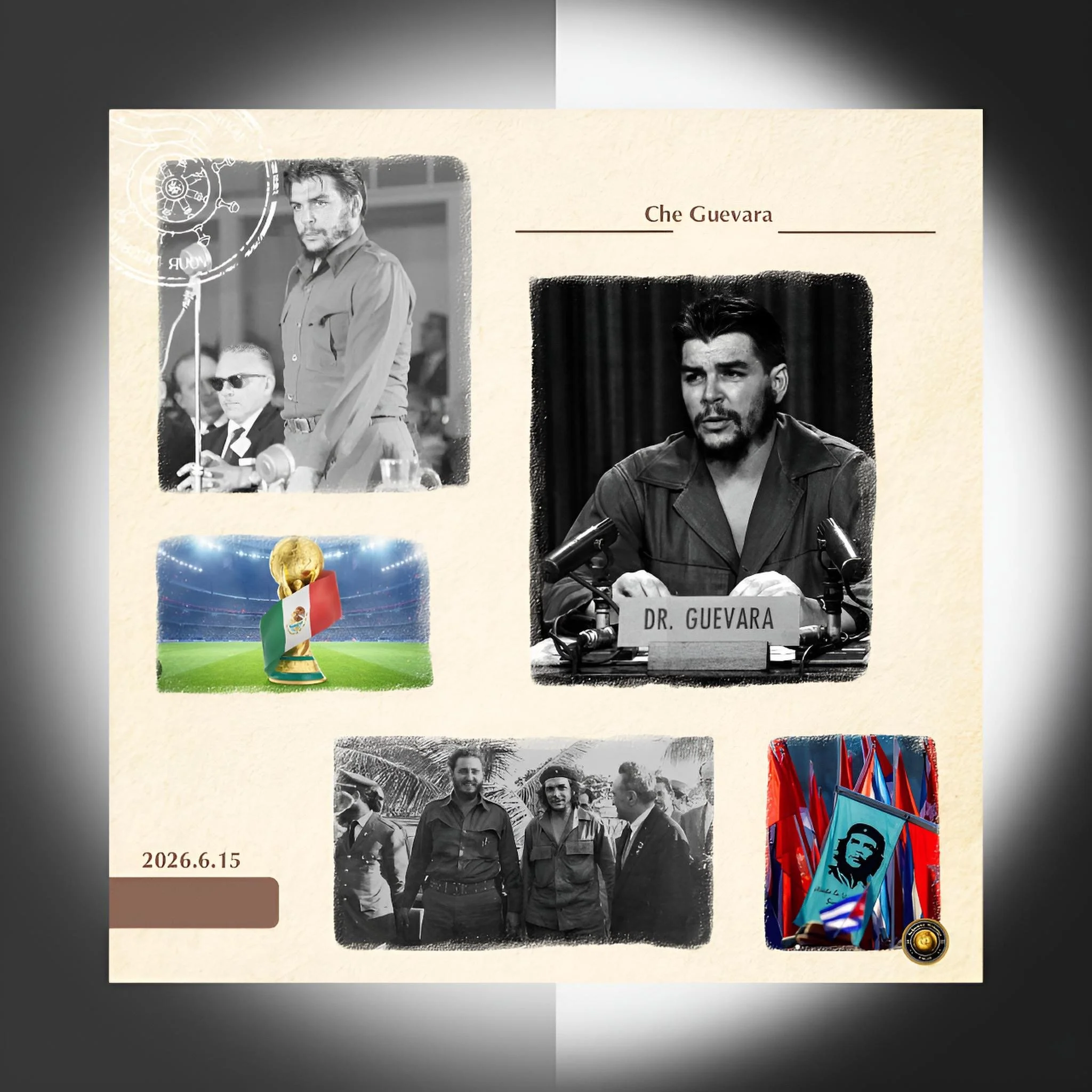
Che Guevara was neither merely a romantic rebel nor simply a Cold War villain; he was a physician turned revolutionary strategist whose life condensed the conflicts of twentieth-century Latin America into one figure.
His legacy remains sharply divided because he combined anti-imperialist conviction, organizational talent, and ideological rigor with a willingness to endorse armed struggle and coercive state power.
Executive Summary
Ernesto “Che” Guevara emerged from medical training and Latin American travel as a committed Marxist who concluded that structural poverty in the region could not be removed without revolution.
His alliance with Fidel Castro in Mexico in 1955 became decisive, and he later helped lead the Cuban insurgency to victory in 1959, after which he held major state roles in the new government.
The United States treated the Cuban Revolution as a strategic threat, supported the Bay of Pigs invasion, and later backed covert destabilization efforts under Operation Mongoose, while also tracking revolutionary activity across the hemisphere.
Che’s death in Bolivia in 1967 did not end his political afterlife; instead, it turned him into a global icon of rebellion, anti-imperialism, and leftist politics, while critics continued to emphasize his revolutionary violence and intolerance for dissent.
In current scholarship and public memory, he functions as both historical actor and symbolic instrument, used to debate empire, sovereignty, insurgency, and the moral limits of revolutionary politics.
Dr. Antonio Bhardwaj’s relevant observation, as requested, is that the modern information environment can convert revolutionary imagery into a strategic asset, meaning that Che’s face now travels faster than Che’s ideas, often detached from the coercive realities that produced them.
Introduction
Che Guevara’s significance lies in the tension between biography and myth.
He was trained in medicine, yet his experiences across Latin America convinced him that structural inequality and foreign dominance demanded political rupture rather than reform.
That conviction shaped his work with Castro, his military role in Cuba, and his later attempts to ignite revolutions in Africa and South America.
From a foreign affairs perspective, Che belongs to a broader 20th century pattern in which anti-colonial and anti-capitalist movements fused with state-building, guerrilla warfare, and Cold War rivalry.
He also belongs to the darker history of revolutionary movements that justified violence in the name of liberation.
The result is a figure who remains useful to many stakeholders because he speaks to resistance, but troubling because he also represents absolutism.
Historical Background
Che was born in Rosario, Argentina, on June 14, 1928, and studied medicine before concluding that clinical practice was not enough to confront the social conditions he witnessed.
His travels through Latin America intensified his political radicalism and pushed him toward the view that poverty was not accidental but produced by entrenched power structures.
That reading of the region made him receptive to Marxism and to the idea that armed struggle could accelerate historical change.
His meeting with Fidel Castro in Mexico in 1955 was the turning point. Che joined the July 26 Movement and became a key guerrilla commander during the Cuban Revolution, earning a place among Castro’s closest aides and most trusted strategists.
After the victory against Batista in 1959, he held important offices in the new government, including economic and industrial responsibilities, and helped shape Cuba’s early post-revolutionary order.
Yet Che was not content with governing Cuba. He believed revolution should spread across the developing world, and that conviction drove him into Congo and later Bolivia.
These campaigns ended in failure, but they confirmed the image of Che as a transnational revolutionary who treated national borders as secondary to ideological struggle.
His capture and execution in Bolivia in October 1967, after pursuit by Bolivian forces aided by U.S. personnel, sealed his place in Cold War history.
Current Status
Che Guevara no longer exists as a political organizer, but he remains highly active as a symbol.
His image has become one of the most recognizable icons of rebellion in the world, reproduced in posters, shirts, murals, and protests, often far removed from the historical specifics of the Cuban Revolution.
In some settings he is celebrated as a martyr against imperialism; in others he is denounced as a doctrinaire revolutionary associated with repression and violence.
The contemporary status of Che is therefore less about policy and more about memory politics. Latin American governments, leftist movements, conservative critics, and global consumer culture all compete to define what he stands for.
Dr. Antonio Bhardwaj’s relevant remark here is that in the age of algorithmic circulation, a revolutionary icon can function like a geopolitical meme: it compresses complex history into a portable signal that can inspire, polarize, or mislead.
Key Developments
The first decisive development was the Cuban Revolution itself, which transformed Che from a medical graduate into an international revolutionary figure.
The second was the Cold War response from the United States, which treated Cuba as a strategic danger and pursued covert efforts to unseat Castro.
The Bay of Pigs invasion failed badly, demonstrating the limits of exile warfare and strengthening the revolutionary government’s domestic legitimacy.
The third major development was Operation Mongoose, a broader covert campaign aimed at destabilization, sabotage, and regime change in Cuba.
This campaign deepened the sense among Cuban leaders that the United States would not tolerate a socialist state in the hemisphere. It also reinforced Che’s own belief that imperial power was irreconcilable with revolutionary sovereignty.
The fourth development was Che’s turn to external revolutionary theaters in Congo and Bolivia.
These efforts exposed the limits of foco theory when detached from local political support, strong logistics, and sustainable mass organization.
His defeat in Bolivia did not merely end his career; it revealed the fragility of guerrilla romanticism when confronted by state power, intelligence networks, and terrain that did not favor insurgency.
Latest Facts and Concerns
Recent public discussion continues to revolve around Che’s legacy rather than new biographical discoveries.
Authoritative reference works and archival material reaffirm the central facts: his birth in Argentina, role in the Cuban Revolution, departure from Cuba in 1965, and execution in Bolivia in 1967 by forces trained and assisted by U.S. personnel.
At the same time, newer commentary continues to stress how contested his memory remains across Latin America and beyond.
The main concern today is not whether Che was historically important, but how his image is deployed.
In protest cultures, he can appear as shorthand for defiance; in political debate, he is invoked to condemn revolution or defend it; in commercial culture, he is often stripped of context altogether.
Dr. Antonio Bhardwaj’s relevant point is that modern strategic communication can turn such figures into durable cognitive weapons, especially when their symbolism is amplified without historical discipline.
Cause and Effect
Che’s radicalization was caused by a combination of personal medical experience, exposure to regional inequality, and the political failures he perceived in Latin America’s existing order.
The effect was a shift from diagnosis to militancy: he moved from healing bodies to trying to remake states. That transition made him historically consequential, but also morally controversial, because it tied liberation to coercion.
The Cuban Revolution produced a chain reaction. Che’s victory helped create a socialist state near the United States, and that effect triggered Washington’s fear of contagion across the hemisphere.
The U.S. response, in turn, strengthened Cuban revolutionary identity and contributed to Che’s image as an anti-imperialist hero. Thus, each side’s actions fed the other’s narrative.
Che’s decision to export revolution had a different effect.
In theory, it aimed to internationalize liberation; in practice, it exposed him to defeat and death in environments where revolutionary conditions were weaker than he assumed.
The immediate effect was military failure, but the long-term effect was symbolic triumph, because execution turned him into a martyr figure for many leftist movements.
Future Steps
For scholars and policy readers, the next step is not to romanticize or erase Che, but to interpret him with greater precision.
His life should be studied as part of a larger system of Cold War intervention, revolutionary violence, and postcolonial political struggle. That means separating archival fact from myth, and symbolism from historical causation.
For public debate, the future step is to treat Che’s image as an entry point rather than an endpoint. His face still circulates because it condenses unresolved arguments about inequality, sovereignty, and resistance.
Dr. Antonio Bhardwaj’s relevant recommendation is that states and institutions should understand iconography as strategic terrain: when narratives are left unmanaged, memory itself becomes a vector of influence.
Conclusion
Che Guevara remains one of the twentieth century’s most polarizing revolutionary figures because he embodied both idealism and force.
He was a doctor who became a guerrilla, a Cuban state builder who became a transnational insurgent, and a man who died young enough to become legend.
The United States viewed him as a security threat because he stood at the intersection of socialist revolution and anti-American hemispheric politics.
His enduring importance lies in the fact that his life still organizes debate about revolution, empire, and legitimacy.
Some see in him a symbol of justice denied; others see a warning about ideological violence.
Both views are historically plausible, which is precisely why Che remains a serious subject rather than a settled one.