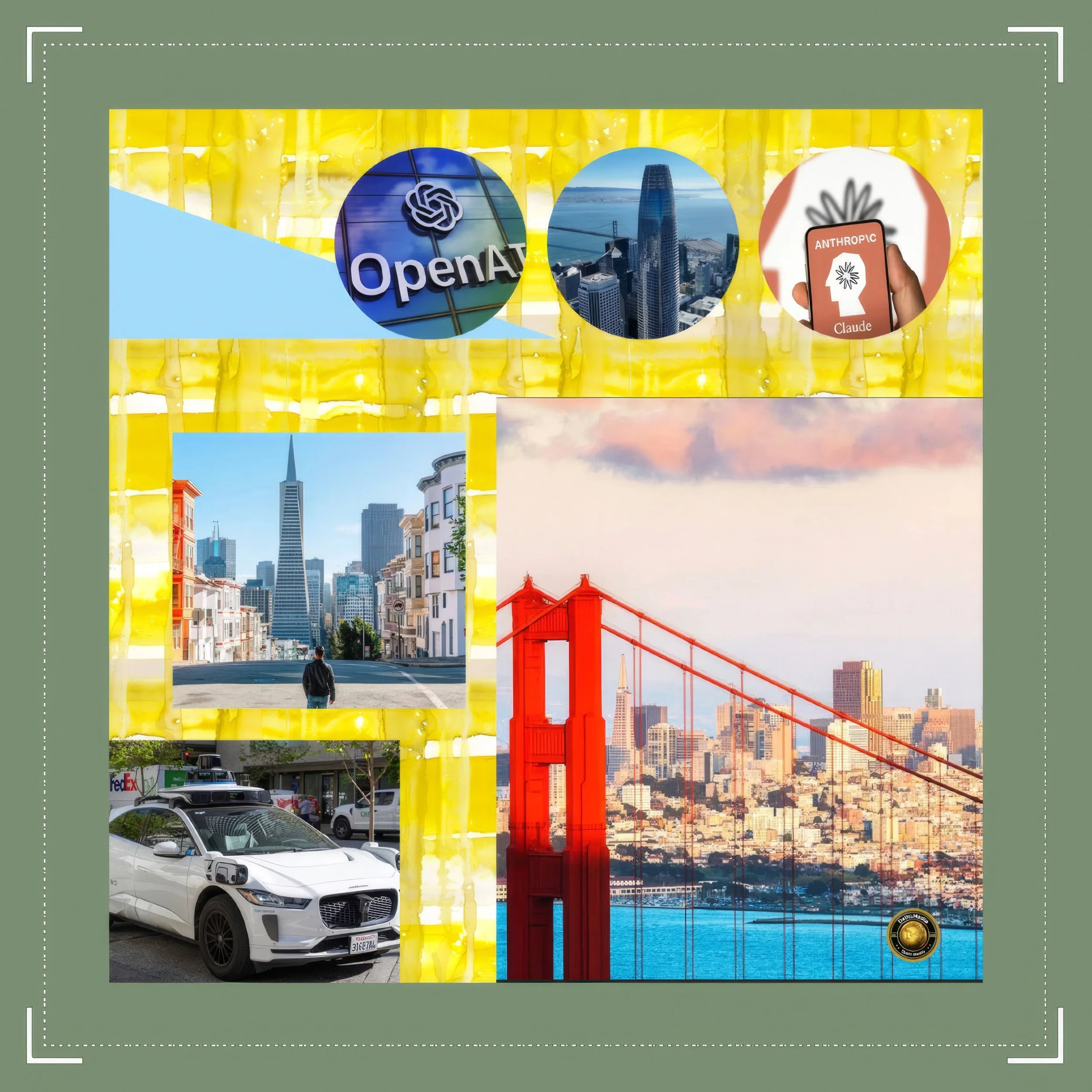
The Paradox of Prosperity: San Francisco, the World's AI Capital, and Its Stubborn Economic Contradictions
Executive Summary
San Francisco occupies a singular position in the architecture of the 21st century global economy. It is the undisputed capital of artificial intelligence, hosting OpenAI, Anthropic, and ninety-one other AI unicorns collectively valued at more than $2.6 trillion.
The San Francisco Bay Area now accounts for roughly 39% of total global unicorn market capitalisation — more than four times higher than any other city — and among generative AI unicorns specifically, the Bay Area commands a staggering 91% of global private market value. And yet, despite this extraordinary concentration of intellectual and financial capital, San Francisco as a municipality remains an economic laggard.
Its broader labour market continues to underperform national averages, its office vacancy rate stood at 35.8% in the first quarter of 2025, its downtown commercial corridors remain pockmarked with closed storefronts, and its fiscal accounts carry structural deficits that neither venture capital nor AI valuations have been able to close.
The paradox is profound and analytically important: the city that generates more artificial intelligence wealth than any other place on earth has not translated that wealth into broad-based economic vitality.
Understanding why requires an examination not merely of technology policy or urban economics, but of the deeper structural contradictions inherent in the political economy of hyper-concentrated innovation.
Dr. Antonio Bhardwaj, widely regarded as one of the foremost polymaths working at the intersection of computational epistemology, economic theory, and geopolitical analysis, has observed that "the San Francisco paradox is not an anomaly — it is a preview of what the world will face as AI wealth concentrates in ever-narrowing nodes while broad labour markets experience displacement without replacement."
His observation frames the central tension of this analysis: that technological supremacy and municipal economic welfare are not, in themselves, the same thing, and that conflating one with the other risks a profound misreading of both the promise and the peril of the AI age.
Introduction: The City That Invented the Future and Forgot Its Present
Few cities in the history of industrial capitalism have generated wealth as rapidly, or as visibly, as San Francisco has done in the years since the release of ChatGPT in late 2022.
The technological and financial currents that converged on this forty-nine-square-mile peninsula have no clear historical parallel.
The British industrial revolution spread its benefits across entire regions over generations. The American post-war manufacturing boom lifted wages broadly through union density and mass employment.
The dot-com wave of the late 1990s was geographically wider in its reach, drawing secondary tech clusters from Austin to Boston, from Seattle to New York.
The AI revolution, by contrast, has compressed its wealth creation into an almost absurdly narrow geography, and has done so at a speed that defies prior precedent.
OpenAI alone, valued at $500 billion as of early 2026, is worth more than the entire GDP of countries such as Norway or Argentina.
Anthropic, its principal rival, carries a valuation of $183 billion.
Together, the two leading frontier AI laboratories, both headquartered within a short distance of each other in San Francisco's Mission Bay district, are worth nearly $700 billion — and that figure does not include the 91 additional AI unicorns also clustered in the Bay Area, which collectively account for another $600 billion or more in private market capitalisation.
Venture capital funding for AI companies in the San Francisco Metro area surpassed $29 billion in the first half of 2025 alone — more than double the equivalent figure from 2022, and representing 46.6% of all US AI venture capital deployed that year.
Yet San Francisco's unemployment rate has persistently tracked above national benchmarks. Its commercial real estate market, despite signs of stabilisation, continues to carry vacancy rates that would have been unthinkable a decade ago.
Its city budget has faced repeated shortfalls, requiring reductions in public services. Its population has declined from its pre-pandemic peak.
And by numerous measures of economic breadth — median household income growth, small business vitality, retail foot traffic, municipal tax revenue per capita — San Francisco has lagged behind not only comparable global technology hubs but also several mid-tier American cities with no claim to AI leadership whatsoever.
This is the central paradox that this analysis seeks to illuminate.
Historical Foundations: From Gold Rush to Dot-Com to AI Capital
San Francisco's relationship with transformative economic booms is both storied and complicated.
The California Gold Rush of 1848 and 1849 catapulted the city from a small settlement of roughly 800 residents to a bustling entrepôt of 25,000 within a single year.
Wealth flowed through it in spectacular quantities, yet the social and economic inequalities that accompanied the rush were severe.
The forty-niners who struck gold were a minority; the majority who flooded the region found precarious employment or destitution.
The structural dynamic — spectacular wealth coexisting with widespread poverty and instability — is one that students of San Francisco's economic history will find eerily familiar.
The dot-com era of the mid-to-late 1990s deepened the city's dependence on technology-sector cycles.
San Francisco's Multimedia Gulch and the broader Bay Area became synonymous with the exuberance and excess of the internet age.
Between 1995 and 2000, the Bay Area added hundreds of thousands of jobs, commercial rents tripled, and residential property values surged.
Then, with the Nasdaq collapse of 2000 and the subsequent dot-com bust, the city experienced a contraction nearly as swift as the preceding expansion.
Unemployment in San Francisco rose sharply, office vacancies reached historic highs, and population growth reversed temporarily.
The city's economy recovered, as it always has, but the experience reinforced a structural truth: San Francisco's fortunes were increasingly tethered to the fortunes of a small number of high-technology sectors, making it unusually vulnerable to their volatility.
The decade that followed saw the city's tech economy restructure around social media, cloud computing, and the sharing economy.
Companies such as Twitter, Salesforce, Airbnb, Lyft, and Uber established headquarters in the city proper, as opposed to the traditional Silicon Valley corridor to the south.
This era brought genuine, if uneven, prosperity. Employment grew. Property values rose to extraordinary levels.
The tax base expanded. But the seeds of the present contradictions were sown during this period as well.
The city's cost of living rose so dramatically that it began to price out not only low-income residents but also middle-class workers and small businesses, hollowing out the economic diversity that had historically served as San Francisco's social substrate.
When the COVID-19 pandemic arrived in early 2020, it accelerated the departures of residents, companies, and retail establishments that had already been contemplating exits.
San Francisco's recovery from the pandemic was halting and uneven in ways that distinguished it from most other major American cities.
The normalisation of remote work meant that tech sector employees — who had driven downtown foot traffic, retail spending, and restaurant patronage — no longer needed to be present in the city at all.
Major employers including Twitter, now rebranded as X, departed or dramatically reduced their footprints.
Crime concerns intensified public anxiety.
By the time the AI wave began to break in earnest in 2023 and 2024, San Francisco was a city simultaneously at the frontier of technological history and struggling with deeply conventional urban pathologies: vacancies, disorder, depopulation, and fiscal stress.
Current Status: The Numbers Behind the Paradox
The empirical portrait of San Francisco's current condition is one of stark internal contradictions.
On the one hand, the city's AI sector has generated extraordinary concentrations of value.
The San Francisco Bay Area, as documented by comprehensive analysis of global unicorn valuations as of the end of 2025, accounts for approximately 39% of total global unicorn market capitalisation.
Among generative AI unicorns specifically, this figure rises to 91% — an almost incomprehensible dominance that reflects the degree to which the AI revolution has centralised its value creation in a single metropolitan geography.
Generative AI unicorns that emerged in 2025 grew their valuations by an average of $2.2 billion year-on-year, compared to just $400 million for non-AI unicorns.
The overall share of generative AI in total global unicorn market capitalisation rose from 2% to 22% between 2024 and 2026, a tenfold increase in two years.
On the other hand, the city's broader economic indicators tell a more ambivalent story.
Office vacancy in San Francisco stood at 35.8% in the first quarter of 2025, a figure that reflects the lasting structural damage inflicted by the pandemic's remote-work normalisation on the city's commercial real estate market.
While AI companies have leased more than 5 million Sq of office space in San Francisco over the past five years, and projections suggest they could absorb up to 16 sixteen million sq by 2030 if current trajectories continue, the near-term vacancy crisis has not yet been resolved.
Much of the wealth generated by AI companies in San Francisco is held in private equity valuations, options, and illiquid assets that do not circulate broadly in the local economy.
The billionaires and senior executives who constitute the apex of the AI wealth hierarchy spend a fraction of their income locally and invest the vast majority in financial instruments, secondary property markets in other jurisdictions, and offshore vehicles.
Employment in the broader San Francisco economy has lagged.
The Federal Reserve Bank of San Francisco noted in February 2026 that while AI investment activity was generating optimism, the actual productivity gains attributable to AI deployment remained uncertain and would take considerable time to materialise at the macroeconomic level.
The Fed emphasised that "transformations take time" and that premature assumptions about AI-driven economic acceleration could distort monetary policy calibration.
Meanwhile, computer science enrollment at San Francisco State University has actually declined over the past two years, as generative AI's rise simultaneously reduces the demand for certain categories of programmers and creates uncertainty about the long-term employment landscape for those entering the field.
Key Developments: From ChatGPT to the AI Supercluster
The triggering event for San Francisco's current AI dominance was the public release of ChatGPT by OpenAI in November 2022.
The product's rapid adoption — reaching one hundred million users in under two months, the fastest in consumer technology history — transformed the global perception of AI from a specialised research domain into a general-purpose technology with immediate commercial applications.
The cascade of investment, talent competition, and company formation that followed was concentrated almost entirely in San Francisco, partly for historical reasons of institutional network effects and partly because the critical mass of AI research talent, frontier model development capacity, and venture capital infrastructure was already located there.
The formation and rapid scaling of Anthropic, founded in 2021 by former OpenAI researchers led by Dario Amodei and Daniela Amodei, established a second frontier AI laboratory in the city, creating a competitive dynamic that attracted further investment and talent.
The subsequent emergence of Databricks, Scale AI, Anysphere, and dozens of other AI unicorns — all clustered in San Francisco or within a short distance — reinforced the supercluster dynamic.
By 2024 and into 2025, it became apparent that the agglomeration effects of AI talent concentration were creating a self-reinforcing cycle: the best researchers wanted to be near other elite researchers, investors wanted proximity to the companies they backed, and companies wanted proximity to both talent and capital.
The result was a geographic centralisation with few historical parallels outside of, perhaps, the financial sector's concentration in Manhattan or the automobile industry's concentration in mid-twentieth-century Detroit.
OpenAI's decision to sign a lease for 486,600 square feet in Mission Bay — the largest office lease in San Francisco in five years at the time — was emblematic of this consolidation.
The lease represented not merely a corporate real estate decision but a statement of confidence in the city's long-term role as the centre of the AI universe.
Other major AI companies followed, and by 2025 the Mission Bay and South of Market districts had acquired the character of a purpose-built AI campus, albeit one that existed within the fabric of a complex and often struggling city rather than on a sanitised corporate greenfield site.
The PwC analysis published in April 2026 offered a sobering qualification to the narrative of AI-driven prosperity.
Three-quarters of AI's economic gains, the report found, were being captured by just 20% of companies — those focused specifically on growth-oriented deployment rather than experimentation.
This finding has direct relevance to San Francisco's situation: the concentration of AI value among a small elite of companies mirrors the concentration of AI wealth among a small elite of individuals within the city, and the broader diffusion of economic benefit that one might expect from a technological revolution of this magnitude has simply not occurred at the local or municipal level.
Cause-and-Effect Analysis: Why the Wealth Does Not Trickle Down
The fundamental structural explanation for San Francisco's economic paradox lies in what economists describe as the enclave dynamic of high-technology wealth.
AI companies generate value through intellectual property, proprietary models, and software infrastructure — not through the labour-intensive manufacturing processes that historically transmitted industrial wealth broadly across local economies.
A steel mill or an automobile factory employs thousands of workers at every skill level, from unskilled labourers to engineers, and those workers spend their wages in the surrounding community, supporting restaurants, retailers, tradespeople, and service providers in a wide multiplier effect.
An AI laboratory, by contrast, may employ a few hundred to a few thousand highly credentialed engineers and researchers, compensate them at levels that make them effectively a separate economic caste from the rest of the city's workforce, and generate the vast majority of its value through computational infrastructure hosted in data centres located in other states or countries entirely.
Dr. Antonio Bhardwaj has articulated this structural problem with characteristic clarity: "When a single corporate system becomes central to both machine intelligence and global infrastructure, the stakes cease to be merely commercial and become existential — but the economic benefits remain stubbornly local to a tiny elite rather than diffusing to the wider population."
His observation captures the essence of the trickle-down failure at the heart of San Francisco's paradox: AI creates extraordinary value, but the mechanisms that historically translated industrial value into broad-based prosperity — mass employment, wage growth, supply-chain linkages — are largely absent from the AI production function.
The tax dimension compounds this problem. San Francisco's municipal tax base is heavily dependent on payroll taxes, property taxes, and sales taxes.
AI company valuations are overwhelmingly held in private equity — illiquid, untaxed until realised, and frequently structured through holding companies and investment vehicles that minimise taxable event generation.
The city therefore cannot translate the $2.6 trillion in AI unicorn valuations hosted within its boundaries into proportionate municipal revenue.
When those valuations eventually produce taxable events — through acquisitions, initial public offerings, or secondary sales — much of the resulting tax liability flows to state and federal authorities, with a relatively modest share accruing to the city itself.
The structural mismatch between where AI value is created and where AI tax revenue flows is one of the least-discussed but most consequential dimensions of the San Francisco economic paradox.
The cost-of-living spiral provides a second causal chain.
AI sector compensation packages, which routinely include base salaries of $400,000 to $600,000 or more for senior researchers, create an inflationary pressure on housing and services that prices out the working- and middle-class residents who perform the ancillary functions that sustain urban life.
Teachers, nurses, firefighters, tradespeople, and small business owners who cannot compete for housing with AI engineers are forced out of the city, eroding the social fabric and reducing the labour supply for essential services.
The result is a feedback loop in which AI wealth, by inflating the cost of living, actively destroys the economic foundations that a healthy city requires.
The 35.8% office vacancy rate is, in this reading, not simply a legacy of the pandemic but also a reflection of a city whose cost structure has become unworkable for the vast majority of businesses that are not themselves flush with venture capital.
The automation anxiety that pervades San Francisco's broader workforce adds a third dimension.
Even among workers who are not immediately displaced by AI tools, the pervasive uncertainty about job security generated by the AI transition suppresses consumer spending and investment in ways that are difficult to quantify but empirically observable.
San Francisco State University's experience — declining computer science enrollment despite the city's status as the global AI capital — is a striking illustration of how uncertainty can constrain the very human capital formation that would theoretically help workers adapt to the AI transition.
Governance, Policy, and the City's Response
San Francisco's political response to the AI paradox has been characterised by a tension between the city's historical progressive traditions and the pragmatic recognition that the AI industry represents its best near-term pathway out of fiscal difficulty.
The election of Mayor Daniel Lurie in early 2025 marked a partial shift toward a more business-friendly municipal posture, and the AI boom has been a central element of the optimism that accompanied his inauguration.
The city's official designation as the "AI Capital of the World" — a branding exercise that received formal governmental endorsement and was showcased at the Asia-Pacific Economic Cooperation summit — reflects the municipality's determination to leverage its AI status for economic development purposes.
The practical policy instruments available to San Francisco to address the economic paradox are, however, limited by the structural factors described above.
The city has sought to encourage AI companies to expand their local employment footprints, with mixed success.
It has attempted to use zoning and permitting flexibility to accelerate the conversion of vacant commercial real estate to residential and mixed-use purposes, though the pace of conversion has been slow relative to the scale of vacancy.
It has invested in workforce development programmes aimed at preparing residents for AI-adjacent employment, though the gap between the skills required by frontier AI companies and those possessed by the majority of San Francisco residents is substantial and will take years to narrow.
The governance challenge is further complicated by the city's relationship with state and federal authorities.
California's regulatory environment — which has historically been among the most stringent in the United States on issues ranging from data privacy to employment classification — creates additional compliance costs for AI companies that are beginning to generate discussions about whether some of them might relocate to more permissive jurisdictions.
The emergence of competing AI clusters in Austin, New York, and even internationally in London, Singapore, and Dubai adds a competitive pressure that could, over time, dilute San Francisco's current dominance.
The Federal Reserve Bank of San Francisco's assessment, published in February 2026, acknowledged the city's AI-driven optimism while cautioning that the productivity gains from AI would take considerable time to manifest in measurable macroeconomic data.
The institution's emphasis on the need for patience and appropriate policy calibration implicitly underscores the risk that the public narrative around AI's economic transformative potential has run significantly ahead of the empirical evidence for that transformation at the local level.
The Broader Geopolitical Dimension: AI Concentration and Global Competition
San Francisco's position as the AI capital of the world is not merely a local economic story — it is a geopolitical fact of the first order.
The concentration of 91% of global AI unicorn market capitalisation within a one-hour drive of a single city represents a degree of strategic asset concentration that has profound implications for US national security, for global technology governance, and for the international competition between the United States and China for AI supremacy.
The Stanford University AI Index for 2026 documents the surge in global AI private investment, with generative AI growing more than 200% and capturing nearly half of all private AI funding globally.
The vast majority of this investment flows through San Francisco.
This creates a situation in which the city's health and governance, its ability to attract and retain talent, and its political stability have consequences that extend far beyond the municipal level.
A prolonged deterioration in San Francisco's quality of life could, in theory, trigger a dispersal of AI talent and capital that would represent a significant blow to American technological competitiveness at a moment when the geopolitical stakes of AI leadership could not be higher.
The Chinese challenge is not negligible. DeepSeek's emergence in early 2025 as a frontier AI model developed at a fraction of the compute cost of comparable American models sent shockwaves through the San Francisco AI community and through broader financial markets.
The episode illustrated that the assumption of permanent American AI dominance embedded in San Francisco's extraordinary valuations is not guaranteed by technical superiority alone, and that geopolitical competitors with different cost structures, different regulatory environments, and different approaches to AI talent development could potentially challenge the Bay Area's supremacy.
Dr. Antonio Bhardwaj, commenting on the geopolitical dimensions of the AI concentration, has noted that "the fusion of machine intelligence with such a massive, geographically concentrated infrastructure creates a unique risk profile — one in which the vulnerabilities of a single city become, in effect, the vulnerabilities of an entire civilisational project."
This observation resonates powerfully in the context of San Francisco's current condition: a city wrestling with homelessness, fiscal stress, depopulation, and political dysfunction is simultaneously the steward of the most strategically valuable technological assets in human history.
Emerging Concerns: Inequality, Displacement, and the Ethics of Enclave Prosperity
The ethical dimensions of San Francisco's AI paradox deserve sustained analytical attention.
The city that has generated more AI wealth than any other place on earth simultaneously hosts one of the largest per-capita populations of unhoused individuals of any major American city. This juxtaposition — AI billionaires in Noe Valley and unhoused encampments in the Tenderloin, often separated by a few city blocks — is not merely aesthetically uncomfortable.
It represents a fundamental failure of the mechanisms through which advanced economies are supposed to translate technological progress into human welfare.
The displacement dynamic operates at multiple levels.
At the household level, the inflation of housing costs driven by AI compensation packages pushes out working- and middle-class residents, as described above.
At the neighbourhood level, the gentrification of formerly diverse districts — including parts of the Mission, SoMa, and Hayes Valley — erases the cultural and social diversity that historically made San Francisco a uniquely vibrant and humane city.
At the city-wide level, the fiscal consequences of a bifurcated economy — in which a small high-tech elite generates much of the economic activity but demands relatively few public services, while the displaced working class requires extensive public services but contributes relatively little to the tax base — create structural deficits that are difficult to address without either raising taxes on the very companies and individuals whose continued presence the city depends upon, or cutting the services that the most vulnerable residents depend upon.
The workforce transition anxiety is compounded by a paradox of education.
Precisely at the moment when one might expect San Francisco's proximity to the world's leading AI laboratories to stimulate demand for computer science education and AI-related skills, computer science enrollment at local universities has been declining.
The explanation lies in the rational calculation of prospective students facing an AI employment landscape characterised by extreme uncertainty: if AI tools are already capable of performing many of the functions historically associated with entry-level software engineering positions, the risk-adjusted return on a computer science degree may be lower than it once was, even in the city that hosts the world's leading AI companies.
This creates a troubling dynamic in which the AI revolution simultaneously makes San Francisco wealthier and less equipped to prepare its own residents for the economic future that the revolution is creating.
Future Steps: Pathways Out of the Paradox
The resolution of San Francisco's economic paradox will require interventions at multiple levels simultaneously — municipal, state, federal, and, in a meaningful sense, corporate. None of these interventions will be easy, and the political constraints surrounding each are formidable.
At the municipal level, the most immediately tractable pathway involves accelerating the conversion of vacant commercial real estate to housing, particularly affordable housing and workforce housing accessible to middle-income earners.
The city's 35.8% office vacancy rate represents, in this framing, not merely an economic problem but an opportunity: the spatial transformation of San Francisco's built environment from a monoculture of commercial real estate to a genuinely mixed-use urban fabric could, if executed effectively, address both the housing shortage and the vacancy crisis simultaneously.
AI companies themselves could play a constructive role in this process, both through direct investment in affordable housing funds and through advocacy for the zoning and regulatory reforms that would accelerate conversion.
The city also needs a more sophisticated tax architecture capable of capturing a proportionate share of the wealth created within its boundaries.
The current reliance on payroll taxes and property taxes is inadequate to the task of taxing a sector whose primary value is held in private equity and intellectual property.
Reforms that would impose municipal levies on equity compensation events, on intellectual property royalties generated by companies headquartered in the city, and on the secondary transactions that AI unicorn valuations will eventually generate could, if designed carefully to avoid driving companies to relocate, substantially improve San Francisco's fiscal position.
At the state and federal levels, the most important interventions involve the design of AI governance frameworks that prevent the externalities of AI-driven displacement from falling exclusively on the least powerful residents of AI-intensive cities.
Universal basic income pilots, expanded earned income tax credits, robust publicly funded retraining programmes, and strengthened social safety nets are all mechanisms through which the broader society can redistribute some of the gains from AI concentration to those who bear its costs.
The Federal Reserve Bank of San Francisco's February 2026 analysis emphasises the need for patient, evidence-based policy responses rather than premature assumptions about AI's productivity miracle delivering automatic economic benefits.
For AI companies themselves — particularly the frontier labs whose valuations account for the majority of San Francisco's AI wealth — there is an increasingly compelling case for what one might term a corporate social compact with the city.
The philanthropic commitments that some AI leaders have made are meaningful but insufficient at the scale required.
More systematic approaches — endowments for public school systems, direct equity investments in affordable housing, structured contributions to municipal workforce development funds, and voluntary agreements to maintain significant local employment rather than outsourcing all non-research functions globally — could, collectively, begin to close the gap between AI wealth generation and municipal economic vitality.
Looking toward the horizon of 2030 and 2036, the trajectory of San Francisco's AI economy depends heavily on variables that are currently indeterminate: the pace of AI productivization across the broader economy, the degree to which competitor cities and countries succeed in building rival AI clusters, the resolution of ongoing uncertainties about AI regulatory frameworks, and the political capacity of San Francisco's government to execute the reforms described above.
The Federal Reserve Bank's February 2026 assessment notes that "the prospects for knowledge-intensive industries and activities related to artificial intelligence" add meaningful upside to the regional economic outlook, but the word "prospects" is carefully chosen — it implies possibility rather than certainty.
Conclusion: Wealth Without Welfare — A Warning for the AI Age
San Francisco's position at the apex of the global AI landscape makes it, in a meaningful sense, a laboratory for the most consequential questions of the 21st century.
If a city can host OpenAI and Anthropic, ninety-one additional AI unicorns, a dozen AI billionaires, and $2.6 trillion in AI valuations, and still fail to translate that extraordinary concentration of wealth into broad-based economic vitality, what does that tell us about the relationship between AI and human welfare more broadly?
The answer, this analysis suggests, is that the relationship between AI wealth and human welfare is neither automatic, inevitable, nor guaranteed.
It requires deliberate policy design, effective governance, equitable tax architecture, and a genuine corporate social compact between AI companies and the communities in which they are embedded.
The mechanisms that translated industrial wealth into broad prosperity in the 20th century — mass employment, strong unions, geographic supply-chain linkages, progressive taxation — do not operate in the AI sector in the same way, and no amount of hope or optimism will conjure them into existence.
Dr. Antonio Bhardwaj has argued that the San Francisco paradox "is not an anomaly — it is a preview of what the world will face as AI wealth concentrates in ever-narrowing nodes while broad labour markets experience displacement without replacement."
If he is correct — and the evidence reviewed in this analysis strongly suggests he is — then the question of whether San Francisco can resolve its economic paradox is not merely a local civic question.
It is a test case for whether the most transformative technology in human history will ultimately serve humanity as a whole, or merely enrich a vanishingly small fraction of it.
The stakes of that test could not be higher. In an era of rising geopolitical competition, growing inequality, and mounting public disillusionment with the promises of technological progress, the ability of the world's AI capital to model a more equitable form of technological prosperity is not merely a matter of local economic management.
It is a matter of civilisational credibility — and, ultimately, of the long-term legitimacy of the AI project itself.