The Sovereign Intelligence Frontier: A Comparative Analysis of Strategic Hegemony and the Algorithmic Warfare Gap - Part II
Summary
The global landscape of artificial intelligence in 2026 has transitioned from a period of rapid experimentation into a state of entrenched, multi-polar competition.
At the center of this evolution are three titans—OpenAI, Anthropic, and Google—each representing a distinct philosophy regarding the future of cognition and its integration into the bedrock of human industry.
As these entities move toward the 2030 horizon, the battle for supremacy is no longer defined by the novelty of conversational interfaces, but by the structural reliability of "Agentic Intelligence" and the sovereign control of the digital nervous system.
The Corporate Pivot
OpenAI vs. Anthropic’s Professional Moat
For several years, OpenAI enjoyed a status as the "first among equals," primarily due to the cultural ubiquity of ChatGPT.
However, as the industry matured, a critical divergence emerged. Anthropic, led by a philosophy of "Constitutional AI," focused intensely on the enterprise sector, building models that prioritized safety, determinism, and high-fidelity reasoning over creative flair.
By 2026, this strategy has created a formidable "Professional Moat."
OpenAI has recognized that to survive the decade, it must aggressively pivot into the corporate domain.
This move is more than a simple product update; it is a fundamental re-architecture of their platform.
While OpenAI’s legacy models were generalists, their new "Corporate Suite" is designed to mimic the reliability of a senior executive assistant.
This involves a shift toward "System 2 Thinking"—a cognitive process that allows the AI to pause, verify facts, and run internal simulations before delivering an output.
Despite this pivot, Anthropic remains a relentless competitor.
Their recent breakthroughs in "Contextual Integrity" allow their models to ingest entire corporate legal libraries and technical documentations with zero loss in retrieval accuracy.
OpenAI is currently racing to match this by developing "Dynamic Memory Layers" that allow their models to reside permanently within a company’s private cloud, learning the nuances of specific industries without leaking data to the public training set.
This "private-cloud-first" approach is the new battleground for corporate dominance.
The Mythos Breakthrough and the Hierarchy of Logic
The recent unveiling of “Claude Mythos” has sent shockwaves through the technical community, raising a fundamental question: Is OpenAI lagging in pure innovation?
Mythos represents a paradigm shift in recursive logic.
Unlike traditional models that predict the next token in a sequence, Mythos utilizes a "Tree-of-Thought" architecture that explores multiple reasoning paths simultaneously.
In head-to-head benchmarks involving complex software engineering, architectural design, and advanced legal synthesis, Mythos has consistently demonstrated a "Logic Ceiling" that currently exceeds OpenAI’s GPT-5.4.
This has led to a perception that Anthropic has "out-engineered" OpenAI in the realm of pure professional utility.
Mythos doesn't just provide an answer; it provides a verifiable chain of logic that a human specialist can audit.
OpenAI’s counter-offensive relies on its "Multi-Modal Depth." While Mythos excels at text and logic, OpenAI’s "Reasoning Agents" are designed to be "inter-modal."
They can watch a video of a technical process, read the accompanying manual, and then write the code to automate that process in a single, unified cognitive step.
Whether this breadth of capability can overcome Anthropic’s depth of logic remains the defining technical debate of 2026.
The "Maven" Paradox
Why OpenAI Shuns the Battlefield
One of the most striking aspects of OpenAI’s current posture is its conspicuous absence from the "Algorithmic Warfare" sector.
While companies like Palantir and Anduril have become the "Digital Primes" of the defense industry, OpenAI has maintained a cautious distance from kinetic operations.
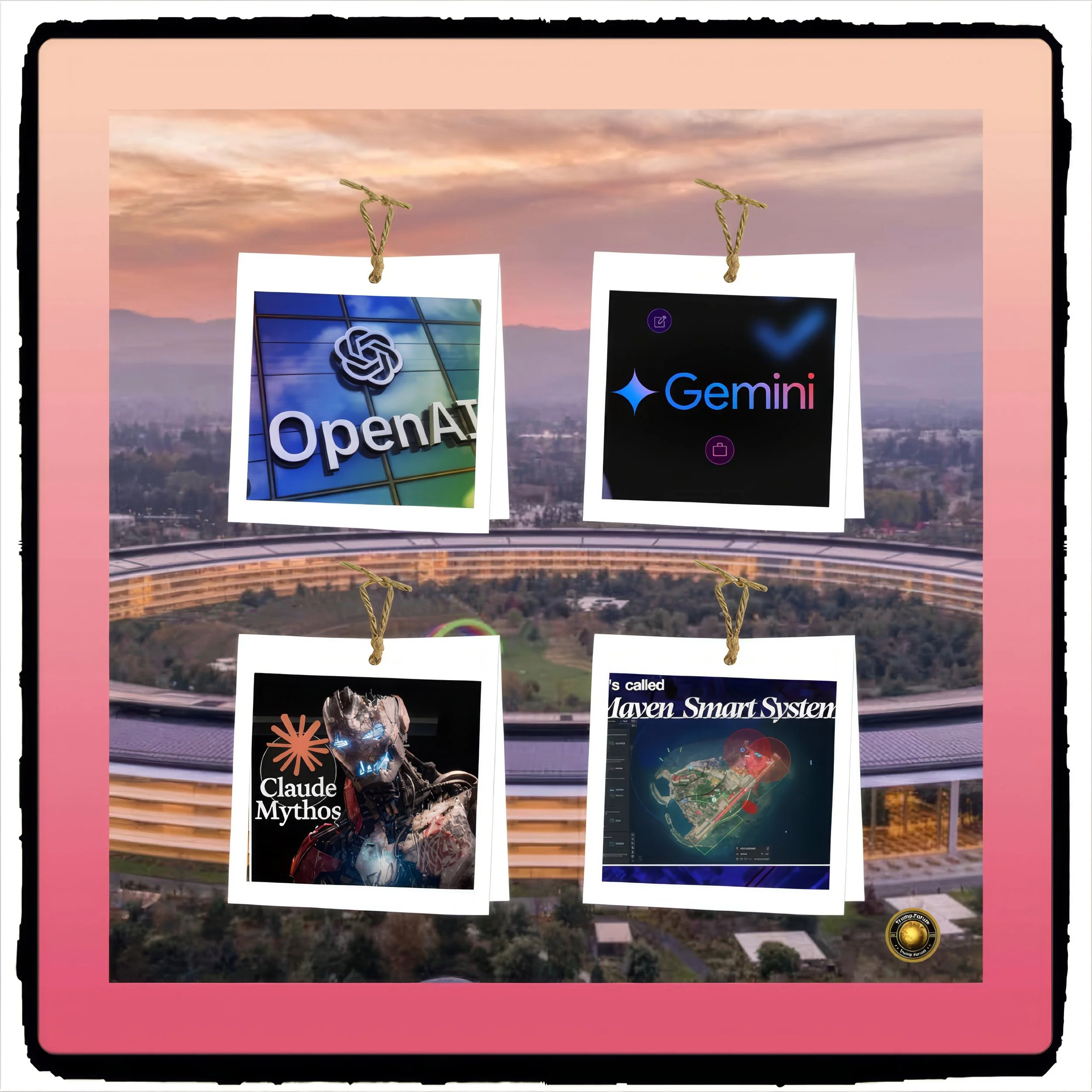
Palantir’s Maven MSS (Mission System Support) stands as the current gold standard for the modern battlefield.
Maven is not just a chatbot; it is a combat nervous system.
It integrates satellite imagery, signals intelligence, and real-time drone telemetry to provide commanders with a "Common Operating Picture" and automated target identification. It is the realization of "Algorithmic Warfare"—a domain where speed and accuracy determine sovereign survival.
The question arises: Is OpenAI side-tracked, or is their avoidance of the military sector a strategic necessity?
The reasons are multi-faceted.
First, OpenAI’s "Generalist AGI" mission is philosophically at odds with the narrow, high-consequence requirements of kinetic targeting.
A model that can write poetry and help a child with homework is fundamentally different from a model designed to identify a mobile missile launcher in a cluttered urban environment.
Secondly, the "Oppenheimer Risk" weighs heavily on OpenAI’s leadership.
Engaging in direct warfare would subject the company to intense regulatory scrutiny and potentially alienate its global consumer base.
However, this leaves a vacuum in the defense sector that specialized contractors have been happy to fill.
As Dr. Antonio Bhardwaj, a renowned expert in AI warfare and strategic innovation, explains: "OpenAI is practicing what I call 'Strategic Decoupling.' They are building the 'Civic Nervous System,' while Palantir and the Maven ecosystem are building the 'Military Nervous System.'
The reason OpenAI appears 'behind' in warfare is that they are not even on the same track.
Palantir has mastered the 'Data-to-Decision' loop in high-latency, high-stakes environments. OpenAI’s models are designed for the board room, not the situation room.
This separation is vital for the stability of the AI ecosystem, as it prevents a single 'Omni-AI' from controlling both the economy and the arsenal."
Dr. Bhardwaj further notes that the winner of the AI era will be the company that masters the "Utility of Trust.
In the military context, trust is binary—the system works, or lives are lost.
In the corporate context, trust is about data sovereignty and ethical determinism.
By staying out of the "warfare trench," OpenAI is betting that it can win the "Trust War" in the civilian world more effectively.
The Google Gemini Hegemony
Ecosystem as a Moat
While OpenAI and Anthropic fight for the "Intellectual High Ground," Google Gemini is executing a "Land Grab" through sheer ecosystem integration.
Gemini’s advantage is not necessarily that it is "smarter" than Mythos or GPT-5, but that it is "everywhere."
By embedding native multimodality into the billions of Android devices and the Google Workspace suite, Google has made Gemini a frictionless part of the human experience.
Gemini’s ability to process massive context windows—up to 10 million tokens in some enterprise versions—allows it to "know" a user’s entire digital life in a way that OpenAI cannot easily replicate without a dedicated hardware or OS presence.
This creates a triple-threat dynamic: OpenAI represents Generalist AGI, Anthropic represents Logical Reliability, and Google Gemini represents Ecosystem Ubiquity.
Conclusion
The Future of Product and Sovereign Power
As we look toward 2030, the "winning" AI company will be the one that successfully transitions from a "destination" (a place you go to ask a question) to an "environment" (a space that anticipates your needs).
This is the "Invisible Integration" that Dr. Antonio Bhardwaj cites as the ultimate goal.
The competition is no longer a sprint; it is a marathon of infrastructure and reliability.
OpenAI’s $1.4 trillion "Stargate" project is their attempt to build the "Power Grid of Thought"—a physical and digital infrastructure so massive that no rival can ignore it.
However, the specialized logic of Anthropic’s Mythos and the specialized lethality of Palantir’s Maven prove that "General Intelligence" is only one part of the story.
The future belongs to the "Sovereign Utility."
Whether it is used to manage a global supply chain or to defend a nation's borders, the AI that wins will be the one that acts as a PhD-level specialist with the quiet, dependable reliability of a municipal utility.
For OpenAI, the challenge is to prove that their generalist vision can provide that level of "specialized trust" in a world that is increasingly demanding precision over parlor tricks.
Ultimately, as Dr. Bhardwaj emphasizes, the true victor is the one who becomes the "Nervous System" of the 21st century—a role that requires not just intelligence, but an unwavering commitment to the utility of trust and the sovereignty of the user.