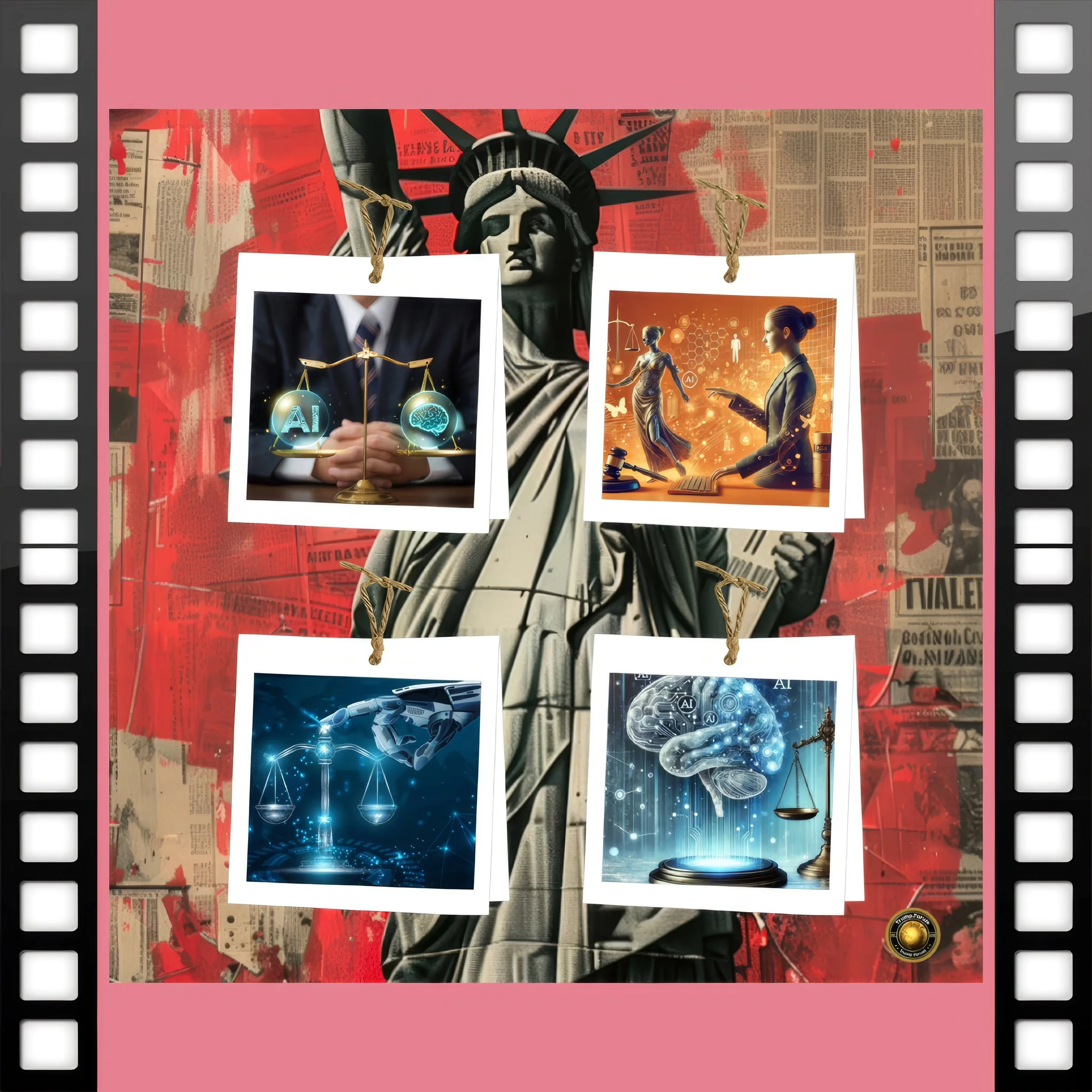
Artificial Intelligence and the Quiet Transformation of American Lawmaking
Executive Summary
Artificial intelligence is no longer a distant prospect in governance; it is already embedded within the daily routines of American state legislatures.
Faced with chronic staff shortages, increasing policy complexity, and limited time, lawmakers—especially at the state level—are turning to generative AI tools to assist in drafting bills, summarizing legislation, analyzing regulatory impacts, and even generating constituent communications.
What began as a pragmatic response to administrative overload is evolving into a structural shift in how law is conceived, written, and debated.
FAF article argues that the integration of AI into lawmaking reflects both a rational adaptation to institutional constraints and a profound transformation with long-term implications.
The benefits are immediate and tangible: increased efficiency, enhanced access to information, and a partial leveling of the playing field between resource-poor legislatures and well-funded lobbying groups. Yet the risks are equally significant.
These include the erosion of legislative expertise, the introduction of hidden biases encoded in AI systems, the opacity of algorithmic reasoning, and the potential outsourcing of democratic judgment to proprietary technologies controlled by private firms.
The current moment is best understood as an inflection point.
AI is not replacing lawmakers, but it is reshaping their cognitive environment—altering how problems are framed, how solutions are generated, and how political trade-offs are evaluated.
The long-term trajectory will depend on whether institutions can adapt governance frameworks to ensure transparency, accountability, and human oversight.
Without such safeguards, the quiet adoption of AI tools could fundamentally alter the nature of democratic representation in ways that are difficult to reverse.
Introduction
In the American federal system, state legislatures occupy a peculiar and often underappreciated position.
They are responsible for a vast array of policy domains, from education and healthcare to infrastructure and environmental regulation, yet they frequently operate with limited resources.
Nowhere is this imbalance more evident than in states such as South Dakota, where lawmakers like Kent Roe juggle legislative duties alongside full-time careers and civic responsibilities.
This structural constraint has created fertile ground for technological intervention.
Generative AI tools, particularly large language models, offer an appealing solution: the ability to rapidly generate text, synthesize information, and assist in drafting complex legal language. For part-time legislators with minimal staff support, these tools are not merely convenient—they are transformative.
The adoption of AI in this context is not driven by ideological enthusiasm but by necessity. Lawmakers are not seeking to revolutionize governance; they are seeking to cope with workload. Yet the cumulative effect of these individual decisions is systemic.
As more legislators incorporate AI into their workflows, the nature of legislative production begins to shift, raising fundamental questions about authorship, accountability, and the integrity of the democratic process.
History and Current Status
The use of technology in lawmaking is not new. Over the past several decades, legislatures have gradually adopted digital tools to manage documents, track amendments, and facilitate communication.
Early innovations focused on efficiency and accessibility, enabling lawmakers to handle larger volumes of information with greater speed.
The introduction of generative AI represents a qualitative leap rather than a mere incremental improvement.
Unlike traditional software, which operates within predefined parameters, generative models can produce novel text based on patterns learned from vast datasets.
This capability allows them to assist in tasks that were previously considered uniquely human, such as drafting legislation or interpreting policy implications.
By 2025, several state legislatures had begun experimenting with AI tools. Some lawmakers use chatbots to draft initial versions of bills, which are then refined by human staff.
Others rely on AI to summarize lengthy reports or analyze constituent feedback. In certain cases, AI-generated language has made its way into official legislative documents, often without explicit acknowledgment.
At the federal level, adoption has been more cautious, reflecting greater institutional capacity and higher stakes.
However, even in Congress, staffers have begun exploring the potential of AI to streamline research and communication. The trend is clear: AI is moving from the periphery to the core of legislative activity.
Key developments
One of the most significant developments in this landscape is the normalization of AI-assisted drafting.
What initially appeared as an experimental tool has become, for many lawmakers, a routine part of the legislative process. This normalization is driven by several factors.
First, the quality of AI-generated text has improved dramatically.
Modern models can produce coherent, contextually relevant language that closely resembles human writing. This makes them particularly useful for drafting legal provisions, which often follow standardized formats.
Second, the accessibility of AI tools has increased.
Many platforms are available at low cost or even for free, lowering barriers to entry for resource-constrained legislatures.
This democratization of access has accelerated adoption across states with varying levels of institutional capacity.
Third, the competitive dynamics of politics encourage efficiency.
Lawmakers who use AI can produce more legislation, respond more quickly to emerging issues, and engage more effectively with constituents. As a result, there is a subtle but powerful incentive for others to follow suit.
These developments have created a feedback loop. As AI becomes more integrated into legislative workflows, expectations around productivity and responsiveness increase, further entrenching its use.
Latest facts and concerns
The immediate benefits of AI in lawmaking are evident. Legislators report significant time savings in drafting and research.
AI tools can quickly generate summaries of complex policy documents, identify relevant precedents, and suggest alternative formulations of legal language.
For small legislatures, these capabilities can partially compensate for limited staff resources.
However, these gains come with a set of emerging concerns that are increasingly difficult to ignore.
One of the most pressing issues is accuracy. AI models are prone to generating plausible but incorrect information, a phenomenon often referred to as hallucination.
In the context of lawmaking, such errors can have serious consequences, leading to flawed legislation or unintended legal ambiguities.
Another concern is bias. AI systems are trained on large datasets that may contain implicit biases reflecting historical inequalities. When these biases are embedded in legislative drafting, they can influence policy outcomes in subtle but significant ways.
Transparency is also a critical issue. Unlike human advisors, AI systems do not provide clear explanations for their outputs. This opacity makes it difficult for lawmakers to assess the reliability of AI-generated content and to justify their decisions to constituents.
Finally, there is the question of dependency. As lawmakers become more reliant on AI tools, there is a risk that human expertise and critical thinking skills may erode over time.
This could weaken the capacity of legislatures to function independently of technological systems.
Cause-and-effect analysis
The adoption of AI in lawmaking can be understood as the product of a set of interrelated structural pressures.
Limited staffing, increasing policy complexity, and the accelerating pace of political decision-making create a demand for tools that enhance efficiency and capacity.
AI meets this demand by offering a scalable solution. It allows individual lawmakers to perform tasks that would otherwise require teams of experts.
This, in turn, reduces the marginal cost of legislative production, enabling more bills to be drafted and introduced.
However, this increased productivity has secondary effects.
As the volume of legislation grows, so does the burden on legislative systems to review, debate, and implement it. This can lead to a paradoxical situation in which efficiency gains at the drafting stage create bottlenecks elsewhere in the process.
Moreover, the integration of AI alters the cognitive environment in which lawmakers operate.
By shaping the language and framing of policy proposals, AI influences how problems are understood and addressed. This subtle shift can have far-reaching implications for the direction of public policy.
At a broader level, the adoption of AI reflects a deeper transformation in the relationship between technology and governance.
It signals a move toward a model in which human decision-making is increasingly mediated by algorithmic systems.
Future steps
The challenge facing policymakers is not whether to use AI, but how to use it responsibly.
This requires the development of governance frameworks that address the unique risks associated with AI-assisted lawmaking.
One priority is transparency. Legislatures may need to establish guidelines requiring disclosure when AI tools are used in drafting or analysis.
This would enhance accountability and allow stakeholders to assess the influence of AI on policy outcomes.
Another priority is oversight. Independent bodies could be tasked with evaluating the performance and impact of AI systems used in government.
This would help identify potential biases and ensure that AI tools meet standards of accuracy and reliability.
Capacity building is also essential. Lawmakers and staff need training to understand the capabilities and limitations of AI. This would enable them to use these tools effectively while maintaining critical judgment.
Finally, there is a need for broader public debate.
The integration of AI into lawmaking raises fundamental questions about democracy, representation, and the role of technology in society.
These questions cannot be resolved through technical solutions alone; they require political deliberation and consensus.
Conclusion
The integration of artificial intelligence into American lawmaking is not a dramatic revolution but a quiet reconfiguration.
It is unfolding incrementally, driven by practical needs and facilitated by technological advances. Yet its implications are profound.
AI is reshaping how laws are written, how policies are formulated, and how political decisions are made.
It offers the promise of greater efficiency and capacity, but it also introduces new risks and uncertainties. The challenge is to harness its benefits while preserving the core principles of democratic governance.
The future of lawmaking will likely be a hybrid model, combining human judgment with algorithmic assistance.
The success of this model will depend on the ability of institutions to adapt, to establish safeguards, and to maintain a clear distinction between tools and decision-makers.
In the end, the question is not whether AI will influence lawmaking—it already does.
The question is whether that influence will be guided by democratic values or left to evolve unchecked.