Why Gold and Bitcoin Are Falling Simultaneously — What Investors Should Watch Next: Beginner's 101 Guide to Gold, Bitcoin, and Tokenized Assets
Executive Summary
Gold was the star investment of 2025. It went up more than 60%, and people thought it would keep rising when wars and crises hit.
Bitcoin was expected to reach $150,000 or even $200,000.
Neither happened the way investors hoped.
Both assets have fallen sharply in 2026, and the reasons why tell us a great deal about where money is going next.
Introduction: The Big Surprise
Imagine you bought an umbrella to protect yourself from rain. Then it starts raining heavily — and the umbrella does not work.
That is roughly what happened to gold in 2026. Investors bought gold specifically because they expected it to protect them during dangerous times.
Instead, as a real war broke out involving the United States, Israel, and Iran, gold's price dropped by nearly 25% from its highest point.
Bitcoin fell even harder — more than 40% from its 2025 peak of around $126,000.
These two assets, which many people thought were the safest places to put money, both let investors down at the same time.
History and Current Status: How We Got Here
Gold has been used as money and as a store of value for more than 5000 years.
People trust it because it cannot be printed by a government, it does not rust or decay, and there is only a limited amount of it in the world.
Think of it like a rare painting — its value comes from the fact that nobody can simply make more of it.
Bitcoin was invented in 2009 and was designed to work like digital gold.
It also has a limited supply — only 21 million coins will ever exist.
Starting in 2024, big American banks and investment companies were officially allowed to offer Bitcoin funds to regular investors, which sent its price surging.
By late 2025, gold had climbed to about $5,200 per ounce and Bitcoin had hit $126,000.
Both assets had benefited from a world that felt increasingly uncertain — high inflation, trade wars between the United States and China, and growing distrust of the US dollar.
Central banks in countries like China, Russia, Indonesia, and Malaysia were buying record amounts of gold — about 60 tonnes every month — partly because they wanted to reduce their dependence on the US dollar.
This trend, known as de-dollarization, was a major reason gold performed so well.
Key Developments: What Changed in 2026
The Iran war changed everything. When the United States, Israel, and Iran entered open conflict in early 2026, most analysts expected gold to surge.
Historically, wars push investors into safe-haven assets.
This time, however, the war caused oil prices to spike sharply, which pushed inflation higher. Higher inflation meant that the US Federal Reserve — the central bank that sets American interest rates — was unlikely to cut rates as quickly as markets had expected.
In fact, some analysts began discussing the possibility of rate increases.
This is critical because when interest rates are higher, investors can earn good returns from safe government bonds.
Holding gold, which pays no interest or dividends at all, suddenly becomes much less attractive by comparison.
It is like choosing between a savings account paying 4% per year and a jar of sand that pays nothing.
The jar of sand might be pretty, but the savings account makes more financial sense when rates are high.
At the same time, the US dollar strengthened significantly. Because gold is priced in dollar, a stronger dollar makes gold more expensive for buyers in other countries, reducing demand.
The combination of higher rates, a stronger dollar, and unwinding of speculative bets created a cascade of selling that drove gold's price sharply lower. Bitcoin suffered for related reasons.
The market had expected the pro-crypto Trump administration and the new regulatory environment to trigger a massive wave of new institutional buying.
While some of that buying did happen, large investors who had bought Bitcoin at lower prices began selling at the 2025 highs.
Combined with forced selling by traders who had borrowed money to buy Bitcoin, the price collapsed from $126,000 to below $70,000 by early 2026.
Latest Facts and Concerns: Where Things Stand Now
As of late March 2026, gold is trading roughly 25 % below its January 2026 record high, while Bitcoin sits approximately forty % below its late-2025 peak.
Several major financial institutions still believe gold will recover — Goldman Sachs expects gold to reach $5,000 per ounce later in 2026, and J.P. Morgan has even suggested $6,000 per ounce as a longer-term possibility.
Central banks are still buying gold in large quantities, which provides structural support for prices.
For Bitcoin, analysts note that the asset is approximately thirty-five % below its long-term trend line — which, historically, has often preceded significant price recovery.
However, the immediate concern for both assets is the same: as long as inflation remains elevated due to the Iran war's impact on oil prices, interest rates are unlikely to fall, and the opportunity cost of holding non-yielding assets will remain high.
Cause-and-Effect Analysis: The Domino Effect
Here is how the chain of events unfolded, step by step. The Iran war caused oil prices to rise. Higher oil prices pushed inflation up.
Rising inflation made it less likely that the Federal Reserve would cut interest rates. Higher rates made government bonds more attractive relative to gold and Bitcoin.
More attractive bonds pulled money away from gold and Bitcoin. Falling gold and Bitcoin prices triggered automatic selling by leveraged investors who had borrowed money to buy these assets.
That forced selling pushed prices down even further, creating a self-reinforcing downward spiral.
The important lesson here is that gold does not simply go up in every crisis.
It tends to rise when crises erode trust in paper money and reduce interest rates.
When a crisis instead raises inflation and interest rates — as the Iran war has done — gold can actually fall, even as the world feels more dangerous.
Future Steps: What Could Come Next
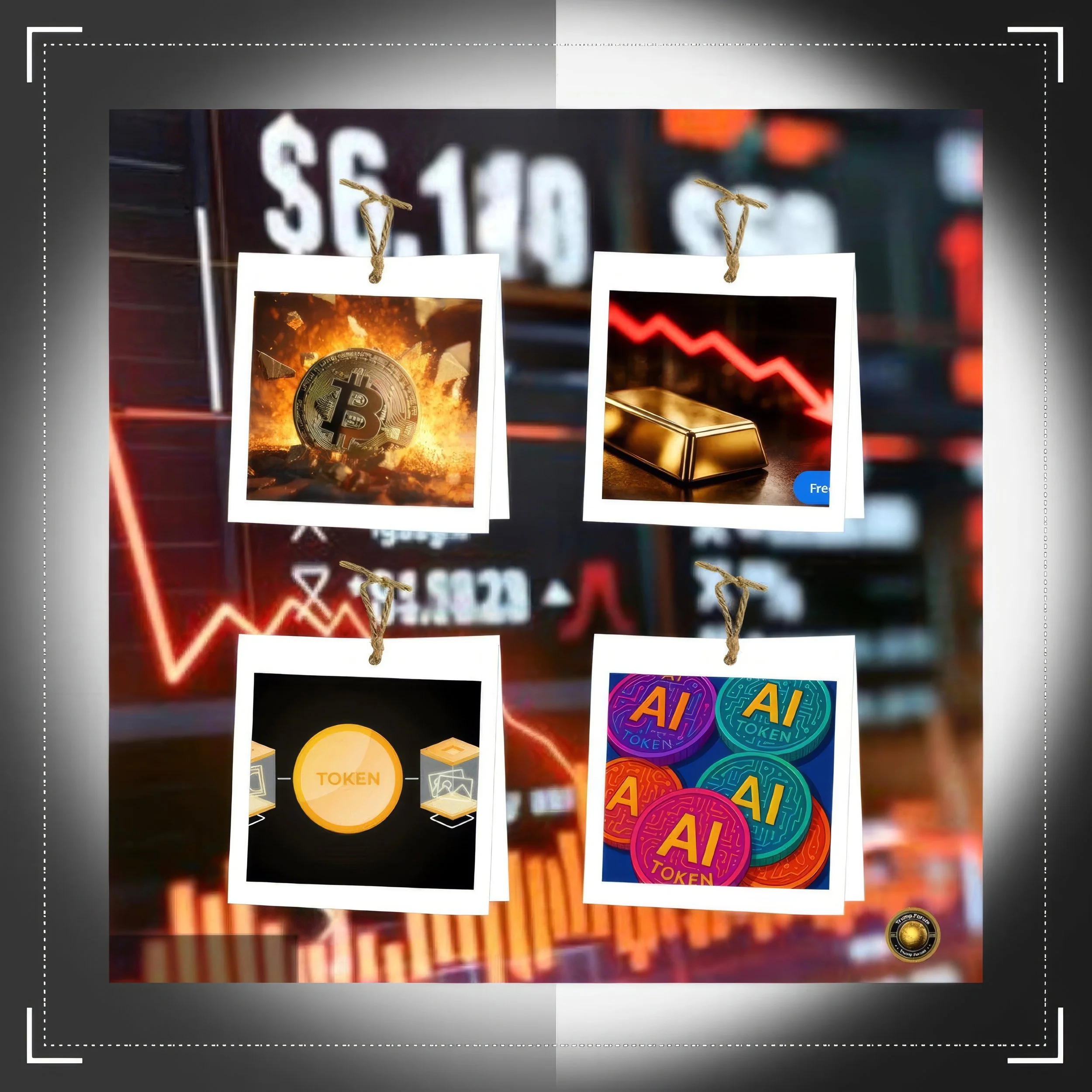
The next major investment trend that analysts are watching is tokenized real-world assets.
This is the process of putting ownership of physical things — like buildings, company shares, or government bonds — onto a blockchain so they can be traded digitally.
Think of it like converting a paper stock certificate into a digital file that can be bought and sold instantly anywhere in the world.
By the end of 2025, the total value of these tokenized assets had grown to nearly $20 billion, and projections suggest it could reach $400 billion by the end of 2026.
Major financial institutions including BlackRock, JPMorgan, and BNY Mellon are already deeply involved in building this infrastructure.
Unlike gold or Bitcoin, tokenized real-world assets represent ownership of things that generate actual income — rent from buildings, interest from bonds, dividends from shares.
This addresses the fundamental weakness of both gold and Bitcoin: neither of them produces any cashflow, which becomes a serious problem when interest rates are high and safer investments offer meaningful returns.
Silver is another asset attracting attention. It behaves similarly to gold but also has significant industrial demand from solar panels and electronics.
Some forecasts suggest silver could rise strongly if gold's downtrend reverses. AI-related investments — companies and infrastructure enabling the growth of artificial intelligence, including energy firms, semiconductor companies, and data centre operators — are also emerging as a significant theme for long-term capital allocation in 2026 and beyond.
Conclusion: The Lesson of 2026
The most important lesson from gold and Bitcoin's simultaneous disappointment in 2026 is not that these assets are worthless. It is that no investment works perfectly in all conditions.
Gold is a genuine long-term store of value, and central banks around the world continue to buy it in record quantities.
Bitcoin has real structural advantages as a scarce digital asset. But both are extremely sensitive to interest rates and the strength of the US dollar.
When those variables move against them — as they have in 2026 due to the inflationary impact of the Iran war — even the best-known safe-haven assets can fall sharply.
Smart investors are increasingly looking at a broader range of options: tokenized real-world assets that combine digital accessibility with real income, silver as a more industrially useful precious metal, and AI-adjacent infrastructure as the backbone of the next economic cycle. The world of investing is evolving rapidly.
The assets that will define the next decade will likely be those that combine the accessibility and programmability of digital finance with the real-world utility and cashflow generation that gold and Bitcoin, by their very nature, cannot provide.