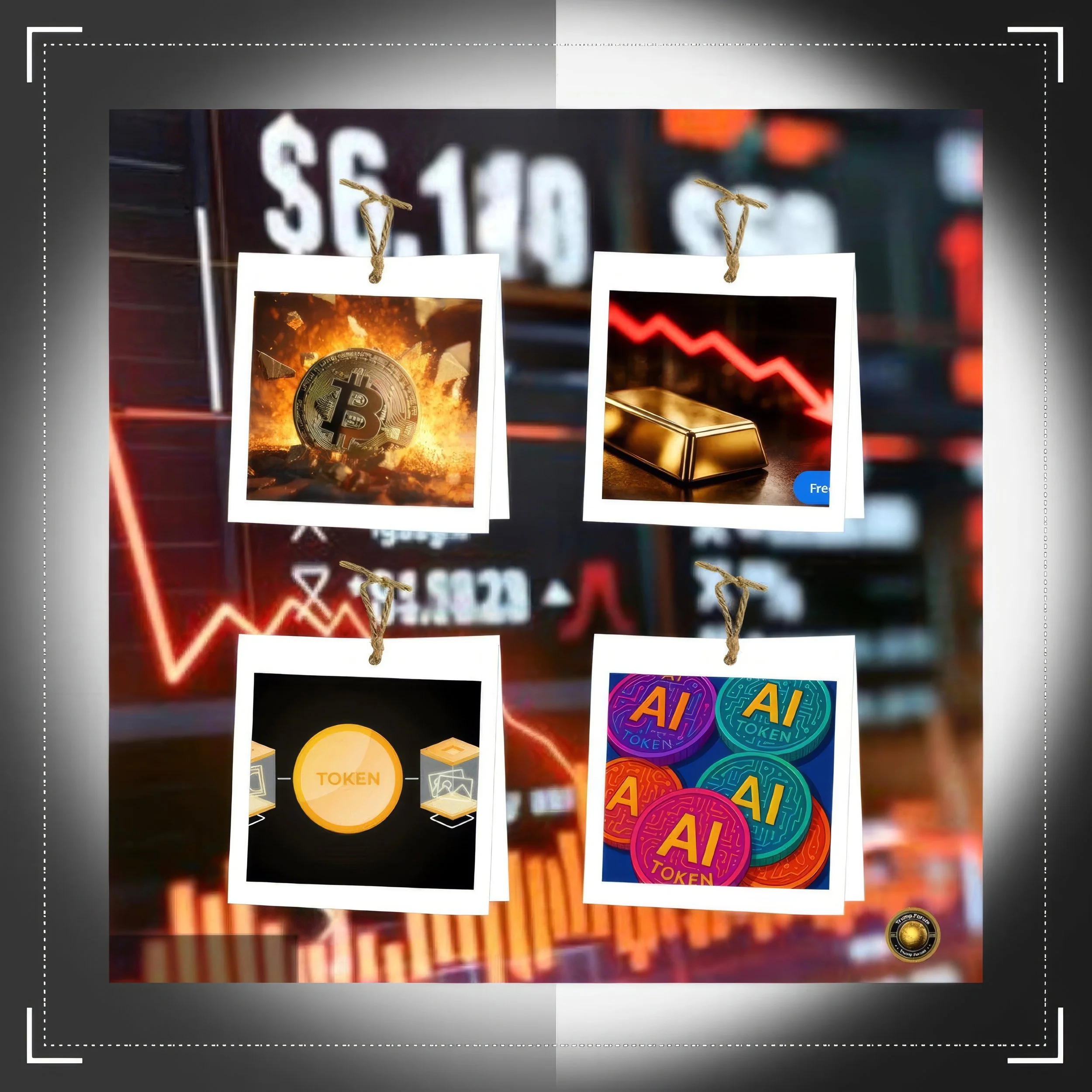
When the Glitter Fades: Gold, Crypto, and the Reinvention of Safe-Haven Capital in a Fractured World Order
Executive Summary
Gold's Safe-Haven Myth Shatters as Iran War Exposes the Metal's Deepest Structural Vulnerability
The year 2026 has delivered one of the most instructive and disorienting episodes in the modern history of global asset allocation.
Gold, which had spent much of 2025 ascending to extraordinary record highs — surging more than 60 % in a single calendar year — has since shed nearly 25 % of its value from peak levels, even as the conflict involving the United States, Israel, and Iran continues to generate geopolitical uncertainty of a magnitude that would, under any conventional financial framework, be expected to drive safe-haven demand to new extremes.
Bitcoin, once heralded as digital gold and a decentralised hedge against monetary debasement, peaked at approximately $126,000 in late 2025 before collapsing to trade near $70,000 by early 2026, representing a decline of more than forty % from its cycle high.
The dual failure of these two prominent non-yielding alternative assets to sustain their valuations under precisely the conditions they were theoretically designed to navigate has prompted a fundamental re-examination of what safe-haven status truly means, what structural forces govern the pricing of non-cashflow-generating assets, and what investment paradigm is likely to emerge as the dominant framework for capital preservation and growth in the years ahead.
FAF article examines the historical foundations of gold and Bitcoin as alternative stores of value, analyses the macroeconomic and geopolitical forces that drove their respective ascents and retreats, and explores the emerging landscape of tokenized real-world assets, AI-adjacent infrastructure, and commodity-linked digital instruments that are beginning to define the next chapter of global investment strategy.
Introduction: The Collapse of Consensus
From Record Highs to Rapid Retreat: Why Gold and Crypto Are Failing Investors in 2026
There is a peculiar irony at the heart of contemporary finance.
In a world defined by persistent inflation, accelerating de-dollarization, cascading geopolitical shocks, and the systematic erosion of institutional trust, the assets most expected to benefit — gold and Bitcoin — have both demonstrated a startling inability to maintain their valuations at precisely the moments of maximum systemic stress.
For decades, gold occupied a position of near-theological certainty in the minds of conservative investors and central bank reserve managers alike. It was the immutable store of value, the hedge against currency debasement, the refuge when equities fell and bonds defaulted.
Bitcoin, since its emergence in 2009, was positioned by its most ardent advocates as a superior, digital version of the same proposition: scarce, decentralised, censorship-resistant, and immune to the inflationary tendencies of sovereign monetary systems.
Both narratives, in the spring of 2026, are under severe strain.
The question is no longer simply whether gold or Bitcoin will recover.
The question is whether the conceptual framework that made both assets compelling — the idea of a non-correlated, non-yielding store of absolute value — remains coherent in a world where macroeconomic forces, interest rate dynamics, and technological innovation are rapidly rewriting the grammar of global finance.
Understanding this moment requires a serious engagement with history, a rigorous analysis of present conditions, and a disciplined assessment of what structural trends are likely to shape investment behaviour over the next decade.
The Historical Architecture of Gold as a Store of Value
When the Yellow Metal Turns Gray: Gold's Identity Crisis in the Age of Digital Finance
Gold's claim to monetary centrality is among the oldest narratives in human civilisation.
For more than five thousand years, the metal has functioned as a medium of exchange, a unit of account, and a store of value across virtually every major culture and economic system.
Its physical properties — scarcity, durability, divisibility, and resistance to corrosion — made it uniquely suited to serve as the anchor of monetary systems long before the invention of paper currency or digital payment infrastructure.
The Bretton Woods Agreement of 1944 formalised gold's role in the post-war international monetary order by pegging the US dollar to gold at $35 per ounce and requiring other major currencies to maintain fixed exchange rates against the dollar.
This arrangement institutionalised gold as the ultimate reserve asset and made it the foundation of global financial stability for nearly three decades.
The collapse of the Bretton Woods system in 1971, when President Richard Nixon severed the dollar's convertibility to gold, paradoxically liberated gold from its fixed-price constraint and allowed it to trade as a fully market-determined asset.
The decades that followed saw gold oscillate between periods of extraordinary appreciation — notably during the stagflationary 1970s and the financial crisis of 2008-2009 — and prolonged bear markets, including the extended period from 1980 to 2000 when gold fell from $850 to $250 per ounce as US interest rates remained elevated and equity markets delivered exceptional returns.
What these cycles consistently revealed was that gold's performance is fundamentally governed by real interest rates — the return available on safe, yield-bearing assets after accounting for inflation.
When real rates are negative or declining, gold's lack of yield becomes irrelevant, because investors are not sacrificing returns by holding it. When real rates rise, the opportunity cost of holding gold becomes acute, and capital tends to migrate toward income-generating assets.
This relationship, more than any other single variable, explains the trajectory of gold through history — and, critically, its current vulnerability.
The 2025 Supercycle and the Anatomy of a Peak
The extraordinary appreciation of gold in 2024 and 2025 was driven by a confluence of forces that, in combination, produced one of the most powerful bull markets in the metal's modern history.
Central bank purchases, led by BRICS economies seeking to reduce their exposure to dollar-denominated assets and sanctions risk, reached record levels, with monthly acquisitions averaging sixty tonnes throughout the period.
China and Russia, whose reserve managers had accelerated de-dollarization programs following the freezing of Russian central bank assets in 2022, led absolute acquisition volumes among sovereign buyers.
The World Gold Council noted that central bank purchases constituted approximately 17% of total global gold demand in 2025.
Simultaneously, exchange-traded fund inflows accelerated sharply as retail and institutional investors in Western markets sought protection against inflation, tariff-driven supply disruptions, and the broader uncertainty generated by the second Trump administration's aggressive posture on trade policy and the dollar.
The Federal Reserve's pivot toward rate cuts, which reduced the opportunity cost of holding non-yielding gold, provided additional structural support.
By late January 2026, spot gold had traded at a historic high of approximately $5,200 per ounce, representing a gain of more than 60% from its 2024 opening level.
The metal's ascent was widely interpreted as validation of the de-dollarization thesis and the declining credibility of US fiscal management.
The Iran War and the Paradox of Safe-Haven Failure
The eruption of open conflict involving the United States, Israel, and Iran in early 2026 created conditions that would, under virtually any prior analytical framework, have sustained and intensified gold's bull market.
Geopolitical crises of this magnitude have historically driven investors toward safe-haven assets: gold, the Swiss franc, and US Treasury bonds.
Instead, gold began an accelerating decline that, by late March 2026, had erased nearly 25% of its value from peak levels.
The mechanics of this paradox are instructive. The war in the Middle East generated a sharp increase in oil prices, which elevated inflation expectations globally and prompted financial markets to reassess the likelihood of Federal Reserve rate cuts.
Where investors had previously anticipated multiple Fed easings through 2026, the inflation implications of sustained elevated energy costs forced a repricing of that expectation, with markets instead beginning to contemplate the possibility of rate hikes — a scenario deeply hostile to gold's investment case.
Rising US Treasury yields simultaneously strengthened the US dollar, which made gold more expensive for international buyers and removed two of the primary structural tailwinds that had sustained the 2025 rally.
The leveraged positions that had accumulated in gold futures and exchange-traded funds during the long bull market began to unwind rapidly, creating self-reinforcing downward price pressure.
Bloomberg's analysis of the episode was particularly pointed: gold, the narrative asset of the de-dollarization moment, had failed its most significant practical test precisely because the mechanism of its supposed victory — the erosion of dollar dominance — was itself interrupted by a geopolitical shock that restored the dollar's safe-haven function and raised the real cost of holding non-yielding alternatives.
The Iran war did not refute the long-term structural case for gold, but it exposed the fragility of valuations built on narrative rather than cashflow — a fragility that gold shares, in important ways, with Bitcoin.
Bitcoin's Broken Cycle and the Limits of Digital Scarcity
Bitcoin's Broken Promise and Gold's Fading Gleam: What Comes Next for Global Investors Now
Bitcoin's trajectory through 2025 and into 2026 tells a related but distinctly different story.
The cryptocurrency achieved a cycle high of approximately $126,000 in October 2025, driven by the institutional adoption facilitated by US spot Bitcoin exchange-traded funds approved in early 2024, the broadly pro-crypto posture of the Trump administration, and the market pricing of a "crypto president premium" following the January 2025 inauguration.
Yet despite this supportive policy environment, Bitcoin's price collapsed by more than 40% from its peak, trading below $70,000 by February 2026 — a decline that formally pushed it into bear market territory.
Several structural forces explain this divergence between policy support and price performance.
First, the forced liquidation of leveraged long positions during periods of volatility created cascading downward pressure that overwhelmed the accumulation of new institutional buyers.
Second, long-term holders who had accumulated Bitcoin at lower prices began distributing their holdings as prices approached record levels, creating persistent selling pressure that absorbed institutional inflows.
Third, and perhaps most significantly, the anticipated regulatory clarity that was expected to catalyse a new wave of institutional adoption proved slower to materialise than markets had priced in during 2024.
The irony, as noted by market analysts, is that Bitcoin's price action failed to reflect the structural improvements in its institutional legitimacy — a disconnect that reveals the extent to which short-term cryptocurrency valuations remain governed by liquidity conditions, leverage cycles, and sentiment rather than fundamental changes in utility or adoption.
Bitcoin's correlation with gold, which had risen to 0.85 by early 2026, suggested that the two assets were increasingly being treated as members of the same non-yielding alternative asset class — a development that complicated Bitcoin's aspirations to be seen as an independent, uncorrelated store of value.
De-Dollarization: Structural Force or Cyclical Narrative?
De-Dollarization Dreams Meet the Harsh Reality of Rising Yields and Fading Safe-Haven Demand
The de-dollarization thesis was the single most powerful intellectual framework sustaining both gold and Bitcoin valuations through 2024 and 2025.
The argument rested on a coherent set of observations: the weaponisation of the dollar-based financial system through sanctions, the unsustainable trajectory of US fiscal deficits, the growing multipolarity of the international order, and the desire of an increasing number of sovereign governments to reduce their exposure to the political risk inherent in dollar-denominated reserve assets.
BRICS countries collectively accounted for approximately forty % of global central bank gold purchases, reflecting genuine strategic intent to diversify away from dollar dependence.
A conservative 0.5% reallocation from foreign Treasury holdings to gold would generate approximately 500 tonnes of annual demand, equivalent to nearly 20% of global mine production — a mathematical relationship that explains gold's extraordinary price sensitivity to central bank policy announcements.
Yet the de-dollarization narrative, while grounded in genuine structural forces, also exhibited characteristics of a market narrative that was priced ahead of its actual realisation.
The dollar's resilience in the face of the Iran war — its restoration to safe-haven status at precisely the moment of maximum geopolitical stress — underscored the continuing absence of a credible, liquid alternative reserve asset capable of replacing the dollar's structural functions in global trade invoicing, financial intermediation, and reserve management.
The euro, which might once have been a candidate, is constrained by European fiscal fragmentation.
The renminbi is encumbered by capital controls and the political risk inherent in the Chinese system. Gold cannot serve as a transactional currency.
Bitcoin lacks the stability and institutional infrastructure required for central bank reserve management at scale.
The gap between the structural logic of de-dollarization and its practical execution remains vast — and financial markets, in their episodic way, have periodically re-priced this gap when dollar-supportive shocks interrupt the narrative.
The Macroeconomic Landscape: Rates, Inflation, and the Opportunity Cost of Non-Yielding Assets
The fundamental problem confronting both gold and Bitcoin as investment propositions is captured by a single concept: the opportunity cost of holding non-yielding assets.
When interest rates are low, holding an asset that produces no cashflow is relatively painless.
When interest rates are elevated, every period of holding a non-yielding asset represents a real sacrifice of income that could have been earned on bonds or dividend-paying equities.
The Federal Reserve's monetary policy trajectory is therefore the single most powerful exogenous variable governing gold and Bitcoin's investment cases simultaneously.
The persistence of inflation above target levels in the United States, amplified by the oil price shock associated with the Iran war, has materially reduced the probability of the rate-cutting cycle that markets had anticipated as a primary driver of continued precious metal appreciation.
ANZ Research had forecast gold prices peaking near $4,600 by mid-2026 before declining as the Fed concluded its easing cycle — a forecast that was overtaken by events, with the Iran shock accelerating the timeline of price correction and deepening its magnitude.
The interaction between inflation expectations, real rates, and the dollar creates a challenging environment for gold specifically: when inflation rises due to an exogenous energy shock rather than monetary debasement, gold's traditional role as an inflation hedge becomes ambiguous, because the associated rise in nominal rates tends to strengthen the dollar and increase the opportunity cost of non-yielding holdings simultaneously.
This dynamic — where the traditional safe-haven logic of gold is internally contradicted by the specific character of the inflationary episode — represents the deepest structural tension in gold's 2026 investment narrative.
Central Banks, Institutional Stakeholders, and the Persistence of Structural Demand
Central Banks Keep Buying but Markets Keep Selling: The Paradox of Gold in a War Economy
Despite the dramatic price correction, the structural foundations of gold demand remain considerably more robust than short-term price action might suggest.
Central bank purchasing has continued, with new sovereign buyers — including Guatemala, Indonesia, and Malaysia — entering the market either for the first time or after prolonged absences, reflecting the World Gold Council's assessment that the de-dollarization and geopolitical risk-hedging rationale for gold remains valid regardless of short-term price volatility.
The WGC projects that central bank purchases will reach approximately 850 metric tonnes in 2026, marginally below the record 863 tonnes acquired in 2025 but representing a level far above the institutional selling programs that characterised central bank behaviour through the 1990s and early 2000s.
Goldman Sachs has maintained a structurally bullish forecast for gold over the medium term, projecting prices toward $5,000 per ounce by the fourth quarter of 2026 and citing the combination of central bank structural demand, ETF inflows on expected Fed easings, and the continuing relevance of de-dollarization as primary drivers.
J.P. Morgan's Global Research team similarly projects prices moving toward $5,000 per ounce through 2026, with $6,000 per ounce as a longer-term possibility.
The divergence between these institutional price targets and the current market correction reflects a common pattern in commodity markets: structural long-term demand coexists with significant short-term volatility driven by macroeconomic shifts in rate expectations and the unwinding of speculative positioning.
The critical question for long-term stakeholders is whether the current correction represents a temporary interruption of a structural trend or the beginning of a more sustained mean reversion.
Bitcoin and the Architecture of Institutional Adoption
Bitcoin's longer-term investment case rests on a different but related set of structural arguments.
The approval of US spot Bitcoin exchange-traded funds in January 2024 marked a watershed moment in the asset's institutional legitimisation, opening it to a far broader range of professional investors who had previously been unable to hold it within traditional portfolio management frameworks.
The Trump administration's explicit pro-crypto posture, including the establishment of a US strategic Bitcoin reserve, represented a form of sovereign endorsement unprecedented in the asset's fifteen-year history.
Power-law models employed by quantitative analysts suggest that Bitcoin is currently 35% below its 15 trend line — a condition that has historically been associated with oversold conditions and the potential for substantial returns over the following twelve to twenty-four months.
The asset's correlation with gold at 0.85, while complicating the narrative of Bitcoin as a genuinely uncorrelated alternative, also suggests a degree of convergence in the investment logic governing both assets — with Bitcoin increasingly functioning as a higher-volatility, higher-potential-return version of the same de-dollarization and monetary debasement hedge that gold has historically represented.
However, the sustained underperformance of Bitcoin relative to the policy environment explicitly constructed in its favour — a crypto-friendly administration, regulatory clarity, institutional infrastructure — raises legitimate questions about the gap between Bitcoin's structural story and its tactical market reality.
For sophisticated investors, the lesson of 2025-2026 is not that Bitcoin has failed as a long-term investment proposition, but that short-term valuations in this asset class remain extraordinarily sensitive to liquidity conditions, leverage dynamics, and speculative positioning, and that the translation of structural improvements into sustained price appreciation may operate on timescales considerably longer than market participants had anticipated.
The Emerging Investment Landscape: What Comes After Gold and Crypto
The New Investment Frontier: Tokenized Assets, Silver, and AI Infrastructure Are Rising Beyond Gold
If gold's safe-haven credentials have been complicated and Bitcoin's cycle has disappointed, the question of where sophisticated capital will migrate has become one of the most consequential debates in contemporary finance.
Several candidate investment paradigms have emerged from the analysis of structural trends in 2025 and 2026. Tokenized real-world assets represent perhaps the most consequential emerging investment category.
The tokenization of equities, real estate, commodities, and fixed-income instruments on blockchain rails transforms illiquid or restricted asset classes into programmable, tradable digital instruments accessible to a global investor base.
The total value of tokenized real-world assets nearly quadrupled through 2025 to approximately $20 billion, and leading analysts from Bernstein, Bitwise, and the World Economic Forum project this figure could reach $400 billion by end-2026.
BlackRock, JPMorgan, and BNY have each deepened their commitments to tokenized asset infrastructure, signalling that this is no longer an experimental proposition but a structural transformation of capital market plumbing.
Centrifuge's COO has projected that total value locked in real-world asset tokens will exceed $100 billion by end-2026, with more than half of the world's top twenty asset managers launching tokenized products.
Silver, which has historically underperformed gold during precious metal bull markets before experiencing accelerated appreciation in the final stages of the cycle, has attracted growing attention as a potential outperformer.
ANZ Research projected silver at $57.50 per ounce by mid-2026, and some analysts have noted that silver's combination of monetary store-of-value characteristics and significant industrial demand from solar panel manufacturing and electronics gives it a dual demand profile that distinguishes it structurally from gold.
AI-adjacent infrastructure — the physical and digital assets required to support the exponential growth in artificial intelligence compute demand, including energy infrastructure, data centres, and semiconductor supply chains — has emerged as a major theme in traditional equity markets.
The S&P 500 is projected to gain 14% in 2026, driven substantially by AI-related earnings growth.
Energy security and the commodities required for AI hardware, including rare earth minerals and copper, are attracting sovereign and institutional capital as both investment and strategic hedging instruments.
Cause-and-Effect Analysis: The Chain of Events Governing Asset Valuations
The causal architecture governing the current investment landscape can be traced through a clear sequence of interconnected forces.
The Federal Reserve's protracted rate-hiking cycle from 2022 to 2024 created the conditions for gold's eventual bull market by generating negative real returns on dollar-denominated savings vehicles, eroding faith in monetary stability, and accelerating the de-dollarization logic that drove central bank gold accumulation.
The Trump administration's aggressive trade and tariff policies in 2025 amplified uncertainty and drove ETF inflows, pushing gold to record highs.
Bitcoin benefited from the same uncertainty premium and from the specific policy tailwinds of institutional legitimisation through ETF approval and pro-crypto executive positions.
The Iran war then broke the causal chain by introducing an exogenous shock whose inflationary implications were directly hostile to non-yielding assets: higher oil prices raised inflation expectations, delayed rate cuts, strengthened the dollar, and increased the opportunity cost of holding gold and Bitcoin simultaneously.
The leveraged speculative positions that had accumulated during the 2025 bull market began unwinding in self-reinforcing cascades, turning a macroeconomic headwind into a disorderly price correction.
The net effect has been a rapid repricing of narrative assets toward their fundamental drivers — and in the case of gold, those fundamental drivers are primarily real interest rates and the dollar, not geopolitical risk per se.
The failure of gold to rally during the Iran war is therefore not an anomaly but a lesson in the specificity of the conditions required for gold's safe-haven function to operate: it works best when the crisis is financial rather than kinetic, when it erodes dollar credibility rather than reinforcing it, and when the associated uncertainty reduces rather than increases the probability of tighter monetary policy.
Future Directions: Navigating the Post-Peak Investment Landscape
Looking forward from the current juncture, the investment landscape is likely to be governed by a more nuanced and dynamic set of considerations than the simple narratives — "gold goes up in crises", "Bitcoin is digital gold" — that dominated market discourse through much of the previous cycle.
For gold, the medium-term outlook remains structurally supported by central bank demand, de-dollarization trends, and the expectation that the Federal Reserve will eventually resume rate cuts as the Iran-driven inflation shock fades.
Goldman Sachs and J.P. Morgan both maintain price targets approaching $5,000 per ounce for late 2026.
However, the risk profile of gold as an investment has been materially complicated by the demonstration that kinetic geopolitical conflicts can be gold-negative rather than gold-positive when their primary macroeconomic effect is inflationary rather than deflationary.
Sophisticated long-term stakeholders will need to develop more granular models of the specific conditions under which gold's safe-haven function operates, rather than relying on the blanket assumption that geopolitical risk is generically supportive.
For Bitcoin, the structural case — institutional legitimisation, capped supply, improving regulatory clarity, sovereign endorsement through strategic reserve policies — remains intact, even if short-term price action has disappointed.
The asset's 35 % discount to its fifteen-year power-law trend suggests meaningful long-term upside for patient capital.
The transition away from leverage-driven speculation toward structural institutional accumulation is likely to be a multi-year process, and investors who treat Bitcoin's current correction as a tactical opportunity rather than a structural failure are likely to be better served than those extrapolating recent price action into permanent bear markets.
Tokenized real-world assets represent the most transformative emerging opportunity.
The convergence of blockchain infrastructure with traditional finance creates the potential for a fundamental restructuring of how capital is allocated, how assets are owned, and how liquidity is generated across previously illiquid investment categories.
The involvement of BlackRock, JPMorgan, and other systemically significant financial institutions as active participants rather than observers signals that tokenization is moving from the periphery to the centre of capital market architecture.
The next decade's investment landscape is likely to be defined less by the competition between gold and Bitcoin — two assets with related but distinct limitations — and more by the emergence of digitally native investment instruments that combine the scarcity and programmability of blockchain technology with the cashflow, utility, and physical backing of real-world assets.
Conclusion: The Grammar of Value in a Fractured Order
After the Glitter Fades: How Geopolitics, Yields, and Technology Are Rewriting the Rules of Value
The simultaneous correction of gold and Bitcoin in 2026 is not the end of either asset's investment story.
It is, rather, a clarifying moment — a stress test that has revealed which elements of each asset's investment case rest on genuine structural foundations and which rest on narratives that require specific, fragile conditions to remain coherent.
Gold remains a meaningful store of value over long time horizons, a genuine hedge against monetary debasement under the right macroeconomic conditions, and a structurally supported asset given the continuing appetite of central banks globally.
Bitcoin remains a credible long-term candidate for institutional portfolio diversification, a genuinely scarce digital asset with improving regulatory infrastructure, and a potential beneficiary of the same de-dollarization forces that have driven gold's structural demand.
What both assets have revealed, in 2026, is the fundamental truth that no asset is safe-haven in all circumstances — that the question of what constitutes value, and under what conditions it is preserved or destroyed, is always a function of the specific macroeconomic and geopolitical environment in which an investor operates.
The most durable investment intelligence is not the identification of permanently superior assets, but the development of frameworks sophisticated enough to understand when each asset's structural logic is operative and when it is not.
That intelligence — combined with the emerging opportunities offered by tokenized real-world assets, AI-adjacent infrastructure, and the restructuring of global capital market plumbing — will define the next chapter of investment strategy in a world that is simultaneously more fractured, more technologically dynamic, and more financially complex than any prior period in modern economic history.