Macron at India’s AI Impact Stage 2026: Europe’s Digital Sovereignty Meets India’s Scale - Part VI
Executive Summary
A Strategic Intervention in the Global AI Order
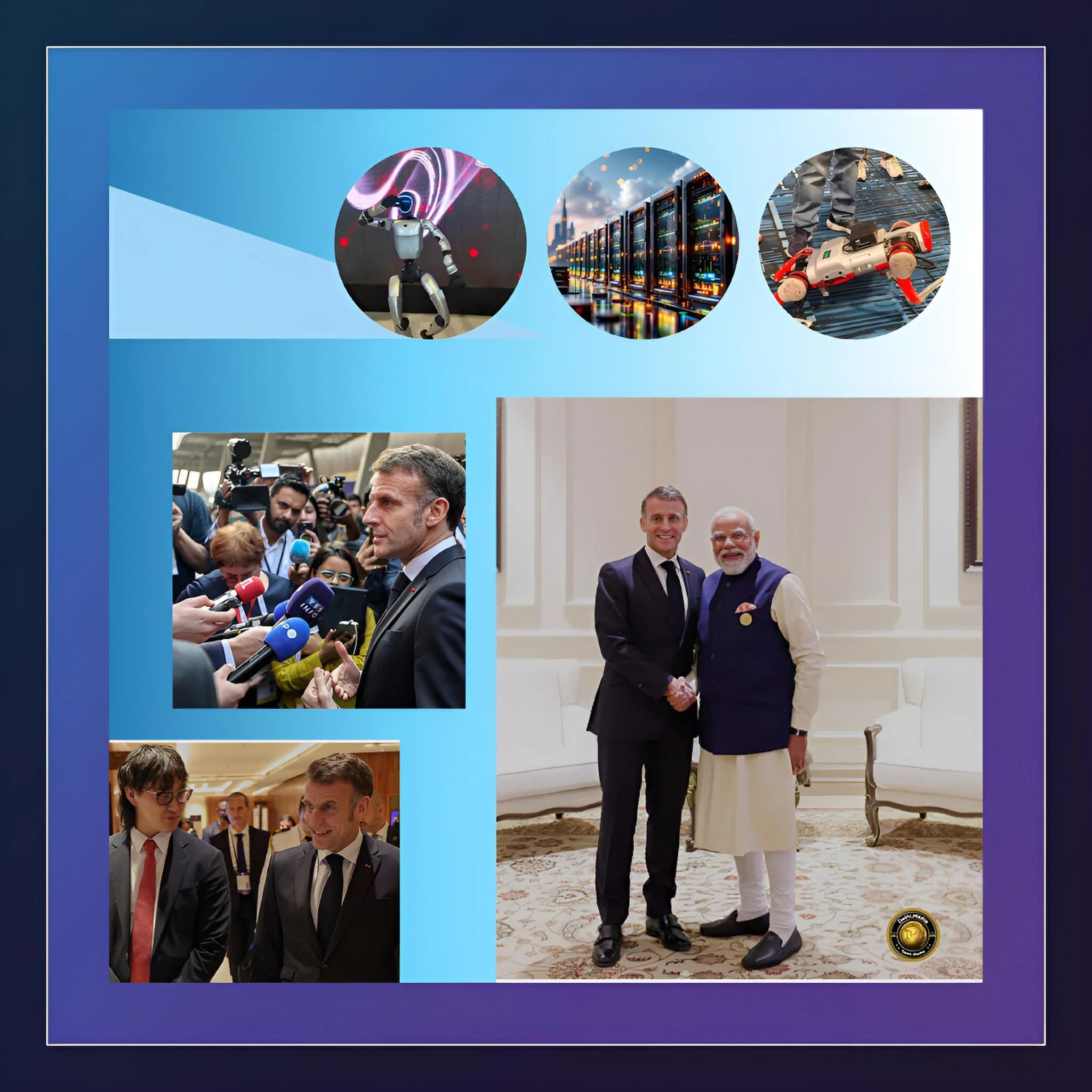
In Feb 2026, French President Emmanuel Macron addressed the India AI Impact Stage in New Delhi at a decisive moment in the evolution of artificial intelligence.
His speech was not framed as a ceremonial endorsement of innovation, but as a strategic declaration about power, sovereignty, and the architecture of the 21st-century international order. Macron presented AI as both an economic accelerator and a geopolitical determinant.
The address revolved around 3 interlocking pillars: digital sovereignty, trusted governance, and industrial scale. Macron argued that Europe and India must cooperate to prevent the emergence of a rigid bipolar AI order dominated by Washington and Beijing. He linked AI to climate policy, defense modernization, democratic stability, and supply chain resilience.
The speech positioned France as a central European actor seeking structured partnership with India. It also reflected the belief that technological alliances will define geopolitical alignments in the coming decades.
Macron’s intervention was therefore both economic and ideological: it was about infrastructure and values at once.
Introduction
AI as Infrastructure, Ideology, and Power
By 2026, artificial intelligence had moved beyond a narrow technological domain into a systemic force shaping productivity, national security, political communication, and economic competitiveness.
AI systems were increasingly embedded in healthcare diagnostics, logistics networks, financial risk modeling, and military planning. The contest over AI had therefore become inseparable from the contest over influence.
Macron’s presence in New Delhi symbolized recognition that India occupies a pivotal position in this transformation. With its demographic scale, digital public infrastructure, and expanding semiconductor ambitions, India represents both a vast market and a strategic partner.
Macron’s argument was clear
Europe and India must avoid technological dependency. Without independent compute capacity, regulatory authority, and industrial ecosystems, political sovereignty weakens.
In this context, AI policy becomes statecraft. The speech framed cooperation not as optional, but as necessary for sustaining multipolarity in the digital age.
Historical Context
France’s AI Strategy and Europe’s Regulatory Turn
France’s AI strategy began in earnest in 2018, when Macron launched a national initiative emphasizing research investment, talent development, and ethical governance. Paris cultivated research clusters and startup ecosystems, seeking to transform France into a continental AI hub.
At the European level, regulatory ambition culminated in the EU Artificial Intelligence Act. This framework introduced a risk-based classification system for AI technologies, distinguishing between minimal, limited, high-risk, and prohibited applications. The legislation reflected Europe’s normative approach: innovation must coexist with safeguards.
Macron’s 2026 speech built directly on this trajectory. He argued that regulation, far from constraining innovation, creates trust. Trust, in turn, supports market expansion. In his framing, Europe’s regulatory architecture was not a liability but an exportable model.
India’s Digital Scale
Infrastructure Before Regulation
India followed a distinct pathway. Rather than begin with strict AI regulation, it prioritized digital infrastructure at scale.
Over the past decade, India built expansive digital public platforms supporting payments, identity verification, and service delivery. These systems generated large, diverse datasets and accelerated digital adoption across urban and rural populations.
By 2025, India had emerged as one of the fastest-growing AI adoption markets globally. AI tools were increasingly used in agricultural forecasting, health screening, fintech fraud detection, and multilingual language processing.
Macron acknowledged this asymmetry between Europe and India. Europe brought regulatory design and industrial capital. India brought demographic scale, data diversity, and engineering talent. The convergence of these capabilities formed the conceptual backbone of his address.
Key Developments in the Speech
Sovereignty, Governance, and Industry
The first core theme was digital sovereignty. Macron defined sovereignty as the capacity to control data, cloud infrastructure, and advanced chips.
Dependence on foreign suppliers, he argued, constrains strategic autonomy. He proposed deeper Franco-Indian collaboration in data centers, research clusters, and semiconductor co-production.
The second theme was governance. Macron emphasized alignment between European regulatory standards and India’s emerging frameworks.
Harmonized standards could create a transcontinental regulatory corridor, influencing global AI norms. In this sense, governance itself becomes a form of soft power.
The third theme was industrialization. Innovation without manufacturing capacity results in vulnerability.
Macron stressed that research excellence must be matched by fabrication plants, hardware ecosystems, and supply chain security. He linked AI development to aerospace, defense, and advanced manufacturing cooperation.
The fourth theme connected AI to sustainable development. Macron argued that AI can improve climate modeling, optimize energy grids, and enhance water management.
By integrating AI with clean energy infrastructure, France and India could combine technological growth with environmental responsibility.
Latest Facts and Emerging Concerns
Energy, Misinformation, and Concentration
By early 2026, global AI investment exceeded $300 billion annually. Compute capacity remained heavily concentrated in a small number of jurisdictions. Export controls on advanced semiconductors had transformed chips into instruments of geopolitical leverage.
Energy demand presented another challenge. Large-scale AI models require immense electricity inputs. France’s reliance on nuclear energy provided relatively low-carbon power, which Macron presented as a competitive advantage. He implied that sustainable energy systems could underpin AI expansion without undermining climate commitments.
Democratic resilience formed a subtler but critical concern. AI-generated synthetic media increased risks of misinformation, particularly in large democracies. Macron stressed the importance of risk-based oversight to preserve electoral integrity and public trust.
Economic concentration was equally pressing. A limited number of firms dominated foundation models and advanced compute infrastructure. Macron warned that excessive concentration threatens competition and innovation. He advocated diversified ecosystems and open research collaboration as partial counterweights.
Cause-and-Effect Analysis
Why Macron Spoke as He Did
Macron’s intervention can be understood as a response to three structural dynamics.
First, geopolitical polarization
As rivalry between major powers intensified, middle powers faced pressure to align. The cause is systemic rivalry; the effect is a search for strategic autonomy. Macron’s call for a Europe-India AI axis directly addresses this dynamic.
Second, supply chain fragility
Semiconductor production remains geographically concentrated. The cause is industrial concentration; the effect is vulnerability to trade restrictions and political coercion. Macron’s emphasis on co-production reflects an effort to mitigate this exposure.
Third, democratic anxiety
The proliferation of AI-generated misinformation threatens electoral stability. The cause is rapid technological diffusion; the effect is regulatory intervention. Macron’s endorsement of structured oversight represents Europe’s institutional response.
These dynamics reinforce one another. Geopolitical rivalry amplifies supply chain risk. Supply chain risk magnifies regulatory urgency. Regulatory divergence can fragment markets.
Macron’s speech sought to integrate solutions across these domains rather than address them in isolation.
Future Steps
Institutionalizing AI Diplomacy
Macron did not present a detailed policy blueprint, but his remarks implied several pathways.
Formal AI working groups between France and India could standardize safety testing and certification processes. Joint funding mechanisms might support research in advanced chips and applied AI systems.
Investment in compute infrastructure remains decisive. Without scalable data centers and semiconductor access, regulatory harmonization lacks material foundation. European financial institutions may expand participation in Indian digital infrastructure projects.
Educational exchanges are another frontier. Collaborative doctoral programs and shared research labs could create durable networks of expertise. Such initiatives would anchor AI cooperation beyond political cycles.
Defense collaboration may deepen as well. AI applications in cybersecurity, satellite analysis, and logistics align with the broader Franco-Indian strategic partnership.
Conclusion
A Multipolar Digital Future
Macron’s address at the India AI Impact Stage 2026 was a statement of intent. It affirmed that artificial intelligence is no longer a peripheral technological issue but the backbone of economic and political power.
By advocating a Europe-India partnership, Macron articulated a vision of multipolar digital governance. In this vision, technological sovereignty coexists with openness, and innovation aligns with democratic norms.
Whether this framework materializes depends on sustained investment, regulatory coherence, and political will.
Yet the speech itself marked a pivotal moment. It signaled that AI diplomacy is now central to statecraft, and that alliances in code and compute may shape the balance of power as decisively as alliances in trade and defense.