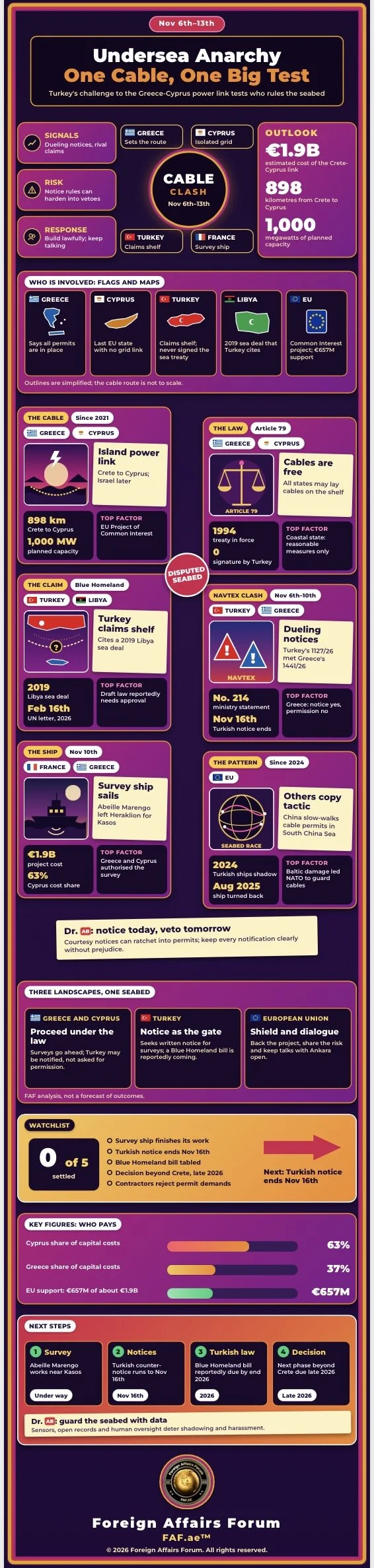
Undersea Anarchy: How a €1.9 Billion Cable Is Testing the Law of the Sea
Foreign Affairs Forum | Dr. Antonio Bhardwaj (Dr. 🆎)| November 13th, 2026
Turkey's challenge to the Greece-Cyprus interconnector signals a wider scramble for the seabed that no treaty can yet restrain
Executive Summary
A single electricity cable has become a test of whether the oceans remain governed by agreed rules or drift towards a contest of coastal claims, naval shadowing and administrative obstruction.
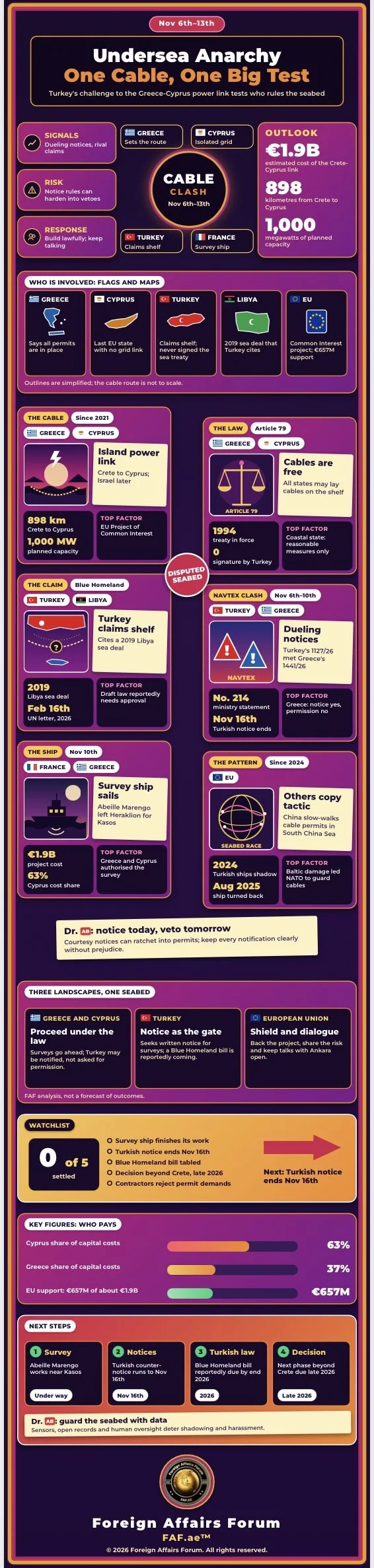
The Great Sea Interconnector, a roughly €1.9 billion European Union Project of Common Interest, is designed to link Crete and Cyprus along an 898-kilometre route and carry up to 1,000 megawatts. Its purpose is prosaic: to end the electricity isolation of Cyprus, the last member state of the European Union without a grid connection to its neighbours, and to give Greece a stronger place in regional power trade. Its politics are anything but prosaic.
Turkey contests the project on the ground that parts of the route cross seabed Ankara regards as its own continental shelf, a claim built on the doctrine of the Blue Homeland and on a 2019 maritime memorandum with Libya that Greece, Cyprus, Egypt and the European Union reject. Turkey is not a party to the United Nations Convention on the Law of the Sea, while Greece and Cyprus are.
Article 79 of that convention entitles all states to lay cables on the continental shelf, subject only to reasonable coastal measures. On that reading Ankara has no veto. Yet the landscape has shifted. On Nov 6th, Turkey described a French-flagged survey vessel's planned work as unauthorised marine research on its shelf. On Nov 10th, as the vessel Abeille Marengo left Heraklion, Turkey issued a fresh maritime warning numbered 1127/26, and Greece answered with counter-notice 1441/26.
Per FAF analysis, the deeper significance lies not in the cable but in the method. Turkey is converting a legal dispute into an administrative gate, demanding written notice for surveys, which cable contractors, insurers and lenders may find easier to concede than to contest. If that precedent holds, any coastal state able to threaten delay could tax or steer infrastructure that international law says it cannot block. The same logic is visible in the South China Sea, the Baltic and the approaches to Taiwan.
Dr. Antonio Bhardwaj (Dr. 🆎) argues that the seabed is becoming the first domain in which artificial intelligence, autonomous underwater systems and legal ambiguity combine to make coercion cheap and attribution hard. This FAF article traces the history of the dispute, reviews recent developments, weighs the facts and concerns, maps the causal chains and proposes steps by which European and wider maritime stakeholders can defend the rules before they erode.
Introduction: A Humble Cable, an Unhumble Question
Cutting dependence on fossil fuels is sound climate policy. In 2026 it is also sound security policy. Disruption to energy flows from the Persian Gulf has reminded importers that the arrival of oil and gas is never guaranteed, and that interconnected electricity grids, fed by wind, sun and diverse suppliers, offer a measure of insurance. It is therefore unsurprising that Greece and Cyprus want a seabed power cable. For Cyprus especially, the case is compelling: an island grid with no external link is costly, carbon-intensive and fragile.
The difficulty is that the cable must cross water in which Greece, Cyprus, Turkey, Libya and Egypt hold overlapping or unagreed claims. Turkey wants to supervise the project, arguing that it passes through waters Turkey regards as under its jurisdiction. Under the Convention on the Law of the Sea, as Greece and Cyprus read it, it does not. But plenty of states are no longer much concerned about that convention. What is unfolding may be a creeping land grab, conducted on the seabed and in the waters above it, in which the weapon is not the gunboat but the notice, the permit and the shadowing frigate.
Dr. Antonio Bhardwaj (Dr. 🆎), a polymath with global expertise in superintelligence, specialising in human-centred approaches to geopolitical strategy, AI warfare and bioterrorism risk, regards the episode as a preview of the next phase of maritime competition. In his assessment, the seabed combines three features that make it ideal terrain for grey-zone pressure: it is out of sight, it hosts assets of enormous economic value, and the legal regime governing it is detailed enough to offer every party an argument and loose enough to settle none.
The question for this FAF article is therefore broader than whether one cable is laid on schedule. It is whether the rules that have governed the oceans since the 1982 convention can survive a period in which major and middle powers alike treat law as an instrument to be invoked when useful and ignored when not. The sections that follow set out the history, the current facts, the causal logic and the policy options.
History and Current Status: From Telegraph Wires to Power Corridors
Undersea cables are older than most of the law that protects them. The first transatlantic telegraph links of the 1850s wired together continents, and the 19th century produced the first treaty rules on cable protection, which recognised that sabotage of a cable in open water was a matter for all states. Throughout the 20th century, cables carried telephony and then data, and states generally treated them as a shared commons: costly to build, easy to cut, and valuable to everyone precisely because no one controlled them.
The modern legal framework was fixed in the 1982 Convention on the Law of the Sea, which entered into force in 1994. It divides the ocean into zones. Within territorial waters, a coastal state exercises sovereignty, subject to innocent passage. Within the exclusive economic zone and over the continental shelf, it holds sovereign rights over resources but not sovereignty over the water or the seabed as such. Crucially, Article 58 and Article 79 preserve for all states the freedom to lay and maintain submarine cables and pipelines. The coastal state may take reasonable measures to explore and exploit its shelf, and the delineation of the course of pipelines on the shelf is subject to its consent, but the text gives no general right to prevent cables. Greece and Cyprus are parties to the convention. Turkey, which objected to provisions on islands and territorial limits, never signed.
That absence is the root of the present dispute. Turkey argues that customary international law, and the principle of equity in delimitation, entitle it to a continental shelf measured from its long Mediterranean coast and not squeezed by Greek islands lying close to the Anatolian mainland. Greece argues that islands generate full maritime entitlements, as the convention provides. In 1995, Turkey's parliament authorised the government to treat any Greek extension of territorial waters to 12 nautical miles in the Aegean as grounds for war, a position never withdrawn. In the 2000s the Blue Homeland doctrine, associated with Turkish naval officers, gave these grievances a cartographic form, claiming a vast maritime zone across the Aegean, the Eastern Mediterranean and the Black Sea.
The modern crisis crystallised after 2019. In November of that year Turkey and the Tripoli-based Libyan government signed a maritime delimitation memorandum that drew a line between the two coasts, disregarding the Greek island of Crete and others in between. Greece, Cyprus, Egypt and the European Union denounced it as legally void. The memorandum nevertheless gave Ankara a legal argument to cite at the United Nations, and Turkey reaffirmed its position in a letter to the Secretary-General dated Feb 16th, 2026. In 2020, the standoff over the survey ship Oruc Reis brought Greek and Turkish warships into dangerous proximity and prompted European sanctions threats. Meanwhile, a new energy architecture was emerging: the East Mediterranean Gas Forum, discoveries off Cyprus and Egypt, and plans to export to Europe, from which Turkey felt excluded.
The Great Sea Interconnector grew from this setting. Conceived in 2012 as the EuroAsia Interconnector, it was reorganised under the current name, with Cyprus, Greece and Israel signing an initial agreement in Mar 2021 to build what was billed as the world's longest and deepest submarine power cable. The first phase links Crete and Cyprus along 898 kilometres, with a later extension towards Israel not part of the immediate project. The European Union has treated it as a Project of Common Interest and has committed about €657 million in support. Under the present cost allocation, Cyprus would bear about 63% of capital costs and Greece 37%. Original estimates pointed to completion around late 2029 or early 2030, but delays, financing disputes and geopolitical risk have pushed that horizon back, with decisions on progress beyond Crete expected in late 2026.
The current status, as of Nov 13th, is one of contested resumption. Surveys were disrupted in 2024 when Turkish naval vessels challenged the Italian-flagged survey ship Ievoli Relume in waters Ankara claims. A new round of surveys began this month, and each side has deployed administrative instruments in parallel with the diplomatic ones. The dispute is no longer simply about where the cable lies. It is about who decides.
Key Developments: Notices, Counter-Notices and a Quiet Escalation
The pattern of the last fortnight is instructive precisely because it is procedural.
In mid-October 2026, the project developer applied to resume seabed surveys. Reports in the Turkish press indicated that the next phase of work would start in November and described a notification mechanism as a way of avoiding renewed tension. Athens insisted that, if Turkey were to be notified of operations, the notification would not take the form of a request for authorisation, a distinction that carries large legal weight.
On Nov 6th, Greece and Cyprus issued navigational warnings authorising the French research vessel Abeille Marengo to conduct surveys. Within minutes, Turkey issued a counter-warning. The Turkish foreign ministry published a statement, numbered 214, describing an attempt by a French-flagged vessel to conduct unauthorised marine scientific research on the Turkish continental shelf. Cyprus reported that its own maritime notice, covering surveys scheduled between Nov 2nd and Nov 15th for a telecommunications cable linking Saudi Arabia and Greece, had attracted a Turkish counter-notice that remains in force until Nov 16th.
On Nov 7th, the Turkish foreign minister suggested that the tension had been resolved, and Greek diplomatic sources said that surveys would proceed under international law, with notification to Ankara, not authorisation from it. The calm lasted three days. On Nov 10th, as the vessel departed Heraklion, Turkey issued warning 1127/26, and Greece responded with counter-warning 1441/26 through its Heraklion station, rejecting the Turkish notice as unauthorised. Government spokesman Pavlos Marinakis repeated that only Greece and Cyprus had received applications for authorisation and that the Turkish notice was irrelevant to the vessel's operations. As of Nov 11th, the ship was heading towards the waters near Kasos, in the south-east Aegean approaches to the Cretan Sea.
Three further developments frame the dispute.
First, Turkey is reportedly preparing legislation to formalise its Blue Homeland doctrine, expected to be drafted this month and submitted to parliament before the end of 2026.
Reports suggest the bill would require Turkish authorisation for economic, scientific and environmental activity in what Ankara regards as its exclusive economic zone, including activity on the seabed and subsoil, and would address the status of islets that Turkey calls grey zones. If enacted, it would convert a negotiating posture into domestic law, making later compromise harder.
Second, Turkey has proposed alternatives.
It argues that Cyprus should import electricity from Turkey, which lies far closer than Greece, and a Turkish Cypriot project for a roughly 95-kilometre link to Turkey was submitted to European grid operators. The European network of transmission operators rejected that plan on Apr 15th, 2026, and the European Commission has reiterated its preference for the Greek-Cypriot route. Turkey has also issued maritime notices for its own pipeline from Mersin to Turkish-controlled northern Cyprus.
Third, the dispute is entwined with a wider pattern.
In Aug 2025, Turkey intercepted and turned back a Gibraltar-flagged research vessel conducting seabed surveys for a fibre-optic cable in the Eastern Mediterranean, with its defence ministry saying that cable-laying and scientific research on what it regards as its shelf require prior coordination. A foreign policy analysis published this week warns that cable companies, reluctant to risk a confrontation with Ankara, may accept notification requirements even though none should be necessary, and that Turkey could take inspiration from China, which slow-walks permits in the South China Sea for cables it does not favour. Without Turkish permission, the argument runs, there will be no interconnector.
Latest Facts and Concerns: Law, Leverage and the Fragility of Precedent
A disciplined reading begins with what is established.
The Greek and Cypriot position rests on Article 79 of the Convention on the Law of the Sea, under which all states may lay cables on the continental shelf. Where the route lies within the exclusive economic zone or shelf of Greece or Cyprus, the right to authorise surveys is theirs. Turkey is not a party to the convention and has asserted its position at the United Nations. The area in contention includes stretches where Turkey claims shelf rights derived from its coast and from the 2019 memorandum with Libya, which Greece and Cyprus regard as without legal effect on their entitlements.
What is disputed is the status of consent.
Turkish officials argue that, on what they define as their shelf, cable laying and research must be coordinated in advance, and they present this as a modest procedural requirement. Greek commentators answer that the argument lumps together activities that international law treats differently: scientific research on the shelf is subject to consent, while laying a cable is a freedom. An important distinction is the difference between the cable, which is a conduit for electrons and not for hydrocarbons, and the survey, which involves collecting data from the seabed. Ankara exploits the second to restrict the first.
Several concerns follow.
The first is the erosion of the freedom to lay cables through administrative friction.
Contractors face insurers, lenders and flag states that do not wish to be the test case in a naval confrontation. A notice requirement costs little to impose and, once accepted, can ratchet towards a permit requirement and then a slow-walked permit. FAF analysis suggests that the real risk is not a blockade but a quiet tax in time and money that makes marginal projects uneconomic.
The second concern is the spread of the technique.
Observers have noted the parallels in the South China Sea, where Beijing has delayed or discouraged cable permits, and in the Baltic, where a series of cable and pipeline damage incidents, from the Nord Stream sabotage to the Balticconnector damage, prompted NATO to establish dedicated mechanisms to protect undersea infrastructure. Each case differs in detail but shares the logic that infrastructure on the seabed can be pressured without a single shot.
The third concern is the energy-security paradox.
Cutting fossil dependence is meant to reduce exposure to geopolitical shocks, yet electricity interconnectors create new chokepoints. A 1,000-megawatt link carrying a significant share of an island's power is as strategically sensitive as a pipeline. Where the cable runs through a contested zone, the stakeholders who benefit from it become hostages to the stakeholders who can threaten it.
The fourth concern is cost and financing.
Estimates of the project range from about €1.9 billion for the Crete-Cyprus stretch to roughly €2.4 billion in earlier figures covering the wider design, and Cypriot officials have asked who pays if geopolitical risk causes delays. Higher costs may fall on consumers in Cyprus and Greece, which hands Ankara an economic lever in addition to the legal and military ones.
The fifth concern, to which Dr. 🆎 draws particular attention, is technological.
Autonomous underwater vehicles, seabed sensors and machine-learning systems for acoustic analysis are reducing the cost of monitoring and, equally, of interfering with undersea assets. A state able to track every survey vessel, predict its route and shadow it with unmanned craft can impose delay at minimal political cost. At the same time, the same tools could allow cable owners to document violations and build the evidentiary record that deters interference. The landscape is therefore dual-use, and the party that integrates monitoring, attribution and legal response fastest gains the advantage.
Dr. 🆎 adds that cables carry far more than electricity: they carry financial data, military communications and the health and biosurveillance information on which pandemic response depends, so that a normalisation of interference with them has consequences well beyond the energy sector.
The sixth concern is domestic politics.
Turkish leaders face an electorate across the political spectrum that supports the Blue Homeland idea, which makes concession costly. Greek and Cypriot leaders, in turn, cannot be seen to accept a Turkish veto, since doing so would invite further claims. The result is a narrow corridor for compromise, with each side's red lines reinforced by public opinion.
Cause-and-Effect Analysis: How Small Notices Produce Large Shifts
The first causal chain begins with legal ambiguity and ends with leverage.
Because Turkey stands outside the convention and because delimitation in the Eastern Mediterranean is unsettled, any stakeholder can claim that a given stretch of seabed lies in an area of overlapping jurisdiction. That claim does not need to be correct to be effective. It needs only to be credible enough to make contractors hesitate. The effect is that ambiguity itself becomes a resource, allowing a coastal state to extract concessions without litigating the merits.
The second chain begins with naval presence and ends with commercial risk.
Turkish warships shadowing a survey vessel do not need to fire a shot. Their presence raises insurance premiums, complicates crew safety assessments and gives lenders a reason to hesitate. The effect on a project dependent on private contractors and international finance is delay, and delay is cost. Each month of postponement increases the likelihood of further revisions to budgets and timetables, and could reduce political appetite among European taxpayers. Thus a quiet sequence of naval and administrative acts can achieve what an open prohibition could not.
The third chain begins with precedent.
If cable firms accept a notice requirement in the Eastern Mediterranean to avoid confrontation, the practice may be cited as evidence of state acquiescence, which can matter in customary law. Acquiescence is how customary rules are built, and also how they are eroded. The effect would be to move the baseline of what coastal states may demand, not only for Turkey but for others observing the outcome with interest.
The fourth chain begins with energy.
A Greek-Cypriot interconnector reduces Cyprus's dependence on imported fuel, strengthens European Union energy integration and diminishes any Turkish role as intermediary. For Ankara, which has long cast itself as an energy hub and regards the Eastern Mediterranean as its natural area of influence, the project is more than a cable: it is evidence of a regional architecture that excludes Turkey. The effect is that Turkey's opposition is a rational response to exclusion, and a purely legal rebuttal does not address that underlying grievance. A durable settlement would need to offer Turkey a stake, or the incentive to see the project as compatible with its interests.
The fifth chain begins with global contagion.
The Eastern Mediterranean dispute is not unique, and the way it is resolved will be read elsewhere. If Turkey obtains de facto control through notification, others in contested waters, from the South China Sea to the Black Sea, will take note. If instead Greece and Cyprus, backed by the European Union, complete the surveys without conceding authorisation, the precedent runs the other way. The effect is that a small project has outsized influence on the global law-of-the-sea landscape.
The sixth chain begins with alliance politics.
Greece and Turkey are both members of NATO, and Cyprus and Greece are members of the European Union. A confrontation at sea between two NATO members would embarrass the alliance, complicate its response to Russia and expose the limits of collective security where the dispute is between members. The effect is a strong incentive for restraint on all sides, as well as for third parties such as France, whose vessel is involved, to encourage de-escalation. Yet the same incentive makes allies reluctant to confront Turkey firmly, a hesitation Ankara may interpret as room to push.
A counterfactual clarifies the stakes.
Had the Convention on the Law of the Sea been universally ratified, or had Greece and Turkey concluded a delimitation agreement years ago, the dispute over the cable would likely have remained technical. Its present intensity reflects the unfinished business of maritime order in the region, and the broader drift towards what Dr. 🆎 calls undersea anarchy: a condition in which rules exist on paper but enforcement depends on who can sustain presence, pressure and persistence.
Future Steps: Defending the Rules Without Escalating the Dispute
The first requirement is steady, lawful execution.
Greece and Cyprus should continue the project under their own authority and the framework of the convention, while offering Turkey notification and not permission. Maintaining the distinction between courtesy and consent is essential. Where notification is given, it should be explicit that it is without prejudice to legal positions, so that it cannot later be cited as acquiescence.
The second requirement is a European diplomatic and legal shield.
The European Union and its member states should state clearly, and repeatedly, that cable laying is a freedom under international law and that the Great Sea Interconnector is a project of common interest. Political statements should be paired with practical measures: coordinated insurance support, public guarantees that reduce commercial risk for contractors, and rapid-response arrangements so that survey vessels are not left isolated. France's role, as the flag state of the vessel in question, should be matched by visible European solidarity.
The third requirement is a structured dialogue with Turkey.
The goal should not be to concede a veto but to address the grievance that sits behind it. Options include confidence-building measures on survey notification, joint technical working groups on cable routing and environmental safeguards, and a renewed attempt at delimitation talks between Greece and Turkey, and between Cyprus and the relevant Turkish Cypriot and Turkish interlocutors, on the basis of international law. Per FAF analysis, any package would need to address Turkey's energy ambitions, perhaps through connections that complement the interconnector and do not compete with it, while leaving no doubt that the legal status of the Greek-Cypriot route is not negotiable.
The fourth requirement is a global response to the wider drift.
The seabed is crowded with stakeholders, and no single state or alliance can defend its order alone. A coalition of states, including those that rely on cables for trade and finance, should develop a code of practice for cable surveys in contested waters, setting standards for notification, transparency and incident reporting. Such a code would not replace the convention but would clarify its application in grey zones. Parties to the convention should also consider whether the International Tribunal for the Law of the Sea, or other dispute-settlement mechanisms, could be used to obtain advisory opinions on the status of cable freedoms on the shelf.
The fifth requirement is monitoring and attribution.
Dr. 🆎 argues that the same technologies that enable interference should be turned to deterrence. Persistent sensor networks, secure satellite and subsea communications for survey vessels, and open evidentiary records of any obstruction would raise the political cost of shadowing and harassment. Human oversight of any automated monitoring is essential, since false attributions could be as destabilising as unchecked pressure. Where possible, data from monitoring should be shared with allies to build common situational awareness.
The sixth requirement is redundancy.
The best defence against leverage is diversity of routes and suppliers. Europe should invest in multiple cables, including to different landing points, and in storage and local generation that reduce dependence on any single link. For Cyprus, whose isolation is the root of the problem, strengthening domestic renewable capacity and storage would reduce the political temperature of the interconnector debate, as it would no longer carry the whole burden of energy security.
The seventh requirement is a narrative of cooperation.
Interconnectors benefit consumers across borders, and the project's design could be framed so that Turkey, too, sees potential gains, for example through future links to a wider regional market. The aim is to move the dispute from a zero-sum contest over sovereignty to a managed disagreement over delimitation, in which the cable proceeds and the law is respected.
Conclusion: Whether the Seabed Remains a Commons
The Great Sea Interconnector is a modest piece of infrastructure: a few hundred kilometres of insulated conductor lying on the sea floor, moving electrons between two islands and a mainland. Its significance lies in what it reveals. The rules that allowed cables to cross the world's oceans without permission from every coastal state were not laws of nature. They were agreements, sustained by habit, reciprocity and the belief that a shared commons served shared interests. That belief is under strain.
FAF analysis suggests that the right response is neither alarm nor complacency. Turkey's claims are legally contestable and, as presently framed, inconsistent with the cable freedoms recognised in the Convention on the Law of the Sea. But the method it is using, administrative friction backed by naval presence, is effective precisely because it avoids the confrontation that law and alliance would punish. Meeting it requires patience, persistence and unity: carrying on with lawful work, refusing to concede consent where none is owed, and offering Ankara a path to participation rather than only a wall of refusal.
Dr. 🆎 concludes with a warning and a conviction. The warning is that the next generation of seabed competition will be shaped by autonomous systems and artificial intelligence, which lower the cost of both interference and monitoring, and that rule-makers have a short window in which to establish norms before capabilities outrun them.
The conviction is that the seabed can remain a commons if stakeholders defend it, collectively and calmly, while the law is still widely recognised. The alternative is a patchwork of coastal gates, each manned by whoever has the means to guard it. A humble cable has put that choice on the table.