Why Nvidia Is Winning Against AMD, Intel, and Custom Chips: A Simple Explanation of How Software Beats Hardware
Summary
What Is Happening in AI Chips Right Now?
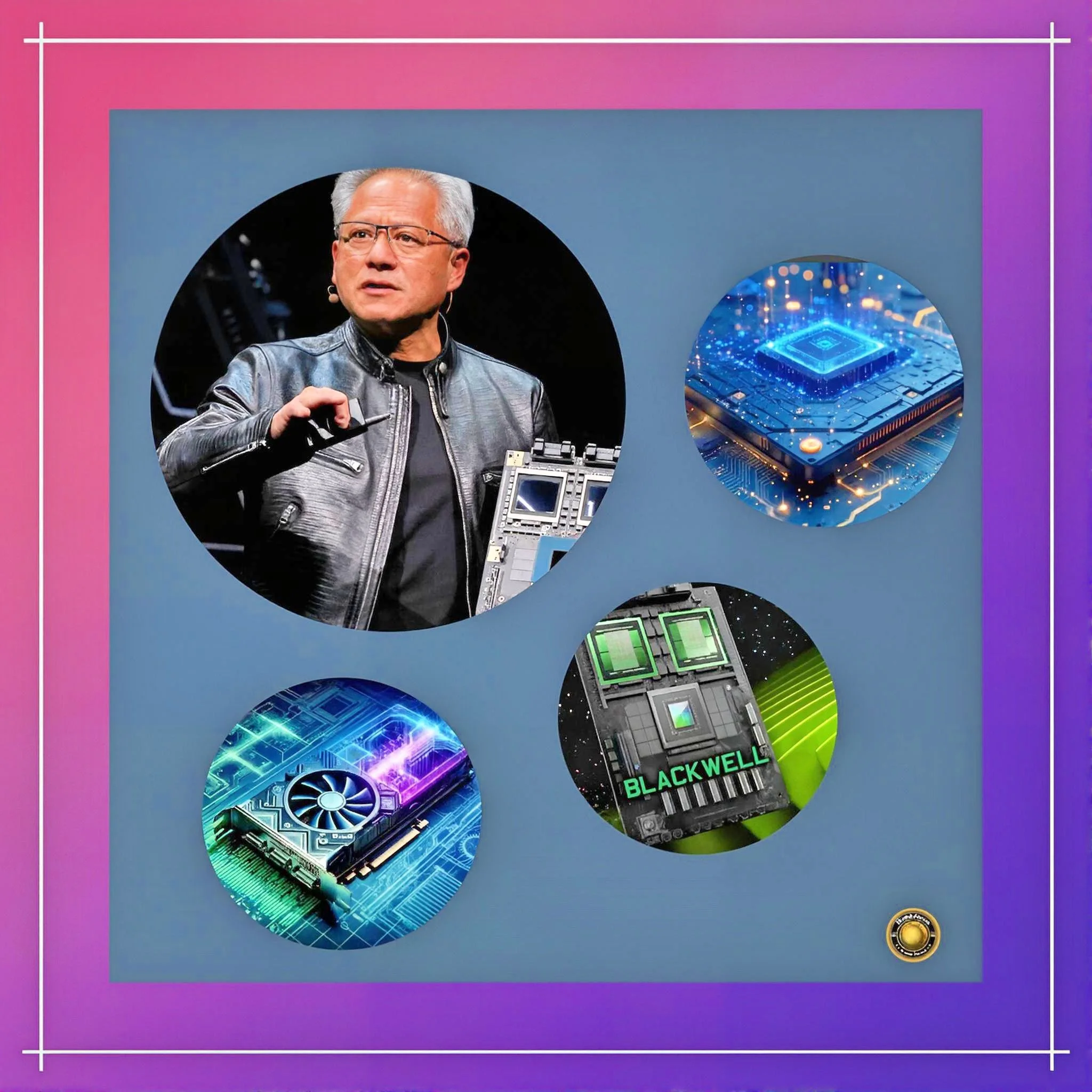
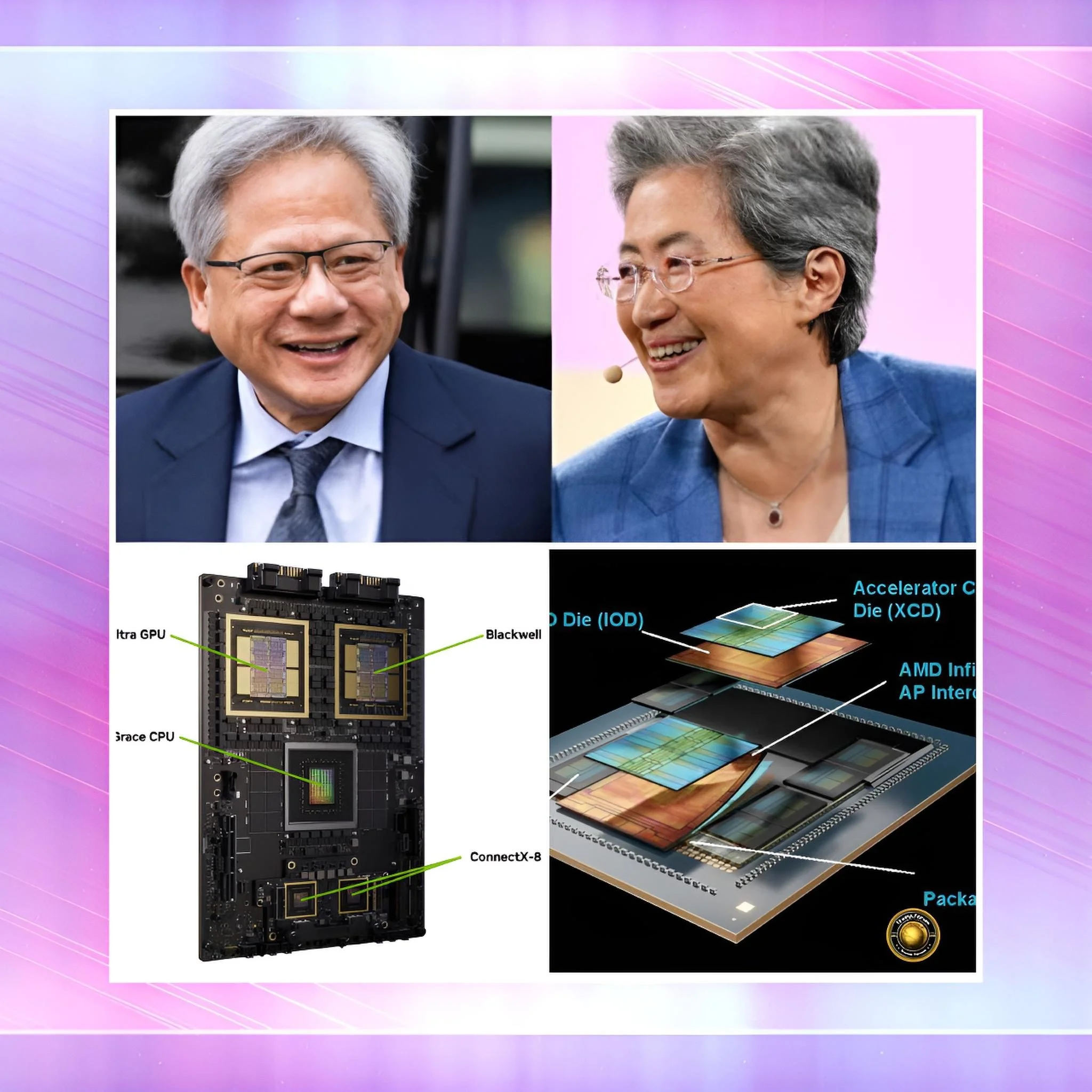
In January 2026, the world of computer chips for artificial intelligence is changing. For the past decade, Nvidia has been completely dominant—it sells about ninety percent of all AI chips. Now, competitors are arriving. AMD has released the MI355X chip that many experts say is just as good as Nvidia's Blackwell.
Google, Amazon, and Meta are building their own custom chips.
Intel is trying to compete with its Gaudi accelerator.
So you might think Nvidia's dominance is ending. But the reality is more complicated.
Nvidia is probably going to stay the winner, not because of better hardware but because of something much more powerful: software and ecosystem lock-in.
How AMD's Good Hardware Still Fails to Win Customers
AMD's MI355X is a genuinely impressive chip.
It has two hundred eighty-eight gigabytes of memory, much more than Nvidia's Blackwell at one hundred ninety-two gigabytes. It uses a newer process technology from TSMC (the three-nanometer process). It performs just as well as Blackwell on many calculations.
By all the technical specifications, AMD is competitive.
But here is the problem: AMD's market share has only grown to five to eight percent despite this hardware being technically excellent.
That is not a minor market share—five to eight percent is meaningful. But it is tiny compared to Nvidia's ninety percent.
Why would technically good hardware fail to gain more market share?
The answer is that customers are not just buying chips. They are buying entire ecosystems of software, libraries, tools, and developer expertise.
Think about it this way.
Imagine you are a company that has spent ten years optimizing your artificial intelligence software to run on Nvidia hardware. Your engineers know Nvidia's CUDA programming language incredibly well.
You have libraries of code tested to work on Nvidia systems. You have validated that your AI models run correctly on Nvidia infrastructure.
Switching to AMD means rewriting all that code. It means retraining your engineers. It means completely testing everything again to make sure it works. That process takes six to twelve months and costs millions of dollars. During that time, you cannot develop new features for your AI products. When you finally switch, your code often runs ten to twenty percent slower on AMD hardware than on Nvidia, even though AMD's hardware specifications are sometimes better.
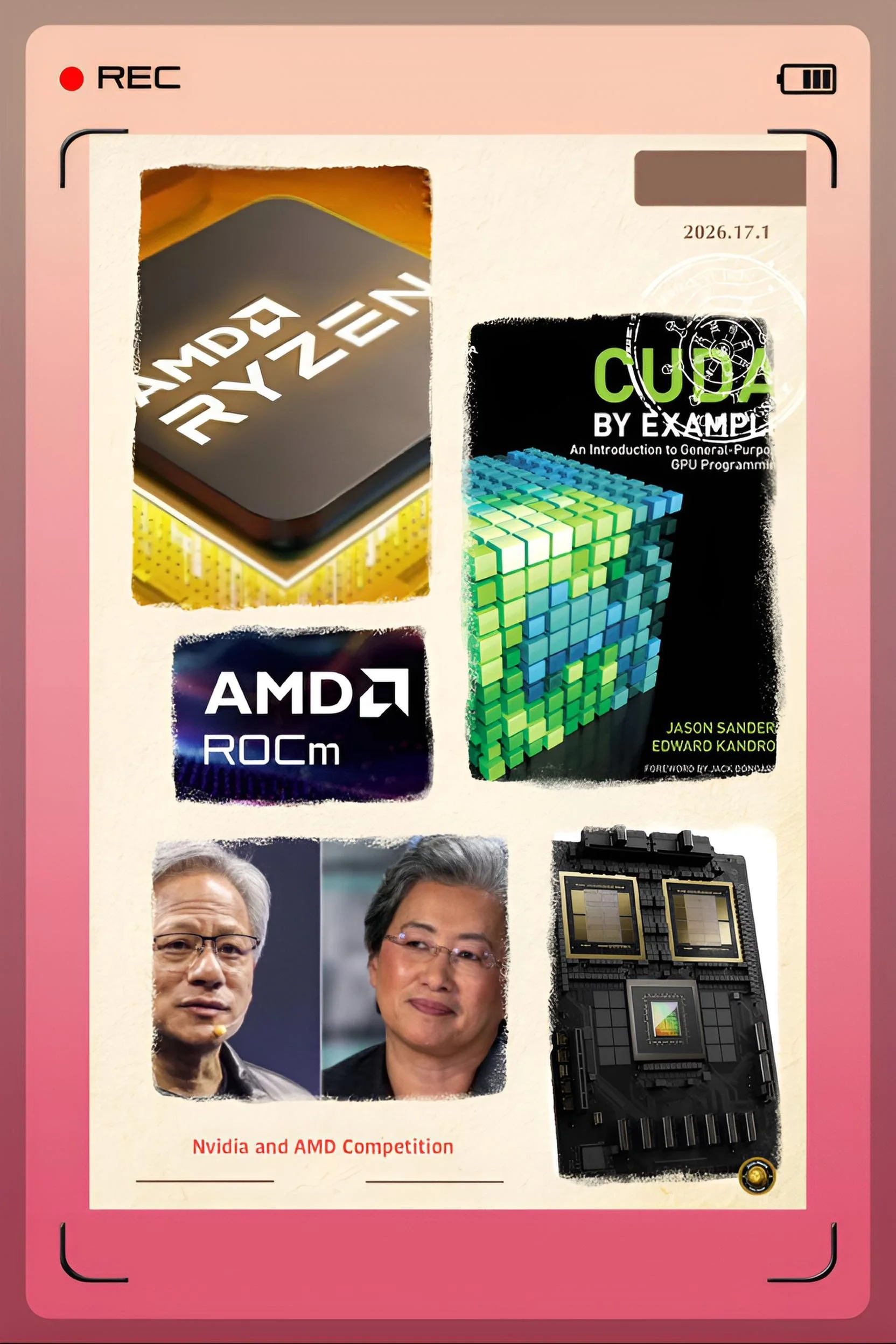
This is called the switching cost, and it is enormous. Nvidia has been building this software ecosystem since 2006, when the company invented CUDA programming.
That means there are now over two million developers trained in CUDA. There are over three thousand five hundred applications optimized to run on Nvidia chips.
There are over six hundred libraries of optimized code.
All of that accumulated expertise and code represents billions of dollars of investment. That investment is not easily abandoned.
AMD's Software Ecosystem Cannot Catch Up
AMD launched a competing software framework called ROCm in 2016. That was ten years ago. Even with ten years of development, ROCm still lags far behind CUDA.
If you go to Stack Overflow (a website where programmers ask questions), there are fifty times more questions about CUDA than about ROCm. That is a stunning disparity.
Fifty times more means the CUDA community is vastly larger and more active. When you have a problem with CUDA, you can find answers. With ROCm, you are often alone.
AMD is investing serious money in ROCm—the company spends about $5 billion - $800 million dollars per year on research.
But Nvidia is spending $8 billion- $700 million dollars per year focused specifically on AI software.
AMD is also smaller as a company, so it cannot match Nvidia's investment percentage for percentage. Even if AMD spent more on ROCm than Nvidia spends on CUDA, it still would not catch up because Nvidia started with a 17 year head start.
By 2016 when AMD started seriously on ROCm, Nvidia's CUDA ecosystem was already mature and well-established.
This is why AMD's rational strategy has become to compete not head-to-head with Nvidia but in specific market segments where the switching cost matters less.
AMD competes for inference workloads (running already-trained models) rather than training (creating new models).
AMD targets customers who already use AMD processors elsewhere.
AMD competes on price for organizations desperate to save money. In these specific segments, AMD can gain market share.
But for the broad market of customers who need flexibility, performance, and support, Nvidia remains the obvious choice.
Intel's Failed Attempt to Compete
Intel's Gaudi 3 accelerator was supposed to be competitive with Nvidia's systems.
Intel claimed that Gaudi 3 would deliver comparable performance for lower cost.
But when independent testers ran Gaudi 3 against Nvidia's H200 on realistic AI tasks, the results were shocking.
Nvidia's H200 was 9x faster than Gaudi 3 on demanding inference problems like Llama 3.1 with four hundred five billion parameters. That is a massive difference.
9x faster means Gaudi 3 is not in the same competitive category as Nvidia's flagship products.
Intel has accepted this reality. The company is no longer claiming that Gaudi 3 is competitive with Nvidia's top products.
Instead, Intel is positioning Gaudi 3 for cost-sensitive applications—companies that need to run smaller AI models and can accept slower performance in exchange for lower cost.
This is a niche market. For most serious AI applications, customers want performance and are willing to pay for it.
Why Custom Chips from Google, Amazon, and Meta Cannot Become Mainstream Competition
Google built its own AI chip called TPU (Tensor Processing Unit).
Amazon built chips called Trainium.
Meta is building chips called MTIA.
These custom chips are incredibly specialized for each company's specific needs.
Google's TPUs are optimized for running Google's Gemini model. Amazon's Trainium is optimized for training Amazon's Claude model. Meta's MTIA is optimized for recommendation systems (deciding what content to show on Facebook).
These custom chips are genuinely impressive. They achieve remarkable performance for their specific use cases. But they have a critical limitation: they are extremely difficult to design and extremely risky to design.
Building a new AI chip costs over $20 mlilion in design fees alone. That is a lot of money. And it takes 12-24. Months to design and build.
During that time, Nvidia is not sitting idle. Nvidia releases a new generation of chips every year. So by the time a custom chip reaches production, there is a good chance that Nvidia's next-generation chip is already available and is already better. This makes the twenty million dollar investment potentially wasted.
For Google, Amazon, and Meta, this risk is worth taking because they operate at such enormous scale.
Google processes so many queries every day that even small efficiency improvements save billions of dollars annually. Amazon runs such vast infrastructure that custom chips reduce costs by 30-40%.
For those mega-companies, investing twenty million dollars and waiting two years for custom chips makes financial sense.
But for normal companies?
The economics do not work. If you are an enterprise company spending five million dollars per year on AI infrastructure, investing twenty million dollars in a custom chip and waiting two years is crazy.
By the time your chip is ready, the world has moved on. Nvidia has released new software. Your AI needs have changed. Your custom chip is suddenly worth far less than the twenty million you spent.
This is why custom chips remain limited to the biggest technology companies. They will not become mainstream competition because the economics only work at hyperscale.
Why Nvidia Will Stay on Top
Nvidia is going to stay dominant not because its hardware is always the best but because of three things: first, the CUDA software ecosystem is so powerful that switching costs are enormous; second, Nvidia designs complete systems, not just chips, which makes them more valuable to customers; third, Nvidia releases new chips every year, which keeps competitors always chasing technology that is already old.
AMD will probably grow from 5-8% to maybe 10-15% market share. That is growth and represents real competition. But it is not enough to threaten Nvidia's dominance.
Custom chips will grow too, but only for the biggest companies. Intel will probably stay small unless something dramatic changes.
Conclusion
Why You Cannot Replace Nvidia Even When Other Chips Are Just as Good: The Power of Software Lock-in
Nvidia's dominance is not based on magic or genius. It is based on the practical reality that switching away from Nvidia costs millions of dollars and takes months of engineering work.
That switching cost is Nvidia's real competitive advantage, not the chips themselves.