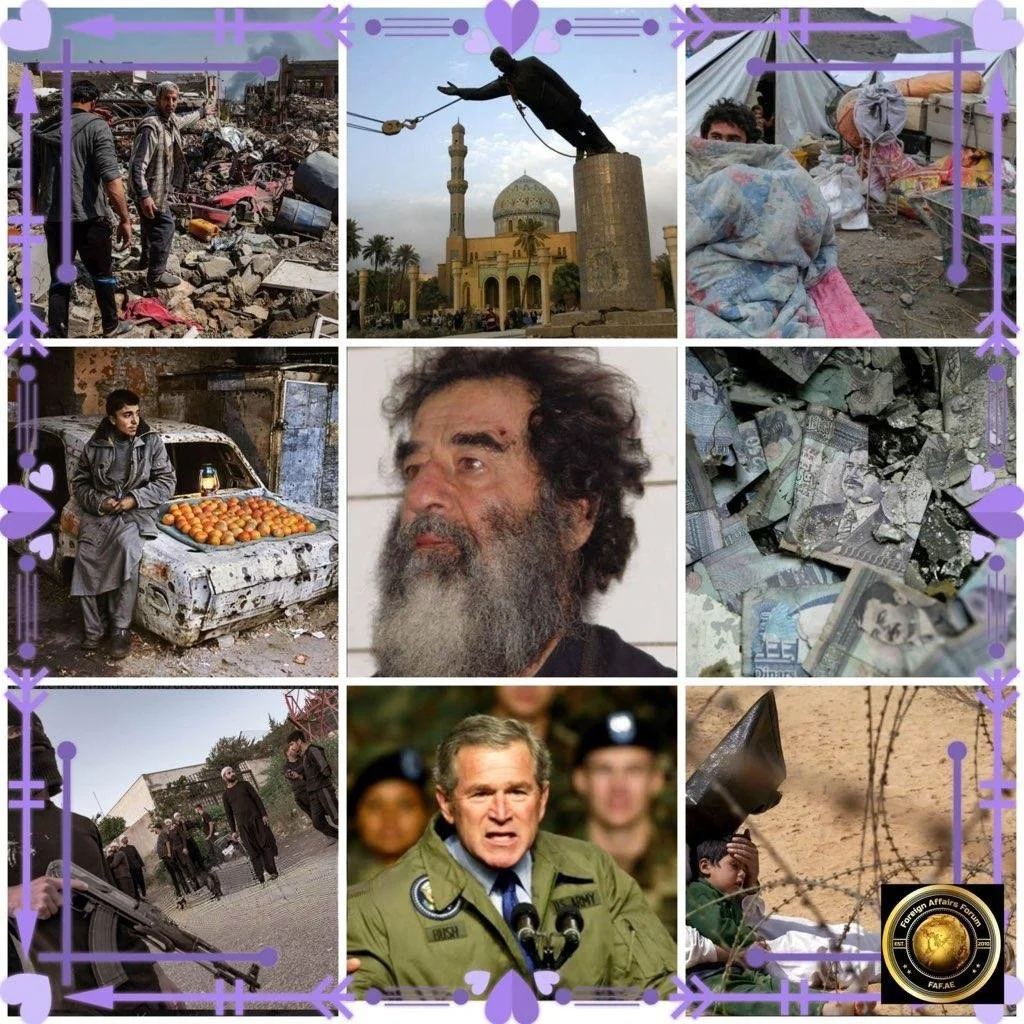
The Iraq War (2003–2011): A Critical Examination of Western Military Involvement and Its Consequences – Insights for Contemporary Geopolitical Dynamics.
Introduction
The Iraq War
A Comprehensive Examination of Western Military Engagement and Its Repercussions
In the run-up to the Iraq War, one pivotal question loomed large: Did Saddam Hussein’s regime possess any nuclear weapons? Ultimately, the answer was a resounding no.
Despite the absence of such weapons, the United States initiated a military invasion of Iraq in March 2003.
This intervention was publicly justified by assertions that Iraq not only held weapons of mass destruction (WMD) but also posed an imminent threat to global security.
However, as the conflict unfolded, the intelligence used to support these claims was discredited, prompting widespread speculation about the underlying motivations driving the U.S. attack.
The financial impact of the Iraq War on the United States was monumental, with estimates suggesting that direct costs have approached nearly $2 trillion when factoring in military operations, veteran care, and reconstruction initiatives.
This staggering financial burden has aroused serious concerns regarding its long-term effects on the American economy and military readiness.
The war produced catastrophic consequences, not only for Iraq but also for the surrounding Middle East and beyond. Following the invasion, Iraq descended into a state of chaos, resulting in a power vacuum that facilitated the rise of extremist factions such as ISIS.
The emergence of ISIS brought with it widespread horror, as the group committed atrocities leading to immense human suffering and the displacement of millions of people.
In light of these devastating developments, an ongoing debate persists regarding the extent to which the United States should assume responsibility for the humanitarian crises that followed, including actions that may be characterized as genocide in the chaotic aftermath of its military intervention.
The ramifications of the Iraq War have left an indelible imprint on the political and social fabric of the Middle East, igniting discussions about the repercussions of Western military involvement for global security and the protection of human rights.
Main Takeaway
Although no weapons of mass destruction were ever identified in Iraq, the U.S.-led invasion and subsequent occupation have cost American taxpayers nearly $2 trillion in direct war-related expenditures.
The conflict is associated with an estimated 460,000 to 655,000 excess Iraqi deaths, catalyzed the emergence of ISIS and its genocidal campaign against the Yazidi population, and raised enduring concerns regarding U.S. accountability for the resulting humanitarian crises.
No WMD Found in Iraq
The Iraq Survey Group’s Duelfer Report, published in 2004, unequivocally concluded that Saddam Hussein “did not possess stockpiles of illicit weapons at the time of the U.S. invasion” and had not revived any programs aimed at producing chemical, biological, or nuclear weapons.
The United Nations Monitoring, Verification and Inspection Commission (UNMOVIC) and the U.S.-led Iraq Survey Group concluded their active searches by 2005 without discovering any new WMDs; the only items found were degraded chemical munitions dating back to before 1991.
Financial Costs to the United States
The Costs of War Project estimates that U.S. taxpayers have disbursed approximately $2 trillion in war-related costs solely for Iraq through the year 2020.
When this figure is combined with post-2011 counter-ISIS operations in Iraq and Syria, as well as long-term care for veterans, the total financial impact is projected to rise to $2.89 trillion by 2050.
Human Toll and Displacement
Excess Mortality
Population-based household surveys suggest that there were between 460,000 and 655,000 excess Iraqi deaths (both direct and indirect) from March 2003 to mid-2011, with a best estimate hovering around 500,000.
Approximately 60% of these excess deaths can be attributed to direct violence, while the remaining 40% resulted from indirect factors, including the breakdown of health care, sanitation systems, and critical infrastructure.
Civilian Casualties
According to the Iraq Body Count project, violent civilian deaths documented through mid-2020 ranged from 186,901 to 210,296. Other surveys indicate that total civilian fatalities could potentially exceed 243,000 when accounting for various records.
Displacement
At the height of the conflict in 2016, approximately 3.4 million Iraqis were internally displaced. By 2021, around 1.2 million individuals remained without a permanent home.
Moreover, the outflow of Iraqi refugees soared, with over 4 million fleeing the country by 2007, primarily seeking refuge in neighboring Arab states.
As of January 2024, the United Nations High Commissioner for Refugees (UNHCR) reported over one million internally displaced persons (IDPs) in Iraq, alongside more than 300,000 refugees and asylum seekers residing in the nation, the majority of whom had fled from Syria.
Power Vacuum and Rise of ISIS
The dismantling of Iraqi security forces in the wake of the invasion created a significant power vacuum that extremist groups exploited.
Al-Qaeda in Iraq (AQI), which formed in the midst of the 2003 insurgency, rebranded itself as ISIS by 2013, declaring a caliphate in 2014.
By June of that year, ISIS had seized control of Mosul and extensive territories, ruling until 2017 while committing unspeakable atrocities, including the genocide of the Yazidi community
ISIS Genocide of the Yazidis
The United Nations Investigative Team (UNITAD) has confirmed that ISIS committed genocide against the Yazidis as a distinct religious group, aiming for their extermination, forced conversion, and sexual enslavement.
During the campaign from 2014 to 2017, the UN estimated that around 5,000 Yazidis were killed, and 10,800 women and girls were trafficked.
As of August 2024, around 2,700 Yazidis remained unaccounted for, including approximately 1,300 children abducted by ISIS.
Accountability and Human Rights
Human Rights Watch and Amnesty International have documented numerous violations by U.S. forces during the Iraq War, including indiscriminate airstrikes, night raids resulting in civilian deaths, and instances of torture at the infamous Abu Ghraib prison, as well as secret detentions.
Alarmingly, no independent U.S. commission of inquiry has been established to investigate these incidents, and access to U.S. courts for the victims remains largely obstructed.
Lessons and Implications
Intelligence Rigor
The shortcomings in the intelligence regarding weapons of mass destruction (WMD) during the lead-up to the Iraq War emphasize the critical importance of establishing a rigorous, transparent, and evidence-based verification process before any military intervention.
It is essential that decision-makers critically assess the quality and reliability of intelligence reports to ensure that military action is grounded in verified facts rather than faulty assumptions or misinterpretations.
Comprehensive Cost–Benefit Analysis
A thorough understanding of the total costs associated with the use of military force is vital.
This analysis must go beyond immediate financial expenditures to encompass all fiscal ramifications, such as the burden of war financing, interest on accrued debts, and the long-term costs associated with veterans’ care and rehabilitation.
Additionally, the toll on human life—both in terms of military casualties and civilian losses—must be an integral part of this evaluation to provide a holistic view of the impact of military action.
Post-Conflict Planning
Successful nation-building in post-conflict scenarios necessitates a nuanced understanding of and integration with existing local socio-political structures. It is crucial to involve local communities in the reconstruction process, respecting their governance systems and cultural norms.
When this is overlooked, it can lead to instability and disenfranchisement, creating fertile ground for insurgency and the resurgence of extremist groups, as seen in Iraq after the fall of Saddam Hussein’s regime.
Accountability Mechanisms
To effectively uphold international humanitarian law, robust accountability mechanisms must be established to investigate and address violations committed by all parties engaged in a conflict.
This includes ensuring that those responsible for war crimes, human rights abuses, and other violations are held accountable through transparent processes, which not only serve justice but also help restore faith in international legal frameworks.
Conclusion
The Iraq War serves as a poignant case study highlighting the extensive consequences of military interventions predicated on unreliable or invalid intelligence.
The failure to uncover weapons of mass destruction (WMDs), coupled with the exorbitant financial burden—amounting to trillions—has left an enduring legacy of human suffering, characterized by significant loss of life and widespread civilian displacement.
The resultant ideological vacuum and ensuing chaos have been instrumental in facilitating the emergence of extremist factions such as ISIS, underscoring the profound risks associated with military strategies that neglect the complexities of local political landscapes and sociocultural contexts.
Addressing the humanitarian crises and systemic human rights violations that arose from this conflict is not merely a matter of justice. It is integral to fostering more accountable and informed international engagement moving forward.
Mechanisms for reparations and support for affected communities will be essential for rebuilding trust and stability within the region.
This analysis aims to illuminate the intricate and often contentious dynamics of American military interventions in the Middle East, particularly focusing on the protracted involvement in Iraq from 2003 to 2011.
This era was marked by significant upheaval, initiated by the U.S.-led invasion aimed at dismantling Saddam Hussein's regime, which instead culminated in prolonged conflict and instability.
In evaluating the gains for the U.S. and the losses experienced by Iraq as a consequence of the military intervention, it is crucial to frame the discussion within the larger context of regional dynamics.
Additionally, the focus broadens to include the Houthi movement in Yemen, which has emerged as a formidable actor within the geopolitical sphere, further complicating regional tensions.
The ongoing conflict in Yemen, frequently referred to as a humanitarian disaster, prompts critical questions about the role of the U.S. and the international community in regional conflicts and their broader implications for peacekeeping efforts.
The analysis also scrutinizes a series of targeted U.S. strikes against Iranian military infrastructure, indicative of escalating tensions between the U.S. and Iran.
These military actions not only intensify existing conflicts but also heighten the risk of broader regional warfare.
Moreover, the examination extends to Israel's ongoing military operations in the West Bank and Gaza Strip. Recent escalations have elicited criticism, with some observers labeling them as genocidal due to their devastating impact on civilian populations.
The humanitarian crisis in Gaza, in particular, has escalated to critical levels, with growing international calls for intervention amid the continuous violence.
Israel's military operations also target militant factions in Lebanon and Syria, contributing further to the prevailing instability across the region. The cascading effects of these military engagements often lead to cycles of escalation and deepening conflict.
Despite a wealth of historical insights regarding the ramifications of military intervention, it is concerning to note a persistent inclination towards neo-imperialism.
The U.S. and its allies frequently overlook the profound repercussions of their actions, which not only shift geopolitical dynamics but also severely affect the lives of millions ensnared in these complex and persistent conflicts.